Kenya LTE IoT Market Size & Growth Rate (2026-2032)
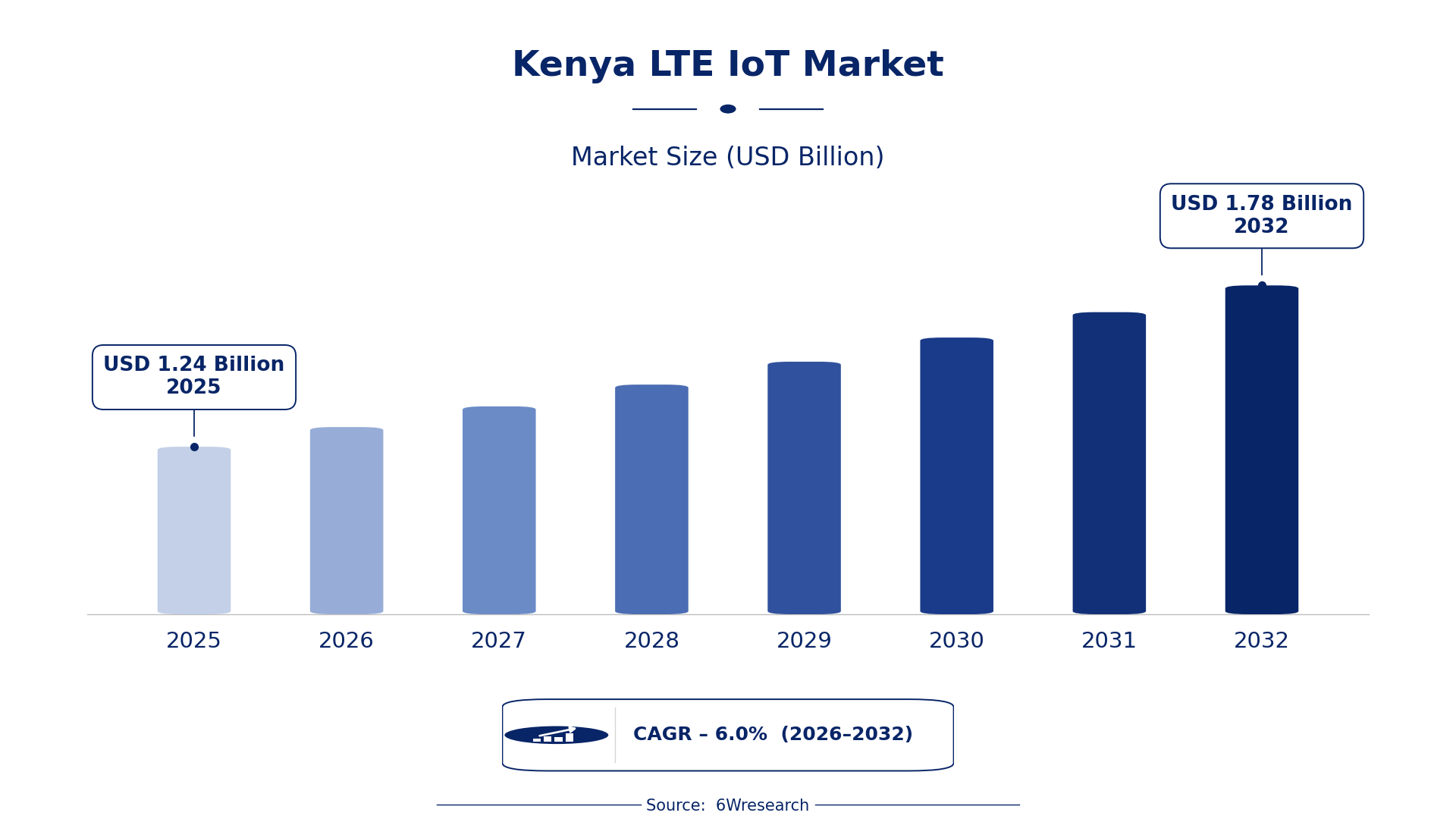
The Kenya LTE IoT Market was estimated at USD 1244 Million in 2025 and is projected to reach USD 1783 Million by 2032, growing at a CAGR of 6.0% from 2026 to 2032.
Kenya LTE IoT Market Synopsis
In Kenya, the LTE IoT market is rapidly expanding, driven primarily by the surging demand for IoT solutions in agriculture and healthcare sectors. The integration of high-speed LTE networks allows for efficient real-time data transmission, essential for sectors that rely on timely insights for decision-making.
In addition to agriculture and healthcare, transportation and smart city initiatives are also gaining traction. The local market is seeing a proliferation of connected devices and sensors, reflecting a broader shift toward embracing digital transformation across various industries.
Kenya LTE IoT Market Year-wise Growth Rate and Key Drivers
This graph illustrates the annual growth rates of the Kenya LTE IoT Market from 2021 to 2032, highlighting a steady upward trajectory and projected expansion over the forecast period.
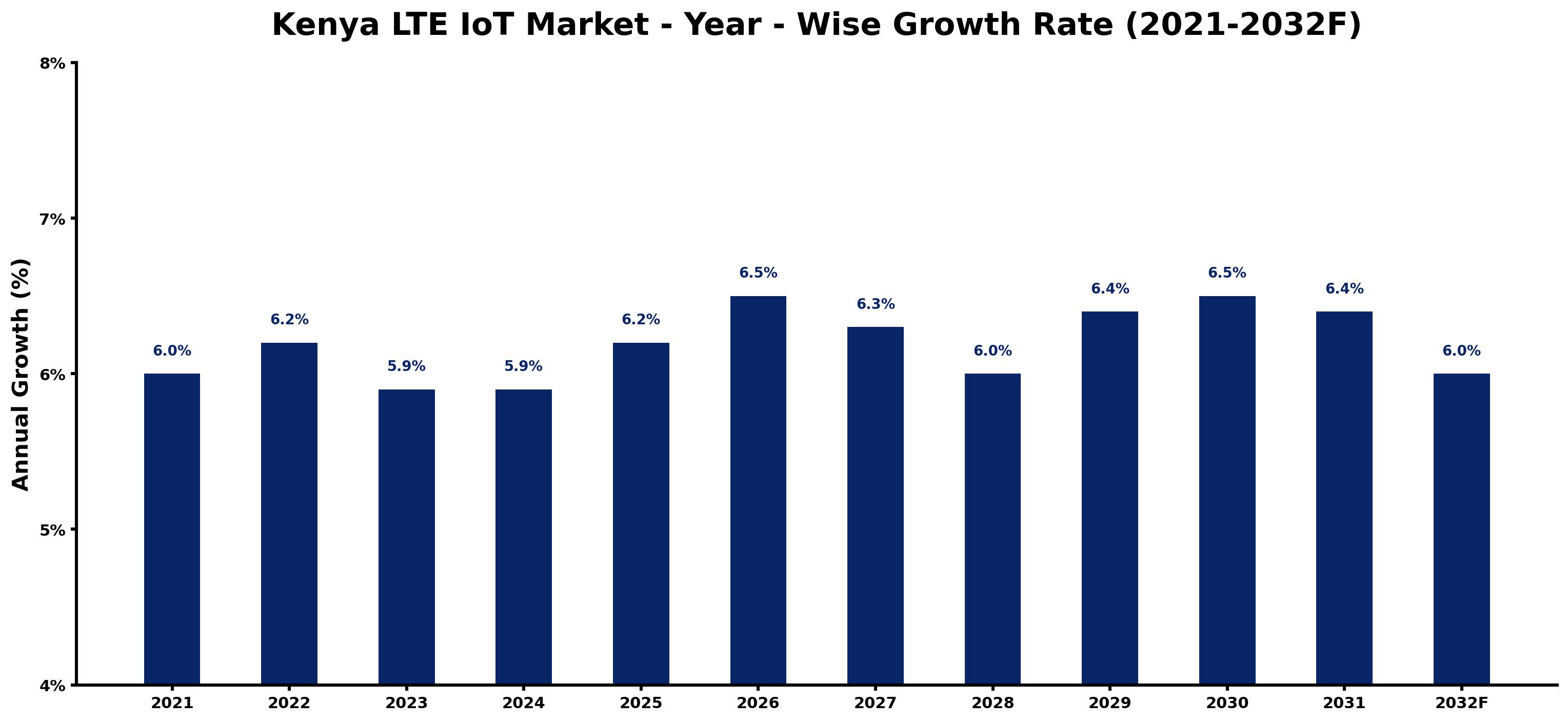
The table below presents the year‑wise growth rates along with the key drivers influencing the market
| Year | Growth Rate | Major Drivers |
| 2021 | 6.0% | Increased mobile network coverage by Safaricom and Airtel. |
| 2022 | 6.2% | Government's Kenya Vision 2030 promoting smart city projects. |
| 2023 | 5.9% | Growing agricultural tech adoption for smart farming solutions. |
| 2024 | 5.9% | Enhanced regulatory support for IoT cybersecurity policies. |
| 2025 | 6.2% | Telecom infrastructure investments by the Communications Authority. |
| 2026 | 6.5% | Rising interest in connected devices for urban planning. |
| 2027 | 6.3% | Local startups innovating in IoT for energy management. |
| 2028 | 6.0% | M-Pesa integrating more IoT solutions for financial services. |
| 2029 | 6.4% | Government initiatives for smart meter implementations across utilities. |
| 2030 | 6.5% | Increased urbanization driving demand for IoT in transport. |
| 2031 | 6.4% | Growing partnerships between telecoms and local IoT firms. |
| 2032 | 6.0% | Rising consumer awareness of smart home technologies. |
Note: Market size estimations and growth projections presented in this report are based on 6Wresearch's proprietary forecasting methodology, utilizing the latest available industry data, government publications, and primary research inputs.
Kenya LTE IoT Market Key Takeaways
Below are some of the specific key takeaways from the market, including:
- The rising adoption of IoT solutions in diverse industries is fueling market growth.
- Government policies are fostering a conducive environment for IoT expansion.
- There is an increasing demand for connected devices and low-power IoT solutions.
- Investment opportunities are abundant in smart agriculture and telemedicine sectors.
- Challenges remain, particularly around device affordability and rural connectivity.
Evaluation of Restraints in Kenya LTE IoT Market
The Kenya LTE IoT market faces notable challenges that hinder its full potential. The high costs associated with LTE-enabled IoT devices create a barrier for widespread adoption, particularly among small and medium enterprises. Moreover, there exists a significant coverage gap in rural areas, which limits the reach of IoT applications crucial for agriculture and public health. Concerns over data privacy and a lack of standardized protocols add to the complexity of the market, making it difficult for businesses to implement IoT solutions effectively.
Kenya LTE IoT Market Trends
A key trend in the Kenya LTE IoT market is the deployment of Low Power Wide Area (LPWA) networks. These networks are designed to facilitate the seamless connectivity of a multitude of low-power IoT devices, which is particularly advantageous in the agriculture sector for precision farming applications. Additionally, there is a growing interest in innovative IoT platforms that are tailored to meet local market demands, enhancing operational efficiencies and customer experiences.
Kenya LTE IoT Market Opportunities
Investment opportunities in the Kenya LTE IoT market are burgeoning, especially in sectors like agriculture, transportation, and healthcare. Companies focusing on IoT solutions for smart farming are particularly well-positioned to take advantage of the growing demand for efficiency and productivity in agricultural practices. Similarly, solutions that optimize fleet management and telemedicine services are gaining traction, as businesses aim to improve asset management and patient care respectively.
Government Initiatives in the Kenya LTE IoT Market
Government policy is significantly influencing the development of the LTE IoT market in Kenya. With a strong emphasis on digital transformation, the government is rolling out initiatives designed to improve connectivity and promote technology adoption across sectors. These policies create an environment ripe for innovation and investment.
- A National Broadband Strategy has been launched to expand broadband access and enhance connectivity across urban and rural areas.
- The Kenya ICT Masterplan is currently being implemented to foster digital innovation and establish an integrated technological framework.
- A regulatory framework was introduced in 2023 mandating billing transparency for IoT services, aimed at enhancing consumer trust.
- Ongoing efforts focus on building smart city infrastructure, expected to include advanced IoT applications in urban planning by 2026.
- A planned public-private partnership is underway to facilitate the deployment of low-cost IoT devices, scheduled for rollout by mid-2025.
Future Insights of the Kenya LTE IoT Market
Looking ahead to 2026-2032, the Kenya LTE IoT market is projected to maintain a trajectory of robust growth. As IoT adoption becomes more prevalent across sectors such as agriculture and healthcare, the demand for efficient, reliable LTE solutions will surge. Government initiatives aimed at enhancing digital infrastructure are likely to catalyze further advancements in technology and connectivity, thereby creating a wealth of opportunities for businesses and investors alike.
Kenya LTE IoT Market Latest Developments
In the past 12-14 months, the Kenya LTE IoT market has witnessed a series of developments that indicate a shift towards greater technological adoption. As industries recognize the potential of IoT, there is a concerted effort to innovate and expand IoT applications, particularly in critical sectors such as agriculture and healthcare.
- A major regional operator launched a new suite of IoT-enabled agricultural solutions in early 2025, enabling farmers to monitor crop conditions remotely.
- An ongoing initiative aims to expand LTE network coverage in underserved regions, started in early 2025 and remains underway.
- A tech startup is currently developing a telemedicine platform utilizing LTE connectivity, expected to launch in Q3 2025.
- Plans for a comprehensive IoT training program have been announced, aimed at upskilling professionals by 2026.
- A strategic partnership was formed in late 2024 between technology providers to enhance IoT device affordability, with pilot projects planned for early 2026.
Kenya LTE IoT Market - Key Attractiveness of the Report
- 10 Years of Market Numbers
- Historical Data Starting from 2022 to 2025
- Base Year: 2025
- Forecast Data until 2032
- Key Performance Indicators Impacting the Market
- Major Upcoming Developments and Projects
Key Highlights of the Report:
- Kenya LTE IoT Market Outlook
- Market Size of Kenya LTE IoT Market, 2025
- Forecast of Kenya LTE IoT Market, 2032
- Historical Data and Forecast of Kenya LTE IoT Revenues & Volume for the Period 2022-2032F
- Kenya LTE IoT Market Trend Evolution
- Kenya LTE IoT Market Drivers and Challenges
- Kenya LTE IoT Price Trends
- Kenya LTE IoT Porter's Five Forces
- Kenya LTE IoT Industry Life Cycle
- Historical Data and Forecast of Kenya LTE IoT Market Revenues & Volume By Technology for the Period 2022-2032F
- Historical Data and Forecast of Kenya LTE IoT Market Revenues & Volume By NB-IoT for the Period 2022-2032F
- Historical Data and Forecast of Kenya LTE IoT Market Revenues & Volume By LTE-M for the Period 2022-2032F
- Historical Data and Forecast of Kenya LTE IoT Market Revenues & Volume By Service for the Period 2022-2032F
- Historical Data and Forecast of Kenya LTE IoT Market Revenues & Volume By Professional Services for the Period 2022-2032F
- Historical Data and Forecast of Kenya LTE IoT Market Revenues & Volume By Managed Services for the Period 2022-2032F
- Historical Data and Forecast of Kenya LTE IoT Market Revenues & Volume By Industry for the Period 2022-2032F
- Historical Data and Forecast of Kenya LTE IoT Market Revenues & Volume By Manufacturing for the Period 2022-2032F
- Historical Data and Forecast of Kenya LTE IoT Market Revenues & Volume By Energy and utilities for the Period 2022-2032F
- Historical Data and Forecast of Kenya LTE IoT Market Revenues & Volume By Transportation and logistics for the Period 2022-2032F
- Historical Data and Forecast of Kenya LTE IoT Market Revenues & Volume By Healthcare for the Period 2022-2032F
- Historical Data and Forecast of Kenya LTE IoT Market Revenues & Volume By Agriculture for the Period 2022-2032F
- Kenya LTE IoT Import Export Trade Statistics
- Market Opportunity Assessment By Technology
- Market Opportunity Assessment By Service
- Market Opportunity Assessment By Industry
- Kenya LTE IoT Top Companies Market Share
- Kenya LTE IoT Competitive Benchmarking By Technical and Operational Parameters
- Kenya LTE IoT Company Profiles
- Kenya LTE IoT Key Strategic Recommendations






































