Kenya Manganese Mining Market Size, Share & Growth Rate
The Kenya Manganese Mining Market was estimated at USD 736 Million in 2025 and is projected to reach USD 1051 Million by 2032, growing at a CAGR of 5.2% from 2026 to 2032. This growth trajectory is primarily driven by the burgeoning global demand for manganese, particularly in the steel production and battery sectors, coupled with the government's commitment to enhancing mining infrastructure and regulatory frameworks. As international interest in manganese escalates, local operators are poised to leverage Kenya's vast untapped reserves.
Kenya Manganese Mining Market Year-wise Growth Rate and Key Drivers
This graph highlights how the Kenya Manganese Mining Market has steadily grown over the years, supported by major growth factors.
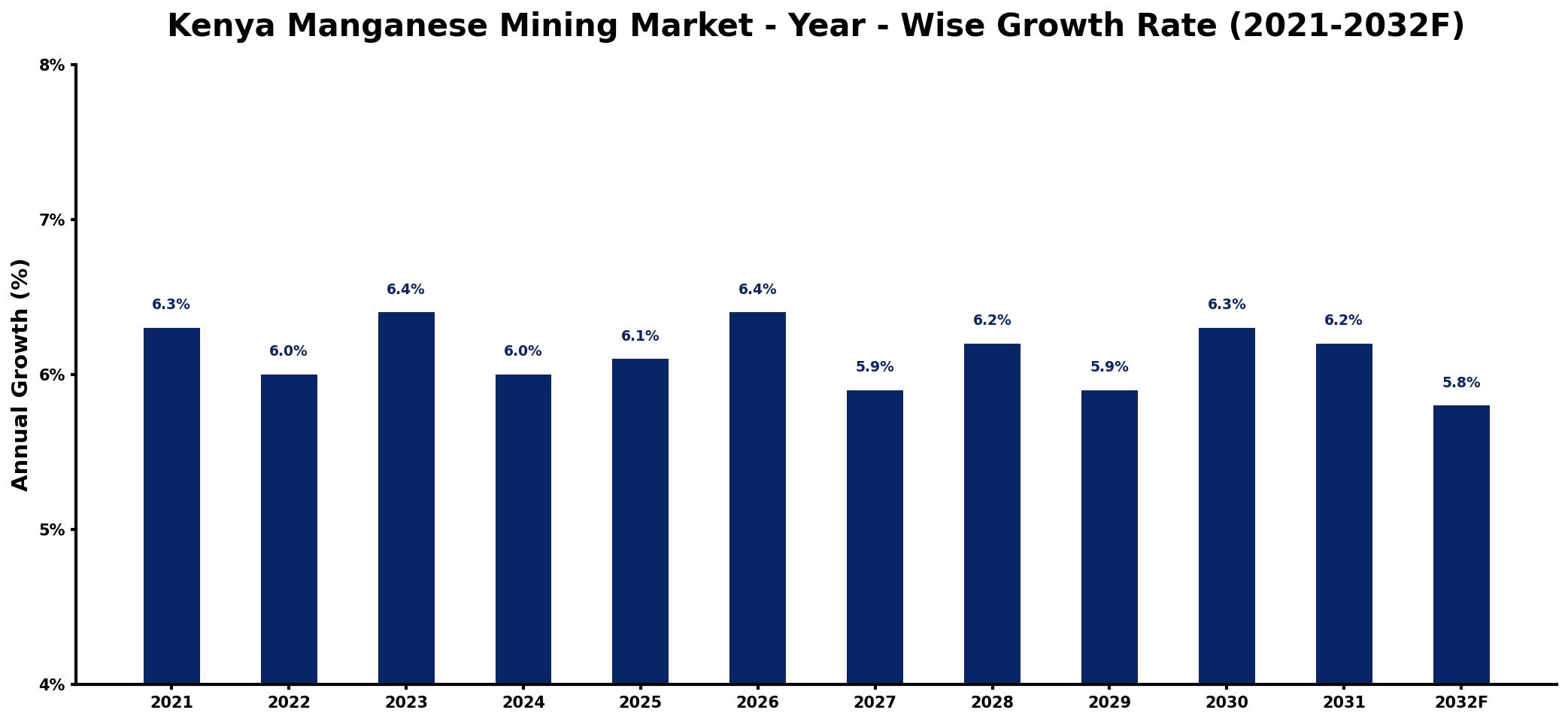
The table below presents the year‑wise growth rates along with the key drivers influencing the market
| Year | Growth Rate | Major Drivers |
| 2021 | 6.3% | Rising demand from steel industry |
| 2022 | 6.0% | Increased investment in infrastructure |
| 2023 | 6.4% | Expansion of renewable energy projects |
| 2024 | 6.0% | Growing automotive sector requirements |
| 2025 | 6.1% | Boost in construction activities |
| 2026 | 6.4% | Surge in electric vehicle production |
| 2027 | 5.9% | Enhanced global supply chain stability |
| 2028 | 6.2% | Increased international trade agreements |
| 2029 | 5.9% | Development of new production technologies |
| 2030 | 6.3% | Rising consumer electronics demand |
| 2031 | 6.2% | Growth in battery manufacturing sector |
| 2032 | 5.8% | growing downstream application demand |
Note: Market size estimations and growth projections presented in this report are based on 6Wresearch's proprietary forecasting methodology, utilizing the latest available industry data, government publications, and primary research inputs.
Kenya Manganese Mining Market Synopsis
The Kenya Manganese Mining Market is currently witnessing a surge in activity, fueled by increasing global demand and governmental initiatives aimed at boosting the sector. However, while recent developments indicate a positive trend, the long-term outlook remains contingent on addressing existing infrastructural and regulatory challenges.
As exploration and investment in the industry gain momentum, the market is expected to evolve significantly. The focus on sustainable mining practices and community engagement is also reshaping operational dynamics, positioning Kenya as a critical player in the manganese supply chain.
Kenya Manganese Mining Market Key Takeaways
- Substantial manganese deposits are located in regions like Kilifi, Garissa, Samburu, and Kitui.
- The government's reforms are encouraging foreign investment and local participation in the mining sector.
- Technological advancements are enhancing operational efficiency and productivity in mining activities.
- Environmental sustainability and community engagement are gaining importance in mining practices.
- The market's growth is closely linked to global demand trends in steel and battery manufacturing.
Evaluation of Restraints in Kenya Manganese Mining Market
Despite the optimistic outlook, the Kenya Manganese Mining Market grapples with significant restraints. Inadequate infrastructure hampers efficient exploration and transportation of manganese ore. Additionally, inconsistent regulatory policies create uncertainty for investors and operators alike. The sector also suffers from a scarcity of skilled labor, which can impede operational efficiency. Environmental concerns, along with community resistance to mining activities, further complicate the landscape, necessitating a concerted effort among stakeholders to foster a more supportive environment for mining.
Kenya Manganese Mining Market Trends
Current trends indicate a shift toward responsible mining practices, driven by both regulatory pressure and community expectations. Technology adoption is on the rise, with innovations aimed at enhancing productivity and minimizing environmental impacts becoming more prevalent. Furthermore, the global demand for manganese, particularly for use in electric vehicle batteries, is catalyzing new avenues for exploration and investment in Kenya.
Kenya Manganese Mining Market Opportunities
Investors will find numerous opportunities within the Kenya Manganese Mining Market. The exploration and development of new manganese deposits present lucrative prospects. Modernizing infrastructure and mining technologies offers pathways to enhance productivity and operational efficiencies. Additionally, partnerships with local companies can yield benefits, enabling investors to tap into local expertise while fostering community engagement and support.
Government Initiatives in the Kenya Manganese Mining Market
The Kenyan government is actively working to improve the mining sector through various initiatives. Policies, such as the Mining Act of 2016 and subsequent regulations, are designed to streamline licensing and promote environmental protection. The introduction of local equity participation requirements encourages local ownership, enhancing community benefits from mining activities. Additionally, agencies like the Mineral Rights Board and the Mineral Rights Tribunal are established to ensure accountability and transparency within the sector, thereby reinforcing investor confidence.
Future Insights of the Kenya Manganese Mining Market
Looking ahead to 2026-2032, the Kenya Manganese Mining Market is positioned for significant growth, driven by increasing global demand and ongoing infrastructural developments. The governments focus on streamlining regulatory processes and attracting foreign investment will likely result in enhanced operational efficiencies. However, addressing the challenges related to infrastructure and environmental sustainability will be crucial for the sector's long-term viability and its role in Kenya's economic development.
Kenya Manganese Mining Market Latest Developments (2025 - 2026)
Recent developments in the Kenya Manganese Mining Market indicate a robust push toward modernization and sustainable practices. The government is enhancing its efforts to attract foreign investment through policy reforms and public-private partnerships. There is also a growing emphasis on community engagement, with mining companies taking proactive steps to address local concerns and foster positive relationships. Technological advancements continue to reshape operational methodologies, driving greater efficiency and environmental stewardship in the sector.
Kenya Manganese Mining Market - Key Attractiveness of the Report
- 10 Years of Market Numbers
- Historical Data Starting from 2022 to 2025
- Base Year: 2025
- Forecast Data until 2032
- Key Performance Indicators Impacting the Market
- Major Upcoming Developments and Projects
Key Highlights of the Report:
- Kenya Manganese Mining Market Outlook
- Market Size of Kenya Manganese Mining Market, 2025
- Forecast of Kenya Manganese Mining Market, 2032
- Historical Data and Forecast of Kenya Manganese Mining Revenues & Volume for the Period 2022-2032F
- Kenya Manganese Mining Market Trend Evolution
- Kenya Manganese Mining Market Drivers and Challenges
- Kenya Manganese Mining Price Trends
- Kenya Manganese Mining Porter's Five Forces
- Kenya Manganese Mining Industry Life Cycle
- Historical Data and Forecast of Kenya Manganese Mining Market Revenues & Volume By Application for the Period 2022-2032F
- Historical Data and Forecast of Kenya Manganese Mining Market Revenues & Volume By Alloys for the Period 2022-2032F
- Historical Data and Forecast of Kenya Manganese Mining Market Revenues & Volume By Othes for the Period 2022-2032F
- Kenya Manganese Mining Import Export Trade Statistics
- Market Opportunity Assessment By Application
- Kenya Manganese Mining Top Companies Market Share
- Kenya Manganese Mining Competitive Benchmarking By Technical and Operational Parameters
- Kenya Manganese Mining Company Profiles
- Kenya Manganese Mining Key Strategic Recommendations






































