Kenya Medical Implant Market Growth Rate Analysis (2021-2031)
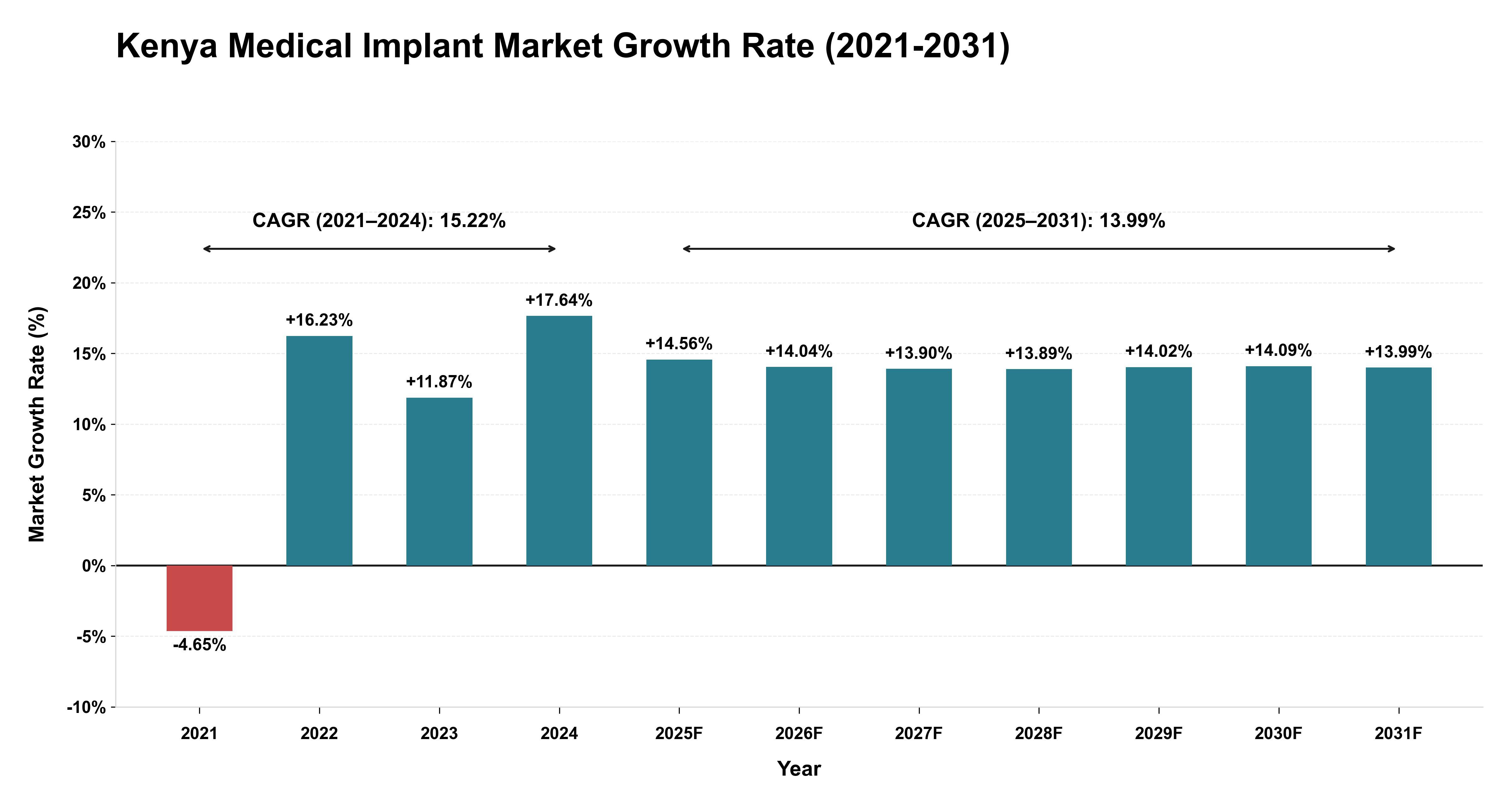
The Kenya Medical Implant Market displayed a volatile performance from 2021 to 2024, marked by a structural consolidation in 2021 with a -4.65% decline, followed by a robust recovery in the subsequent years, showcasing market compression and demand corrections. The market then entered a phase of stabilizing expansion, with growth rates gradually stabilizing around the forecasted CAGR of 13.99% for the period 2025-2031. Despite the fluctuations in growth rates post-2021, the market demonstrated resilience and regained momentum, indicating a mature phase characterized by steady growth and market stabilization following the initial period of turbulence.
Key Highlights of the Report:
- Kenya Medical Implant Market Outlook
- Market Size of Kenya Medical Implant Market, 2024
- Forecast of Kenya Medical Implant Market, 2031
- Historical Data and Forecast of Kenya Medical Implant Revenues & Volume for the Period 2021- 2031
- Kenya Medical Implant Market Trend Evolution
- Kenya Medical Implant Market Drivers and Challenges
- Kenya Medical Implant Price Trends
- Kenya Medical Implant Porter's Five Forces
- Kenya Medical Implant Industry Life Cycle
- Historical Data and Forecast of Kenya Medical Implant Market Revenues & Volume By PRODUCT for the Period 2021- 2031
- Historical Data and Forecast of Kenya Medical Implant Market Revenues & Volume By Orthopedic Implants for the Period 2021- 2031
- Historical Data and Forecast of Kenya Medical Implant Market Revenues & Volume By Cardiovascular Implants for the Period 2021- 2031
- Historical Data and Forecast of Kenya Medical Implant Market Revenues & Volume By Neurostimulators for the Period 2021- 2031
- Historical Data and Forecast of Kenya Medical Implant Market Revenues & Volume By Facial Implants for the Period 2021- 2031
- Historical Data and Forecast of Kenya Medical Implant Market Revenues & Volume By Breast Implants for the Period 2021- 2031
- Historical Data and Forecast of Kenya Medical Implant Market Revenues & Volume By Biomaterial Type for the Period 2021- 2031
- Historical Data and Forecast of Kenya Medical Implant Market Revenues & Volume By Metallic Biomaterials for the Period 2021- 2031
- Historical Data and Forecast of Kenya Medical Implant Market Revenues & Volume By Ceramic biomaterials for the Period 2021- 2031
- Historical Data and Forecast of Kenya Medical Implant Market Revenues & Volume By Polymers biomaterials for the Period 2021- 2031
- Historical Data and Forecast of Kenya Medical Implant Market Revenues & Volume By Natural biomaterials for the Period 2021- 2031
- Kenya Medical Implant Import Export Trade Statistics
- Market Opportunity Assessment By PRODUCT
- Market Opportunity Assessment By Biomaterial Type
- Kenya Medical Implant Top Companies Market Share
- Kenya Medical Implant Competitive Benchmarking By Technical and Operational Parameters
- Kenya Medical Implant Company Profiles
- Kenya Medical Implant Key Strategic Recommendations






































