Kenya Metal Recycling Market Summary
The kenya metal recycling market was estimated at USD 404 Million in 2025 and is projected to reach USD 581 Million by 2032, growing at a CAGR of 6.3% from 2026 to 2032.
Kenya Metal Recycling Market Year-wise Growth Rate and Key Drivers
This graph highlights how the Kenya Metal Recycling Market has steadily grown over the past five years, supported by major growth factors.
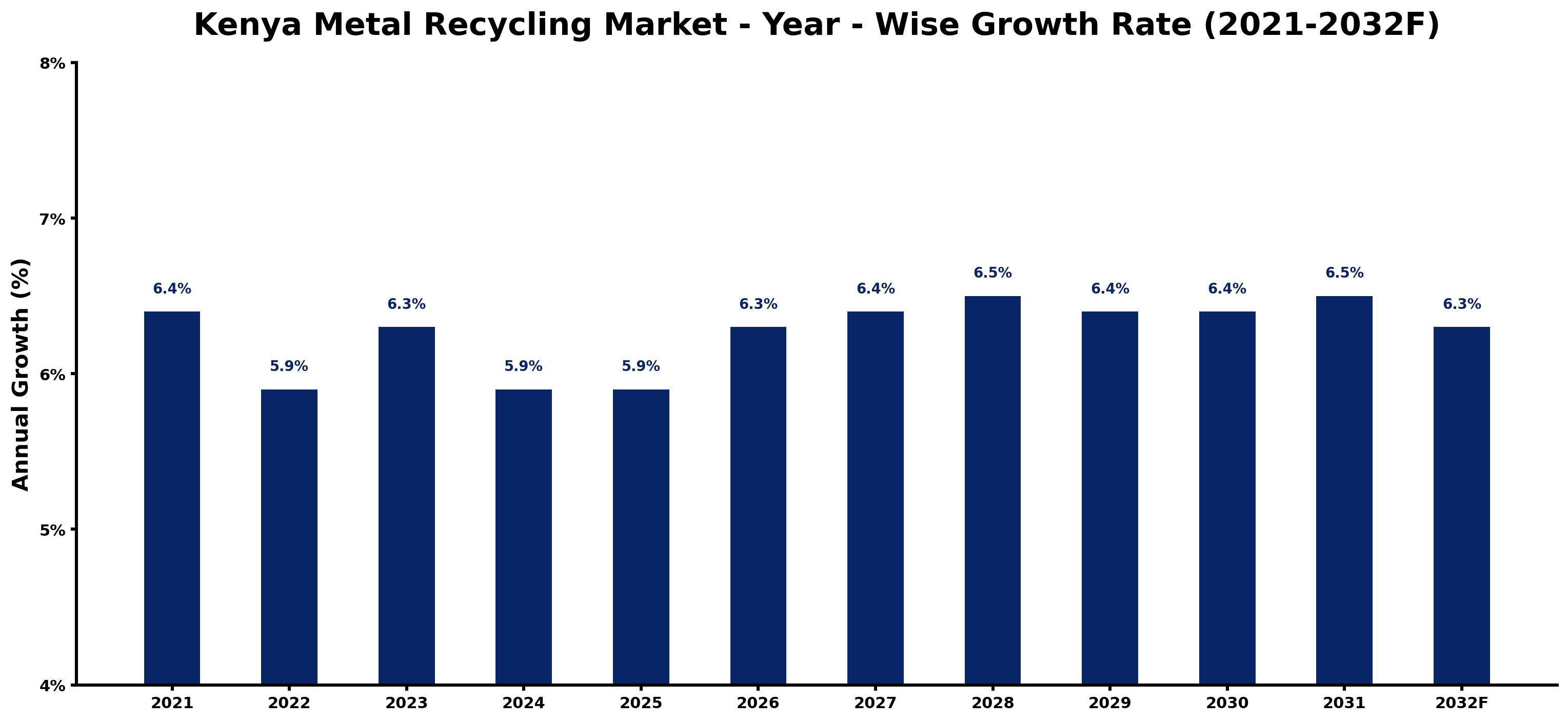
The table below presents the year wise growth rates along with the key drivers influencing the market
| Year | Growth Rate | Major Drivers |
| 2021 | 6.4% | Local communities increasingly recognize the importance of recycling metal waste. |
| 2022 | 5.9% | Innovative startups emerge, focusing on efficient metal collection and processing solutions. |
| 2023 | 6.3% | Awareness campaigns highlight environmental benefits tied to responsible metal recycling. |
| 2024 | 5.9% | Manufacturing sectors seek sustainable materials, boosting demand for recycled metals. |
| 2025 | 5.9% | Technological improvements streamline operations, increasing recycling efficiency and output. |
| 2026 | 6.3% | Investment in recycling infrastructure attracts foreign capital and expertise into Kenya. |
| 2027 | 6.4% | Collaborations among businesses lead to shared recycling initiatives and resource pooling. |
| 2028 | 6.5% | Emerging markets for recycled products expand, opening new avenues for local businesses. |
| 2029 | 6.4% | Educational programs promote metal recycling, creating a skilled workforce for the industry. |
| 2030 | 6.4% | Consumer preferences shift toward sustainable products, enhancing market value for recyclers. |
| 2031 | 6.5% | Environmental policies incentivize companies to adopt circular economy practices and integrate recycling. |
| 2032 | 6.3% | Urbanization trends increase metal waste generation, necessitating robust recycling solutions. |
Note - Market size estimations and growth projections presented in this report are based on 6Wresearch's advanced forecasting approach, validated with industry datasets as of June 2026.
Kenya Metal Recycling Market Synopsis
The Kenya Metal Recycling Market is projected to reach 6.3% and witness significant growth during the forecast period (2026-2032). This market plays a pivotal role in resource conservation, environmental sustainability, and meeting the demand for raw materials across various sectors. With an increasing focus on circular economy principles and heightened regulatory support, the metal recycling landscape in Kenya is evolving rapidly.
Kenya Metal Recycling Market Growth Drivers
The metal recycling market in Kenya is driven by several compelling factors that foster its expansion. Firstly, stringent environmental regulations are propelling industries to adopt recycling practices to mitigate their ecological footprint. As awareness regarding sustainability grows, many companies are integrating recycled materials into their production processes, leading to a surge in demand for recycled metals.
- Government incentives aimed at promoting recycling initiatives play a crucial role in shaping market dynamics. Such initiatives often include tax breaks and grants to encourage recycling infrastructure development.
- The construction sector's robust growth contributes significantly to the demand for recycled metals, as many construction firms seek sustainable material alternatives.
- Technological advancements in recycling processes enhance the efficiency and quality of recycled metals, making them more appealing to manufacturers.
- Increased urbanization in Kenya drives the demand for construction and infrastructure development, thereby elevating the need for scrap metal recycling.
- Public awareness campaigns highlight the economic and environmental benefits of recycling, motivating businesses and consumers to participate more actively in recycling activities.
Kenya Metal Recycling Market Challenges and Restraints
Despite the promising outlook, the Kenya Metal Recycling Market faces several challenges that could impede growth. One of the primary obstacles is the high cost associated with recycling processes, including access to specialized equipment and trained personnel. This financial barrier can deter new entrants and limit the capabilities of existing players.
- Intense competition from both local and international recyclers can affect pricing strategies, resulting in thinner profit margins for operators in the market.
- Compliance with stringent regulatory frameworks can be burdensome, requiring significant investment in environmental management systems.
- The variability in the availability and quality of scrap metal presents challenges for recyclers striving to maintain consistent output and meet strict quality standards.
- Limited public infrastructure for efficient collection and processing of scrap metals can hinder operational effectiveness and market growth.
- A lack of consumer and business education regarding the advantages of recycling can slow adoption rates across various sectors.
Kenya Metal Recycling Market Government Investment and Initiatives
The Kenyan government has initiated several policies aimed at boosting the metal recycling sector. By promoting a circular economy, authorities are focusing on the sustainable management of resources, particularly metals. Government investments are directed towards improving the recycling infrastructure, which is vital for efficient collection and processing of scrap materials.
- National policies encourage private sector participation through grants and incentives for recycling projects, fostering innovation and growth.
- Partnerships between the government and non-governmental organizations are designed to enhance public education around recycling benefits, leading to increased community involvement.
- Investment in research and development initiatives helps modernize recycling technologies, improving process efficiency and material recovery rates.
- Regulatory bodies are actively engaging in the monitoring of compliance to ensure that recycling facilities adhere to environmental standards.
- Efforts to enhance the supply chain for scrap metal collection have been prioritized, ensuring that recyclers have access to high-quality materials.
Kenya Metal Recycling Market Latest Developments (May 2025 - June 2026)
Recent developments in the Kenya Metal Recycling Market signify a strategic shift toward enhanced sustainability and operational efficiency. The period from May 2025 to June 2026 witnessed growing collaboration between government bodies and the private sector to streamline recycling processes and bolster infrastructure. New investments aimed at improving sorting and processing technologies have emerged, facilitating better recovery rates and expanding the types of materials that can be recycled.
- Many local authorities have launched public campaigns to raise awareness about the importance of recycling, thereby increasing participation from communities and businesses.
- In response to economic pressures, some companies have begun to specifically source recycled metals, emphasizing sustainability in their supply chains.
- The market is observing a gradual shift towards the integration of digital technologies, such as blockchain, to enhance transparency and traceability in recycling operations.
- Policy reviews by the government aimed at simplifying compliance with environmental standards are in the pipeline, aiming to reduce barriers for new market entrants.
- Innovative partnerships between recyclers and manufacturers are fostering greater collaboration to optimize the use of recycled materials in production processes.
Kenya Metal Recycling Market - Key Attractiveness of the Report
- 10 Years of Market Numbers
- Historical Data Starting from 2022 to 2025
- Base Year: 2025
- Forecast Data until 2032
- Key Performance Indicators Impacting the Market
- Major Upcoming Developments and Projects
Key Highlights of the Report:
- Kenya Metal Recycling Market Outlook
- Market Size of Kenya Metal Recycling Market, 2025
- Forecast of Kenya Metal Recycling Market, 2032
- Historical Data and Forecast of Kenya Metal Recycling Revenues & Volume for the Period 2022-2032F
- Kenya Metal Recycling Market Trend Evolution
- Kenya Metal Recycling Market Drivers and Challenges
- Kenya Metal Recycling Price Trends
- Kenya Metal Recycling Porter's Five Forces
- Kenya Metal Recycling Industry Life Cycle
- Historical Data and Forecast of Kenya Metal Recycling Market Revenues & Volume By Metal Type for the Period 2022-2032F
- Historical Data and Forecast of Kenya Metal Recycling Market Revenues & Volume By Ferrous Metal for the Period 2022-2032F
- Historical Data and Forecast of Kenya Metal Recycling Market Revenues & Volume By Non-ferrous Metal for the Period 2022-2032F
- Historical Data and Forecast of Kenya Metal Recycling Market Revenues & Volume By Scrap Types for the Period 2022-2032F
- Historical Data and Forecast of Kenya Metal Recycling Market Revenues & Volume By Old Scrap for the Period 2022-2032F
- Historical Data and Forecast of Kenya Metal Recycling Market Revenues & Volume By New Scrap for the Period 2022-2032F
- Historical Data and Forecast of Kenya Metal Recycling Market Revenues & Volume By Equipment Types for the Period 2022-2032F
- Historical Data and Forecast of Kenya Metal Recycling Market Revenues & Volume By Shears for the Period 2022-2032F
- Historical Data and Forecast of Kenya Metal Recycling Market Revenues & Volume By Shredders for the Period 2022-2032F
- Historical Data and Forecast of Kenya Metal Recycling Market Revenues & Volume By Briquette Machines for the Period 2022-2032F
- Historical Data and Forecast of Kenya Metal Recycling Market Revenues & Volume By Granulating Machines for the Period 2022-2032F
- Historical Data and Forecast of Kenya Metal Recycling Market Revenues & Volume By Others for the Period 2022-2032F
- Historical Data and Forecast of Kenya Metal Recycling Market Revenues & Volume By End-users for the Period 2022-2032F
- Historical Data and Forecast of Kenya Metal Recycling Market Revenues & Volume By Building & Construction for the Period 2022-2032F
- Historical Data and Forecast of Kenya Metal Recycling Market Revenues & Volume By Packaging for the Period 2022-2032F
- Historical Data and Forecast of Kenya Metal Recycling Market Revenues & Volume By Automotive for the Period 2022-2032F
- Historical Data and Forecast of Kenya Metal Recycling Market Revenues & Volume By Industrial Machinery for the Period 2022-2032F
- Historical Data and Forecast of Kenya Metal Recycling Market Revenues & Volume By Electronics & Electrical Equipment for the Period 2022-2032F
- Historical Data and Forecast of Kenya Metal Recycling Market Revenues & Volume By Shipbuilding for the Period 2022-2032F
- Historical Data and Forecast of Kenya Metal Recycling Market Revenues & Volume By Others for the Period 2022-2032F
- Kenya Metal Recycling Import Export Trade Statistics
- Market Opportunity Assessment By Metal Type
- Market Opportunity Assessment By Scrap Types
- Market Opportunity Assessment By Equipment Types
- Market Opportunity Assessment By End-users
- Kenya Metal Recycling Top Companies Market Share
- Kenya Metal Recycling Competitive Benchmarking By Technical and Operational Parameters
- Kenya Metal Recycling Company Profiles
- Kenya Metal Recycling Key Strategic Recommendations






































