Kenya Mining Drills & Breakers Market Size, Share & Growth Rate
The Kenya Mining Drills & Breakers Market was estimated at USD 417 Million in 2025 and is projected to reach USD 567 Million by 2032, growing at a CAGR of 4.5% from 2026 to 2032. This growth trajectory is primarily driven by the increasing mining activities across various minerals, including gold and titanium. Furthermore, the government's strategic initiatives to attract investment and modernize the mining sector significantly bolster demand for drilling and breaking equipment.
Kenya Mining Drills & Breakers Market Year-wise Growth Rate and Key Drivers
This graph highlights how the Kenya Mining Drills & Breakers Market has steadily grown over the years, supported by major growth factors.
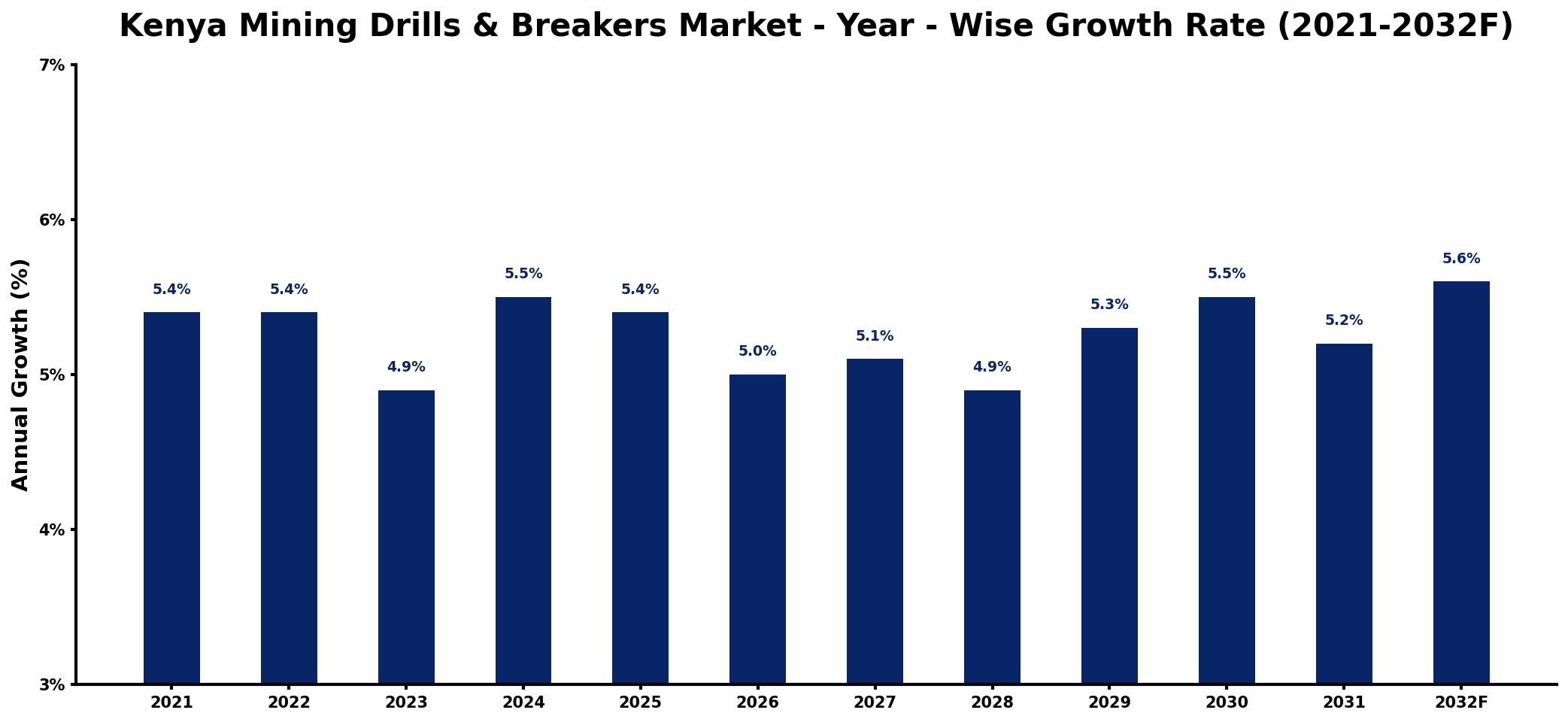
The table below presents the year‑wise growth rates along with the key drivers influencing the market
| Year | Growth Rate | Major Drivers |
| 2021 | 5.4% | Increased infrastructure development projects |
| 2022 | 5.4% | Rising demand for natural resources |
| 2023 | 4.9% | Expansion of renewable energy initiatives |
| 2024 | 5.5% | Growing foreign direct investments |
| 2025 | 5.4% | Enhanced technological advancements adoption |
| 2026 | 5.0% | Strengthening local supply chains |
| 2027 | 5.1% | Increased government support programs |
| 2028 | 4.9% | Rising interest in sustainable practices |
| 2029 | 5.3% | Growing urbanization driving demand |
| 2030 | 5.5% | growing downstream application demand |
| 2031 | 5.2% | Increasing exploration activities planned |
| 2032 | 5.6% | Emerging markets seeking resource access |
Note: Market size estimations and growth projections presented in this report are based on 6Wresearch's proprietary forecasting methodology, utilizing the latest available industry data, government publications, and primary research inputs.
Kenya Mining Drills & Breakers Market Synopsis
The most significant force currently shaping the Kenya Mining Drills & Breakers Market is the robust growth of the mining sector itself. Exploration and extraction activities are expanding, urging mining companies to invest in advanced equipment to enhance efficiency and productivity.
The market landscape features both local and international manufacturers, all striving to deliver high-quality, innovative solutions. As sustainability becomes a pressing concern, there is a marked shift towards eco-friendly technologies, fostering further opportunities within the sector.
- The market is set to benefit from increasing demand for minerals and metals in Kenya.
- Technological advancements are driving innovation in drilling and breaking equipment.
- Government initiatives are creating a conducive environment for investments in the mining sector.
- There is a notable shift toward sustainable and eco-friendly mining practices.
- Investment in versatile equipment is becoming essential as mining operations diversify.
The Kenya Mining Drills & Breakers Market faces significant restraints, particularly in access to modern technology and equipment. Many remote mining areas suffer from inadequate infrastructure, which can complicate logistics and operations. Furthermore, high operational costs, driven by rising fuel and maintenance expenses, can deter investment. A scarcity of skilled labor adds another layer of complexity, as mining companies seek to meet modern demands while navigating regulatory hurdles that can be both intricate and time-consuming. Addressing these issues is critical for sustainable growth in the sector.
Current trends in the Kenya Mining Drills & Breakers Market emphasize the adoption of automation and digital solutions to improve safety and operational accuracy. There's a rising demand for versatile drilling and breaking equipment capable of handling diverse materials and terrains, catering to various mining requirements. Moreover, a shift towards environmentally friendly equipment reflects a broader commitment to sustainable mining practices. Continuous investment in research and development by market players aims to enhance product reliability and cost-effectiveness.
As the mining sector continues to expand, there are abundant investment opportunities within the Kenya Mining Drills & Breakers Market. Companies focused on providing high-quality, efficient equipment can greatly benefit, especially as mining firms strive to improve productivity and reduce costs. Collaborating with local companies or supplying to multinational operations presents a viable pathway for profitability. Furthermore, the government's supportive policies offer a favorable landscape for investors eager to innovate and deliver solutions that enhance safety and environmental sustainability in the sector.
The Kenyan government has actively sought to regulate and promote the mining industry through a series of policies and initiatives. The Mining Act of 2016 establishes a framework for licensing and operational standards, while regulations mandate local equity participation, fostering community involvement in mining activities. Additionally, policies encouraging community development agreements help enhance socio-economic growth, which, in turn, supports the mining sector's demand for advanced drilling and breaking equipment.
Looking ahead to 2026-2032, the Kenya Mining Drills & Breakers Market is poised for steady expansion, fueled by ongoing investments in various mineral extraction projects. The government's commitment to promoting mining initiatives and attracting foreign investment will play a crucial role in maintaining this growth. Furthermore, as technology continues to evolve, the focus on enhancing productivity and efficiency will likely drive demand for innovative drilling and breaking solutions, further solidifying the market's positive outlook.
Recent developments within the Kenya Mining Drills & Breakers Market indicate a strong push towards automation and improved safety measures in mining operations. The focus on sustainable practices has led companies to explore new eco-friendly materials and technologies. Additionally, collaboration between the government and private sectors is becoming increasingly prevalent, aiming to streamline regulatory processes and enhance infrastructure in remote mining regions, paving the way for future growth.
- 10 Years of Market Numbers
- Historical Data Starting from 2022 to 2025
- Base Year: 2025
- Forecast Data until 2032
- Key Performance Indicators Impacting the Market
- Major Upcoming Developments and Projects
Key Highlights of the Report:
- Kenya Mining Drills & Breakers Market Outlook
- Market Size of Kenya Mining Drills & Breakers Market, 2025
- Forecast of Kenya Mining Drills & Breakers Market, 2032
- Historical Data and Forecast of Kenya Mining Drills & Breakers Revenues & Volume for the Period 2022-2032F
- Kenya Mining Drills & Breakers Market Trend Evolution
- Kenya Mining Drills & Breakers Market Drivers and Challenges
- Kenya Mining Drills & Breakers Price Trends
- Kenya Mining Drills & Breakers Porter's Five Forces
- Kenya Mining Drills & Breakers Industry Life Cycle
- Historical Data and Forecast of Kenya Mining Drills & Breakers Market Revenues & Volume By Product for the Period 2022-2032F
- Historical Data and Forecast of Kenya Mining Drills & Breakers Market Revenues & Volume By Rotary Drills for the Period 2022-2032F
- Historical Data and Forecast of Kenya Mining Drills & Breakers Market Revenues & Volume By Crawler Drills for the Period 2022-2032F
- Historical Data and Forecast of Kenya Mining Drills & Breakers Market Revenues & Volume By Rock Breakers for the Period 2022-2032F
- Historical Data and Forecast of Kenya Mining Drills & Breakers Market Revenues & Volume By Hydraulic Breakers for the Period 2022-2032F
- Historical Data and Forecast of Kenya Mining Drills & Breakers Market Revenues & Volume By Application for the Period 2022-2032F
- Historical Data and Forecast of Kenya Mining Drills & Breakers Market Revenues & Volume By Metal Mining for the Period 2022-2032F
- Historical Data and Forecast of Kenya Mining Drills & Breakers Market Revenues & Volume By Coal Mining for the Period 2022-2032F
- Historical Data and Forecast of Kenya Mining Drills & Breakers Market Revenues & Volume By Mineral Mining for the Period 2022-2032F
- Historical Data and Forecast of Kenya Mining Drills & Breakers Market Revenues & Volume By Others for the Period 2022-2032F
- Kenya Mining Drills & Breakers Import Export Trade Statistics
- Market Opportunity Assessment By Product
- Market Opportunity Assessment By Application
- Kenya Mining Drills & Breakers Top Companies Market Share
- Kenya Mining Drills & Breakers Competitive Benchmarking By Technical and Operational Parameters
- Kenya Mining Drills & Breakers Company Profiles
- Kenya Mining Drills & Breakers Key Strategic Recommendations






































