Kenya Mobile BI Market Size & Growth Rate (2026-2032)
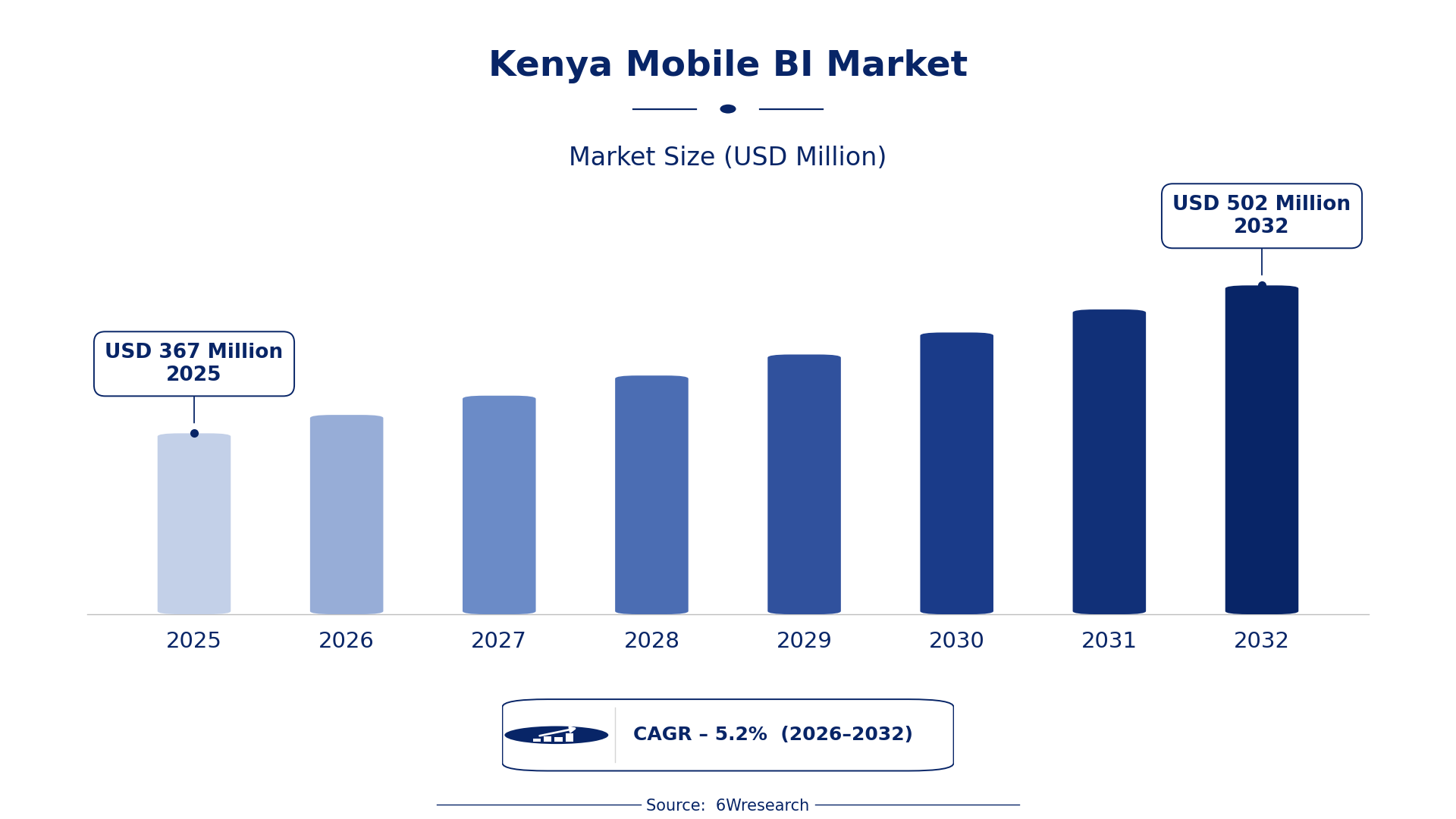
The Kenya Mobile BI Market was estimated at USD 367 Million in 2025 and is projected to reach USD 502 Million by 2032, growing at a CAGR of 5.2% from 2026 to 2032.
Kenya Mobile BI Market Synopsis
Organizations in Kenya are increasingly adopting mobile business intelligence (BI) solutions to stay competitive. With a growing reliance on data analytics for timely decision-making, these tools are transforming how businesses operate, offering insights that drive productivity and strategic planning.
The market is being shaped by several factors, including the widespread use of mobile devices and cloud technology. Companies are looking to harness real-time data to inform their business strategies, yet they face hurdles such as data fragmentation and affordability concerns that can impede access to effective BI tools.
Kenya Mobile BI Market Year-wise Growth Rate and Key Drivers
This graph illustrates the annual growth rates of the Kenya Mobile BI Market from 2021 to 2032, highlighting a steady upward trajectory and projected expansion over the forecast period.
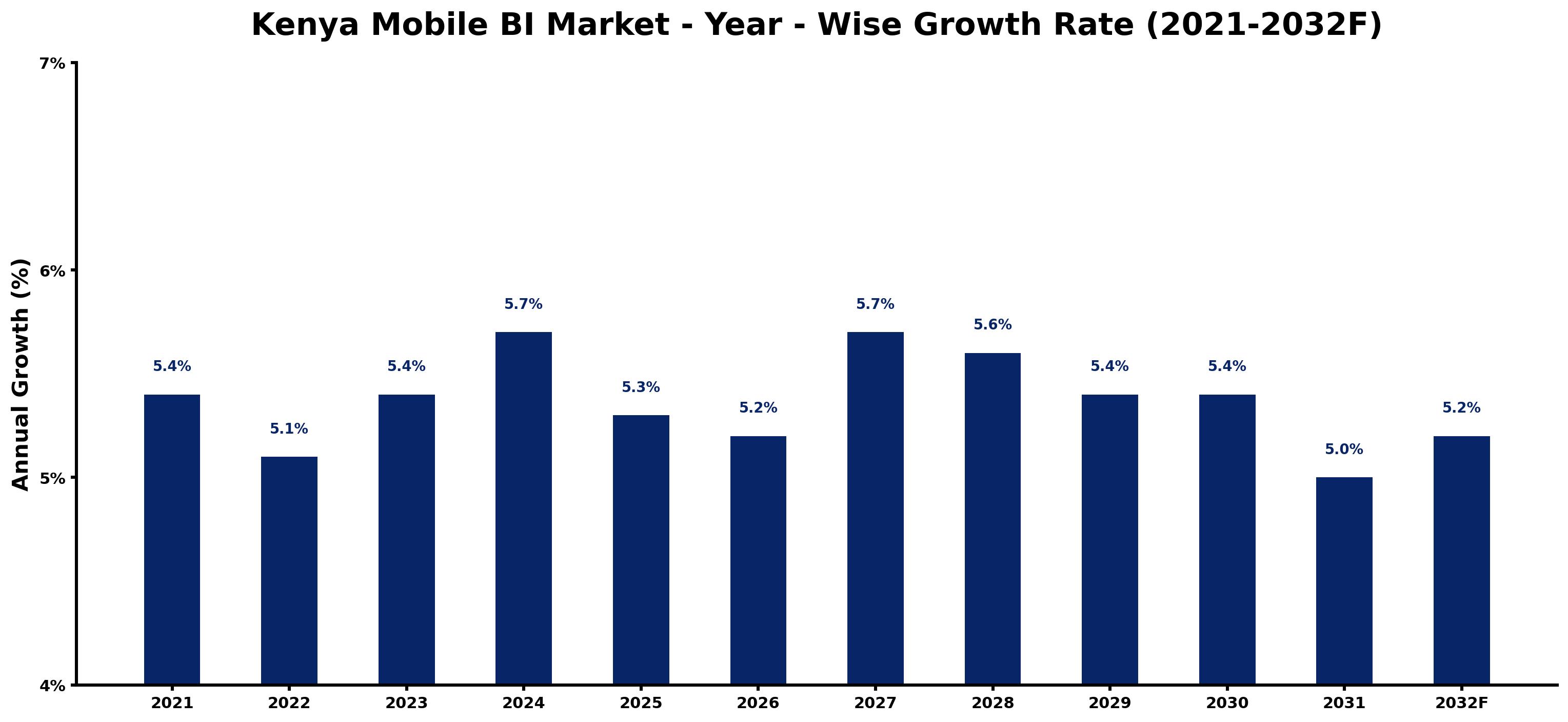
The table below presents the year‑wise growth rates along with the key drivers influencing the market
| Year | Growth Rate | Major Drivers |
| 2021 | 5.4% | Rapid adoption of mobile money services nationwide |
| 2022 | 5.1% | Increased investment in local data analytics startups |
| 2023 | 5.4% | Mobile broadband expansion enhancing data access |
| 2024 | 5.7% | Government policy promoting e-governance and data use |
| 2025 | 5.3% | Growing interest in mobile-first business strategies |
| 2026 | 5.2% | Rise of online education driving demand for BI tools |
| 2027 | 5.7% | Enhanced mobile infrastructure improving connectivity and usage |
| 2028 | 5.6% | Health sector utilizing mobile BI for patient data |
| 2029 | 5.4% | Increased mobile app development fostering analytics use |
| 2030 | 5.4% | Demand for real-time decision-making in agriculture sector |
| 2031 | 5.0% | Adoption of digital platforms by SMEs for insights |
| 2032 | 5.2% | Support from local tech hubs for innovation in BI |
Note: Market size estimations and growth projections presented in this report are based on 6Wresearch's proprietary forecasting methodology, utilizing the latest available industry data, government publications, and primary research inputs.
Kenya Mobile BI Market Key Takeaways
Below are some of the specific key takeaways from the market, including:
- The market is experiencing a steady growth trajectory driven by the need for real-time analytics.
- Mobile BI tools are becoming essential for businesses aiming to enhance productivity and informed decision-making.
- Data security and governance challenges remain significant barriers to widespread adoption.
- Small and medium-sized enterprises struggle with affordability and access to expertise in BI.
- The government is taking steps to improve digital infrastructure and data accessibility in the sector.
Evaluation of Restraints in Kenya Mobile BI Market
Despite the promising outlook for the Kenya Mobile BI market, several restraints limit its growth potential. Data fragmentation across different systems creates challenges for organizations trying to consolidate insights into a single, actionable view. Many businesses, particularly SMEs, grapple with the costs associated with implementing mobile BI solutions, often lacking the necessary expertise and resources to leverage these tools effectively. on top of that, concerns about data security and compliance with regulatory frameworks deter some organizations from fully embracing mobile BI capabilities.
Kenya Mobile BI Market Trends
A noticeable trend is the increasing integration of artificial intelligence into mobile BI solutions. This integration allows for advanced predictive analytics, helping businesses anticipate market changes and customer needs. Another emerging trend is the shift towards user-friendly interfaces that accommodate mobile screen sizes, making data insights more accessible to a broader audience. The rise of cloud-based BI tools also supports scalability, enabling businesses to adapt quickly to changing demands.
Kenya Mobile BI Market Opportunities
The potential for growth in the Kenya Mobile BI market is significant. Organizations that invest in mobile BI solutions can gain a competitive edge by enhancing operational efficiency and improving decision-making capabilities. There is also an opportunity for technology providers to offer tailored solutions that address the specific needs of SMEs, including affordable pricing models and training programs to bridge the skills gap. Collaborations with government initiatives aimed at improving digital infrastructure further present avenues for market expansion.
Government Initiatives in the Kenya Mobile BI Market
Government policies are increasingly influencing the Kenya Mobile BI market, with a focus on enhancing data accessibility and improving digital infrastructure. Such initiatives aim to facilitate real-time data processing and empower organizations to make informed decisions based on accurate insights. As Kenya positions itself as a regional tech hub, these governmental efforts are crucial for fostering a conducive environment for mobile BI adoption.
- A national digital infrastructure upgrade programme, now in its rollout phase, aims to improve internet connectivity across urban and rural areas.
- Ongoing initiatives focus on establishing regulatory frameworks that ensure data protection and compliance, critical for fostering trust in mobile BI solutions.
- A recently launched programme seeks to provide training and resources for SMEs to enhance their BI capabilities and data literacy.
- A planned public-private partnership expected to expand access to mobile BI tools for local businesses is set to begin by mid-2026.
- The government is working on a policy to promote the use of cloud computing in the public sector, which will benefit mobile BI applications.
Future Insights of the Kenya Mobile BI Market
Looking ahead to 2026-2032, the Kenya Mobile BI market is likely to witness accelerated growth as organizations continue to prioritize data-driven decision-making. The integration of advanced analytics and AI will reshape how businesses utilize mobile BI, enabling them to glean deeper insights from their data. With ongoing government support for digital infrastructure and the increasing adoption of cloud-based solutions, the market stands to benefit significantly from these trends, ultimately leading to enhanced competitiveness among Kenyan enterprises.
Kenya Mobile BI Market Latest Developments
In the past year, the Kenya Mobile BI market has seen notable developments that signal a shift towards greater adoption and innovation. Companies are increasingly recognizing the value of mobile analytics, leading to new product offerings and partnerships aimed at enhancing user experience and data accessibility.
- A leading regional operator launched a new mobile BI application in early 2025, designed to provide real-time analytics to SMEs.
- An ongoing initiative began in mid-2025, focusing on integrating AI-driven analytics into existing mobile BI platforms for enhanced predictive capabilities.
- A major technology vendor is working on a service upgrade that aims to improve data visualization tools by late 2025, catering to mobile users.
- Upcoming collaborations between tech startups and established firms are expected to be announced in early 2026, focusing on mobile BI solutions tailored for specific sectors.
- A pilot project to test new mobile BI features in the public sector is set to begin in Q3 2025, aiming to enhance data-driven decision-making processes.
Kenya Mobile BI Market - Key Attractiveness of the Report
- 10 Years of Market Numbers
- Historical Data Starting from 2022 to 2025
- Base Year: 2025
- Forecast Data until 2032
- Key Performance Indicators Impacting the Market
- Major Upcoming Developments and Projects
Key Highlights of the Report:
- Kenya Mobile BI Market Outlook
- Market Size of Kenya Mobile BI Market, 2025
- Forecast of Kenya Mobile BI Market, 2032
- Historical Data and Forecast of Kenya Mobile BI Revenues & Volume for the Period 2022-2032F
- Kenya Mobile BI Market Trend Evolution
- Kenya Mobile BI Market Drivers and Challenges
- Kenya Mobile BI Price Trends
- Kenya Mobile BI Porter's Five Forces
- Kenya Mobile BI Industry Life Cycle
- Historical Data and Forecast of Kenya Mobile BI Market Revenues & Volume By Type for the Period 2022-2032F
- Historical Data and Forecast of Kenya Mobile BI Market Revenues & Volume By Software for the Period 2022-2032F
- Historical Data and Forecast of Kenya Mobile BI Market Revenues & Volume By Services for the Period 2022-2032F
- Historical Data and Forecast of Kenya Mobile BI Market Revenues & Volume By Organization Size for the Period 2022-2032F
- Historical Data and Forecast of Kenya Mobile BI Market Revenues & Volume By SMES for the Period 2022-2032F
- Historical Data and Forecast of Kenya Mobile BI Market Revenues & Volume By Large Enterprises for the Period 2022-2032F
- Historical Data and Forecast of Kenya Mobile BI Market Revenues & Volume By Business Function for the Period 2022-2032F
- Historical Data and Forecast of Kenya Mobile BI Market Revenues & Volume By IT for the Period 2022-2032F
- Historical Data and Forecast of Kenya Mobile BI Market Revenues & Volume By Marketing for the Period 2022-2032F
- Historical Data and Forecast of Kenya Mobile BI Market Revenues & Volume By Sales for the Period 2022-2032F
- Historical Data and Forecast of Kenya Mobile BI Market Revenues & Volume By Operations for the Period 2022-2032F
- Historical Data and Forecast of Kenya Mobile BI Market Revenues & Volume By Finance for the Period 2022-2032F
- Historical Data and Forecast of Kenya Mobile BI Market Revenues & Volume By Human resources (HR) for the Period 2022-2032F
- Historical Data and Forecast of Kenya Mobile BI Market Revenues & Volume By Business Application for the Period 2022-2032F
- Historical Data and Forecast of Kenya Mobile BI Market Revenues & Volume By Fraud and security management for the Period 2022-2032F
- Historical Data and Forecast of Kenya Mobile BI Market Revenues & Volume By Sales and marketing management for the Period 2022-2032F
- Historical Data and Forecast of Kenya Mobile BI Market Revenues & Volume By Predictive asset maintenance for the Period 2022-2032F
- Historical Data and Forecast of Kenya Mobile BI Market Revenues & Volume By Risk and compliance management for the Period 2022-2032F
- Historical Data and Forecast of Kenya Mobile BI Market Revenues & Volume By Customer engagement and analysis for the Period 2022-2032F
- Historical Data and Forecast of Kenya Mobile BI Market Revenues & Volume By Supply chain management and procurement for the Period 2022-2032F
- Historical Data and Forecast of Kenya Mobile BI Market Revenues & Volume By Operations management for the Period 2022-2032F
- Historical Data and Forecast of Kenya Mobile BI Market Revenues & Volume By Others for the Period 2022-2032F
- Historical Data and Forecast of Kenya Mobile BI Market Revenues & Volume By Industry Vertical for the Period 2022-2032F
- Historical Data and Forecast of Kenya Mobile BI Market Revenues & Volume By Banking, Financial Services, and Insurance (BFSI) for the Period 2022-2032F
- Historical Data and Forecast of Kenya Mobile BI Market Revenues & Volume By Telecommunications and IT for the Period 2022-2032F
- Historical Data and Forecast of Kenya Mobile BI Market Revenues & Volume By Retail and eCommerce for the Period 2022-2032F
- Historical Data and Forecast of Kenya Mobile BI Market Revenues & Volume By Healthcare and life sciences for the Period 2022-2032F
- Historical Data and Forecast of Kenya Mobile BI Market Revenues & Volume By Manufacturing for the Period 2022-2032F
- Historical Data and Forecast of Kenya Mobile BI Market Revenues & Volume By Government for the Period 2022-2032F
- Historical Data and Forecast of Kenya Mobile BI Market Revenues & Volume By Energy and utilities for the Period 2022-2032F
- Historical Data and Forecast of Kenya Mobile BI Market Revenues & Volume By Media and entertainment for the Period 2022-2032F
- Historical Data and Forecast of Kenya Mobile BI Market Revenues & Volume By Deployment Model for the Period 2022-2032F
- Historical Data and Forecast of Kenya Mobile BI Market Revenues & Volume By On-Premise for the Period 2022-2032F
- Historical Data and Forecast of Kenya Mobile BI Market Revenues & Volume By Hosted/ On-Cloud for the Period 2022-2032F
- Kenya Mobile BI Import Export Trade Statistics
- Market Opportunity Assessment By Type
- Market Opportunity Assessment By Organization Size
- Market Opportunity Assessment By Business Function
- Market Opportunity Assessment By Business Application
- Market Opportunity Assessment By Industry Vertical
- Market Opportunity Assessment By Deployment Model
- Kenya Mobile BI Top Companies Market Share
- Kenya Mobile BI Competitive Benchmarking By Technical and Operational Parameters
- Kenya Mobile BI Company Profiles
- Kenya Mobile BI Key Strategic Recommendations






































