Nigeria Mobile BI Market Size & Growth Rate (2026-2032)
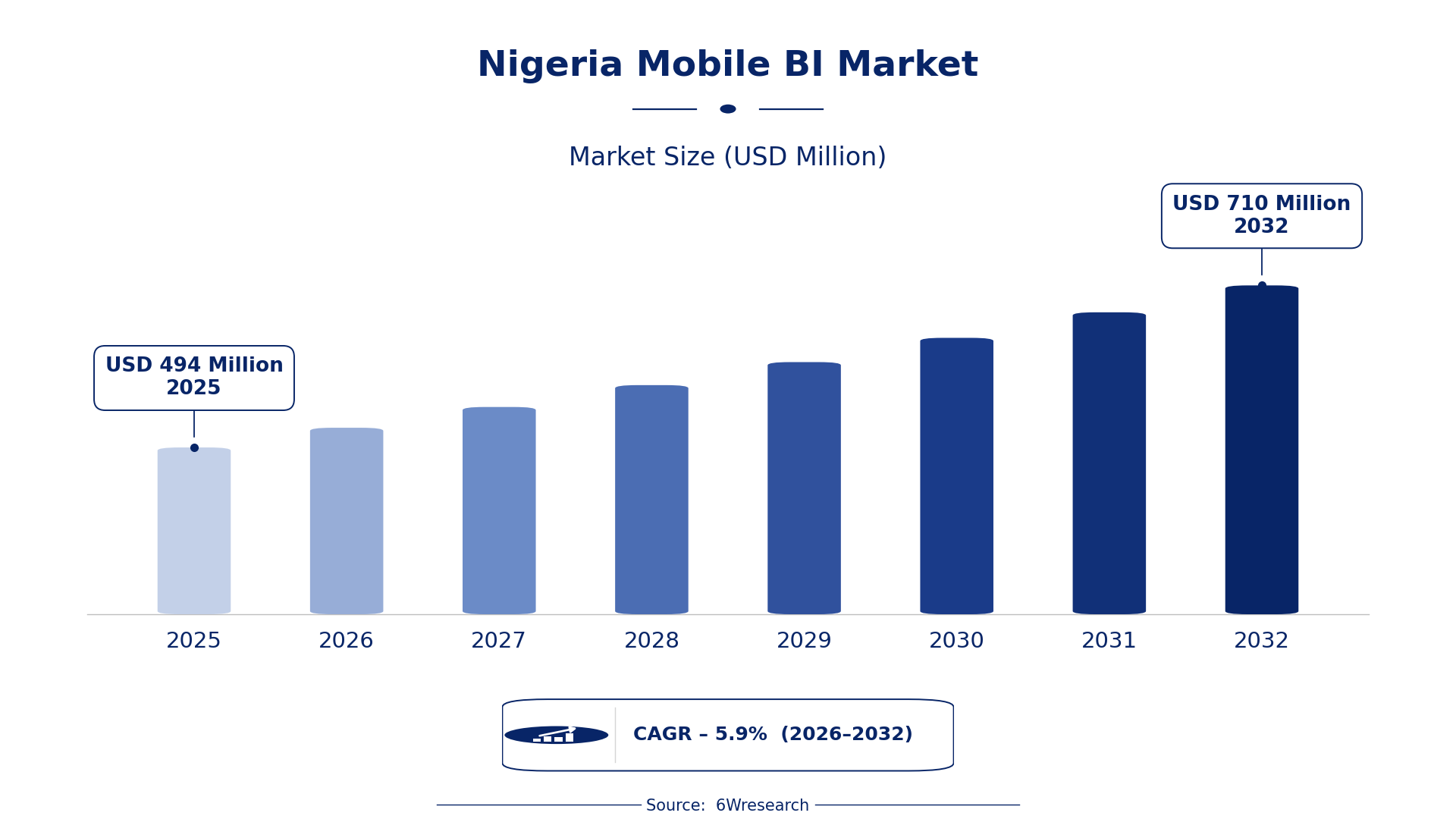
The Nigeria Mobile BI Market was estimated at USD 494 Million in 2025 and is projected to reach USD 710 Million by 2032, growing at a CAGR of 5.9% from 2026 to 2032.
Nigeria Mobile BI Market Synopsis
In Nigeria, businesses are increasingly recognizing the necessity of having business intelligence tools accessible on mobile devices. This trend is driven by the need for timely data analytics that enable quick decision-making in a fast-paced business environment.
The demand for mobile BI solutions is further fueled by the proliferation of smartphones and tablets in the Nigerian market. As organizations strive to enhance operational efficiency and gain competitive advantages, the emphasis on data-driven strategies is becoming undeniable.
Nigeria Mobile BI Market Year-wise Growth Rate and Key Drivers
This graph illustrates the annual growth rates of the Nigeria Mobile BI Market from 2021 to 2032, highlighting a steady upward trajectory and projected expansion over the forecast period.
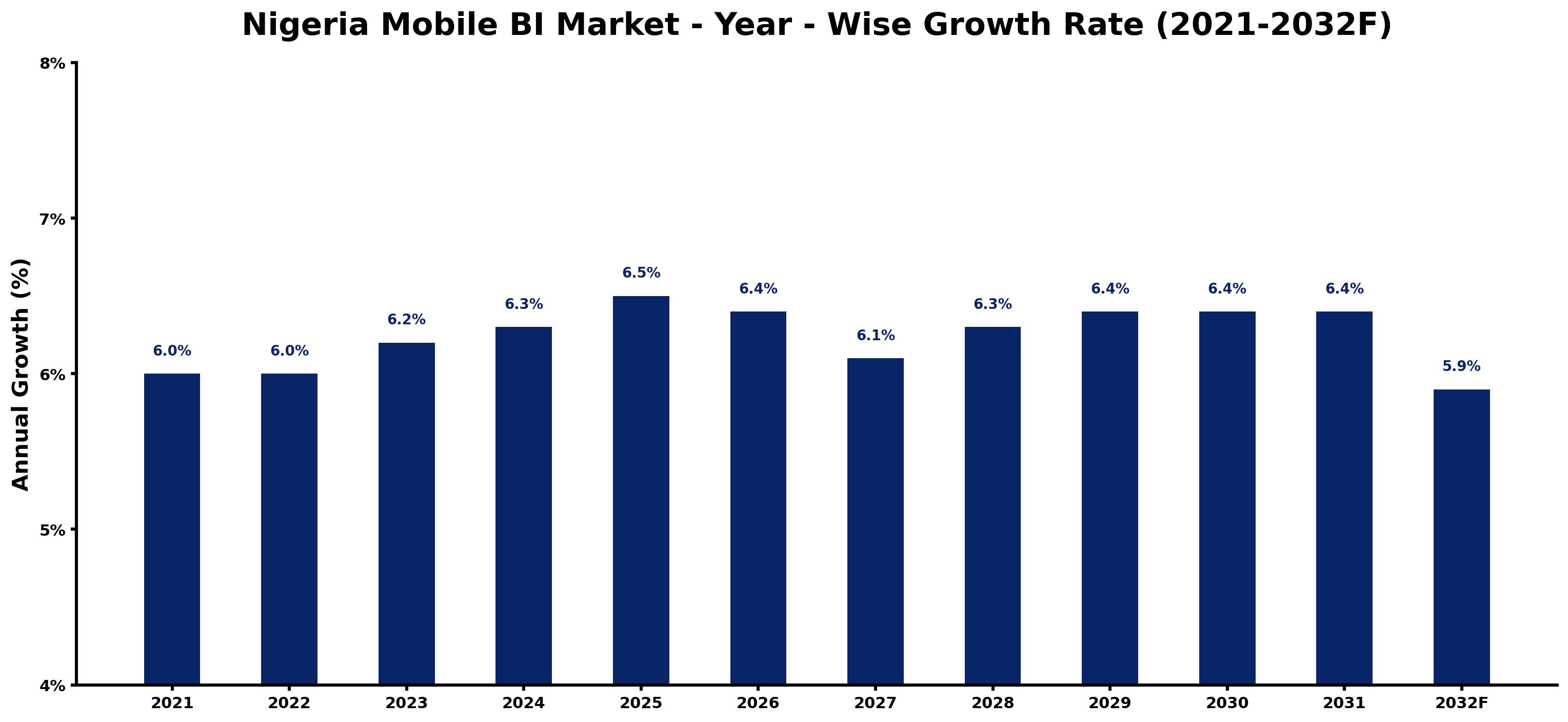
The table below presents the year‑wise growth rates along with the key drivers influencing the market
| Year | Growth Rate | Major Drivers |
| 2021 | 6.0% | Increased smartphone adoption among Nigerian youth demographic. |
| 2022 | 6.0% | Government initiatives promoting digital literacy and analytics. |
| 2023 | 6.2% | Significant rise in mobile internet penetration rates. |
| 2024 | 6.3% | Emergence of local mobile BI startups and innovations. |
| 2025 | 6.5% | Continued investment in telecommunications infrastructure by providers. |
| 2026 | 6.4% | Increased demand for real-time data in trade sectors. |
| 2027 | 6.1% | Adoption of mobile BI by financial institutions in Nigeria. |
| 2028 | 6.3% | Surge in remote working solutions boosting mobile applications. |
| 2029 | 6.4% | Growing partnerships between tech firms and local businesses. |
| 2030 | 6.4% | Nigerian banks enhancing customer experience through mobile analytics. |
| 2031 | 6.4% | Increasing regulatory support for fintech mobile applications. |
| 2032 | 5.9% | Improved mobile payment systems driving market analytics needs. |
Note: Market size estimations and growth projections presented in this report are based on 6Wresearch's proprietary forecasting methodology, utilizing the latest available industry data, government publications, and primary research inputs.
Nigeria Mobile BI Market Key Takeaways
Below are some of the specific key takeaways from the market, including:
- The rise in mobile device usage is catalyzing demand for mobile BI solutions across various sectors.
- Organizations are focusing on real-time data accessibility to enhance decision-making processes.
- Cloud-based platforms and AI-driven analytics are transforming the capabilities of mobile BI tools.
- Investment in data infrastructure remains critical to overcoming existing market challenges.
- Government initiatives aimed at bolstering data privacy are expected to impact market growth positively.
Evaluation of Restraints in Nigeria Mobile BI Market
Several obstacles hinder the growth of the mobile BI market in Nigeria. Limited data infrastructure poses a significant challenge, affecting the reliability and accessibility of business intelligence applications. Privacy concerns also loom large, as companies grapple with ensuring the security of sensitive information. Additionally, there is a shortage of skilled professionals who can effectively utilize mobile BI tools, creating a gap in the market that needs urgent attention.
Nigeria Mobile BI Market Trends
Several trends are currently shaping the Nigeria Mobile BI market. First, the integration of artificial intelligence into mobile BI solutions is enhancing data analysis capabilities, allowing organizations to derive insights faster. Second, as more companies shift to cloud-based solutions, mobile BI is becoming more accessible and scalable. The push for data democratization is also gaining traction, enabling employees at all levels to engage with data analytics.
Nigeria Mobile BI Market Opportunities
The mobile BI market in Nigeria presents numerous opportunities for growth. Companies that invest in improving their data infrastructure will likely see a competitive edge. on top of that, with the government's focus on enhancing digital literacy, training programs for mobile BI technologies can help fill the skills gap. Organizations can also explore partnerships with technology providers to innovate and expand their BI capabilities.
Government Initiatives in the Nigeria Mobile BI Market
Government policies are increasingly recognizing the vital role of mobile business intelligence in empowering businesses and enhancing performance. Current initiatives aim to promote the adoption of mobile BI across various sectors while ensuring data security and privacy. Policymakers are prioritizing a regulatory framework that encourages technological advancements while safeguarding sensitive data.
- A recently completed initiative involved the launch of a national digital infrastructure upgrade programme, aimed at enhancing connectivity for businesses across Nigeria.
- Currently, a regulatory review is underway to strengthen data privacy laws, ensuring businesses can implement mobile BI solutions securely.
- Planned upcoming initiatives include a public-private partnership expected to focus on expanding access to mobile BI training and resources by 2026.
- The government is also working on a framework to incentivize businesses that adopt mobile BI solutions to improve operational efficiency.
Future Insights of the Nigeria Mobile BI Market
Looking ahead to 2026-2032, the Nigeria Mobile BI market is set to experience significant transformation. As businesses continue to emphasize data-driven decision-making, the demand for advanced mobile BI solutions will only grow. Innovations in AI and machine learning will further enhance the capabilities of these tools, making them indispensable for organizations seeking a competitive edge in the digital economy.
Nigeria Mobile BI Market Latest Developments
Recent developments in the Nigeria Mobile BI market indicate a surge in activity aimed at enhancing data capabilities. Over the past year, organizations have increasingly prioritized the integration of mobile BI solutions into their operations. This trend is likely to accelerate as more businesses recognize the value of real-time data insights.
- A major technology vendor announced the rollout of an AI-driven analytics tool for mobile BI, aimed at small and medium enterprises, launched in Q1 2025.
- In mid-2025, a collaboration between local universities and tech firms was initiated to develop a mobile BI training curriculum for professionals.
- An initiative launched in late 2025 focuses on providing grants to startups developing innovative mobile BI solutions.
- A planned expansion of mobile data networks is set to begin in the second half of 2026 to improve accessibility in rural areas.
Nigeria Mobile BI Market - Key Attractiveness of the Report
- 10 Years of Market Numbers
- Historical Data Starting from 2022 to 2025
- Base Year: 2025
- Forecast Data until 2032
- Key Performance Indicators Impacting the Market
- Major Upcoming Developments and Projects
Key Highlights of the Report:
- Nigeria Mobile BI Market Outlook
- Market Size of Nigeria Mobile BI Market, 2025
- Forecast of Nigeria Mobile BI Market, 2032
- Historical Data and Forecast of Nigeria Mobile BI Revenues & Volume for the Period 2022-2032F
- Nigeria Mobile BI Market Trend Evolution
- Nigeria Mobile BI Market Drivers and Challenges
- Nigeria Mobile BI Price Trends
- Nigeria Mobile BI Porter's Five Forces
- Nigeria Mobile BI Industry Life Cycle
- Historical Data and Forecast of Nigeria Mobile BI Market Revenues & Volume By Type for the Period 2022-2032F
- Historical Data and Forecast of Nigeria Mobile BI Market Revenues & Volume By Software for the Period 2022-2032F
- Historical Data and Forecast of Nigeria Mobile BI Market Revenues & Volume By Services for the Period 2022-2032F
- Historical Data and Forecast of Nigeria Mobile BI Market Revenues & Volume By Organization Size for the Period 2022-2032F
- Historical Data and Forecast of Nigeria Mobile BI Market Revenues & Volume By SMES for the Period 2022-2032F
- Historical Data and Forecast of Nigeria Mobile BI Market Revenues & Volume By Large Enterprises for the Period 2022-2032F
- Historical Data and Forecast of Nigeria Mobile BI Market Revenues & Volume By Business Function for the Period 2022-2032F
- Historical Data and Forecast of Nigeria Mobile BI Market Revenues & Volume By IT for the Period 2022-2032F
- Historical Data and Forecast of Nigeria Mobile BI Market Revenues & Volume By Marketing for the Period 2022-2032F
- Historical Data and Forecast of Nigeria Mobile BI Market Revenues & Volume By Sales for the Period 2022-2032F
- Historical Data and Forecast of Nigeria Mobile BI Market Revenues & Volume By Operations for the Period 2022-2032F
- Historical Data and Forecast of Nigeria Mobile BI Market Revenues & Volume By Finance for the Period 2022-2032F
- Historical Data and Forecast of Nigeria Mobile BI Market Revenues & Volume By Human resources (HR) for the Period 2022-2032F
- Historical Data and Forecast of Nigeria Mobile BI Market Revenues & Volume By Business Application for the Period 2022-2032F
- Historical Data and Forecast of Nigeria Mobile BI Market Revenues & Volume By Fraud and security management for the Period 2022-2032F
- Historical Data and Forecast of Nigeria Mobile BI Market Revenues & Volume By Sales and marketing management for the Period 2022-2032F
- Historical Data and Forecast of Nigeria Mobile BI Market Revenues & Volume By Predictive asset maintenance for the Period 2022-2032F
- Historical Data and Forecast of Nigeria Mobile BI Market Revenues & Volume By Risk and compliance management for the Period 2022-2032F
- Historical Data and Forecast of Nigeria Mobile BI Market Revenues & Volume By Customer engagement and analysis for the Period 2022-2032F
- Historical Data and Forecast of Nigeria Mobile BI Market Revenues & Volume By Supply chain management and procurement for the Period 2022-2032F
- Historical Data and Forecast of Nigeria Mobile BI Market Revenues & Volume By Operations management for the Period 2022-2032F
- Historical Data and Forecast of Nigeria Mobile BI Market Revenues & Volume By Others for the Period 2022-2032F
- Historical Data and Forecast of Nigeria Mobile BI Market Revenues & Volume By Industry Vertical for the Period 2022-2032F
- Historical Data and Forecast of Nigeria Mobile BI Market Revenues & Volume By Banking, Financial Services, and Insurance (BFSI) for the Period 2022-2032F
- Historical Data and Forecast of Nigeria Mobile BI Market Revenues & Volume By Telecommunications and IT for the Period 2022-2032F
- Historical Data and Forecast of Nigeria Mobile BI Market Revenues & Volume By Retail and eCommerce for the Period 2022-2032F
- Historical Data and Forecast of Nigeria Mobile BI Market Revenues & Volume By Healthcare and life sciences for the Period 2022-2032F
- Historical Data and Forecast of Nigeria Mobile BI Market Revenues & Volume By Manufacturing for the Period 2022-2032F
- Historical Data and Forecast of Nigeria Mobile BI Market Revenues & Volume By Government for the Period 2022-2032F
- Historical Data and Forecast of Nigeria Mobile BI Market Revenues & Volume By Energy and utilities for the Period 2022-2032F
- Historical Data and Forecast of Nigeria Mobile BI Market Revenues & Volume By Media and entertainment for the Period 2022-2032F
- Historical Data and Forecast of Nigeria Mobile BI Market Revenues & Volume By Deployment Model for the Period 2022-2032F
- Historical Data and Forecast of Nigeria Mobile BI Market Revenues & Volume By On-Premise for the Period 2022-2032F
- Historical Data and Forecast of Nigeria Mobile BI Market Revenues & Volume By Hosted/ On-Cloud for the Period 2022-2032F
- Nigeria Mobile BI Import Export Trade Statistics
- Market Opportunity Assessment By Type
- Market Opportunity Assessment By Organization Size
- Market Opportunity Assessment By Business Function
- Market Opportunity Assessment By Business Application
- Market Opportunity Assessment By Industry Vertical
- Market Opportunity Assessment By Deployment Model
- Nigeria Mobile BI Top Companies Market Share
- Nigeria Mobile BI Competitive Benchmarking By Technical and Operational Parameters
- Nigeria Mobile BI Company Profiles
- Nigeria Mobile BI Key Strategic Recommendations






































