Kenya Network Automation Market Size & Growth Rate (2026-2032)
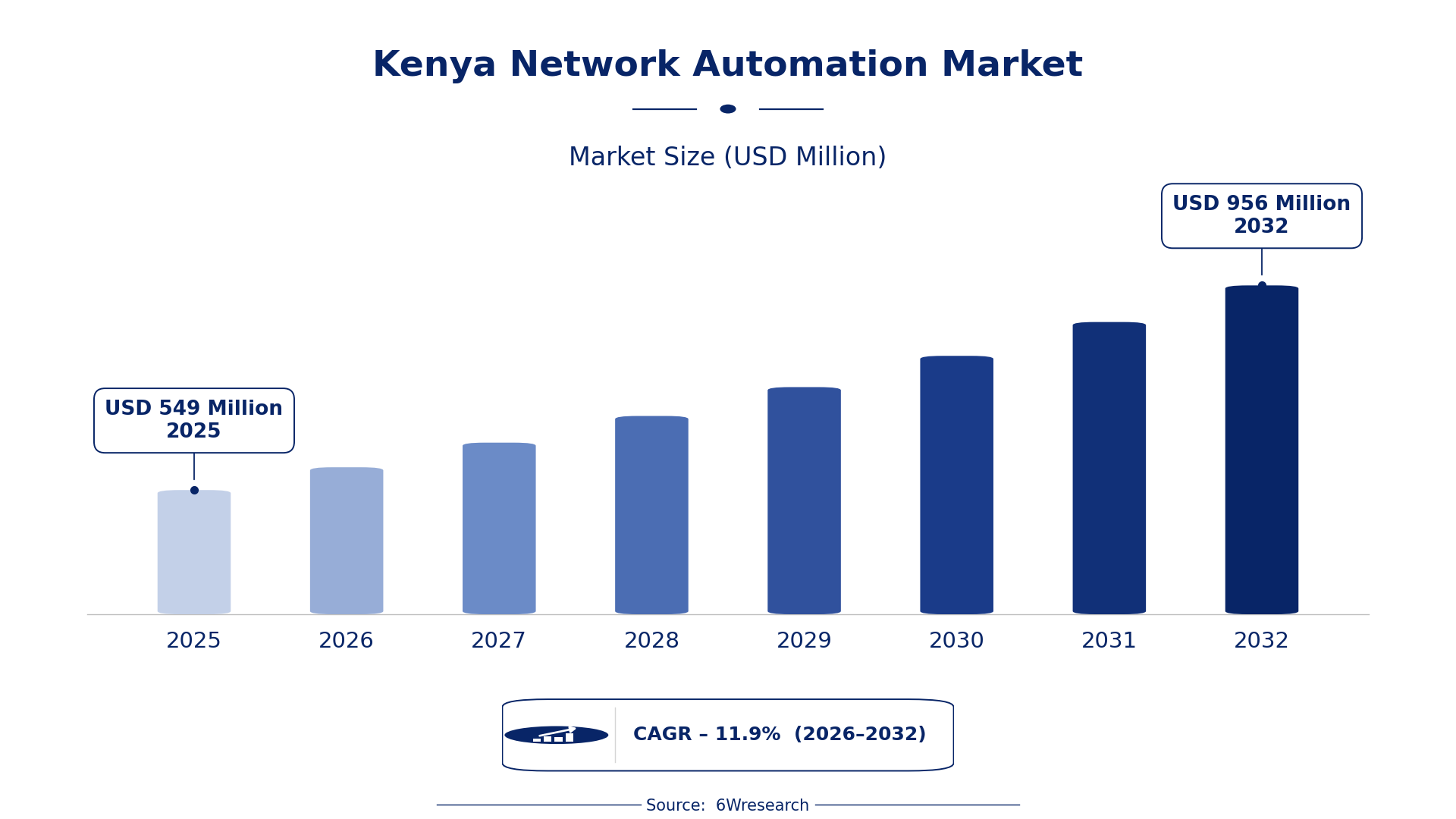
The Kenya Network Automation Market was estimated at USD 549 Million in 2025 and is projected to reach USD 956 Million by 2032, growing at a CAGR of 11.9% from 2026 to 2032.
Kenya Network Automation Market Synopsis
The Kenya Network Automation Market is experiencing a notable transformation as organizations increasingly seek to streamline their network operations. With the growing complexity of network infrastructures, businesses are turning to automation technologies to enhance efficiency and reduce operational costs.
Advancements in artificial intelligence and machine learning are crucial drivers of this shift, enabling organizations to deploy services swiftly and accurately. However, the market's growth is challenged by high implementation costs and a significant skills gap in managing automated systems.
Kenya Network Automation Market Year-wise Growth Rate and Key Drivers
This graph illustrates the annual growth rates of the Kenya Network Automation Market from 2021 to 2032, highlighting a steady upward trajectory and projected expansion over the forecast period.
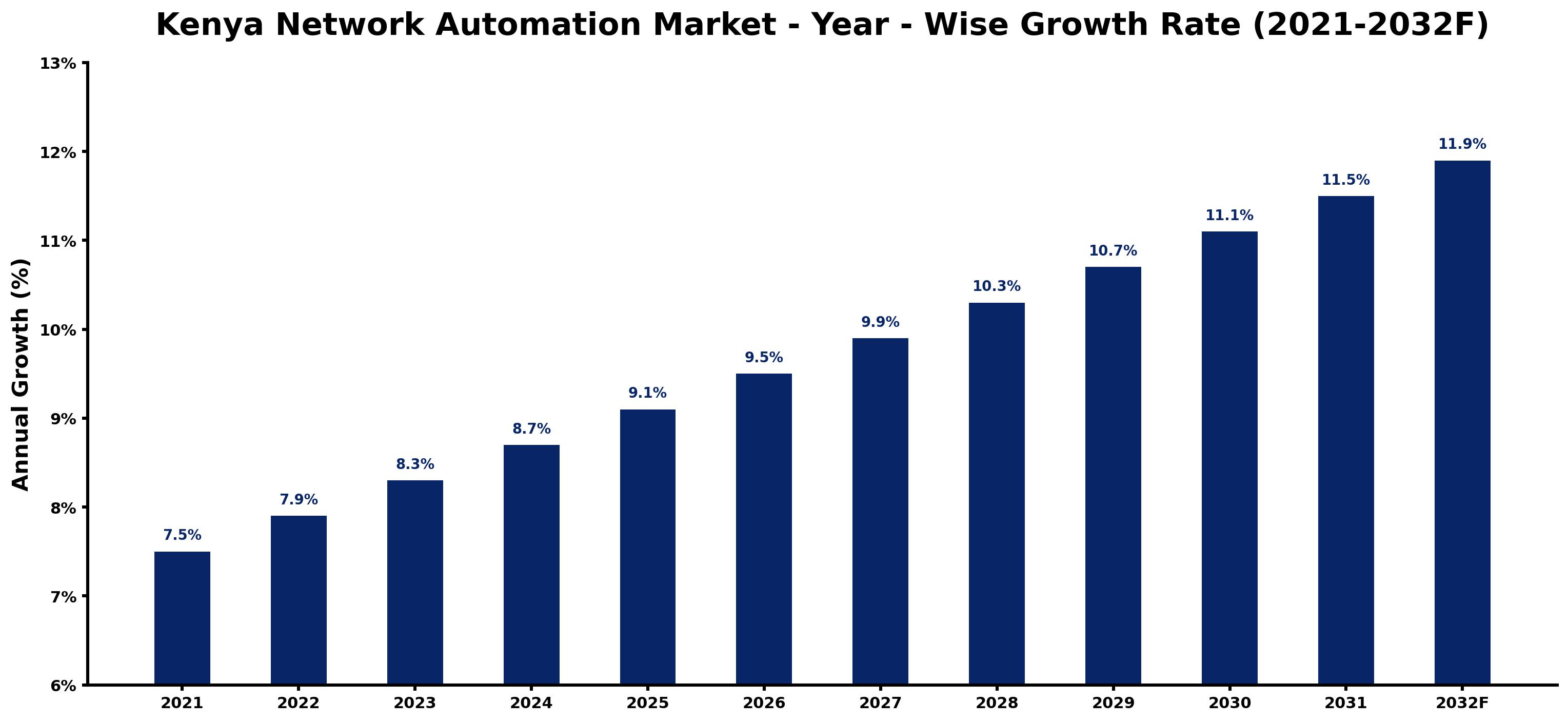
The table below presents the year‑wise growth rates along with the key drivers influencing the market
| Year | Growth Rate | Major Drivers |
| 2021 | 7.5% | Government ICT policy promoting digital infrastructure development |
| 2022 | 7.9% | Increasing mobile internet penetration boosting network automation needs |
| 2023 | 8.3% | Telcos upgrading networks to support growing data traffic |
| 2024 | 8.7% | Emergence of 5G technology driving automation advancements |
| 2025 | 9.1% | Local startups innovating in network management solutions |
| 2026 | 9.5% | Digital transformation initiatives by Kenyan enterprises expanding demand |
| 2027 | 9.9% | Investment in smart agriculture enhancing network reliability requirements |
| 2028 | 10.3% | Partnerships between tech firms and universities fostering innovation |
| 2029 | 10.7% | Regulatory support enhancing cybersecurity and network management standards |
| 2030 | 11.1% | Rise in remote working increasing automated network solutions demand |
| 2031 | 11.5% | Local government initiatives promoting smart city projects' connectivity |
| 2032 | 11.9% | Increased focus on fintech driving secure network automation |
Note: Market size estimations and growth projections presented in this report are based on 6Wresearch's proprietary forecasting methodology, utilizing the latest available industry data, government publications, and primary research inputs.
Kenya Network Automation Market Key Takeaways
Below are some of the specific key takeaways from the market, including:
- The increasing need for efficient network management is propelling the adoption of automation technologies.
- Challenges related to legacy infrastructure compatibility are hindering some organizations from embracing automation.
- AI and machine learning advancements are significantly influencing the adoption rate of network automation solutions.
- Resistance to change from traditional manual processes is a barrier that organizations must overcome.
- There's a pressing demand for skilled personnel capable of implementing and managing automated systems.
Evaluation of Restraints in Kenya Network Automation Market
Despite the clear advantages of network automation, several restraints are hampering market growth in Kenya. High implementation costs remain a substantial barrier, particularly for smaller organizations lacking the necessary financial resources. on top of that, a widespread lack of awareness about the benefits of network automation prevents many businesses from making informed decisions. The scarcity of skilled professionals who can effectively implement and manage these advanced technologies adds another layer of complexity. Additionally, the challenges posed by integrating automation with existing IT infrastructure complicate adoption efforts, making it difficult for organizations to realize the potential operational efficiencies.
Kenya Network Automation Market Trends
Several trends are shaping the Kenya Network Automation Market. The increasing reliance on cloud-based solutions is driving the need for agile network management tools that can adapt to changing demands. Organizations are also focusing on implementing security automation to safeguard their networks against evolving threats. on top of that, the rise of IoT devices is necessitating the deployment of automated network solutions to manage vast data traffic effectively. As businesses prioritize rapid service delivery, the integration of AI and machine learning technologies into network management is becoming a standard practice.
Kenya Network Automation Market Opportunities
The market presents several growth opportunities for businesses willing to invest in automation technologies. As companies increasingly recognize the operational efficiencies that automation brings, demand for scalable solutions is on the rise. Public-private partnerships aimed at enhancing digital infrastructure will create further avenues for investment. Additionally, firms that specialize in training and upskilling personnel in automation technologies will find a growing market for their services. The continued expansion of the telecommunications sector in Kenya also presents a ripe environment for network automation solutions.
Government Initiatives in the Kenya Network Automation Market
Government policies play a crucial role in shaping the Kenya Network Automation Market. The Kenyan government is actively promoting digital transformation to enhance connectivity and efficiency across various sectors. As part of this effort, initiatives aimed at improving the regulatory framework for technology adoption are underway, which will facilitate smoother integration of automation solutions.
- A recently completed initiative focused on launching a national digital infrastructure upgrade program to enhance connectivity in rural areas.
- A current program is underway to establish a regulatory framework that encourages the adoption of automation technologies across government agencies.
- There are plans for a public-private partnership aimed at expanding telecom infrastructure access, expected to roll out by 2028.
- The government has introduced initiatives to increase awareness about the benefits of network automation among businesses.
- Upcoming training programs aimed at developing a skilled workforce to manage automated systems are set to launch in early 2026.
Future Insights of the Kenya Network Automation Market
Looking ahead to 2026-2032, the Kenya Network Automation Market is expected to witness robust growth as organizations embrace automation to stay competitive. Enhanced digital infrastructure and a growing understanding of automation's benefits will likely lead to wider adoption. As more businesses invest in AI and machine learning technologies, the operational landscape will evolve. Companies that prioritize agility and adaptability will thrive in this dynamic environment, positioning themselves for success in the coming years.
Kenya Network Automation Market Latest Developments
Recent activity in the Kenya Network Automation Market indicates a shift towards more advanced automation solutions. Companies are increasingly investing in technologies that enhance their network capabilities, reflecting a broader trend toward efficiency and cost reduction.
- A major technology vendor launched a new AI-driven network management platform in Q1 2025, significantly improving operational efficiency for users.
- An initiative that began in early 2025 and remains underway involves a regional telecom operator upgrading its infrastructure to support automated network solutions.
- In late 2025, a collaboration was formed between local businesses and educational institutions to promote skill development in network automation.
- A rollout of a cloud-based automation service is expected to begin in the second half of 2026, catering to the growing demand for remote management solutions.
- By mid-2025, an initiative focused on enhancing cybersecurity measures through automation is set to be implemented across major financial institutions.
Kenya Network Automation Market - Key Attractiveness of the Report
- 10 Years of Market Numbers
- Historical Data Starting from 2022 to 2025
- Base Year: 2025
- Forecast Data until 2032
- Key Performance Indicators Impacting the Market
- Major Upcoming Developments and Projects
Key Highlights of the Report:
- Kenya Network Automation Market Outlook
- Market Size of Kenya Network Automation Market, 2025
- Forecast of Kenya Network Automation Market, 2032
- Historical Data and Forecast of Kenya Network Automation Revenues & Volume for the Period 2022-2032F
- Kenya Network Automation Market Trend Evolution
- Kenya Network Automation Market Drivers and Challenges
- Kenya Network Automation Price Trends
- Kenya Network Automation Porter's Five Forces
- Kenya Network Automation Industry Life Cycle
- Historical Data and Forecast of Kenya Network Automation Market Revenues & Volume By Network Type for the Period 2022-2032F
- Historical Data and Forecast of Kenya Network Automation Market Revenues & Volume By Physical for the Period 2022-2032F
- Historical Data and Forecast of Kenya Network Automation Market Revenues & Volume By Virtual for the Period 2022-2032F
- Historical Data and Forecast of Kenya Network Automation Market Revenues & Volume By Hybrid for the Period 2022-2032F
- Historical Data and Forecast of Kenya Network Automation Market Revenues & Volume By Component for the Period 2022-2032F
- Historical Data and Forecast of Kenya Network Automation Market Revenues & Volume By Solution for the Period 2022-2032F
- Historical Data and Forecast of Kenya Network Automation Market Revenues & Volume By Services for the Period 2022-2032F
- Historical Data and Forecast of Kenya Network Automation Market Revenues & Volume By Deployment Mode for the Period 2022-2032F
- Historical Data and Forecast of Kenya Network Automation Market Revenues & Volume By Cloud for the Period 2022-2032F
- Historical Data and Forecast of Kenya Network Automation Market Revenues & Volume By On-Premises for the Period 2022-2032F
- Historical Data and Forecast of Kenya Network Automation Market Revenues & Volume By Organization Size for the Period 2022-2032F
- Historical Data and Forecast of Kenya Network Automation Market Revenues & Volume By Large Enterprises for the Period 2022-2032F
- Historical Data and Forecast of Kenya Network Automation Market Revenues & Volume By Small and Medium-sized Enterprises for the Period 2022-2032F
- Historical Data and Forecast of Kenya Network Automation Market Revenues & Volume By End User for the Period 2022-2032F
- Historical Data and Forecast of Kenya Network Automation Market Revenues & Volume By Enterprise Vertical for the Period 2022-2032F
- Historical Data and Forecast of Kenya Network Automation Market Revenues & Volume By Service Providers for the Period 2022-2032F
- Historical Data and Forecast of Kenya Network Automation Market Revenues & Volume By Vertical for the Period 2022-2032F
- Historical Data and Forecast of Kenya Network Automation Market Revenues & Volume By Information Technology (IT) for the Period 2022-2032F
- Historical Data and Forecast of Kenya Network Automation Market Revenues & Volume By Banking, Financial Services, and Insurance (BFSI) for the Period 2022-2032F
- Historical Data and Forecast of Kenya Network Automation Market Revenues & Volume By Manufacturing for the Period 2022-2032F
- Historical Data and Forecast of Kenya Network Automation Market Revenues & Volume By Healthcare for the Period 2022-2032F
- Historical Data and Forecast of Kenya Network Automation Market Revenues & Volume By Energy and Utilities for the Period 2022-2032F
- Historical Data and Forecast of Kenya Network Automation Market Revenues & Volume By Education for the Period 2022-2032F
- Historical Data and Forecast of Kenya Network Automation Market Revenues & Volume By Others for the Period 2022-2032F
- Kenya Network Automation Import Export Trade Statistics
- Market Opportunity Assessment By Network Type
- Market Opportunity Assessment By Component
- Market Opportunity Assessment By Deployment Mode
- Market Opportunity Assessment By Organization Size
- Market Opportunity Assessment By End User
- Market Opportunity Assessment By Vertical
- Kenya Network Automation Top Companies Market Share
- Kenya Network Automation Competitive Benchmarking By Technical and Operational Parameters
- Kenya Network Automation Company Profiles
- Kenya Network Automation Key Strategic Recommendations






































