Kenya Network Slicing Market Size, Share & Growth Rate
The Kenya Network Slicing Market was estimated at USD 1432 Million in 2025 and is projected to reach USD 2095 Million by 2032, growing at a CAGR of 5.6% from 2026 to 2032. This growth trajectory is primarily fueled by the rapid rollout of 5G technology, which enhances the demand for tailored network solutions across various sectors. As industries increasingly require specific service-level agreements for applications like IoT and autonomous vehicles, the need for efficient resource allocation through network slicing becomes even more critical.
Kenya Network Slicing Market Year-wise Growth Rate and Key Drivers
This graph highlights how the Kenya Network Slicing Market has steadily grown over the years, supported by major growth factors.
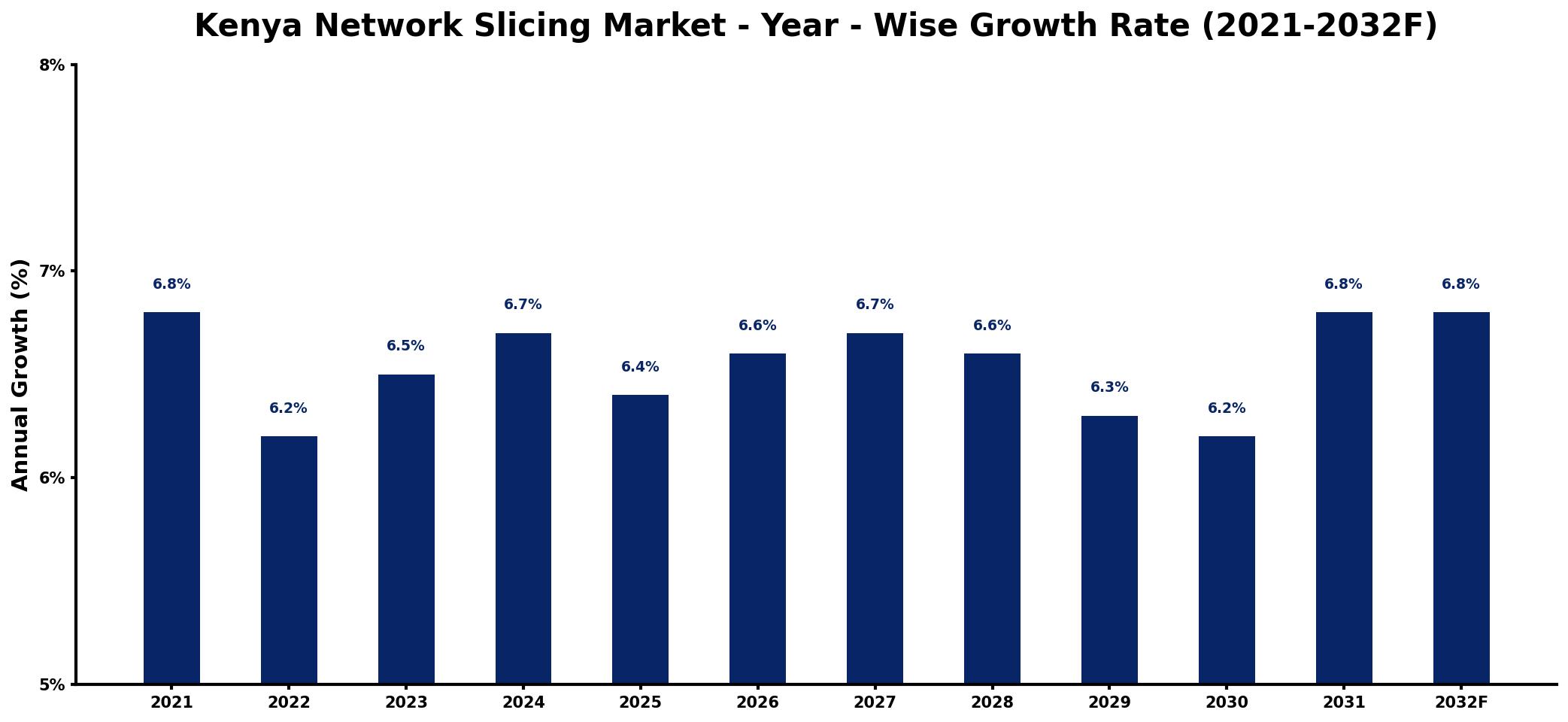
The table below presents the year‑wise growth rates along with the key drivers influencing the market
| Year | Growth Rate | Major Drivers |
| 2021 | 6.8% | Increased investment in technology |
| 2022 | 6.2% | Growing demand for digital services |
| 2023 | 6.5% | Expansion of mobile infrastructure |
| 2024 | 6.7% | Rising adoption of IoT solutions |
| 2025 | 6.4% | Increased focus on automation |
| 2026 | 6.6% | Growth in cloud service utilization |
| 2027 | 6.7% | Surge in smart city projects |
| 2028 | 6.6% | Higher demand for 5G applications |
| 2029 | 6.3% | Investment in telecommunications upgrades |
| 2030 | 6.2% | increased overall sector activity |
| 2031 | 6.8% | Increased interest in digital transformation |
| 2032 | 6.8% | Growing need for enhanced security |
Note: Market size estimations and growth projections presented in this report are based on 6Wresearch's proprietary forecasting methodology, utilizing the latest available industry data, government publications, and primary research inputs.
Kenya Network Slicing Market Synopsis
The demand for customized network services in Kenya is intensifying, particularly as businesses seek to leverage the unique capabilities of 5G technology. This urgency is driven by various sectors, including healthcare and transportation, which require high-performance, reliable networks to support innovative applications. Coupled with ongoing expansions in telecom infrastructure, the Kenya Network Slicing Market is set for significant growth.
Despite the exciting prospects, the market faces hurdles such as the steep initial investments required for upgrading legacy systems. Additionally, the current regulatory framework surrounding network slicing remains underdeveloped, which adds another layer of complexity for telecom operators seeking to implement these cutting-edge solutions.
Kenya Network Slicing Market Key Takeaways
- The growing need for customized network solutions across multiple sectors drives market growth.
- 5G technology is the primary enabler of network slicing adoption in Kenya.
- Initial investment and regulatory uncertainties pose significant challenges to market entry.
- Demand for advanced training programs is increasing to equip stakeholders with the necessary expertise.
- Telecom infrastructure expansion is crucial to support the burgeoning network slicing market.
Evaluation of Restraints in Kenya Network Slicing Market
The primary restraint facing the Kenya Network Slicing Market is the intricate nature of network slicing technology itself. Its deployment requires considerable initial investments in both technology and infrastructure, posing a barrier for smaller telecom operators. Moreover, a lack of in-depth technical knowledge among industry stakeholders complicates implementation efforts. The nascent regulatory environment also presents uncertainty, as policies have yet to fully adapt to the complexities and opportunities offered by network slicing, further stalling potential growth.
Kenya Network Slicing Market Trends
Emerging trends in the Kenya Network Slicing Market reflect a growing reliance on virtualized network solutions tailored to specific applications. Enhanced capabilities, such as increased bandwidth and low-latency communication, are being prioritized to meet the demands of businesses in sectors such as logistics and smart cities. Additionally, the shift toward automation and data analytics in network management is transforming how telecom operators view network slicing, leading to more strategic investment decisions.
Kenya Network Slicing Market Opportunities
With the evolution of 5G technology, significant growth opportunities exist within the Kenya Network Slicing Market. Companies are increasingly looking for ways to optimize network resources for various applications, from real-time data processing in smart manufacturing to enhancing user experiences in augmented reality. These opportunities are further complemented by public and private sector partnerships aimed at improving telecommunications infrastructure, which could pave the way for innovative service offerings.
Government Initiatives in the Kenya Network Slicing Market
The Kenyan government is actively promoting the expansion of digital infrastructure as part of its Vision 2030 initiative. This includes public spending on telecom infrastructure improvements and digital literacy programs. While specific policies on network slicing are still being developed, the government is encouraging public-private partnerships to facilitate the implementation of advanced telecommunications solutions, thereby laying a foundation for the growth of the network slicing market.
Future Insights of the Kenya Network Slicing Market
Looking ahead to 2026-2032, the Kenya Network Slicing Market is poised to benefit from advancements in 5G technologies and an increasing demand for tailored network services. As the regulatory landscape evolves and technical expertise within the industry develops, operators will find themselves in a stronger position to leverage network slicing. This will enable not just a wider array of services but also a more efficient allocation of resources, ultimately leading to improved customer satisfaction and increased market competitiveness.
Kenya Network Slicing Market Latest Developments (2025 - 2026)
In recent months, the Kenyan telecommunications sector has seen various initiatives aimed at enhancing network infrastructure to support network slicing. There has been a concerted effort from both public and private entities to conduct pilot projects that explore the full capabilities of this technology. These developments signify a growing interest and willingness to invest in advanced telecommunications solutions, with a focus on improving service delivery across multiple applications.
Kenya Network Slicing Market - Key Attractiveness of the Report
- 10 Years of Market Numbers
- Historical Data Starting from 2022 to 2025
- Base Year: 2025
- Forecast Data until 2032
- Key Performance Indicators Impacting the Market
- Major Upcoming Developments and Projects
Key Highlights of the Report:
- Kenya Network Slicing Market Outlook
- Market Size of Kenya Network Slicing Market, 2025
- Forecast of Kenya Network Slicing Market, 2032
- Historical Data and Forecast of Kenya Network Slicing Revenues & Volume for the Period 2022-2032F
- Kenya Network Slicing Market Trend Evolution
- Kenya Network Slicing Market Drivers and Challenges
- Kenya Network Slicing Price Trends
- Kenya Network Slicing Porter's Five Forces
- Kenya Network Slicing Industry Life Cycle
- Historical Data and Forecast of Kenya Network Slicing Market Revenues & Volume By Component for the Period 2022-2032F
- Historical Data and Forecast of Kenya Network Slicing Market Revenues & Volume By Solution for the Period 2022-2032F
- Historical Data and Forecast of Kenya Network Slicing Market Revenues & Volume By Services (Professional & Managed) for the Period 2022-2032F
- Historical Data and Forecast of Kenya Network Slicing Market Revenues & Volume By End User for the Period 2022-2032F
- Historical Data and Forecast of Kenya Network Slicing Market Revenues & Volume By Telecom Operators for the Period 2022-2032F
- Historical Data and Forecast of Kenya Network Slicing Market Revenues & Volume By Enterprises for the Period 2022-2032F
- Historical Data and Forecast of Kenya Network Slicing Market Revenues & Volume By Application for the Period 2022-2032F
- Historical Data and Forecast of Kenya Network Slicing Market Revenues & Volume By Manufacturing for the Period 2022-2032F
- Historical Data and Forecast of Kenya Network Slicing Market Revenues & Volume By Government for the Period 2022-2032F
- Historical Data and Forecast of Kenya Network Slicing Market Revenues & Volume By Automotive for the Period 2022-2032F
- Historical Data and Forecast of Kenya Network Slicing Market Revenues & Volume By Media and Entertainment for the Period 2022-2032F
- Kenya Network Slicing Import Export Trade Statistics
- Market Opportunity Assessment By Component
- Market Opportunity Assessment By End User
- Market Opportunity Assessment By Application
- Kenya Network Slicing Top Companies Market Share
- Kenya Network Slicing Competitive Benchmarking By Technical and Operational Parameters
- Kenya Network Slicing Company Profiles
- Kenya Network Slicing Key Strategic Recommendations






































