Kenya Organic Personal Care And Cosmetic Products Market Size, Share & Growth Rate
The Kenya Organic Personal Care And Cosmetic Products Market was estimated at USD 182 Million in 2025 and is projected to reach USD 254 Million by 2032, growing at a CAGR of 4.9% from 2026 to 2032. This growth trajectory reflects a paradigm shift as consumers increasingly prioritize health and sustainability in their beauty choices. The rise in awareness around the benefits of organic ingredients, coupled with the influence of lifestyle trends and social media, is fuelling a robust demand for natural products in Kenya's vibrant beauty sector.
Kenya Organic Personal Care And Cosmetic Products Market Year-wise Growth Rate and Key Drivers
This graph highlights how the Kenya Organic Personal Care And Cosmetic Products Market has steadily grown over the years, supported by major growth factors.
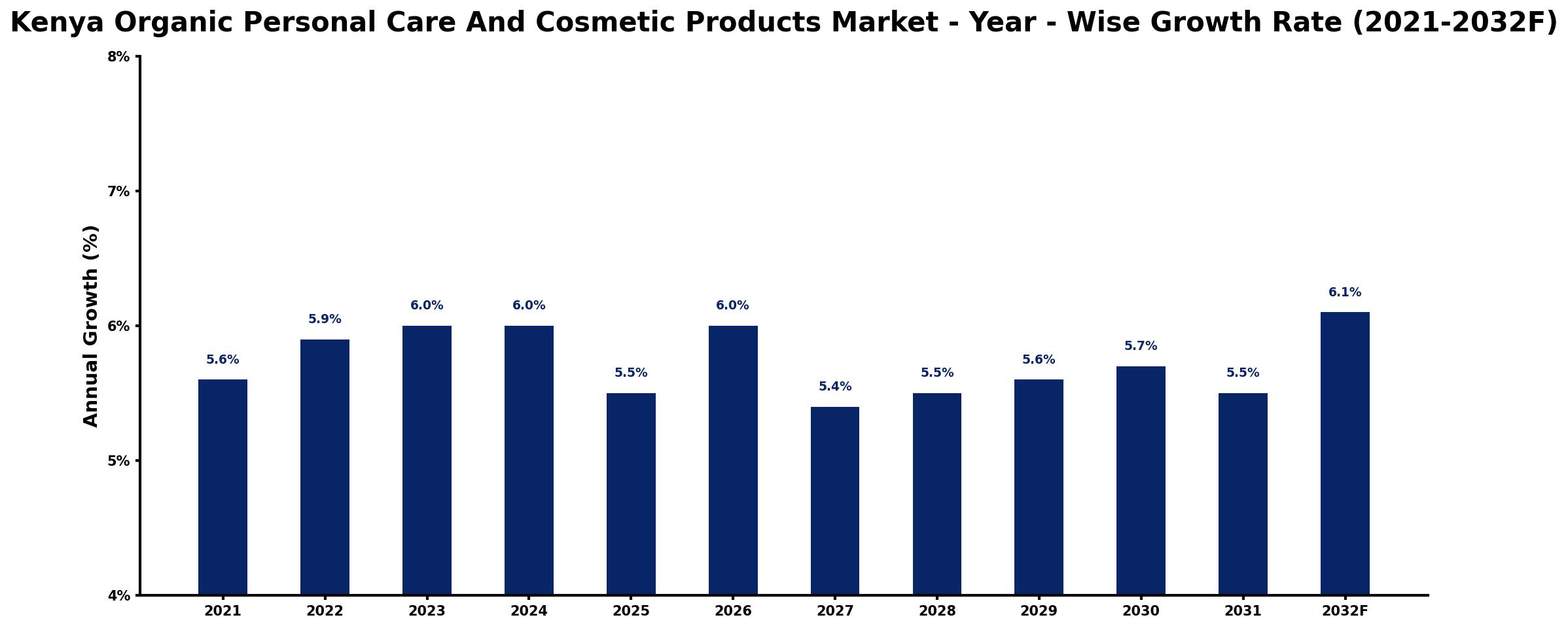
The table below presents the year‑wise growth rates along with the key drivers influencing the market
| Year | Growth Rate | Major Drivers |
| 2021 | 5.6% | Rise in health consciousness |
| 2022 | 5.9% | Growth in e-commerce platforms |
| 2023 | 6.0% | Expansion of retail distribution |
| 2024 | 6.0% | Increase in sustainable investments |
| 2025 | 5.5% | Shift towards natural ingredients |
| 2026 | 6.0% | Surge in consumer awareness |
| 2027 | 5.4% | Development of local brands |
| 2028 | 5.5% | Innovation in packaging solutions |
| 2029 | 5.6% | Rising popularity of wellness |
| 2030 | 5.7% | Enhancement of regulatory frameworks |
| 2031 | 5.5% | Emergence of new demographics |
| 2032 | 6.1% | Strengthening of export markets |
Note: Market size estimations and growth projections presented in this report are based on 6Wresearch's proprietary forecasting methodology, utilizing the latest available industry data, government publications, and primary research inputs.
Kenya Organic Personal Care And Cosmetic Products Market Synopsis
In Kenya, the organic personal care and cosmetic products market is characterized by a burgeoning interest in products that are free from harmful chemicals. A notable increase in consumer demand for skincare items that offer natural ingredients is reshaping the product offerings from local manufacturers. Additionally, there is a growing trend toward sustainable packaging solutions, reflecting a broader commitment to environmental responsibility among consumers.
Despite the rising interest, many local producers are challenged by high production costs associated with sourcing organic raw materials. This often results in a pricing structure that may alienate a significant portion of the consumer base, thus creating a pressing need for effective educational campaigns to inform consumers about the long-term benefits of organic personal care products.
Kenya Organic Personal Care And Cosmetic Products Market Key Takeaways
- Growing awareness of health and environmental benefits propels demand for organic personal care products.
- Higher production costs of organic ingredients present a barrier to widespread consumer adoption.
- Regulatory challenges around organic certification affect market trust and credibility.
- Sustainable packaging is becoming a crucial factor in consumer purchasing decisions.
- Social media and lifestyle trends significantly influence consumer preferences in the beauty market.
Evaluation of Restraints in Kenya Organic Personal Care And Cosmetic Products Market
The Kenya Organic Personal Care And Cosmetic Products Market is not without its challenges. High production costs stemming from the sourcing of organic raw materials limit accessibility for many consumers, making organic products a premium choice rather than a standard offering. Furthermore, a lack of consumer education surrounding the benefits of organic alternatives results in lower demand when compared to conventional products. Compounded by regulatory complexities in organic certification, these factors inhibit the potential growth of this sector, requiring a strategic approach to market development.
Kenya Organic Personal Care And Cosmetic Products Market Trends
Current trends in the Kenya Organic Personal Care And Cosmetic Products Market indicate a shift towards transparency and authenticity. Consumers are increasingly seeking brands that provide clear information regarding ingredient sourcing and manufacturing processes. Additionally, the rise of online retailing has empowered consumers to explore a diverse range of organic beauty products, further enhancing market dynamics. Collaborations between brands and local farmers are also becoming prevalent, promoting sustainable agricultural practices and boosting local economies.
Kenya Organic Personal Care And Cosmetic Products Market Opportunities
Opportunities within the Kenya Organic Personal Care And Cosmetic Products Market are ripe for exploration. Expanding educational initiatives can bridge the gap in consumer knowledge, fostering a more robust demand for organic products. Additionally, leveraging e-commerce platforms can significantly enhance market reach, allowing brands to connect with a broader audience. Innovating product offerings, such as gender-neutral cosmetics and skincare lines for specific demographics, also presents a unique avenue for growth.
Government Initiatives in the Kenya Organic Personal Care And Cosmetic Products Market
The Kenyan government recognizes the potential of the organic personal care sector and has initiated various programs to bolster growth. Public investments in agricultural development, aimed at increasing the availability of organic raw materials, are being prioritized. Moreover, government agencies are working towards establishing regulatory frameworks that simplify the organic certification process, thus enhancing consumer confidence and market credibility. These initiatives are designed to create a favorable environment for both local producers and consumers.
Future Insights of the Kenya Organic Personal Care And Cosmetic Products Market
Looking forward to the period between 2026 and 2032, the Kenya Organic Personal Care And Cosmetic Products Market is poised for substantial growth. As consumer preferences continue to evolve towards natural and sustainable choices, brands that effectively communicate their commitment to quality and sustainability will likely thrive. Furthermore, advancements in technology and production methods are expected to lower costs, making organic products more accessible to a wider audience. With increasing government support and community engagement, the market is set to flourish.
Kenya Organic Personal Care And Cosmetic Products Market Latest Developments (2025 - 2026)
Recent developments in the Kenya Organic Personal Care And Cosmetic Products Market highlight a surge in innovative product launches. Local companies are increasingly focusing on developing unique formulations that cater to the specific skin types and concerns of Kenyan consumers. Additionally, partnerships between producers and environmental organizations are becoming more common, driving sustainability efforts and enhancing brand credibility. Consumer engagement through social media campaigns has also increased, facilitating a deeper connection between brands and their target markets.
Kenya Organic Personal Care And Cosmetic Products Market - Key Attractiveness of the Report
- 10 Years of Market Numbers
- Historical Data Starting from 2022 to 2025
- Base Year: 2025
- Forecast Data until 2032
- Key Performance Indicators Impacting the Market
- Major Upcoming Developments and Projects
Key Highlights of the Report:
- Kenya Organic Personal Care And Cosmetic Products Market Outlook
- Market Size of Kenya Organic Personal Care And Cosmetic Products Market, 2025
- Forecast of Kenya Organic Personal Care And Cosmetic Products Market, 2032
- Historical Data and Forecast of Kenya Organic Personal Care And Cosmetic Products Revenues & Volume for the Period 2022-2032F
- Kenya Organic Personal Care And Cosmetic Products Market Trend Evolution
- Kenya Organic Personal Care And Cosmetic Products Market Drivers and Challenges
- Kenya Organic Personal Care And Cosmetic Products Price Trends
- Kenya Organic Personal Care And Cosmetic Products Porter's Five Forces
- Kenya Organic Personal Care And Cosmetic Products Industry Life Cycle
- Historical Data and Forecast of Kenya Organic Personal Care And Cosmetic Products Market Revenues & Volume By Product Type for the Period 2022-2032F
- Historical Data and Forecast of Kenya Organic Personal Care And Cosmetic Products Market Revenues & Volume By Skin Care for the Period 2022-2032F
- Historical Data and Forecast of Kenya Organic Personal Care And Cosmetic Products Market Revenues & Volume By Hair Care for the Period 2022-2032F
- Historical Data and Forecast of Kenya Organic Personal Care And Cosmetic Products Market Revenues & Volume By Oral Care for the Period 2022-2032F
- Historical Data and Forecast of Kenya Organic Personal Care And Cosmetic Products Market Revenues & Volume By Makeup and Color Cosmetics for the Period 2022-2032F
- Historical Data and Forecast of Kenya Organic Personal Care And Cosmetic Products Market Revenues & Volume By Others for the Period 2022-2032F
- Historical Data and Forecast of Kenya Organic Personal Care And Cosmetic Products Market Revenues & Volume By Consumer for the Period 2022-2032F
- Historical Data and Forecast of Kenya Organic Personal Care And Cosmetic Products Market Revenues & Volume By Men for the Period 2022-2032F
- Historical Data and Forecast of Kenya Organic Personal Care And Cosmetic Products Market Revenues & Volume By Women for the Period 2022-2032F
- Historical Data and Forecast of Kenya Organic Personal Care And Cosmetic Products Market Revenues & Volume By Distribution channel for the Period 2022-2032F
- Historical Data and Forecast of Kenya Organic Personal Care And Cosmetic Products Market Revenues & Volume By Supermarkets and Hypermarkets for the Period 2022-2032F
- Historical Data and Forecast of Kenya Organic Personal Care And Cosmetic Products Market Revenues & Volume By Departmental stores for the Period 2022-2032F
- Historical Data and Forecast of Kenya Organic Personal Care And Cosmetic Products Market Revenues & Volume By Drug Stores for the Period 2022-2032F
- Historical Data and Forecast of Kenya Organic Personal Care And Cosmetic Products Market Revenues & Volume By Brand Outlets for the Period 2022-2032F
- Historical Data and Forecast of Kenya Organic Personal Care And Cosmetic Products Market Revenues & Volume By Online Sales for the Period 2022-2032F
- Historical Data and Forecast of Kenya Organic Personal Care And Cosmetic Products Market Revenues & Volume By Others for the Period 2022-2032F
- Kenya Organic Personal Care And Cosmetic Products Import Export Trade Statistics
- Market Opportunity Assessment By Product Type
- Market Opportunity Assessment By Consumer
- Market Opportunity Assessment By Distribution channel
- Kenya Organic Personal Care And Cosmetic Products Top Companies Market Share
- Kenya Organic Personal Care And Cosmetic Products Competitive Benchmarking By Technical and Operational Parameters
- Kenya Organic Personal Care And Cosmetic Products Company Profiles
- Kenya Organic Personal Care And Cosmetic Products Key Strategic Recommendations






































