Kenya Orphan Drugs Market Size, Share & Growth Rate
The Kenya Orphan Drugs Market was estimated at USD 266 Million in 2025 and is projected to reach USD 366 Million by 2032, growing at a CAGR of 4.7% from 2026 to 2032. This growth trajectory is largely driven by heightened awareness regarding rare diseases and the increasing demand for specialized treatments. Additionally, government initiatives aimed at improving healthcare infrastructure play a critical role in facilitating access to orphan drugs across the country.
Kenya Orphan Drugs Market Year-wise Growth Rate and Key Drivers
This graph highlights how the Kenya Orphan Drugs Market has steadily grown over the years, supported by major growth factors.
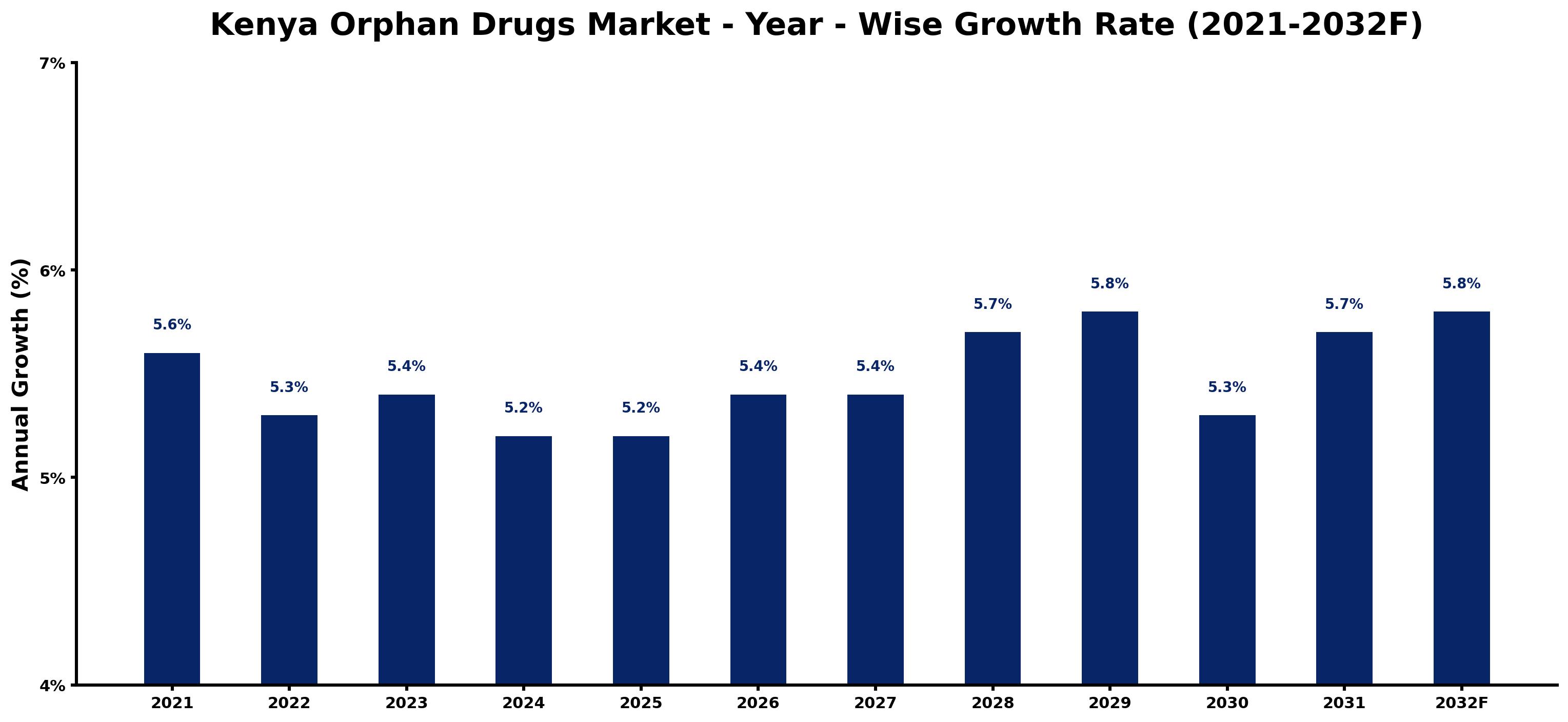
The table below presents the year‑wise growth rates along with the key drivers influencing the market
| Year | Growth Rate | Major Drivers |
| 2021 | 5.6% | Rapid growth in telecom and data center sectors |
| 2022 | 5.3% | Growing urbanization and commercial development |
| 2023 | 5.4% | Growing urbanization and commercial development |
| 2024 | 5.2% | Expansion of manufacturing activities |
| 2025 | 5.2% | Expansion of commercial construction activities |
| 2026 | 5.4% | Expansion of commercial construction activities |
| 2027 | 5.4% | Expansion of manufacturing activities |
| 2028 | 5.7% | Increasing industrial automation investments |
| 2029 | 5.8% | Rising electricity demand across industries |
| 2030 | 5.3% | Expansion of manufacturing activities |
| 2031 | 5.7% | Rapid growth in telecom and data center sectors |
| 2032 | 5.8% | Increasing adoption of advanced technologies |
Note - Market size estimations and growth projections presented in this report are based on 6Wresearch’s advanced forecasting approach, validated with industry datasets as of June 2026.
Kenya Orphan Drugs Market Synopsis
Recently, the Kenya orphan drugs market has seen significant momentum fueled by collaborations between pharmaceutical companies and healthcare institutions. However, as the market moves forward, the focus will shift toward enhancing regulatory frameworks and addressing accessibility issues to ensure that those in need of orphan drugs can receive timely treatment.
As the awareness of rare diseases continues to grow, the urgency for effective orphan drug solutions becomes increasingly evident. The sector is on the cusp of transformation, with the potential to leverage government support and private partnerships to foster innovation and expand market reach.
Kenya Orphan Drugs Market Key Takeaways
- The market is expected to grow at a CAGR of 4.7% between 2026 and 2032.
- Increased awareness and government support are significant growth drivers.
- Collaboration between pharmaceutical firms and research institutions is on the rise.
- Regulatory frameworks are evolving to expedite orphan drug approvals.
- High costs and limited budgets still pose challenges to market expansion.
Evaluation of Restraints in Kenya Orphan Drugs Market
Several factors continue to restrain the growth of the Kenya orphan drugs market. A notable constraint is the limited awareness and understanding of rare diseases among healthcare providers, which often leads to underdiagnosis and delayed treatment for patients. Additionally, the high costs associated with orphan drugs remain a barrier, as these medications can be prohibitively expensive and are frequently not covered by insurance or government healthcare initiatives. Lastly, lengthy regulatory approval processes discourage pharmaceutical companies from investing in orphan drugs, particularly for small patient populations. Addressing these issues requires a concerted effort to enhance education, increase access to affordable treatments, and encourage supportive policies that stimulate research and development.
Kenya Orphan Drugs Market Trends
Current trends indicate a robust push towards partnerships and collaborations focused on developing orphan drugs tailored to the unique needs of the Kenyan population. The rising prevalence of rare diseases is driving demand for innovative treatment options that address unmet medical needs. Furthermore, the implementation of more efficient regulatory frameworks is accelerating the approval process for orphan drugs, allowing for quicker access to these critical treatments.
Kenya Orphan Drugs Market Opportunities
The Kenya orphan drugs market is ripe with investment opportunities, particularly in light of the growing demand for specialized medications. Pharmaceutical companies have a unique chance to establish a presence in the market by developing targeted therapies that cater specifically to rare diseases prevalent in the region. Collaborating with local healthcare providers and distributors can further enhance market entry strategies, as these partnerships may provide critical insights into local dynamics and access points.
Government Initiatives in the Kenya Orphan Drugs Market
The Kenyan government has demonstrated a commitment to supporting the orphan drugs market through various initiatives. Policies such as the National Health Insurance Fund (NHIF) provide coverage for orphan drugs under specialized services, ensuring that access is improved for affected individuals. Additionally, the Pharmacy and Poisons Board plays a crucial role in regulating the registration and importation of orphan drugs, maintaining safety and efficacy standards. Tax incentives and waivers further encourage pharmaceutical companies to invest in the production and distribution of these crucial medications.
Future Insights of the Kenya Orphan Drugs Market
Looking ahead to 2026-2032, the Kenya orphan drugs market is anticipated to flourish as awareness around rare diseases increases and healthcare infrastructure continues to improve. The government's proactive approach to enhancing access to orphan drugs is expected to foster innovation in drug development, particularly through partnerships with research institutions. However, ongoing challenges, including high costs and regulatory complexities, will need to be addressed to fully realize the market's potential. In summary, the future appears promising as stakeholders come together to tackle unmet medical needs.
Kenya Orphan Drugs Market Latest Developments (May 2025 - June 2026)
Recent developments in the Kenya orphan drugs market reflect a growing focus on partnerships and innovation. Numerous collaborations between local pharmaceutical companies and international research institutions have emerged, aimed at developing new therapies for rare diseases. Additionally, increased advocacy for policy improvements is gaining traction, with stakeholders pushing for more streamlined regulatory processes that can facilitate quicker access to essential treatments.
Kenya Orphan Drugs Market - Key Attractiveness of the Report
- 10 Years of Market Numbers
- Historical Data Starting from 2022 to 2025
- Base Year: 2025
- Forecast Data until 2032
- Key Performance Indicators Impacting the Market
- Major Upcoming Developments and Projects
Key Highlights of the Report:
- Kenya Orphan Drugs Market Outlook
- Market Size of Kenya Orphan Drugs Market, 2025
- Forecast of Kenya Orphan Drugs Market, 2032
- Historical Data and Forecast of Kenya Orphan Drugs Revenues & Volume for the Period 2022-2032F
- Kenya Orphan Drugs Market Trend Evolution
- Kenya Orphan Drugs Market Drivers and Challenges
- Kenya Orphan Drugs Price Trends
- Kenya Orphan Drugs Porter's Five Forces
- Kenya Orphan Drugs Industry Life Cycle
- Historical Data and Forecast of Kenya Orphan Drugs Market Revenues & Volume By Drugs for the Period 2022-2032F
- Historical Data and Forecast of Kenya Orphan Drugs Market Revenues & Volume By Revlimid for the Period 2022-2032F
- Historical Data and Forecast of Kenya Orphan Drugs Market Revenues & Volume By Rituxan for the Period 2022-2032F
- Historical Data and Forecast of Kenya Orphan Drugs Market Revenues & Volume By Opdivo for the Period 2022-2032F
- Historical Data and Forecast of Kenya Orphan Drugs Market Revenues & Volume By Keytruda for the Period 2022-2032F
- Historical Data and Forecast of Kenya Orphan Drugs Market Revenues & Volume By Imbruvica for the Period 2022-2032F
- Historical Data and Forecast of Kenya Orphan Drugs Market Revenues & Volume By Soliris for the Period 2022-2032F
- Historical Data and Forecast of Kenya Orphan Drugs Market Revenues & Volume By Other Orphan Drugs for the Period 2022-2032F
- Historical Data and Forecast of Kenya Orphan Drugs Market Revenues & Volume By Drug Type for the Period 2022-2032F
- Historical Data and Forecast of Kenya Orphan Drugs Market Revenues & Volume By Biologics for the Period 2022-2032F
- Historical Data and Forecast of Kenya Orphan Drugs Market Revenues & Volume By Non-Biologics for the Period 2022-2032F
- Historical Data and Forecast of Kenya Orphan Drugs Market Revenues & Volume By Therapy Class for the Period 2022-2032F
- Historical Data and Forecast of Kenya Orphan Drugs Market Revenues & Volume By Oncology for the Period 2022-2032F
- Historical Data and Forecast of Kenya Orphan Drugs Market Revenues & Volume By Blood for the Period 2022-2032F
- Historical Data and Forecast of Kenya Orphan Drugs Market Revenues & Volume By Endocrine for the Period 2022-2032F
- Historical Data and Forecast of Kenya Orphan Drugs Market Revenues & Volume By Central Nervous Systems for the Period 2022-2032F
- Historical Data and Forecast of Kenya Orphan Drugs Market Revenues & Volume By Cardiovascular for the Period 2022-2032F
- Historical Data and Forecast of Kenya Orphan Drugs Market Revenues & Volume By Respiratory for the Period 2022-2032F
- Kenya Orphan Drugs Import Export Trade Statistics
- Market Opportunity Assessment By Drugs
- Market Opportunity Assessment By Drug Type
- Market Opportunity Assessment By Therapy Class
- Kenya Orphan Drugs Top Companies Market Share
- Kenya Orphan Drugs Competitive Benchmarking By Technical and Operational Parameters
- Kenya Orphan Drugs Company Profiles
- Kenya Orphan Drugs Key Strategic Recommendations






































