Kenya Plumbing Fixtures Market Size, Share & Growth Rate
The Kenya Plumbing Fixtures Market was estimated at USD 496 Million in 2025 and is projected to reach USD 667 Million by 2032, growing at a CAGR of 4.3% from 2026 to 2032. This growth is primarily driven by the rising demand for modern and efficient plumbing solutions in response to the expanding construction and hospitality sectors. Additionally, the increasing focus on sustainability and water conservation is fostering the adoption of water-efficient fixtures, further enhancing market prospects.
Kenya Plumbing Fixtures Market Year-wise Growth Rate and Key Drivers
This graph highlights how the Kenya Plumbing Fixtures Market has steadily grown over the years, supported by major growth factors.
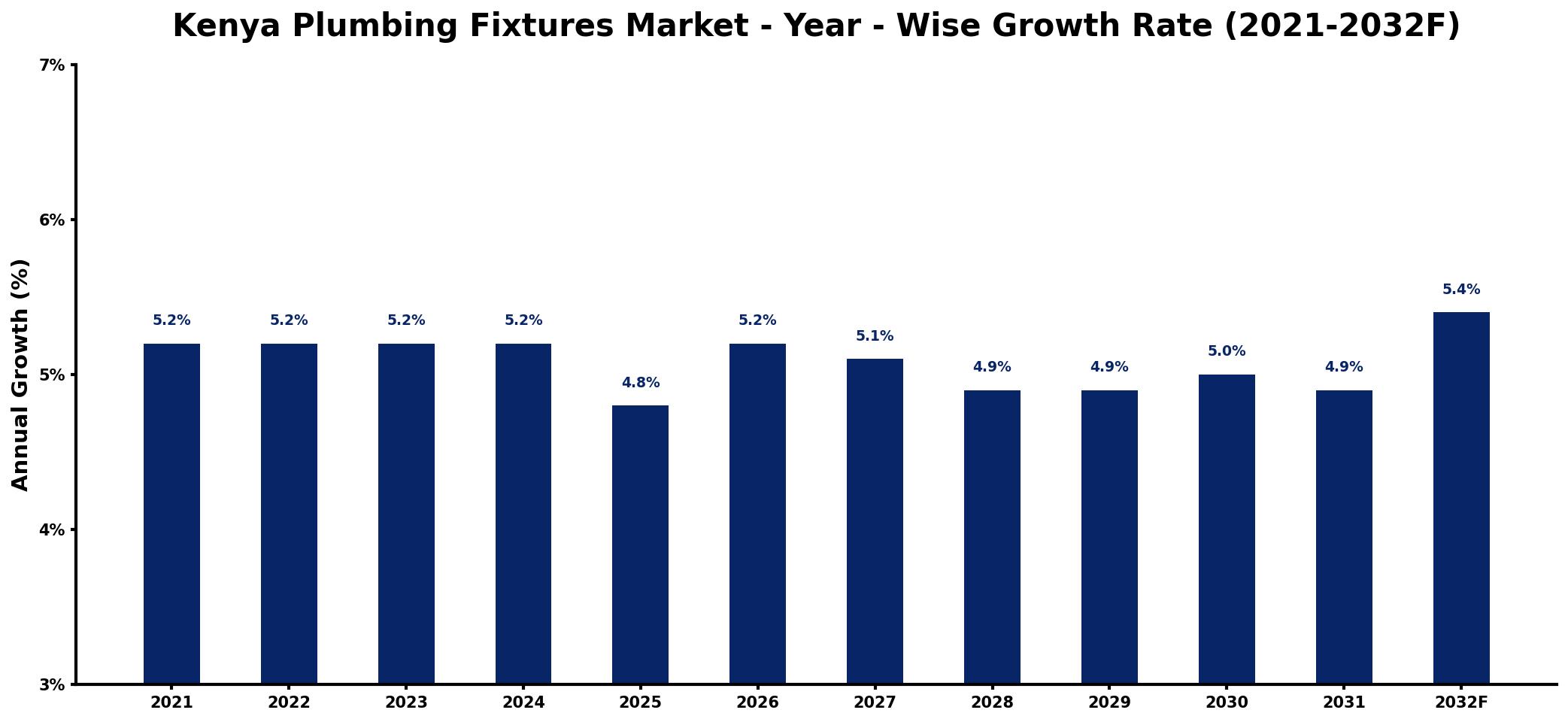
The table below presents the year‑wise growth rates along with the key drivers influencing the market
| Year | Growth Rate | Major Drivers |
| 2021 | 5.2% | Increase in housing construction projects |
| 2022 | 5.2% | Rise in urban population density |
| 2023 | 5.2% | Government investment in infrastructure |
| 2024 | 5.2% | Growing awareness of water conservation |
| 2025 | 4.8% | Shift towards sustainable building practices |
| 2026 | 5.2% | Expansion of residential developments |
| 2027 | 5.1% | Increased focus on health standards |
| 2028 | 4.9% | Advancements in smart technology integration |
| 2029 | 4.9% | Growth in commercial property investments |
| 2030 | 5.0% | Rising demand for eco-friendly solutions |
| 2031 | 4.9% | Enhanced distribution network efficiency |
| 2032 | 5.4% | improved raw material availability |
Note: Market size estimations and growth projections presented in this report are based on 6Wresearch's proprietary forecasting methodology, utilizing the latest available industry data, government publications, and primary research inputs.
Kenya Plumbing Fixtures Market Synopsis
The Kenya plumbing fixtures market has recently witnessed a surge in momentum, propelled by increased consumer awareness and a burgeoning middle class that values quality and aesthetics. However, as the market grows, it grapples with challenges such as high production costs and a heavy reliance on imports, which create pricing pressures.
As the sector transitions toward modern plumbing technologies, the focus on smart fixtures and water-saving devices is expected to reshape the competitive landscape. Despite challenges, the market is poised for expansion, driven by ongoing construction activities and a growing preference for upscale bathroom and kitchen renovations.
Kenya Plumbing Fixtures Market Key Takeaways
- The market is expected to grow steadily, fueled by urbanization and a rising demand for aesthetic improvements in bathrooms and kitchens.
- Remodeling activities in residential and commercial sectors are significant contributors to market growth.
- The increasing emphasis on sustainability is driving demand for water-efficient plumbing fixtures.
- Local manufacturing faces challenges from high production costs and competition from imported products.
- Government regulations concerning water conservation are impacting market dynamics and product development.
Evaluation of Restraints in Kenya Plumbing Fixtures Market
The Kenya plumbing fixtures market is confronted with several restraints that impede its growth. High costs associated with raw materials and manufacturing processes are among the most pressing challenges. Additionally, the market's heavy reliance on imports can complicate supply chain management, particularly in a landscape where price sensitivity is prevalent. The lack of adequate local manufacturing capabilities limits competition and innovation, while inconsistent regulatory standards create uncertainty for manufacturers and consumers alike. Furthermore, consumer awareness regarding the advantages of advanced plumbing solutions remains limited, which can stifle demand.
Kenya Plumbing Fixtures Market Trends
Several key trends are currently shaping the Kenya plumbing fixtures market. Notably, there is a marked shift towards smart plumbing solutions that integrate technology for enhanced user experience and efficiency. The rise of eco-friendly products, designed to minimize water wastage, is also gaining traction in response to growing environmental concerns. Additionally, the expansion of the hospitality sector is influencing the demand for high-quality fixtures, as hotels and restaurants aim to offer luxurious experiences to their clientele.
Kenya Plumbing Fixtures Market Opportunities
Opportunities for growth in the Kenya plumbing fixtures market abound, particularly in the context of urban development and infrastructure projects. Investments in residential housing, commercial buildings, and public facilities are expected to boost demand for advanced plumbing solutions. Moreover, increased awareness of water conservation practices presents an avenue for companies to innovate and market products that align with these values. There is also significant potential for enhancing local manufacturing capabilities, which could reduce reliance on imports and foster competitive pricing.
Government Initiatives in the Kenya Plumbing Fixtures Market
The Kenyan government is actively promoting initiatives aimed at improving water conservation and sustainable practices in the plumbing sector. Public spending on infrastructure development and housing projects often includes provisions for advanced plumbing fixtures. Additionally, regulatory frameworks are evolving to encourage the adoption of environmentally friendly products, which benefits both manufacturers and consumers. Programs aimed at enhancing local manufacturing capabilities are also in place to support industry growth.
Future Insights of the Kenya Plumbing Fixtures Market
Looking ahead to 2026-2032, the Kenya plumbing fixtures market is set to evolve significantly. As the economy continues to grow and the middle class expands, demand for high-quality, aesthetically pleasing fixtures will remain robust. Technological advancements in plumbing solutions, particularly in smart and water-efficient products, are expected to redefine consumer expectations. Moreover, as regulatory pressures increase regarding sustainability, companies will need to adapt to meet these standards while capturing emerging market opportunities.
Kenya Plumbing Fixtures Market Latest Developments (2025 - 2026)
Recent developments in the Kenya plumbing fixtures market indicate a growing emphasis on innovation and sustainability. Manufacturers are increasingly investing in research and development to introduce advanced products that meet contemporary consumer preferences. Additionally, collaborations and partnerships are being formed within the industry to enhance local production capabilities, mitigate supply chain vulnerabilities, and respond effectively to market demands.
Kenya Plumbing Fixtures Market - Key Attractiveness of the Report
- 10 Years of Market Numbers
- Historical Data Starting from 2022 to 2025
- Base Year: 2025
- Forecast Data until 2032
- Key Performance Indicators Impacting the Market
- Major Upcoming Developments and Projects
Key Highlights of the Report:
- Kenya Plumbing Fixtures Market Outlook
- Market Size of Kenya Plumbing Fixtures Market, 2025
- Forecast of Kenya Plumbing Fixtures Market, 2032
- Historical Data and Forecast of Kenya Plumbing Fixtures Revenues & Volume for the Period 2022-2032F
- Kenya Plumbing Fixtures Market Trend Evolution
- Kenya Plumbing Fixtures Market Drivers and Challenges
- Kenya Plumbing Fixtures Price Trends
- Kenya Plumbing Fixtures Porter's Five Forces
- Kenya Plumbing Fixtures Industry Life Cycle
- Historical Data and Forecast of Kenya Plumbing Fixtures Market Revenues & Volume By Product for the Period 2022-2032F
- Historical Data and Forecast of Kenya Plumbing Fixtures Market Revenues & Volume By Bathtub for the Period 2022-2032F
- Historical Data and Forecast of Kenya Plumbing Fixtures Market Revenues & Volume By Sinks for the Period 2022-2032F
- Historical Data and Forecast of Kenya Plumbing Fixtures Market Revenues & Volume By Toilets for the Period 2022-2032F
- Historical Data and Forecast of Kenya Plumbing Fixtures Market Revenues & Volume By Showers for the Period 2022-2032F
- Historical Data and Forecast of Kenya Plumbing Fixtures Market Revenues & Volume By Faucets & Taps for the Period 2022-2032F
- Historical Data and Forecast of Kenya Plumbing Fixtures Market Revenues & Volume By Drains for the Period 2022-2032F
- Historical Data and Forecast of Kenya Plumbing Fixtures Market Revenues & Volume By Others for the Period 2022-2032F
- Historical Data and Forecast of Kenya Plumbing Fixtures Market Revenues & Volume By Deployment for the Period 2022-2032F
- Historical Data and Forecast of Kenya Plumbing Fixtures Market Revenues & Volume By Residential for the Period 2022-2032F
- Historical Data and Forecast of Kenya Plumbing Fixtures Market Revenues & Volume By Commercial for the Period 2022-2032F
- Historical Data and Forecast of Kenya Plumbing Fixtures Market Revenues & Volume By Location for the Period 2022-2032F
- Historical Data and Forecast of Kenya Plumbing Fixtures Market Revenues & Volume By Bathroom for the Period 2022-2032F
- Historical Data and Forecast of Kenya Plumbing Fixtures Market Revenues & Volume By Kitchen for the Period 2022-2032F
- Historical Data and Forecast of Kenya Plumbing Fixtures Market Revenues & Volume By Others for the Period 2022-2032F
- Historical Data and Forecast of Kenya Plumbing Fixtures Market Revenues & Volume By Application for the Period 2022-2032F
- Historical Data and Forecast of Kenya Plumbing Fixtures Market Revenues & Volume By New Construction for the Period 2022-2032F
- Historical Data and Forecast of Kenya Plumbing Fixtures Market Revenues & Volume By Repair & Remodel for the Period 2022-2032F
- Historical Data and Forecast of Kenya Plumbing Fixtures Market Revenues & Volume By Distribution Channel for the Period 2022-2032F
- Historical Data and Forecast of Kenya Plumbing Fixtures Market Revenues & Volume By Online for the Period 2022-2032F
- Historical Data and Forecast of Kenya Plumbing Fixtures Market Revenues & Volume By Offline for the Period 2022-2032F
- Kenya Plumbing Fixtures Import Export Trade Statistics
- Market Opportunity Assessment By Product
- Market Opportunity Assessment By Deployment
- Market Opportunity Assessment By Location
- Market Opportunity Assessment By Application
- Market Opportunity Assessment By Distribution Channel
- Kenya Plumbing Fixtures Top Companies Market Share
- Kenya Plumbing Fixtures Competitive Benchmarking By Technical and Operational Parameters
- Kenya Plumbing Fixtures Company Profiles
- Kenya Plumbing Fixtures Key Strategic Recommendations






































