Kenya Polio Vaccine Market Size, Share & Growth Rate
The Kenya Polio Vaccine Market was estimated at USD 375 Million in 2025 and is projected to reach USD 502 Million by 2032, growing at a CAGR of 4.3% from 2026 to 2032. This growth trajectory is primarily propelled by robust government immunization programs and international health initiatives aimed at eradicating polio. Additionally, increasing funding for vaccination campaigns and partnerships with NGOs are bolstering accessibility and public health awareness across Kenya.
Kenya Polio Vaccine Market Year-wise Growth Rate and Key Drivers
This graph highlights how the Kenya Polio Vaccine Market has steadily grown over the years, supported by major growth factors.
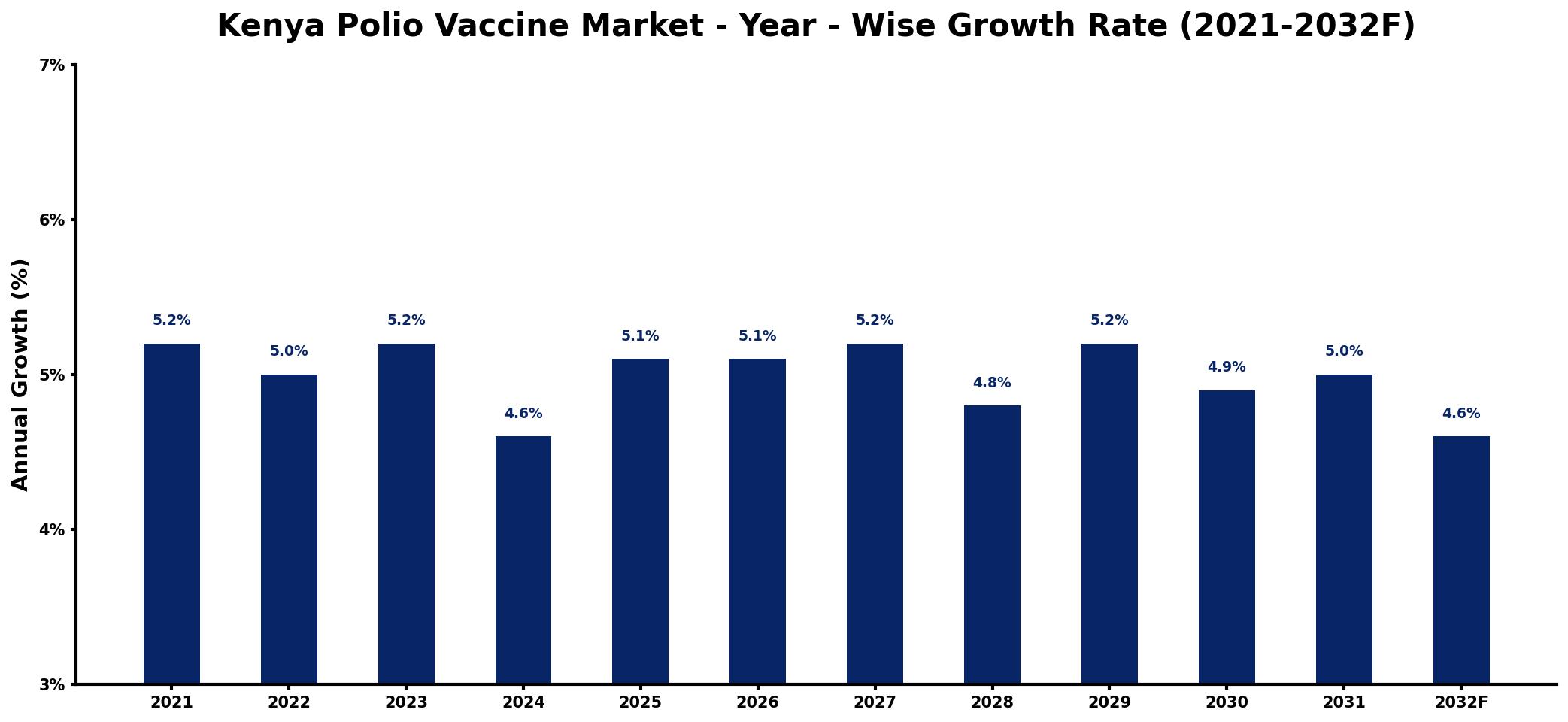
The table below presents the year‑wise growth rates along with the key drivers influencing the market
| Year | Growth Rate | Major Drivers |
| 2021 | 5.2% | Increase in healthcare funding initiatives |
| 2022 | 5.0% | Expansion of immunization outreach programs |
| 2023 | 5.2% | Growing public health awareness campaigns |
| 2024 | 4.6% | Strengthening regional healthcare partnerships |
| 2025 | 5.1% | Rising demand for preventive healthcare |
| 2026 | 5.1% | Investment in healthcare infrastructure improvements |
| 2027 | 5.2% | Enhancing cold chain logistics capabilities |
| 2028 | 4.8% | Boosting community healthcare engagement efforts |
| 2029 | 5.2% | Increased collaboration with NGOs |
| 2030 | 4.9% | Diversification of healthcare service offerings |
| 2031 | 5.0% | Strengthened government policy support |
| 2032 | 4.6% | growing regional consumption patterns |
Note: Market size estimations and growth projections presented in this report are based on 6Wresearch's proprietary forecasting methodology, utilizing the latest available industry data, government publications, and primary research inputs.
Kenya Polio Vaccine Market Synopsis
The Kenya Polio Vaccine Market has shown promising momentum in recent years, driven by concerted efforts to enhance vaccination coverage. However, this growth contrasts with persistent challenges such as public awareness and logistical inefficiencies that threaten future achievements. Looking ahead, the focus will be on overcoming these barriers to improve vaccine uptake and access.
As the landscape shifts, the market is positioned to benefit from increased government and international collaboration. Heightened public health campaigns are expected to elevate awareness, while improvements in distribution channels aim to reach remote populations, ensuring no child is left unprotected against polio.
Kenya Polio Vaccine Market Key Takeaways
- Government immunization programs are central to market growth and vaccine accessibility.
- International health initiatives play a significant role in funding and supporting vaccination drives.
- Logistical challenges in remote areas hinder vaccine distribution and accessibility.
- Public awareness campaigns are crucial for increasing vaccine uptake among populations.
- Partnerships between governments and NGOs are key to addressing infrastructure limitations.
Evaluation of Restraints in Kenya Polio Vaccine Market
Despite the optimistic growth outlook, the Kenya Polio Vaccine Market faces significant restraints that could hinder progress. High production and distribution costs remain a critical barrier, particularly for rural healthcare providers. Additionally, the reliance on international aid creates uncertainty in supply chains and funding continuity. Logistical challenges compounded by inadequate healthcare infrastructure limit vaccine reach, particularly in remote regions. Furthermore, public understanding of the importance of polio vaccination is often lacking, leading to lower uptake rates and coverage. These factors combine to create a complex environment that stakeholders must navigate carefully.
Kenya Polio Vaccine Market Trends
The Kenya Polio Vaccine Market is shaped by emerging trends focused on sustainability and efficiency. The integration of digital technologies in health campaigns is increasingly prevalent, improving data collection and outreach efforts. Mobile vaccination units are becoming more common, designed to bridge gaps in access for remote communities. Additionally, there is a growing emphasis on community engagement to foster trust and understanding of vaccination benefits. Such trends are indicative of a paradigm shift towards more inclusive and effective healthcare delivery.
Kenya Polio Vaccine Market Opportunities
Genuine growth opportunities lie in enhancing public-private partnerships that leverage resources for better vaccine distribution and education. Investments in infrastructure, particularly in underserved areas, can significantly improve vaccine access and coverage rates. Moreover, expanding collaborations with international health organizations could enhance funding and technical expertise, facilitating innovative approaches to vaccination drives. Emphasizing community health initiatives will also foster a proactive approach to public health, ultimately driving the market forward.
Government Initiatives in the Kenya Polio Vaccine Market
The Kenyan government has implemented various initiatives to bolster the polio vaccination effort. Public spending on health has increased, with targeted programs designed to eliminate polio in the country. Collaborative efforts with international organizations and NGOs are vital, providing resources and expertise necessary for successful vaccination campaigns. Additionally, awareness programs aimed at educating the public on the importance of vaccination are becoming a focal point of government policy, reflecting a commitment to eradicating polio.
Future Insights of the Kenya Polio Vaccine Market
Looking ahead to the period from 2026 to 2032, the Kenya Polio Vaccine Market is poised for continued growth, driven by enhanced governmental and international collaboration. The focus on infrastructure improvements will facilitate better vaccine access, particularly in rural areas. Furthermore, ongoing public health campaigns aimed at raising awareness and understanding of vaccination will likely yield higher uptake rates. With a structured strategy addressing logistical challenges and public education, the trajectory for the market appears promising, aligning with global eradication efforts.
Kenya Polio Vaccine Market Latest Developments (2025 - 2026)
Recent developments in the Kenya Polio Vaccine Market have underscored a commitment to enhancing vaccination coverage across the nation. Various public health campaigns have been launched, targeting increased awareness among communities. Additionally, partnerships between government agencies and international health organizations have been strengthened, leading to improved logistics and distribution methods. The emphasis on community engagement has also gained traction, fostering trust in the vaccine and encouraging higher participation rates in immunization drives.
Kenya Polio Vaccine Market - Key Attractiveness of the Report
- 10 Years of Market Numbers
- Historical Data Starting from 2022 to 2025
- Base Year: 2025
- Forecast Data until 2032
- Key Performance Indicators Impacting the Market
- Major Upcoming Developments and Projects
Key Highlights of the Report:
- Kenya Polio Vaccine Market Outlook
- Market Size of Kenya Polio Vaccine Market, 2025
- Forecast of Kenya Polio Vaccine Market, 2032
- Historical Data and Forecast of Kenya Polio Vaccine Revenues & Volume for the Period 2022-2032F
- Kenya Polio Vaccine Market Trend Evolution
- Kenya Polio Vaccine Market Drivers and Challenges
- Kenya Polio Vaccine Price Trends
- Kenya Polio Vaccine Porter's Five Forces
- Kenya Polio Vaccine Industry Life Cycle
- Historical Data and Forecast of Kenya Polio Vaccine Market Revenues & Volume By Type for the Period 2022-2032F
- Historical Data and Forecast of Kenya Polio Vaccine Market Revenues & Volume By Oral Polio Vaccine (OPV) for the Period 2022-2032F
- Historical Data and Forecast of Kenya Polio Vaccine Market Revenues & Volume By Inactivated Poliomyelitis Vaccine (IPV) for the Period 2022-2032F
- Historical Data and Forecast of Kenya Polio Vaccine Market Revenues & Volume By Application for the Period 2022-2032F
- Historical Data and Forecast of Kenya Polio Vaccine Market Revenues & Volume By Public for the Period 2022-2032F
- Historical Data and Forecast of Kenya Polio Vaccine Market Revenues & Volume By Private for the Period 2022-2032F
- Kenya Polio Vaccine Import Export Trade Statistics
- Market Opportunity Assessment By Type
- Market Opportunity Assessment By Application
- Kenya Polio Vaccine Top Companies Market Share
- Kenya Polio Vaccine Competitive Benchmarking By Technical and Operational Parameters
- Kenya Polio Vaccine Company Profiles
- Kenya Polio Vaccine Key Strategic Recommendations






































