Kenya Railway Platform Security Market Size & Growth Rate (2026-2032)
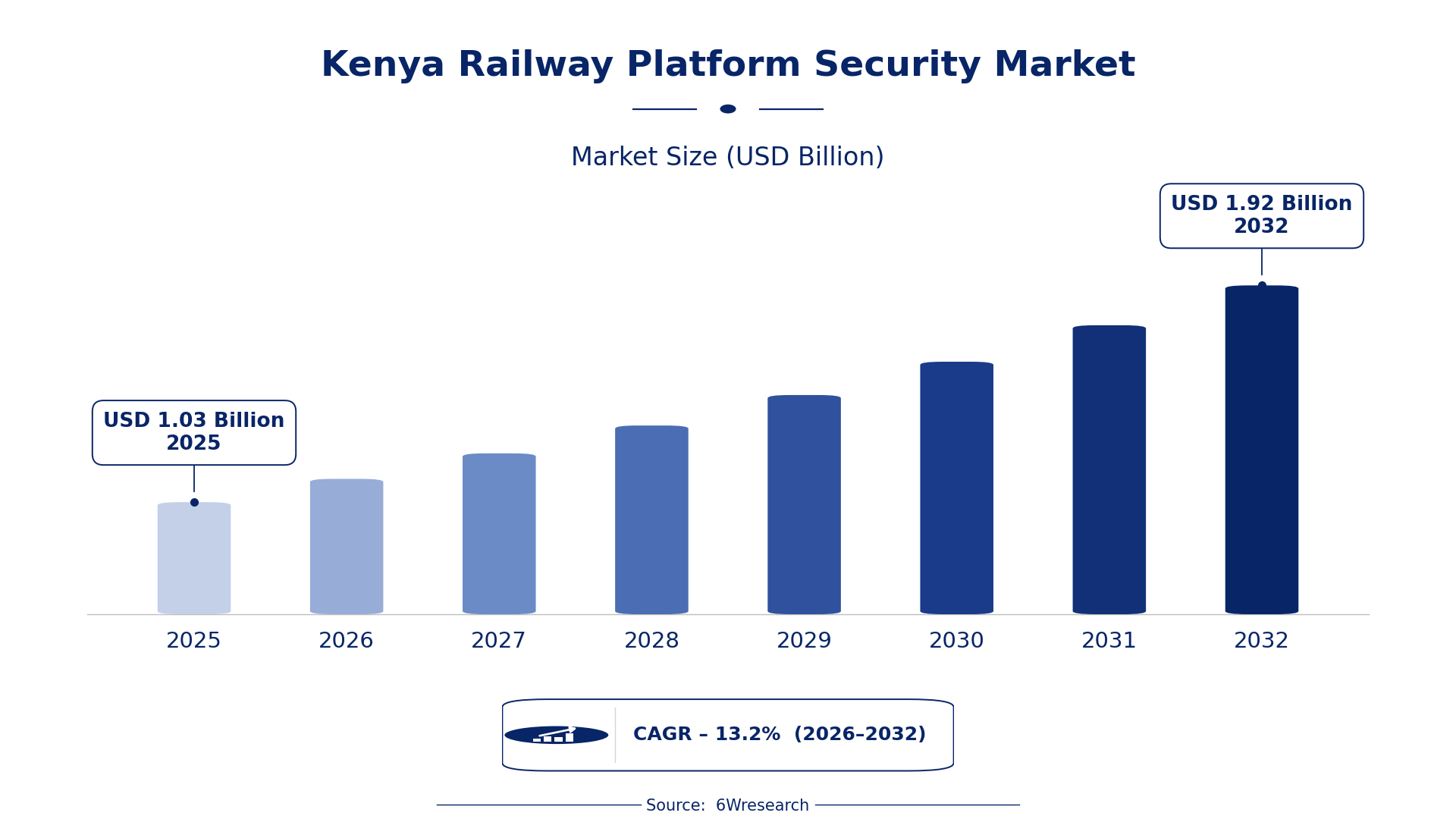
The Kenya Railway Platform Security Market was estimated at USD 1026 Million in 2025 and is projected to reach USD 1919 Million by 2032, growing at a CAGR of 13.2% from 2026 to 2032.
Kenya Railway Platform Security Market Synopsis
The surge in governmental and public focus on enhancing security measures in railway stations stands as the primary force shaping the Kenya Railway Platform Security Market. As passenger traffic continues to rise, the urgency for effective and reliable security solutions has never been more pronounced.
This market is characterized by a shift towards advanced technology integrations, including video surveillance, access control, and biometric systems. Stakeholders are increasingly prioritizing comprehensive security frameworks to address potential threats and ensure passenger safety.
Kenya Railway Platform Security Market Year-wise Growth Rate and Key Drivers
This graph illustrates the annual growth rates of the Kenya Railway Platform Security Market from 2021 to 2032, highlighting a steady upward trajectory and projected expansion over the forecast period.
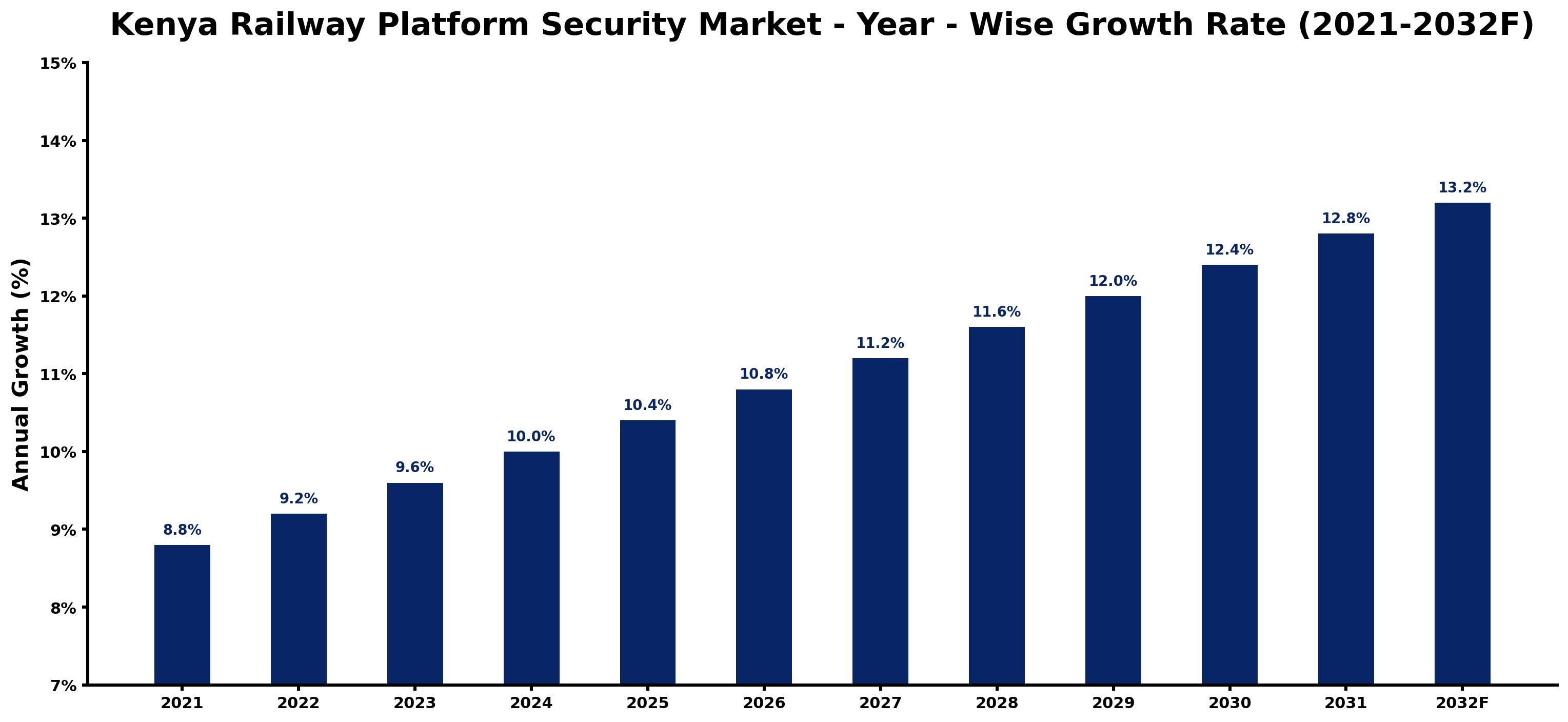
The table below presents the year‑wise growth rates along with the key drivers influencing the market
| Year | Growth Rate | Major Drivers |
| 2021 | 8.8% | Kenya Railways' enhanced focus on passenger safety initiatives. |
| 2022 | 9.2% | Launch of new biometric verification systems by Kenya Railways. |
| 2023 | 9.6% | Increased government funding for railway security technologies. |
| 2024 | 10.0% | Implementation of stricter safety regulations by Transport Authority. |
| 2025 | 10.4% | Growing urban rail ridership demanding upgraded security solutions. |
| 2026 | 10.8% | Adoption of advanced surveillance technology across major stations. |
| 2027 | 11.2% | Public-private partnerships enhancing railway infrastructure security. |
| 2028 | 11.6% | Rising concerns over theft and vandalism on railways. |
| 2029 | 12.0% | Introduction of smart ticketing systems requiring enhanced security. |
| 2030 | 12.4% | Mobilization of funds for anti-terrorism measures in railways. |
| 2031 | 12.8% | Integration of railway networks with national security strategies. |
| 2032 | 13.2% | Increased collaboration with cybersecurity firms for rail systems. |
Note: Market size estimations and growth projections presented in this report are based on 6Wresearch's proprietary forecasting methodology, utilizing the latest available industry data, government publications, and primary research inputs.
Kenya Railway Platform Security Market Key Takeaways
Below are some of the specific key takeaways from the market, including:
- The market is driven by government modernization initiatives aimed at improving railway infrastructure security.
- Advanced technologies such as AI and IoT are gaining traction for real-time monitoring and analytics capabilities.
- Investments in training programs for security personnel are essential for enhancing operational effectiveness.
- There is a growing emphasis on cybersecurity to protect railway systems from digital threats.
- Integrated security solutions tailored for railway platforms are becoming a critical focus for stakeholders.
Evaluation of Restraints in Kenya Railway Platform Security Market
Despite the growth prospects, several restraints impede the Kenya Railway Platform Security Market. The challenge of resource allocation remains significant, as budget constraints often limit the deployment of advanced security measures. Additionally, the vast geographical spread of railway networks complicates effective surveillance and monitoring. Inadequate training for security personnel further exacerbates vulnerabilities, as personnel may lack the skills necessary to respond to emerging threats. Coordinating security efforts across various stakeholders is also a persistent challenge, hindering the development of a cohesive security strategy.
Kenya Railway Platform Security Market Trends
A notable trend within the Kenya Railway Platform Security Market is the increasing adoption of integrated security solutions. These encompass a combination of video surveillance, access controls, and biometric authentication, aimed at providing comprehensive safety measures. on top of that, there is a growing demand for real-time monitoring systems that enable swift responses to security breaches. The integration of artificial intelligence into security frameworks is also gaining momentum, enhancing analytical capabilities and predictive maintenance. As passenger numbers rise, the focus on cybersecurity to safeguard sensitive data and critical infrastructure is intensifying.
Kenya Railway Platform Security Market Opportunities
The market presents a wealth of investment opportunities, particularly in advanced security technologies. Solutions such as video surveillance systems, access control mechanisms, and biometric tools are in high demand, reflecting the need for enhanced security measures. Additionally, there is a significant opportunity for companies to develop training programs aimed at improving security personnel capabilities. By investing in innovative solutions and services tailored to the unique challenges of the railway sector, stakeholders can play a crucial role in modernizing Kenya’s railway security infrastructure.
Government Initiatives in the Kenya Railway Platform Security Market
The Kenyan government is actively implementing policies to bolster security across railway platforms, reflecting its commitment to passenger safety and infrastructure integrity. Recent initiatives have focused on deploying security personnel to monitor railway stations, coupled with technological enhancements like surveillance systems. By collaborating with law enforcement agencies, the government aims to create a coordinated approach to security management that is essential for effective oversight of the railway network.
- A national initiative recently launched in early 2025 focuses on deploying additional security personnel at major railway stations to enhance passenger safety.
- Ongoing upgrades to surveillance infrastructure are set to improve monitoring capabilities across key railway platforms by mid-2026.
- A planned regulatory framework is expected to be introduced in late 2026, mandating enhanced security measures for all railway operations.
- Current collaborations with law enforcement are aimed at developing a centralized command system for coordinated security responses.
- Future plans include a comprehensive cybersecurity program to safeguard railway operational data and systems by 2027.
Future Insights of the Kenya Railway Platform Security Market
Looking ahead to 2026-2032, the Kenya Railway Platform Security Market is set for remarkable growth. The combination of increased investments in railway infrastructure and a heightened focus on security measures will drive demand for sophisticated solutions. Emerging technologies like AI and IoT will play crucial roles in reshaping security protocols, enabling better threat detection and response strategies. As stakeholders prioritize safety, the market will likely see a shift towards more comprehensive security frameworks that encompass both physical and digital security measures.
Kenya Railway Platform Security Market Latest Developments
Recent developments within the Kenya Railway Platform Security Market indicate a vigorous push towards modernizing security measures. Over the past year, stakeholders have begun to embrace innovative technologies to address growing security concerns effectively. This shift reflects a broader commitment to ensuring passenger safety and enhancing operational efficiency.
- An advanced video surveillance system was launched in Q1 2025, aimed at improving real-time monitoring capabilities at major railway hubs.
- A partnership between technology vendors and railway authorities is currently underway, focusing on integrating biometric access controls into railway stations.
- In early 2026, training programs aimed at enhancing security personnel skills are set to begin, focusing on emergency response and threat assessment.
- A planned rollout of an IoT-based security monitoring system is expected to commence in late 2026, targeting remote railway sections.
- Recent evaluations have led to the introduction of new cybersecurity protocols for protecting operational data, with implementation slated for mid-2026.
Kenya Railway Platform Security Market - Key Attractiveness of the Report
- 10 Years of Market Numbers
- Historical Data Starting from 2022 to 2025
- Base Year: 2025
- Forecast Data until 2032
- Key Performance Indicators Impacting the Market
- Major Upcoming Developments and Projects
Key Highlights of the Report:
- Kenya Railway Platform Security Market Outlook
- Market Size of Kenya Railway Platform Security Market, 2025
- Forecast of Kenya Railway Platform Security Market, 2032
- Historical Data and Forecast of Kenya Railway Platform Security Revenues & Volume for the Period 2022-2032F
- Kenya Railway Platform Security Market Trend Evolution
- Kenya Railway Platform Security Market Drivers and Challenges
- Kenya Railway Platform Security Price Trends
- Kenya Railway Platform Security Porter's Five Forces
- Kenya Railway Platform Security Industry Life Cycle
- Historical Data and Forecast of Kenya Railway Platform Security Market Revenues & Volume By Components for the Period 2022-2032F
- Historical Data and Forecast of Kenya Railway Platform Security Market Revenues & Volume By Solutions for the Period 2022-2032F
- Historical Data and Forecast of Kenya Railway Platform Security Market Revenues & Volume By Services for the Period 2022-2032F
- Historical Data and Forecast of Kenya Railway Platform Security Market Revenues & Volume By Applications for the Period 2022-2032F
- Historical Data and Forecast of Kenya Railway Platform Security Market Revenues & Volume By Subways for the Period 2022-2032F
- Historical Data and Forecast of Kenya Railway Platform Security Market Revenues & Volume By Trains for the Period 2022-2032F
- Kenya Railway Platform Security Import Export Trade Statistics
- Market Opportunity Assessment By Components
- Market Opportunity Assessment By Applications
- Kenya Railway Platform Security Top Companies Market Share
- Kenya Railway Platform Security Competitive Benchmarking By Technical and Operational Parameters
- Kenya Railway Platform Security Company Profiles
- Kenya Railway Platform Security Key Strategic Recommendations






































