Kenya Sail Canvas Market Size, Share & Growth Rate
The Kenya Sail Canvas Market was estimated at USD 358 Million in 2025 and is projected to reach USD 658 Million by 2032, growing at a CAGR of 9.1% from 2026 to 2032. This substantial growth trajectory can be attributed to the rising interest in recreational boating and the expanding marine industry within Kenya. Additionally, the demand for high-performance, weather-resistant sail materials is being fueled by the country's diverse sailing conditions and a growing preference for durable canvas solutions among both recreational and professional sailors.
Kenya Sail Canvas Market Growth Rate Analysis (2021-2032)
The Kenya Sail Canvas market has exhibited remarkable upward momentum, witnessing growth rates of 8.5% in 2021, gradually increasing to 9.3% in 2023, and projected to reach 12.5% by 2031. This expansion is primarily driven by a booming maritime sector, coupled with rising consumer demand for high-quality marine products. Investments in local manufacturing and sustainable materials have also played a pivotal role, fostering innovation within the industry. Furthermore, policy support aimed at promoting exports and enhancing maritime trade infrastructure continues to bolster growth. As energy transition efforts gain traction, the adoption of eco-friendly materials is anticipated to further enhance market dynamics in the upcoming years.
Kenya Sail Canvas Market Year-wise Growth Rate and Key Drivers
This graph highlights how the Kenya Sail Canvas Market has steadily grown over the past five years, supported by major growth factors.
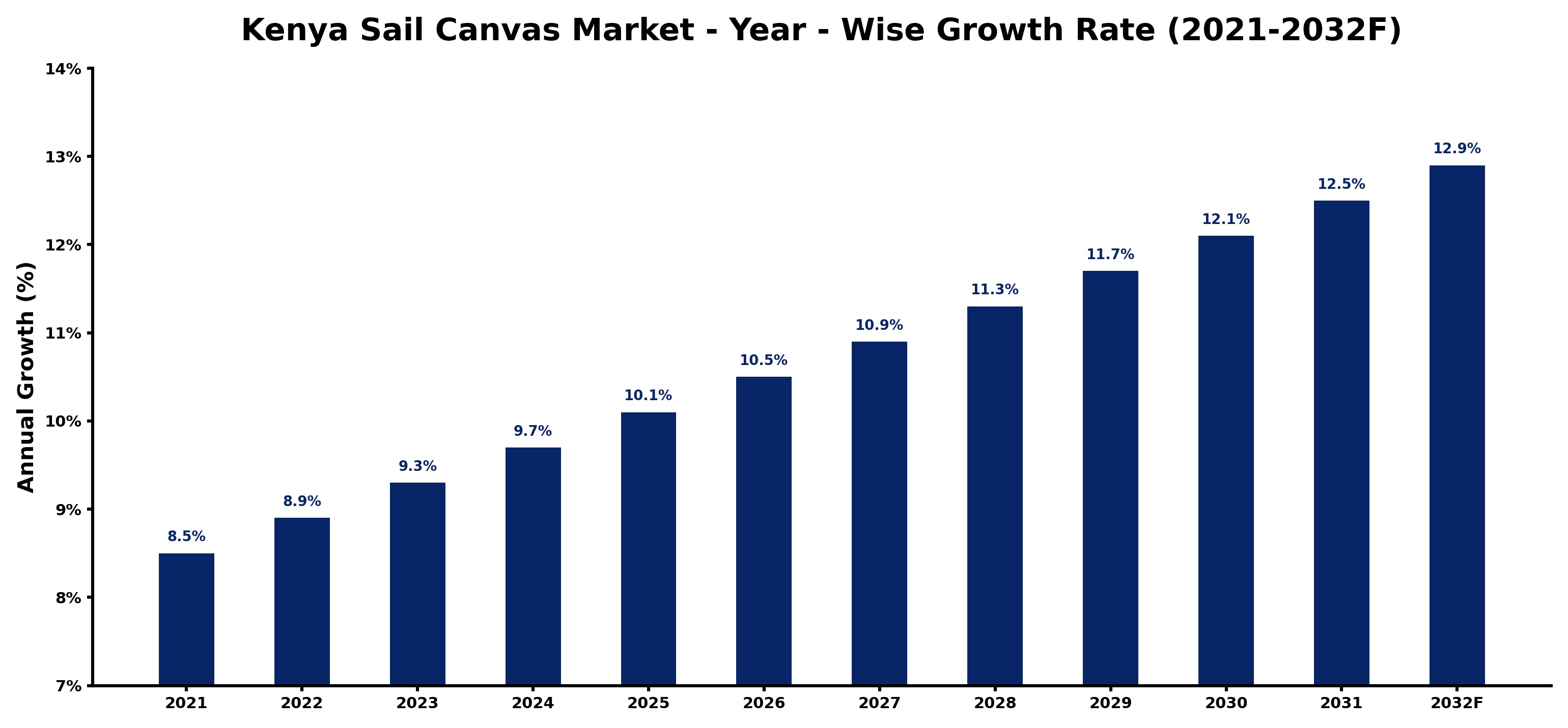
The table below presents the year‑wise growth rates along with the key drivers influencing the market
| Year | Growth Rate | Major Drivers |
| 2021 | 8.5% | Local sail manufacturers invest in modern machinery for efficiency |
| 2022 | 8.9% | Expanded textile production capabilities boost Kenya's sail canvas output |
| 2023 | 9.3% | Local textile machinery upgrades boost sail canvas production capacity |
| 2024 | 9.7% | Manufacturing investments boost Kenya’s capacity for sail canvas production |
| 2025 | 10.1% | Digital textile printing adoption enhances customization in sail production |
| 2026 | 10.5% | Local tourism resurgence boosts demand for customized sail production |
| 2027 | 10.9% | Digital design tools streamline sail production and enhance customization |
| 2028 | 11.3% | Advanced sewing technologies improved productivity in canvas production facilities |
| 2029 | 11.7% | Export driven demand boosts local sail manufacturing capacity investments |
| 2030 | 12.1% | Local textile manufacturing advancements boost sail canvas production capabilities |
| 2031 | 12.5% | Tourism sector rebound drives demand for custom sail production |
| 2032 | 12.9% | Sail manufacturing investments boosted capacity utilization in coastal regions |
Note - Market size estimations and growth projections presented in this report are based on 6Wresearch’s advanced forecasting approach, validated with industry datasets as of June 2026.
Kenya Sail Canvas Market Synopsis
The demand for high-quality sail canvas in Kenya is increasingly linked to the growth of the local marine tourism sector. Boasting an expansive coastline and favorable sailing conditions, Kenya has become a hub for both local and international boating enthusiasts, driving the need for reliable and robust sail materials. Furthermore, the increasing use of synthetic fibers such as polyester and nylon has revolutionized the sail canvas manufacturing process, enhancing durability and performance.
On the supply side, local manufacturers are ramping up production capabilities to meet the burgeoning demand. Initiatives are in place to improve supply chain logistics for raw materials, ensuring that production meets the quality standards required for competitive sailing. The growing emphasis on eco-friendly materials is also steering the market toward innovations in sustainable fabric production.
Kenya Sail Canvas Market Key Takeaways
- Robust growth is driven by an expanding marine industry and rising recreational boating activities.
- High-performance synthetic materials are increasingly preferred for their durability and UV resistance.
- Local manufacturers are investing in production capabilities to meet heightened demand.
- Regulatory initiatives are promoting the use of eco-friendly materials in sail canvas production.
- Challenges remain in maintaining consistent supply chains and adhering to safety regulations.
Evaluation of Restraints in Kenya Sail Canvas Market
Despite the positive outlook, several factors may restrain the growth of the Kenya sail canvas market. Weather conditions can significantly impact fabric durability and performance, raising concerns among manufacturers and consumers alike. Furthermore, maintaining a consistent supply chain for raw materials is essential for production stability but can be hampered by logistical issues. Compliance with international safety standards poses additional complexities, making it imperative for producers to keep pace with evolving regulations. These challenges necessitate proactive measures to ensure a resilient and competitive market environment.
Kenya Sail Canvas Market Trends
Current trends in the Kenya sail canvas market include a notable shift toward environmentally sustainable materials, driven by increasing consumer awareness of ecological impacts. Innovations in fabric technology are enhancing performance characteristics, such as tear strength and water resistance, which are crucial for the diverse sailing conditions encountered in the region. Additionally, there is a growing trend towards customization in sail design, allowing consumers to tailor their equipment to specific sailing conditions and personal preferences.
Kenya Sail Canvas Market Opportunities
Opportunities for growth in the Kenya sail canvas market lie in expanding the range of sustainable and high-performance products. As marine tourism flourishes, investment in developing high-quality, durable sail materials can capture a larger share of this emerging market. Furthermore, partnerships with local sailing schools and tour operators can foster collaborative initiatives aimed at promoting the use of superior sail canvas, ultimately benefitting the industry as a whole.
Government Initiatives in the Kenya Sail Canvas Market
The Kenyan government has implemented policies aimed at bolstering the marine industry, with specific focus on promoting the use of durable and environmentally friendly materials in sail canvas production. Initiatives to enhance marine tourism infrastructure and support local manufacturers are in place, alongside programs that incentivize sustainable practices within the industry. These government efforts are critical to ensuring that the sail canvas market aligns with international safety and performance standards.
Future Insights of the Kenya Sail Canvas Market
Looking ahead to 2026-2032, the Kenya sail canvas market is poised for significant advancement, driven by continued growth in the marine tourism sector and increasing recreational boating activities. As consumer preferences evolve towards high-performance, environmentally sustainable materials, manufacturers will need to innovate to meet these demands. The synergy between local manufacturers and government initiatives will further bolster market stability, paving the way for a thriving industry that caters to both local and international markets.
Kenya Sail Canvas Market Latest Developments (May 2025 - June 2026)
Recent developments within the Kenya sail canvas market have centered around enhanced product offerings and increased focus on sustainability. Manufacturers are exploring new fabric technologies to improve sail performance under various weather conditions. Additionally, collaborative efforts between industry stakeholders and the government are fostering advancements in eco-friendly production practices, ensuring that the market adapts to global sustainability trends.
Kenya Sail Canvas Market - Key Attractiveness of the Report
- 10 Years of Market Numbers
- Historical Data Starting from 2022 to 2025
- Base Year: 2025
- Forecast Data until 2032
- Key Performance Indicators Impacting the Market
- Major Upcoming Developments and Projects
Key Highlights of the Report:
- Kenya Sail Canvas Market Outlook
- Market Size of Kenya Sail Canvas Market, 2025
- Forecast of Kenya Sail Canvas Market, 2032
- Historical Data and Forecast of Kenya Sail Canvas Revenues & Volume for the Period 2022-2032F
- Kenya Sail Canvas Market Trend Evolution
- Kenya Sail Canvas Market Drivers and Challenges
- Kenya Sail Canvas Price Trends
- Kenya Sail Canvas Porter's Five Forces
- Kenya Sail Canvas Industry Life Cycle
- Historical Data and Forecast of Kenya Sail Canvas Market Revenues & Volume By Type for the Period 2022-2032F
- Historical Data and Forecast of Kenya Sail Canvas Market Revenues & Volume By 8 Ann Canvas for the Period 2022-2032F
- Historical Data and Forecast of Kenya Sail Canvas Market Revenues & Volume By 12 Ann Canvas for the Period 2022-2032F
- Historical Data and Forecast of Kenya Sail Canvas Market Revenues & Volume By Polyester Canvas for the Period 2022-2032F
- Historical Data and Forecast of Kenya Sail Canvas Market Revenues & Volume By Others for the Period 2022-2032F
- Historical Data and Forecast of Kenya Sail Canvas Market Revenues & Volume By Application for the Period 2022-2032F
- Historical Data and Forecast of Kenya Sail Canvas Market Revenues & Volume By Sailing for the Period 2022-2032F
- Historical Data and Forecast of Kenya Sail Canvas Market Revenues & Volume By Yacht for the Period 2022-2032F
- Historical Data and Forecast of Kenya Sail Canvas Market Revenues & Volume By Others for the Period 2022-2032F
- Kenya Sail Canvas Import Export Trade Statistics
- Market Opportunity Assessment By Type
- Market Opportunity Assessment By Application
- Kenya Sail Canvas Top Companies Market Share
- Kenya Sail Canvas Competitive Benchmarking By Technical and Operational Parameters
- Kenya Sail Canvas Company Profiles
- Kenya Sail Canvas Key Strategic Recommendations






































