Kenya Soil Testing Equipment Market Size, Share & Growth Rate
The Kenya Soil Testing Equipment Market was estimated at USD 361 Million in 2025 and is projected to reach USD 498 Million by 2032, growing at a CAGR of 4.7% from 2026 to 2032. This promising trajectory is propelled by an increasing recognition of soil testing's role in enhancing agricultural yields, alongside government initiatives aimed at promoting sustainable farming practices. As the agricultural landscape in Kenya evolves, the demand for innovative soil testing solutions is set to rise, reflecting farmers' urgent need for reliable data to inform their cultivation strategies.
Kenya Soil Testing Equipment Market Year-wise Growth Rate and Key Drivers
This graph highlights how the Kenya Soil Testing Equipment Market has steadily grown over the years, supported by major growth factors.
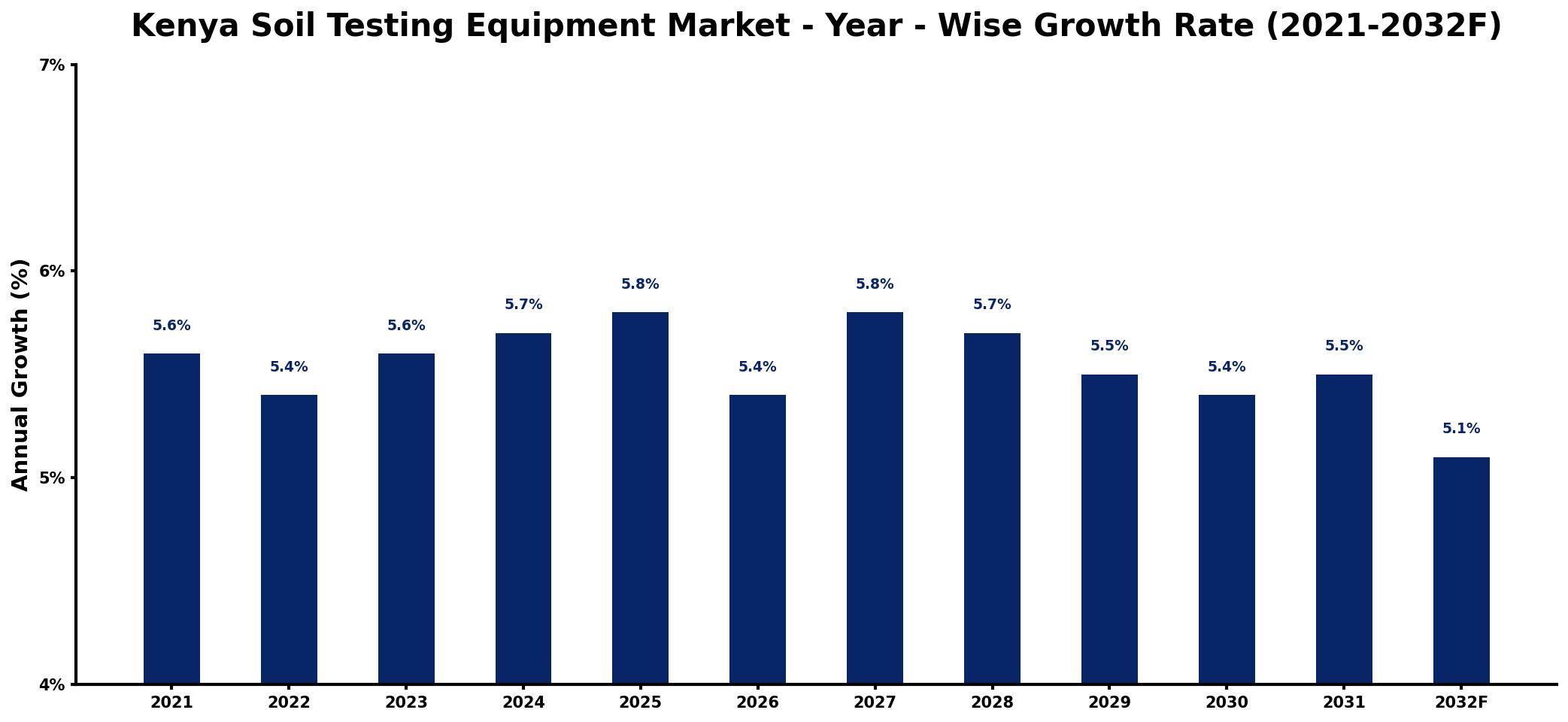
The table below presents the year‑wise growth rates along with the key drivers influencing the market
| Year | Growth Rate | Major Drivers |
| 2021 | 5.6% | Rising agricultural sector investments |
| 2022 | 5.4% | Growing environmental awareness initiatives |
| 2023 | 5.6% | Increased demand for sustainable practices |
| 2024 | 5.7% | Expansion of agricultural research programs |
| 2025 | 5.8% | Government support for precision farming |
| 2026 | 5.4% | Emergence of new agricultural technologies |
| 2027 | 5.8% | Strengthened partnerships with agribusinesses |
| 2028 | 5.7% | Heightened focus on food security |
| 2029 | 5.5% | Increased availability of financing options |
| 2030 | 5.4% | Growing interest in organic farming |
| 2031 | 5.5% | Development of educational training programs |
| 2032 | 5.1% | rising procurement volume requirements |
Note: Market size estimations and growth projections presented in this report are based on 6Wresearch's proprietary forecasting methodology, utilizing the latest available industry data, government publications, and primary research inputs.
Kenya Soil Testing Equipment Market Synopsis
A fundamental force shaping the Kenya Soil Testing Equipment Market is the growing awareness among farmers regarding soil health and its direct impact on crop productivity. With a strong push towards sustainable agricultural methods, many stakeholders recognize that understanding soil composition is crucial for maximizing output and sustainability.
Government initiatives aimed at fostering agricultural innovation are also instrumental in driving market growth. Policies supporting soil testing practices not only enhance agricultural productivity but also encourage farmers to adopt modern, precision farming techniques, thereby reshaping the market landscape.
Kenya Soil Testing Equipment Market Key Takeaways
- The market is benefiting from increased awareness about soil health among Kenyan farmers.
- Government support through policies and subsidies is enhancing the adoption of soil testing equipment.
- There is a significant shift towards precision agriculture techniques, further propelling equipment demand.
- Technological advancements in soil testing are creating opportunities for innovative solutions.
- The rise of commercial farming in Kenya is contributing to the expansion of the market.
Evaluation of Restraints in Kenya Soil Testing Equipment Market
While the Kenya Soil Testing Equipment Market exhibits promising growth potential, it is not without its challenges. One of the primary constraints is the general lack of awareness among farmers regarding the benefits and necessity of soil testing. This limited understanding hampers widespread adoption and utilization of testing equipment. Furthermore, the high costs associated with advanced soil testing tools pose financial barriers for many farmers, particularly in rural areas where agriculture is predominantly small-scale. Inadequate infrastructure also complicates access to essential resources, slowing down the market's overall expansion.
Kenya Soil Testing Equipment Market Trends
Current trends in the Kenya Soil Testing Equipment Market are leaning towards the adoption of portable and user-friendly testing devices, reflecting a broader push for efficiency in agricultural practices. Farmers are increasingly inclined to seek out equipment that delivers rapid, accurate results, thereby aiding in precise fertilizer application and optimizing crop yields. Additionally, digital innovations such as integrated data analytics capabilities are becoming more prevalent, allowing for enhanced soil management strategies and informed decision-making.
Kenya Soil Testing Equipment Market Opportunities
The landscape of the Kenya Soil Testing Equipment Market is ripe with investment opportunities, especially as the push for sustainable agricultural practices gains momentum. There is a substantial demand for advanced soil testing kits and digital mapping technologies, which can empower farmers to make data-driven decisions. Opportunities also abound in establishing soil testing services and consultancy to aid farmers in navigating the complexities of soil health management. Furthermore, collaborative ventures with governmental and non-profit organizations focusing on agricultural development can lead to lucrative investment pathways.
Government Initiatives in the Kenya Soil Testing Equipment Market
The Kenyan government has been proactive in implementing policies that bolster the Soil Testing Equipment Market. The National Soil Testing Policy, for example, serves to encourage the adoption of soil testing practices among farmers. Various incentives, including subsidies aimed at reducing the financial burden of acquiring testing equipment, are available to promote the use of these tools. Additionally, the collaboration between the Ministry of Agriculture and research institutions is crucial in developing quality standards and regulations for soil testing, ensuring reliability across the market.
Future Insights of the Kenya Soil Testing Equipment Market
Looking ahead to 2026-2032, the Kenya Soil Testing Equipment Market is poised for significant growth driven by rising demands for sustainable agricultural practices and heightened focus on improving soil health. As more farmers embrace precision farming techniques, the need for reliable soil testing solutions will intensify. Technological advancements, particularly in mobile and digital solutions for soil testing, will likely enhance market offerings, enabling farmers to optimize their cultivation strategies and yield high-quality crops.
Kenya Soil Testing Equipment Market Latest Developments (2025 - 2026)
Recent trends in the Kenya Soil Testing Equipment Market have highlighted a shift towards increased digitalization of soil testing processes. Innovations in mobile applications that provide real-time soil data have gained traction among farmers. Additionally, various agricultural workshops and training programs are being initiated to raise awareness about soil health and the importance of testing, contributing to the markets overall growth momentum. Collaborations between governmental bodies and agricultural technology firms are becoming more common, enhancing access to innovative soil testing solutions.
Kenya Soil Testing Equipment Market - Key Attractiveness of the Report
- 10 Years of Market Numbers
- Historical Data Starting from 2022 to 2025
- Base Year: 2025
- Forecast Data until 2032
- Key Performance Indicators Impacting the Market
- Major Upcoming Developments and Projects
Key Highlights of the Report:
- Kenya Soil Testing Equipment Market Outlook
- Market Size of Kenya Soil Testing Equipment Market, 2025
- Forecast of Kenya Soil Testing Equipment Market, 2032
- Historical Data and Forecast of Kenya Soil Testing Equipment Revenues & Volume for the Period 2022-2032F
- Kenya Soil Testing Equipment Market Trend Evolution
- Kenya Soil Testing Equipment Market Drivers and Challenges
- Kenya Soil Testing Equipment Price Trends
- Kenya Soil Testing Equipment Porter's Five Forces
- Kenya Soil Testing Equipment Industry Life Cycle
- Historical Data and Forecast of Kenya Soil Testing Equipment Market Revenues & Volume By End-user Industry for the Period 2022-2032F
- Historical Data and Forecast of Kenya Soil Testing Equipment Market Revenues & Volume By Agriculture for the Period 2022-2032F
- Historical Data and Forecast of Kenya Soil Testing Equipment Market Revenues & Volume By Construction for the Period 2022-2032F
- Historical Data and Forecast of Kenya Soil Testing Equipment Market Revenues & Volume By Others for the Period 2022-2032F
- Historical Data and Forecast of Kenya Soil Testing Equipment Market Revenues & Volume By On Type for the Period 2022-2032F
- Historical Data and Forecast of Kenya Soil Testing Equipment Market Revenues & Volume By Physical for the Period 2022-2032F
- Historical Data and Forecast of Kenya Soil Testing Equipment Market Revenues & Volume By Residual for the Period 2022-2032F
- Historical Data and Forecast of Kenya Soil Testing Equipment Market Revenues & Volume By Chemical for the Period 2022-2032F
- Historical Data and Forecast of Kenya Soil Testing Equipment Market Revenues & Volume By Site for the Period 2022-2032F
- Historical Data and Forecast of Kenya Soil Testing Equipment Market Revenues & Volume By Laboratory for the Period 2022-2032F
- Historical Data and Forecast of Kenya Soil Testing Equipment Market Revenues & Volume By On-site for the Period 2022-2032F
- Historical Data and Forecast of Kenya Soil Testing Equipment Market Revenues & Volume By Automation for the Period 2022-2032F
- Historical Data and Forecast of Kenya Soil Testing Equipment Market Revenues & Volume By Manual for the Period 2022-2032F
- Historical Data and Forecast of Kenya Soil Testing Equipment Market Revenues & Volume By Semi-automatic for the Period 2022-2032F
- Historical Data and Forecast of Kenya Soil Testing Equipment Market Revenues & Volume By Automatic for the Period 2022-2032F
- Kenya Soil Testing Equipment Import Export Trade Statistics
- Market Opportunity Assessment By End-user Industry
- Market Opportunity Assessment By On Type
- Market Opportunity Assessment By Site
- Market Opportunity Assessment By Automation
- Kenya Soil Testing Equipment Top Companies Market Share
- Kenya Soil Testing Equipment Competitive Benchmarking By Technical and Operational Parameters
- Kenya Soil Testing Equipment Company Profiles
- Kenya Soil Testing Equipment Key Strategic Recommendations






































