Kenya Textile Garment Market Growth Rate Analysis (2025 - 2031)
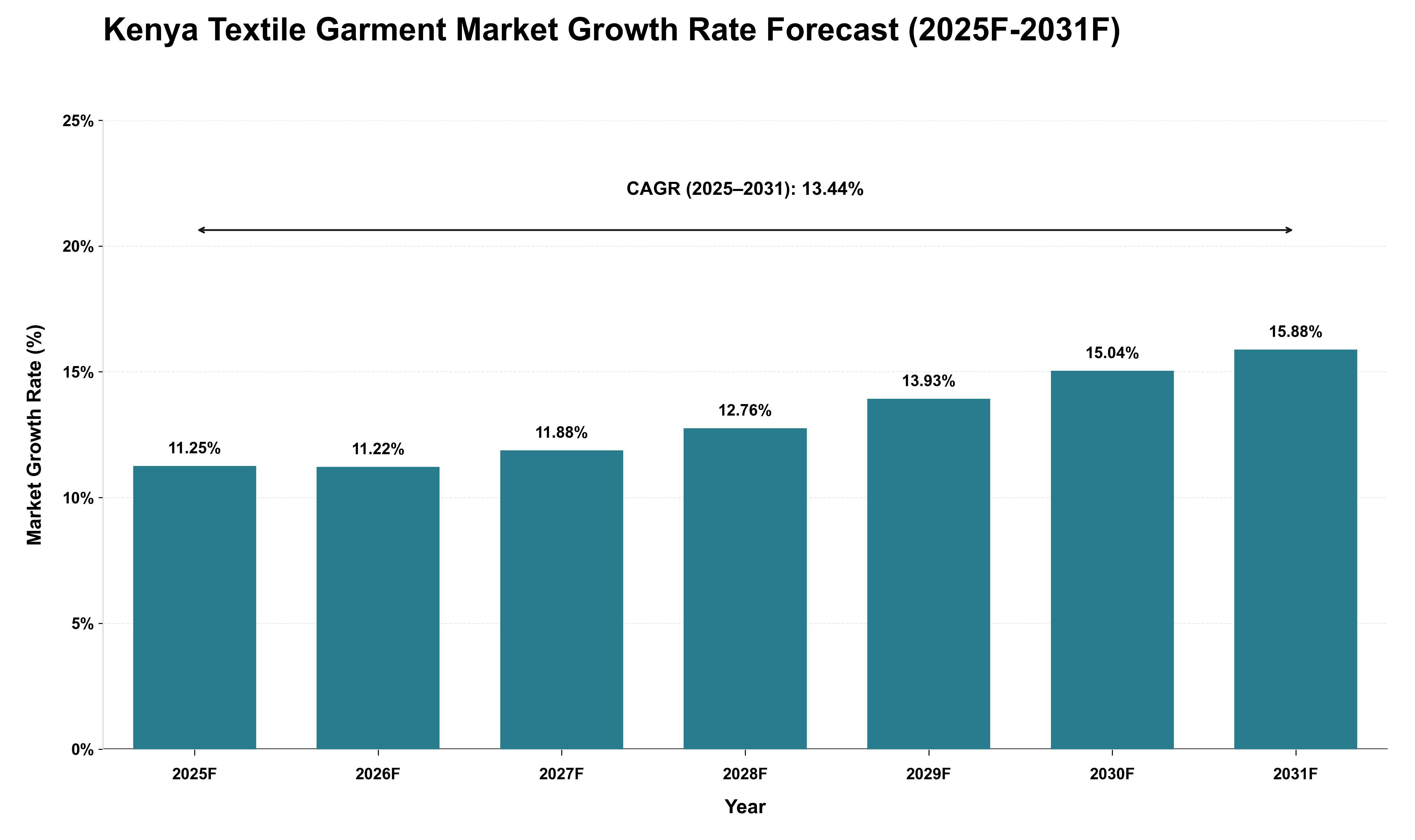
The projected compound annual growth rate of 13.44% for the Kenya textile garment market from 2025 to 2031 indicates a robust expansion driven by evolving supply chain dynamics and fluctuating input costs. As global demand for textiles continues to rise, Kenya's strategic positioning within regional trade networks will likely enhance its export capabilities, particularly as manufacturers adapt to shifts in sourcing strategies and labor costs. The anticipated annual growth rates, peaking at 15.88% in 2031, suggest that firms will increasingly leverage technological advancements and sustainable practices to optimize production efficiency. However, reliance on imported raw materials may introduce volatility in input costs, influenced by global commodity price fluctuations and trade policies. Consequently, the interplay between local production enhancements and external economic pressures will shape the competitive landscape of the textile sector throughout this forecast period.
Key Highlights of the Report:
- Kenya Textile Garment Market Outlook
- Market Size of Kenya Textile Garment Market, 2024
- Forecast of Kenya Textile Garment Market, 2031
- Historical Data and Forecast of Kenya Textile Garment Revenues & Volume for the Period 2021- 2031
- Kenya Textile Garment Market Trend Evolution
- Kenya Textile Garment Market Drivers and Challenges
- Kenya Textile Garment Price Trends
- Kenya Textile Garment Porter's Five Forces
- Kenya Textile Garment Industry Life Cycle
- Historical Data and Forecast of Kenya Textile Garment Market Revenues & Volume By Material Type for the Period 2021- 2031
- Historical Data and Forecast of Kenya Textile Garment Market Revenues & Volume By Cotton for the Period 2021- 2031
- Historical Data and Forecast of Kenya Textile Garment Market Revenues & Volume By Wool for the Period 2021- 2031
- Historical Data and Forecast of Kenya Textile Garment Market Revenues & Volume By Silk for the Period 2021- 2031
- Historical Data and Forecast of Kenya Textile Garment Market Revenues & Volume By Denim for the Period 2021- 2031
- Historical Data and Forecast of Kenya Textile Garment Market Revenues & Volume By Others for the Period 2021- 2031
- Historical Data and Forecast of Kenya Textile Garment Market Revenues & Volume By Application for the Period 2021- 2031
- Historical Data and Forecast of Kenya Textile Garment Market Revenues & Volume By Women for the Period 2021- 2031
- Historical Data and Forecast of Kenya Textile Garment Market Revenues & Volume By Men for the Period 2021- 2031
- Historical Data and Forecast of Kenya Textile Garment Market Revenues & Volume By Kids for the Period 2021- 2031
- Kenya Textile Garment Import Export Trade Statistics
- Market Opportunity Assessment By Material Type
- Market Opportunity Assessment By Application
- Kenya Textile Garment Top Companies Market Share
- Kenya Textile Garment Competitive Benchmarking By Technical and Operational Parameters
- Kenya Textile Garment Company Profiles
- Kenya Textile Garment Key Strategic Recommendations






































