Kenya Toys and Hobby Goods Market Summary
The kenya toys and hobby goods market was estimated at USD 380 Million in 2025 and is projected to reach USD 538 Million by 2032, growing at a CAGR of 6.3% from 2026 to 2032.
Kenya Toys and Hobby Goods Market Year-wise Growth Rate and Key Drivers
This graph highlights how the Kenya Toys and Hobby Goods Market has steadily grown over the past five years, supported by major growth factors.
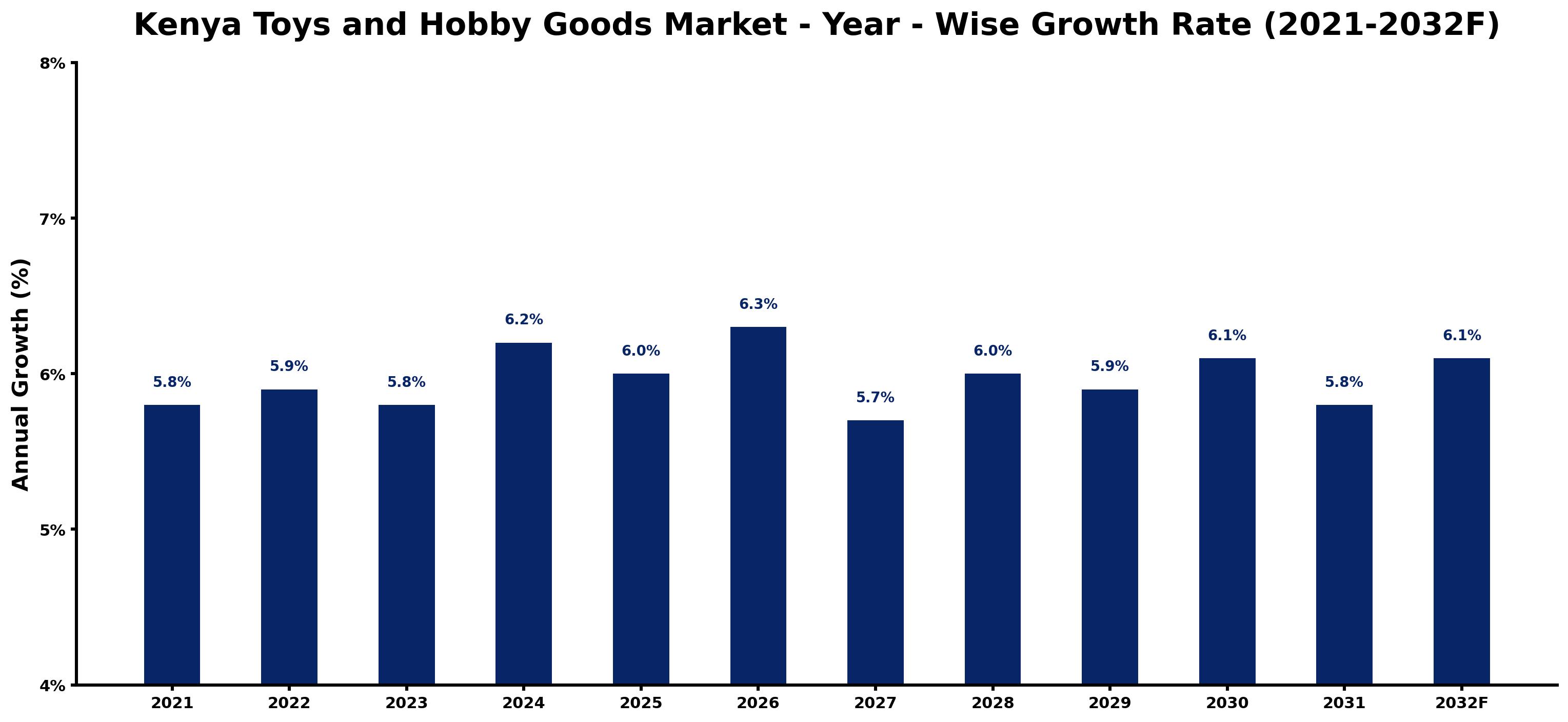
The table below presents the year wise growth rates along with the key drivers influencing the market
| Year | Growth Rate | Major Drivers |
| 2021 | 5.8% | Local manufacturers introduced unique toys, resonating with cultural values and preferences. |
| 2022 | 5.9% | E-commerce platforms expanded, making toys accessible across various demographic segments. |
| 2023 | 5.8% | Sustainable materials gained popularity, aligning with global environmental awareness trends. |
| 2024 | 6.2% | Social media marketing effectively engaged younger parents, boosting brand interactions and loyalty. |
| 2025 | 6.0% | Collaboration between artists and toy designers introduced limited-edition collectibles into the market. |
| 2026 | 6.3% | Increased urbanization led to higher disposable incomes among middle-class households nationwide. |
| 2027 | 5.7% | Educational toys emphasized STEM learning, appealing to parents prioritizing developmental benefits. |
| 2028 | 6.0% | Pop culture influences sparked demand for branded toys, enhancing consumer engagement and sales. |
| 2029 | 5.9% | Local craft fairs showcased handmade toys, encouraging community support for local artisans. |
| 2030 | 6.1% | Subscription box services for toys offered convenience, becoming popular among busy families. |
| 2031 | 5.8% | Improvements in logistics reduced delivery times, enhancing overall customer satisfaction levels. |
| 2032 | 6.1% | Partnerships with international toy brands diversified product offerings, attracting a broader audience. |
Note - Market size estimations and growth projections presented in this report are based on 6Wresearch's advanced forecasting approach, validated with industry datasets as of June 2026.
Kenya Toys and Hobby Goods Market Synopsis
The Kenya Toys and Hobby Goods Market is projected to reach 6.3% and witness significant growth during the forecast period (2026-2032). This growth trajectory reflects various factors contributing to market expansion, including rising disposable incomes, an increasing preference for international brands, and the burgeoning trend of online shopping. As e-commerce platforms emerge, they enable manufacturers to reach consumers in remote areas, thereby expanding their customer base beyond traditional urban centers. Kenyan economic strength, primarily driven by industrial sectors such as manufacturing and construction, remains a fundamental pillar supporting this market's growth.
Kenya Toys and Hobby Goods Market Growth Drivers
A multitude of factors are influencing the dynamics of the Kenya toys and hobby goods market positively:
- Increasing Disposable Income: The notable rise of the middle class in Kenya, supported by sustained economic growth, has enhanced consumer spending on leisure items, including toys and hobby goods.
- Growing Preference for International Brands: Kenyan consumers are increasingly opting for international brands perceived to deliver superior quality and contemporary designs, which boosts sales and brand equity.
- Rising Trend of Online Shopping: The acceleration of internet access across the country allows consumers, including those in rural areas, to shop online, enhancing market reach for retailers and manufacturers.
- Urbanization and Population Density: Rapid urbanization is leading to a concentration of families in urban centers, which, in turn, increases the demand for toys and hobby items due to a growing child population.
- Enhanced Retail Infrastructure: The expansion of retail outlets offering a wider variety of toys and hobby goods at competitive prices contributes to better access for consumers across different segments.
Kenya Toys and Hobby Goods Market Trends and Opportunities
Emerging trends within the Kenya toys and hobby goods market are defining the future landscape of this sector. A marked shift towards premium, innovative products is observed, with manufacturers increasingly investing in research and development to cater to evolving consumer preferences.
- Increased Focus on Sustainability: Eco-friendly toys are gaining traction as consumers become more environmentally conscious, presenting opportunities for companies to innovate sustainable product lines.
- Rise of Educational Toys: There is a growing demand for educational toys that support learning and development, which aligns with parental desires for toys that provide cognitive benefits.
- Integration of Technology: The incorporation of technology in toys, such as augmented reality and interactive features, is becoming more prevalent, appealing to tech-savvy children and parents alike.
- Local Production Initiatives: Opportunities exist for local manufacturers to produce goods that resonate with cultural relevance, attracting consumers who value local craftsmanship.
- Expansion of Niche Markets: The rising interest in specific hobby goods, such as arts and crafts or model building, presents unique market segments that can be targeted by specialized retailers.
Kenya Toys and Hobby Goods Market Government Investment and Initiatives
The Kenyan government has recognized the potential of various sectors, including toys and hobby goods, as vital for economic development. Policies that encourage foreign investments and support local manufacturing are instrumental in shaping a conducive environment for market growth.
- The government aims to improve infrastructure, which is crucial for distributing toys and hobby goods efficiently across urban and rural areas.
- Incentives for local manufacturers, such as tax breaks and grants, are being implemented to promote domestic production and reduce reliance on imports.
- Educational programs that foster creativity and innovation among children are supported through public funding, thereby indirectly boosting demand for relevant toys and hobby goods.
- Public initiatives aimed at improving digital accessibility are facilitating online shopping growth, allowing a wider audience to engage with the toys market.
- Collaboration between the government and industry stakeholders is encouraged to create standards for safety and quality assurance in toys, enhancing consumer confidence in local products.
Kenya Toys and Hobby Goods Market Latest Developments (May 2025 - June 2026)
Recent developments within the Kenya toys and hobby goods market have reflected a proactive adaptation to shifting consumer behaviors and economic conditions. During this period, there has been an observable increase in partnerships between local artisans and international brands, focusing on creating unique, culturally relevant products. Furthermore, advancements in logistics and supply chain operations have contributed to improved delivery times for online purchases. Manufacturers are also enhancing their product offerings by introducing technologically advanced toys, integrating features that promote engagement and educational value. This evolution aligns with a more significant global trend towards interactive and learning-centric toys. Additionally, market players are actively participating in community initiatives to promote play and creativity among children, reinforcing the societal value of toys beyond mere entertainment.
Kenya Toys and Hobby Goods Market - Key Attractiveness of the Report
- 10 Years of Market Numbers
- Historical Data Starting from 2022 to 2025
- Base Year: 2025
- Forecast Data until 2032
- Key Performance Indicators Impacting the Market
- Major Upcoming Developments and Projects
Key Highlights of the Report:
- Kenya Toys and Hobby Goods Market Outlook
- Market Size of Kenya Toys and Hobby Goods Market, 2025
- Forecast of Kenya Toys and Hobby Goods Market, 2032F
- Historical Data and Forecast of Kenya Toys and Hobby Goods Revenues & Volume for the Period 2022-2032F
- Kenya Toys and Hobby Goods Market Trend Evolution
- Kenya Toys and Hobby Goods Market Drivers and Challenges
- Kenya Toys and Hobby Goods Price Trends
- Kenya Toys and Hobby Goods Porter's Five Forces
- Kenya Toys and Hobby Goods Industry Life Cycle
- Historical Data and Forecast of Kenya Toys and Hobby Goods Market Revenues & Volume By Type for the Period 2022-2032F
- Historical Data and Forecast of Kenya Toys and Hobby Goods Market Revenues & Volume By Sports Toys for the Period 2022-2032F
- Historical Data and Forecast of Kenya Toys and Hobby Goods Market Revenues & Volume By Intellectual Toys for the Period 2022-2032F
- Historical Data and Forecast of Kenya Toys and Hobby Goods Market Revenues & Volume By Education Toys for the Period 2022-2032F
- Historical Data and Forecast of Kenya Toys and Hobby Goods Market Revenues & Volume By Decorative Toys for the Period 2022-2032F
- Historical Data and Forecast of Kenya Toys and Hobby Goods Market Revenues & Volume By Other for the Period 2022-2032F
- Historical Data and Forecast of Kenya Toys and Hobby Goods Market Revenues & Volume By Application for the Period 2022-2032F
- Historical Data and Forecast of Kenya Toys and Hobby Goods Market Revenues & Volume By Online Sales for the Period 2022-2032F
- Historical Data and Forecast of Kenya Toys and Hobby Goods Market Revenues & Volume By Offline Sales for the Period 2022-2032F
- Historical Data and Forecast of Kenya Toys and Hobby Goods Market Revenues & Volume By Others for the Period 2022-2032F
- Kenya Toys and Hobby Goods Import Export Trade Statistics
- Market Opportunity Assessment By Type
- Market Opportunity Assessment By Application
- Kenya Toys and Hobby Goods Top Companies Market Share
- Kenya Toys and Hobby Goods Competitive Benchmarking By Technical and Operational Parameters
- Kenya Toys and Hobby Goods Company Profiles
- Kenya Toys and Hobby Goods Key Strategic Recommendations






































