Kenya Transistors Market Summary
The kenya transistors market was estimated at USD 386 Million in 2025 and is projected to reach USD 546 Million by 2032, growing at a CAGR of 6.0% from 2026 to 2032.
Kenya Transistors Market Year-wise Growth Rate and Key Drivers
This graph highlights how the Kenya Transistors Market has steadily grown over the past five years, supported by major growth factors.
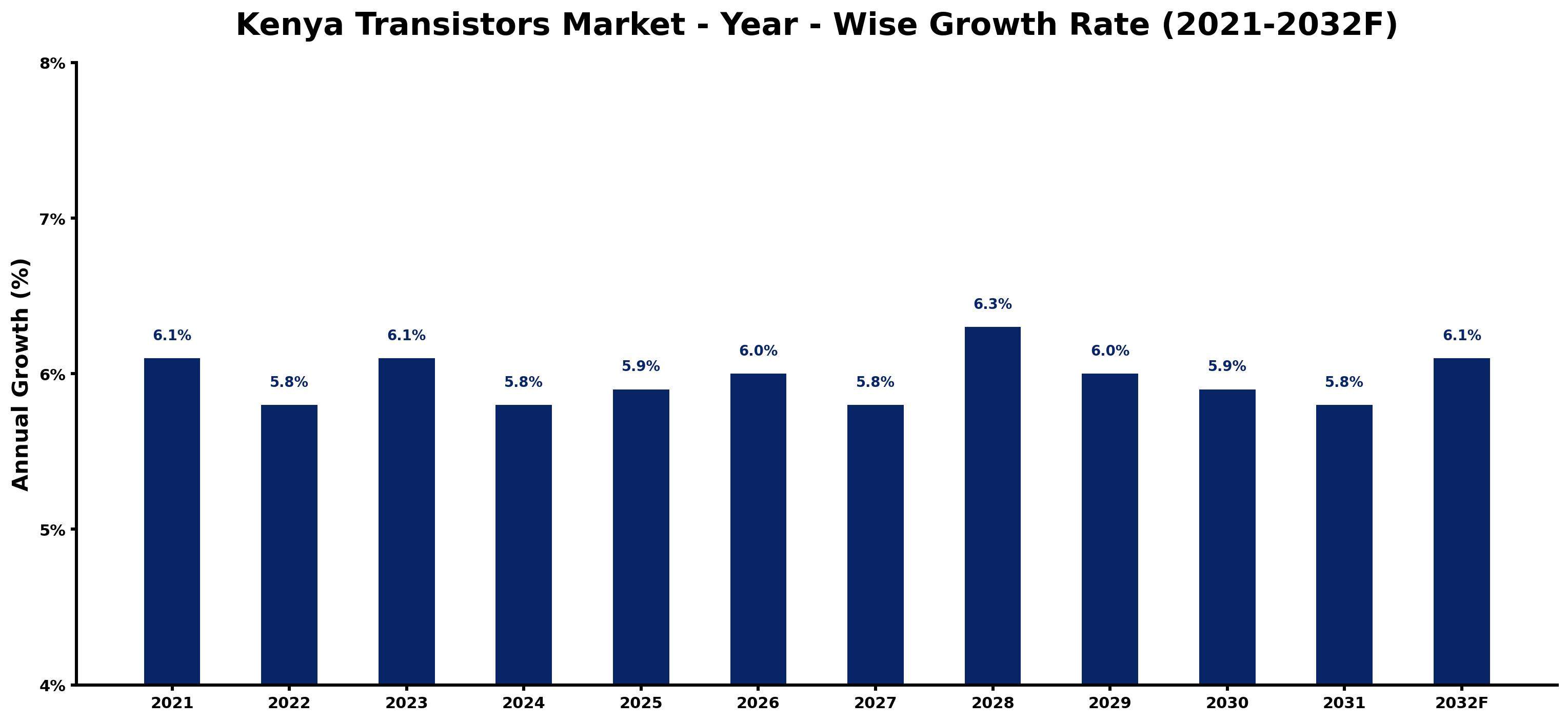
The table below presents the year wise growth rates along with the key drivers influencing the market
| Year | Growth Rate | Major Drivers |
| 2021 | 6.1% | Post-pandemic recovery sparked renewed interest in consumer electronics across urban centers. |
| 2022 | 5.8% | The push for renewable energy solutions created niche markets for energy-efficient transistors. |
| 2023 | 6.1% | Local manufacturers started investing heavily in production capabilities to meet rising demand. |
| 2024 | 5.8% | Urbanization trends led to increased investment in smart city infrastructure, boosting transistor usage. |
| 2025 | 5.9% | The introduction of affordable smartphones expanded the consumer base for electronic components. |
| 2026 | 6.0% | Technological partnerships emerged between local firms and international companies to enhance innovation. |
| 2027 | 5.8% | The expansion of telecommunication networks improved accessibility to transistor-powered devices nationwide. |
| 2028 | 6.3% | Emerging tech start-ups began focusing on IoT applications, fueling demand for advanced transistors. |
| 2029 | 6.0% | Consumer preferences shifted towards compact gadgets, requiring smaller, more efficient transistors. |
| 2030 | 5.9% | E-commerce platforms thrived, driving online sales of transistor-based electronics significantly. |
| 2031 | 5.8% | Investment in educational programs fostered a skilled workforce, enhancing local transistor production capabilities. |
| 2032 | 6.1% | Sustainability trends redirected focus towards eco-friendly transistor manufacturing processes and materials. |
Note - Market size estimations and growth projections presented in this report are based on 6Wresearch's advanced forecasting approach, validated with industry datasets as of June 2026.
Key Highlights of the Report:
- Kenya Transistors Market Outlook
- Market Size of Kenya Transistors Market, 2025
- Forecast of Kenya Transistors Market, 2032F
- Historical Data and Forecast of Kenya Transistors Revenues & Volume for the Period 2022-2032F
- Kenya Transistors Market Trend Evolution
- Kenya Transistors Market Drivers and Challenges
- Kenya Transistors Price Trends
- Kenya Transistors Porter's Five Forces
- Kenya Transistors Industry Life Cycle
- Historical Data and Forecast of Kenya Transistors Market Revenues & Volume By Types for the Period 2022-2032F
- Historical Data and Forecast of Kenya Transistors Market Revenues & Volume By Bipolar Junction Transistor for the Period 2022-2032F
- Historical Data and Forecast of Kenya Transistors Market Revenues & Volume By Field Effect Transistor for the Period 2022-2032F
- Historical Data and Forecast of Kenya Transistors Market Revenues & Volume By Heterojunction Bipolar Transistor for the Period 2022-2032F
- Historical Data and Forecast of Kenya Transistors Market Revenues & Volume By Others for the Period 2022-2032F
- Historical Data and Forecast of Kenya Transistors Market Revenues & Volume By Applications for the Period 2022-2032F
- Historical Data and Forecast of Kenya Transistors Market Revenues & Volume By Consumer Electronics for the Period 2022-2032F
- Historical Data and Forecast of Kenya Transistors Market Revenues & Volume By Communication And Technology for the Period 2022-2032F
- Historical Data and Forecast of Kenya Transistors Market Revenues & Volume By Automotive for the Period 2022-2032F
- Historical Data and Forecast of Kenya Transistors Market Revenues & Volume By Manufacturing for the Period 2022-2032F
- Kenya Transistors Import Export Trade Statistics
- Market Opportunity Assessment By Types
- Market Opportunity Assessment By Applications
- Kenya Transistors Top Companies Market Share
- Kenya Transistors Competitive Benchmarking By Technical and Operational Parameters
- Kenya Transistors Company Profiles
- Kenya Transistors Key Strategic Recommendations






































