Kenya Vinyl Records Market Size, Share & Growth Rate
The Kenya Vinyl Records Market was estimated at USD 335 Million in 2025 and is projected to reach USD 455 Million by 2032, growing at a CAGR of 4.5% from 2026 to 2032. This growth trajectory is propelled by the growing nostalgia for analog formats, as well as a rising community of collectors and audiophiles in urban areas. The increasing availability of local and international vinyl releases is further driving market expansion, positioning Kenya as a unique hub for vinyl culture in East Africa.
Kenya Vinyl Records Market Growth Rate Analysis (2021-2032)
The Kenya vinyl records market has experienced notable growth, reflecting a resurgence in consumer interest driven by a blend of nostalgia and cultural appreciation. Following a robust increase of 5.4% in 2021, growth moderated to 4.9% in 2022 due to supply chain challenges. However, it rebounded to 5.0% in 2023, supported by rising disposable incomes and a flourishing local music scene. Looking ahead, a stable yearly growth is anticipated, with projections of 5.2% in 2024 and 5.5% in 2026 as investments in local production capabilities bolster supply. The continued digitalization of music consumption alongside vinyl's unique appeal ensures sustained demand through at least 2032, despite minor fluctuations influenced by shifts in consumer preferences.
Kenya Vinyl Records Market Year-wise Growth Rate and Key Drivers
This graph highlights how the Kenya Vinyl Records Market has steadily grown over the past five years, supported by major growth factors.
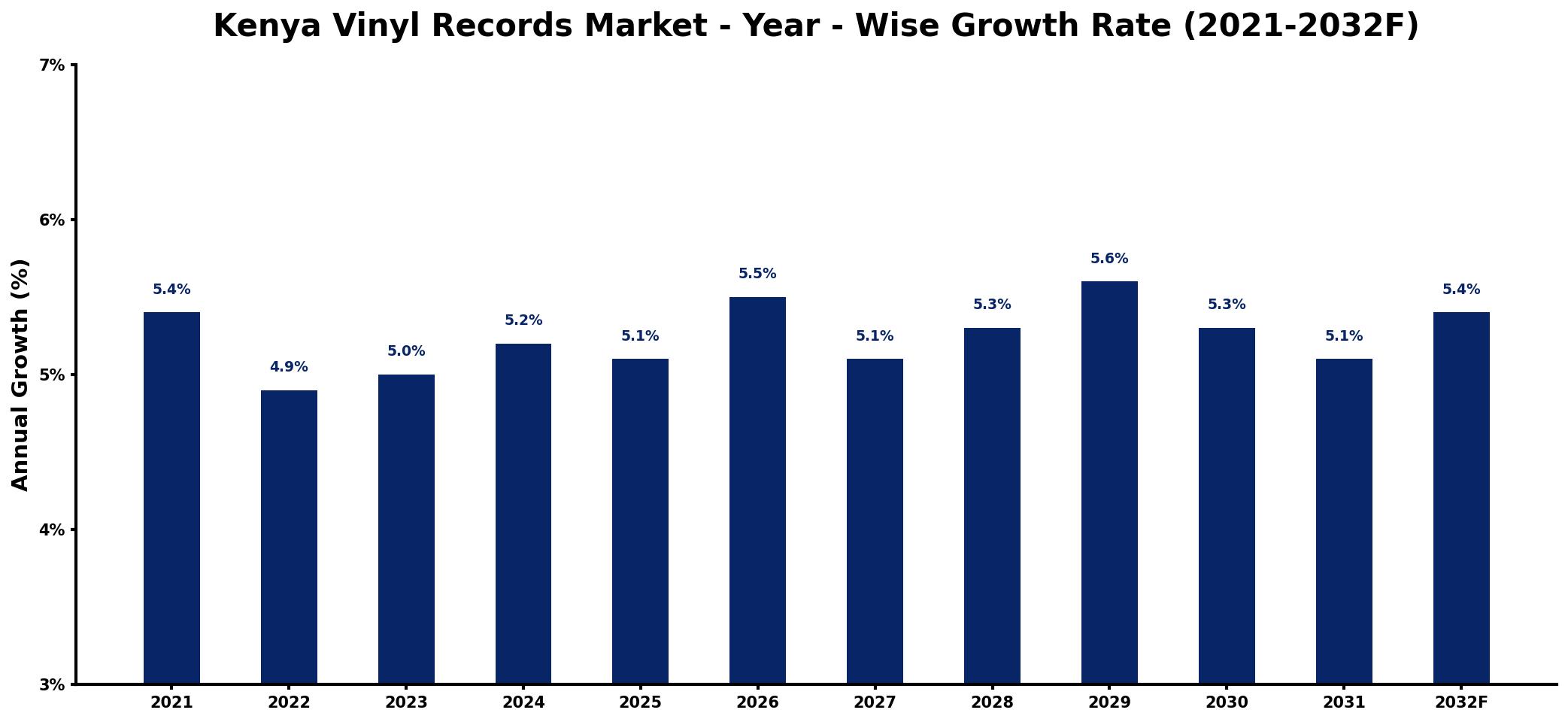
The table below presents the year‑wise growth rates along with the key drivers influencing the market
| Year | Growth Rate | Major Drivers |
| 2021 | 5.4% | Rising interest in analog music |
| 2022 | 4.9% | Growing collector community engagement |
| 2023 | 5.0% | Increased investment in music events |
| 2024 | 5.2% | Expansion of vintage music shops |
| 2025 | 5.1% | Surge in online music sales |
| 2026 | 5.5% | Emergence of new local labels |
| 2027 | 5.1% | Boost in music streaming partnerships |
| 2028 | 5.3% | Revival of retro-themed festivals |
| 2029 | 5.6% | Enhanced marketing for music experiences |
| 2030 | 5.3% | Wider distribution of music platforms |
| 2031 | 5.1% | Collaboration with fashion industries |
| 2032 | 5.4% | Strengthening of music education programs |
Note: Market size estimations and growth projections presented in this report are based on 6Wresearch's proprietary forecasting methodology, utilizing the latest available industry data, government publications, and primary research inputs.
Kenya Vinyl Records Market Synopsis
In recent years, the Kenya Vinyl Records Market has witnessed a vibrant resurgence, reflecting a growing appreciation for the richness and warmth of analog sound. With a diverse audience ranging from serious collectors to casual listeners, the market's appeal extends beyond music to encompass a lifestyle choice steeped in nostalgia.
The influx of specialized record stores and listening events has helped cultivate a thriving community around vinyl records, particularly in major cities like Nairobi. This environment fosters both cultural preservation and innovation, offering artists new avenues for expression while engaging consumers in a tangible music experience.
Kenya Vinyl Records Market Key Takeaways
- The market is projected to grow significantly, reaching USD 455 Million by 2032.
- Audiophiles and collectors are increasingly driving demand for high-quality analog sound experiences.
- The emergence of record fairs and specialized stores is enhancing consumer engagement and community building.
- Local and international artists are leveraging vinyl as a medium for new music releases.
- Despite challenges, opportunities exist for innovative investment in production and distribution channels.
Evaluation of Restraints in Kenya Vinyl Records Market
While the Kenya Vinyl Records Market shows promising growth, several key restraints hinder its full potential. One of the most pressing issues is the limited availability of local vinyl pressing facilities, which can result in increased production costs and longer turnaround times for releases. This situation is compounded by the existing challenges of copyright enforcement, impacting both artists and labels. Additionally, the markets distribution networks are still developing, making it difficult for artists to reach broader audiences and for consumers to access varied music offerings. Furthermore, the general lack of awareness and appreciation for vinyl as a medium compared to digital formats poses another hurdle, necessitating increased marketing efforts to elevate consumer interest.
Kenya Vinyl Records Market Trends
Current trends in the Kenya Vinyl Records Market highlight a growing enthusiasm for vintage formats among the younger demographics. This resurgence is characterized by the popularity of second-hand vinyl sales, as collectors actively seek rare finds to enhance their collections. Furthermore, social media plays a critical role in shaping vinyl culture, as enthusiasts share their experiences and discoveries, generating a buzz around specific genres and artists.
Additionally, collaborations between local musicians and vinyl producers are on the rise, creating opportunities for exclusive releases that captivate niche markets. Listening parties and record fairs are becoming staple events, encouraging social interaction and community building around the shared love for vinyl.
Kenya Vinyl Records Market Opportunities
As the market continues to expand, numerous investment opportunities arise for both businesses and collectors. Setting up dedicated vinyl retail outlets or e-commerce platforms caters to the growing demand while providing a venue for artists to showcase their work. Investors can also focus on sourcing rare records and engaging in the burgeoning second-hand market, where profits can be significant for limited editions or iconic releases. Partnerships with local artists to produce exclusive vinyl records can tap into a dedicated consumer base eager for unique offerings.
Government Initiatives in the Kenya Vinyl Records Market
While there are no specific government policies targeting the vinyl records sector, existing trade regulations and copyright laws indirectly influence its dynamics. The Kenyan governments broader initiatives aimed at promoting the creative arts could have positive implications for vinyl culture. Support for local artists, including grants or public showcases, can help elevate the profile of vinyl records and increase consumer engagement in the market.
Future Insights of the Kenya Vinyl Records Market
Looking ahead to 2026-2032, the Kenya Vinyl Records Market is poised for a sustained renaissance as interest in tangible music formats continues to grow. The resurgence of vinyl reflects not only a shift in consumer preferences but also a wider cultural movement that values authenticity and craftsmanship. As the community around vinyl expands, we can expect innovations in production techniques and distribution strategies. These developments, coupled with the persistent allure of rare and vintage records, will likely drive the markets growth trajectory in the coming years.
Kenya Vinyl Records Market Latest Developments (2025 - 2026)
In the past year, the Kenya Vinyl Records Market has seen a surge in the establishment of niche record stores and pop-up vinyl fairs, further invigorating the scene. Local artists are increasingly experimenting with vinyl releases, utilizing the format to create a distinct auditory experience that sets them apart in a digital landscape. Collaboration projects that promote local talent are gaining traction, contributing to an enriched cultural dialogue around music in Kenya. Moreover, awareness campaigns aimed at educating consumers about the benefits of vinyl have begun to take root, enhancing market prospects.
Kenya Vinyl Records Market - Key Attractiveness of the Report
- 10 Years of Market Numbers
- Historical Data Starting from 2022 to 2025
- Base Year: 2025
- Forecast Data until 2032
- Key Performance Indicators Impacting the Market
- Major Upcoming Developments and Projects
Key Highlights of the Report:
- Kenya Vinyl Records Market Outlook
- Market Size of Kenya Vinyl Records Market, 2025
- Forecast of Kenya Vinyl Records Market, 2032
- Historical Data and Forecast of Kenya Vinyl Records Revenues & Volume for the Period 2022-2032F
- Kenya Vinyl Records Market Trend Evolution
- Kenya Vinyl Records Market Drivers and Challenges
- Kenya Vinyl Records Price Trends
- Kenya Vinyl Records Porter's Five Forces
- Kenya Vinyl Records Industry Life Cycle
- Historical Data and Forecast of Kenya Vinyl Records Market Revenues & Volume By Product Type for the Period 2022-2032F
- Historical Data and Forecast of Kenya Vinyl Records Market Revenues & Volume By Long Play (LP) Vinyl Records for the Period 2022-2032F
- Historical Data and Forecast of Kenya Vinyl Records Market Revenues & Volume By Singles Vinyl Records for the Period 2022-2032F
- Historical Data and Forecast of Kenya Vinyl Records Market Revenues & Volume By Others for the Period 2022-2032F
- Historical Data and Forecast of Kenya Vinyl Records Market Revenues & Volume By Distribution Channel for the Period 2022-2032F
- Historical Data and Forecast of Kenya Vinyl Records Market Revenues & Volume By Online for the Period 2022-2032F
- Historical Data and Forecast of Kenya Vinyl Records Market Revenues & Volume By Offline for the Period 2022-2032F
- Kenya Vinyl Records Import Export Trade Statistics
- Market Opportunity Assessment By Product Type
- Market Opportunity Assessment By Distribution Channel
- Kenya Vinyl Records Top Companies Market Share
- Kenya Vinyl Records Competitive Benchmarking By Technical and Operational Parameters
- Kenya Vinyl Records Company Profiles
- Kenya Vinyl Records Key Strategic Recommendations






































