Kenya Wax Market Size, Share & Growth Rate
The Kenya Wax Market was estimated at USD 1391 Million in 2025 and is projected to reach USD 1990 Million by 2032, growing at a CAGR of 5.2% from 2026 to 2032. This growth trajectory is significantly influenced by the expanding personal care industry, along with a heightened demand for sustainable and eco-friendly packaging solutions. Innovations in wax production technologies also play a crucial role in shaping the market dynamics, driving forward both production capabilities and product diversification.
Kenya Wax Market Growth Rate Analysis (2021-2032)
The Kenya wax market has demonstrated steady expansion, witnessing a growth rate of 5.9% from 2021 to 2023, reflecting stable consumer demand for high-quality wax products. This trend is anticipated to continue, with growth projected at 6.4% in 2025 before slightly adjusting to 6.3% in 2026, likely due to evolving market dynamics and increased competition. Factors driving this growth include investments in sustainable production practices and technological advancements that enhance product quality. Furthermore, the country's infrastructure development efforts support distribution improvements, which are crucial for meeting rising consumer expectations. As we approach 2032, growth rates are expected to stabilize around 6.1% to 6.4%, underscoring a robust market environment.
Kenya Wax Market Year-wise Growth Rate and Key Drivers
This graph highlights how the Kenya Wax Market has steadily grown over the past five years, supported by major growth factors.
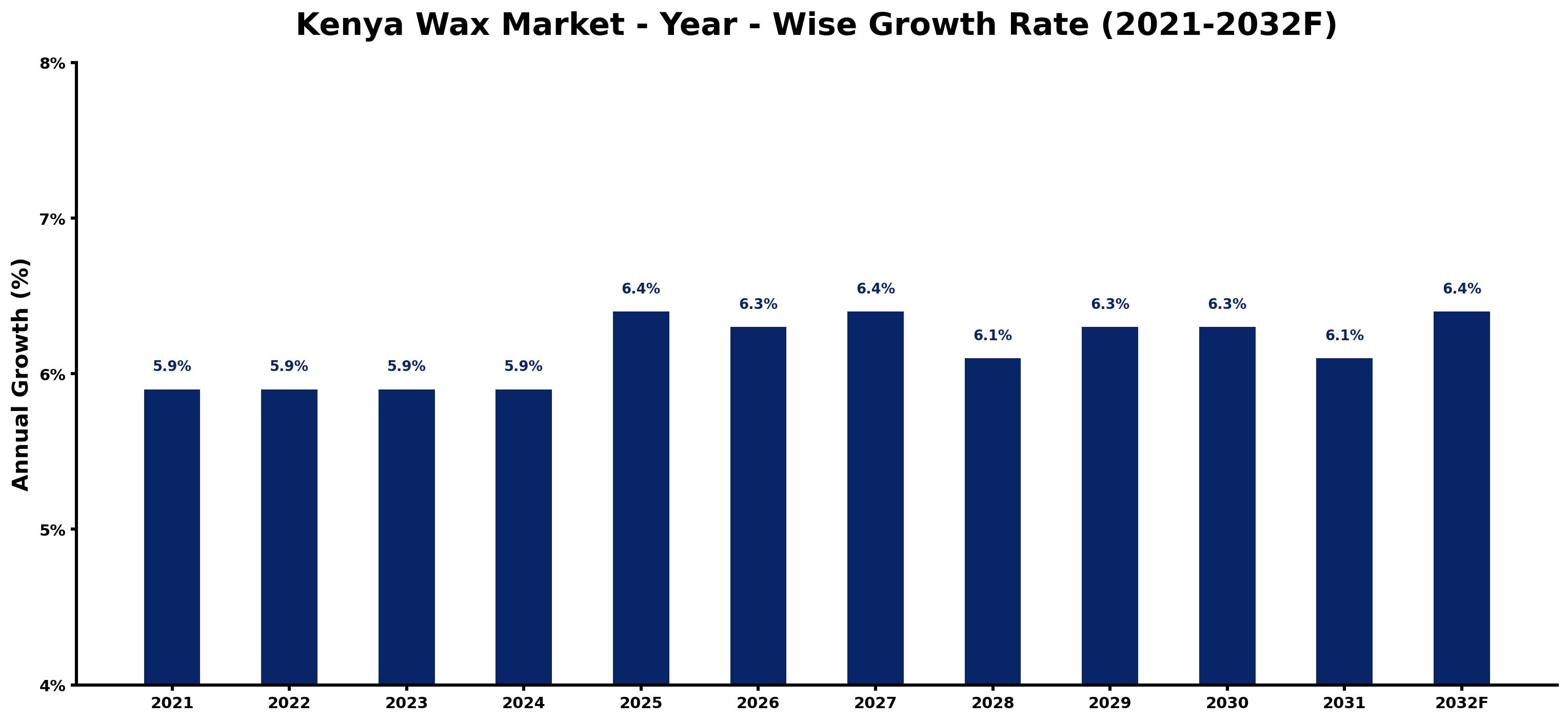
The table below presents the year‑wise growth rates along with the key drivers influencing the market
| Year | Growth Rate | Major Drivers |
| 2021 | 5.9% | Rising electricity demand across industries |
| 2022 | 5.9% | Rapid growth in telecom and data center sectors |
| 2023 | 5.9% | Increasing smart city development projects |
| 2024 | 5.9% | Rising electricity demand across industries |
| 2025 | 6.4% | Increasing adoption of advanced technologies |
| 2026 | 6.3% | Expansion of commercial construction activities |
| 2027 | 6.4% | Rising electricity demand across industries |
| 2028 | 6.1% | Increasing industrial infrastructure investments |
| 2029 | 6.3% | Increasing industrial automation investments |
| 2030 | 6.3% | Growing urbanization and commercial development |
| 2031 | 6.1% | Growing renewable energy integration projects |
| 2032 | 6.4% | Growing urbanization and commercial development |
Note - Market size estimations and growth projections presented in this report are based on 6Wresearch's advanced forecasting approach, validated with industry datasets as of June 2026.
Kenya Wax Market Synopsis
The strongest force currently shaping the Kenya Wax Market is the increasing demand for environmentally friendly products. This trend is particularly evident in the cosmetics and packaging sectors, where brands are seeking biodegradable alternatives to traditional materials. Additionally, the rise of local and international personal care brands is further propelling market growth, making it a vibrant space for innovation and investment.
As consumers become more conscious of sustainability, the popularity of natural waxes, such as beeswax, is on the rise. Simultaneously, advancements in refining processes are enhancing the quality of synthetic waxes, catering to diverse industrial applications. This dual approach is reshaping the competitive landscape, providing opportunities for both established players and new entrants.
Kenya Wax Market Key Takeaways
- The market is experiencing robust growth driven by personal care and packaging industries.
- Consumer preference is shifting towards eco-friendly and sustainable wax products.
- Innovations in wax production and refining technologies are enhancing product offerings.
- Government policies are supporting market growth through quality regulation and R&D incentives.
- The dependency on imported raw materials poses a challenge to market stability.
Evaluation of Restraints in Kenya Wax Market
Despite its promising growth, the Kenya Wax Market faces significant restraints. Fluctuating raw material costs can impact production and pricing, creating uncertainty for manufacturers. Additionally, the limited refining capacity within the country leads to dependency on imports, which can hinder the ability of local businesses to compete effectively. These challenges emphasize the need for strategic investments in local processing facilities to enhance self-sufficiency and stabilize the market.
Kenya Wax Market Trends
Several trends are currently shaping the Kenya Wax Market. The ongoing shift towards natural and organic products continues to drive demand for beeswax and other bio-based waxes. Concurrently, the rising prevalence of e-commerce has spurred innovations in packaging, pushing businesses to adopt more sustainable wax solutions. Furthermore, technological advancements in wax production processes are facilitating the emergence of new, high-performance wax products that meet evolving consumer preferences.
Kenya Wax Market Opportunities
Significant growth opportunities lie in the expansion of the local production of waxes. Investments in modernizing refining technologies and establishing manufacturing hubs can help alleviate the issues related to raw material dependency. Additionally, tapping into niche markets—such as biodegradable waxes for the food industry—presents avenues for product innovation. As the personal care sector continues to evolve, there is a clear demand for high-quality wax solutions that meet both functional and sustainability criteria.
Government Initiatives in the Kenya Wax Market
The Kenyan government is actively promoting the growth of the wax market through various initiatives aimed at enhancing product quality and safety. Policies include offering incentives to businesses investing in wax extraction and processing technologies, thus encouraging local production. Furthermore, the government supports research and development in wax applications, creating a favorable environment for innovation and bolstering local industry capabilities.
Future Insights of the Kenya Wax Market
Looking ahead to 2026-2032, the Kenya Wax Market is poised for substantial growth, driven by the increasing need for sustainable products across various sectors. As consumer preferences continue to evolve towards environmentally friendly options, businesses that align with these values are likely to thrive. The continued advancements in production technologies will also facilitate diversification in product offerings, enabling the market to cater to a broader range of applications.
Kenya Wax Market Latest Developments (May 2025 - June 2026)
Recent developments in the Kenya Wax Market indicate a growing focus on sustainability and innovation. Companies are increasingly investing in research to develop eco-friendly wax alternatives and improve refining processes. The government's initiatives to enhance local production capabilities are gaining traction, with several programs aimed at supporting small and medium enterprises in the wax sector. As these trends evolve, they are set to transform the competitive landscape of the market.
Kenya Wax Market - Key Attractiveness of the Report
- 10 Years of Market Numbers
- Historical Data Starting from 2022 to 2025
- Base Year: 2025
- Forecast Data until 2032
- Key Performance Indicators Impacting the Market
- Major Upcoming Developments and Projects
Key Highlights of the Report:
- Kenya Wax Market Outlook
- Market Size of Kenya Wax Market, 2025
- Forecast of Kenya Wax Market, 2032F
- Historical Data and Forecast of Kenya Wax Revenues & Volume for the Period 2022-2032F
- Kenya Wax Market Trend Evolution
- Kenya Wax Market Drivers and Challenges
- Kenya Wax Price Trends
- Kenya Wax Porter's Five Forces
- Kenya Wax Industry Life Cycle
- Historical Data and Forecast of Kenya Wax Market Revenues & Volume By Product for the Period 2022-2032F
- Historical Data and Forecast of Kenya Wax Market Revenues & Volume By Mineral for the Period 2022-2032F
- Historical Data and Forecast of Kenya Wax Market Revenues & Volume By Synthetic for the Period 2022-2032F
- Historical Data and Forecast of Kenya Wax Market Revenues & Volume By Natural for the Period 2022-2032F
- Historical Data and Forecast of Kenya Wax Market Revenues & Volume By Applications for the Period 2022-2032F
- Historical Data and Forecast of Kenya Wax Market Revenues & Volume By Candles for the Period 2022-2032F
- Historical Data and Forecast of Kenya Wax Market Revenues & Volume By Packaging for the Period 2022-2032F
- Historical Data and Forecast of Kenya Wax Market Revenues & Volume By Plastic & Rubber for the Period 2022-2032F
- Historical Data and Forecast of Kenya Wax Market Revenues & Volume By Cosmetics & Toiletries for the Period 2022-2032F
- Historical Data and Forecast of Kenya Wax Market Revenues & Volume By Fire Logs for the Period 2022-2032F
- Historical Data and Forecast of Kenya Wax Market Revenues & Volume By Adhesives for the Period 2022-2032F
- Historical Data and Forecast of Kenya Wax Market Revenues & Volume By Others for the Period 2022-2032F
- Kenya Wax Import Export Trade Statistics
- Market Opportunity Assessment By Product
- Market Opportunity Assessment By Applications
- Kenya Wax Top Companies Market Share
- Kenya Wax Competitive Benchmarking By Technical and Operational Parameters
- Kenya Wax Company Profiles
- Kenya Wax Key Strategic Recommendations






































