Kenya Welding Consumables Market Size, Share & Growth Rate
The Kenya Welding Consumables Market was estimated at USD 283 Million in 2025 and is projected to reach USD 393 Million by 2032, growing at a CAGR of 4.8% from 2026 to 2032. This growth trajectory is primarily fueled by robust infrastructure development and a burgeoning automotive sector, both of which demand high-quality welding materials. Additionally, the ongoing modernization of the manufacturing industry in Kenya further bolsters the market, as companies seek to enhance production efficiency and adopt advanced welding technologies.
Kenya Welding Consumables Market Year-wise Growth Rate and Key Drivers
This graph highlights how the Kenya Welding Consumables Market has steadily grown over the years, supported by major growth factors.
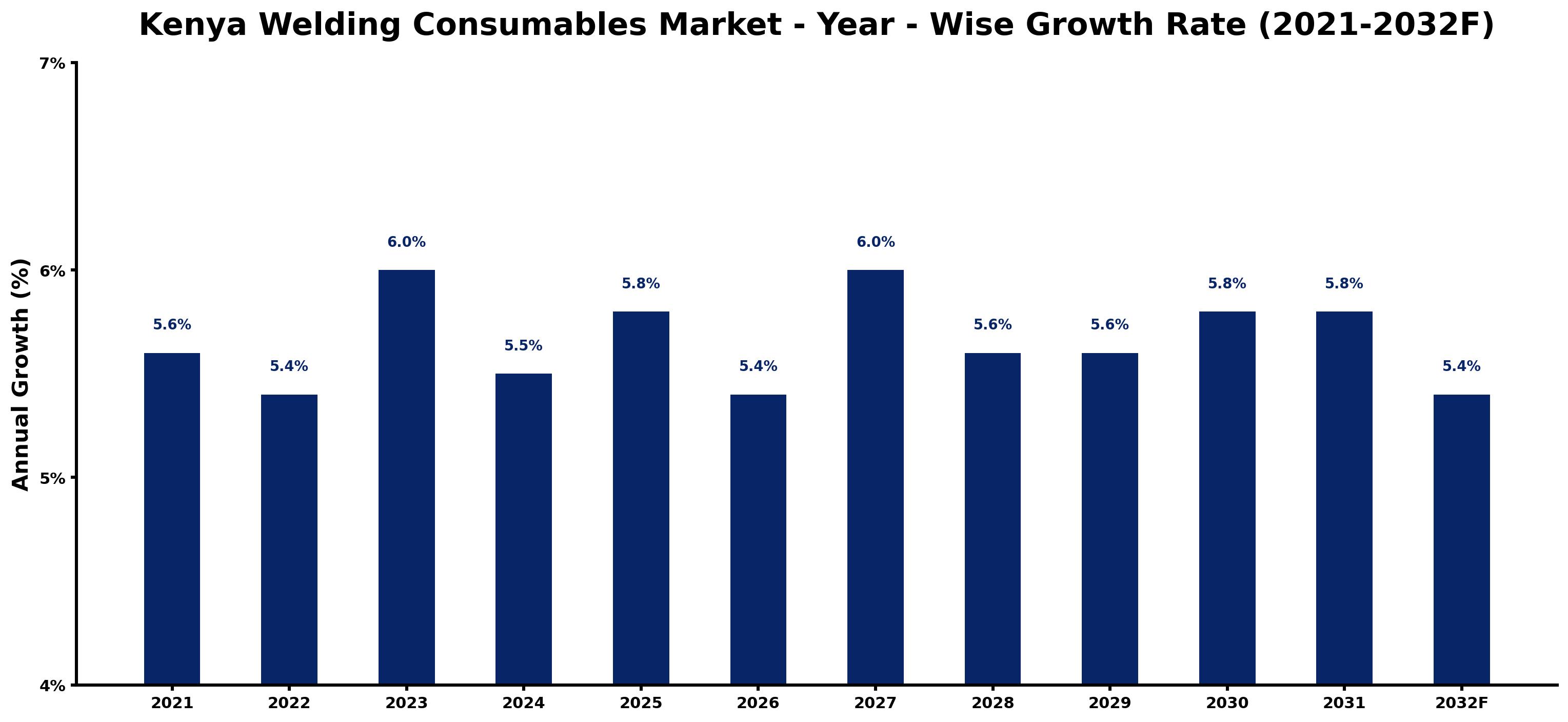
The table below presents the year‑wise growth rates along with the key drivers influencing the market
| Year | Growth Rate | Major Drivers |
| 2021 | 5.6% | Growing urbanization and commercial development |
| 2022 | 5.4% | Increasing adoption of advanced technologies |
| 2023 | 6.0% | Government infrastructure modernization initiatives |
| 2024 | 5.5% | Expansion of transportation and logistics networks |
| 2025 | 5.8% | Government infrastructure modernization initiatives |
| 2026 | 5.4% | Increasing industrial automation investments |
| 2027 | 6.0% | Expansion of manufacturing activities |
| 2028 | 5.6% | Increasing smart city development projects |
| 2029 | 5.6% | Increasing industrial infrastructure investments |
| 2030 | 5.8% | Expansion of commercial construction activities |
| 2031 | 5.8% | Increasing smart city development projects |
| 2032 | 5.4% | Rising electricity demand across industries |
Note - Market size estimations and growth projections presented in this report are based on 6Wresearch's advanced forecasting approach, validated with industry datasets as of June 2026.
Kenya Welding Consumables Market Synopsis
The strongest force shaping the Kenya Welding Consumables Market today is the government's commitment to infrastructure improvement. With numerous ongoing construction projects, there is a heightened need for reliable welding consumables to meet the rigorous demands of these developments. Simultaneously, as Kenya positions itself as an emerging automotive hub in East Africa, the increasing production of vehicles drives the demand for specialized welding materials.
The market is characterized by fierce competition between local suppliers and international manufacturers, all striving to meet stringent quality standards. The growing trend toward renewable energy projects also presents new opportunities for welding consumables, as industries adopt cleaner technologies that require specialized welding processes.
Kenya Welding Consumables Market Key Takeaways
- Infrastructure development is a major catalyst for market growth, with extensive construction projects underway.
- The automotive sector's expansion is significantly influencing demand for high-quality welding materials.
- Investments in renewable energy initiatives are opening new avenues for welding consumables usage.
- Local and international manufacturers face the challenge of meeting rigorous quality standards amidst fluctuating raw material costs.
- The lack of standardized testing processes underscores the need for improved product certification in the market.
Evaluation of Restraints in Kenya Welding Consumables Market
While the Kenya Welding Consumables Market is poised for growth, several restraints hinder its full potential. One significant challenge is the inconsistency in the quality and availability of raw materials such as alloys and fluxes. These fluctuations can adversely affect manufacturing processes and the final product's reliability. Moreover, the absence of standardized testing and certification hampers trust among consumers, leading to hesitancy in adopting newer products. The competitive landscape is also intensifying, as local manufacturers strive to offer quality products at competitive prices against low-cost imports, primarily from Asian markets.
Kenya Welding Consumables Market Trends
Current trends in the Kenya Welding Consumables Market reveal a growing preference for environmentally friendly materials. As industries pivot towards sustainability, there is an increasing demand for welding consumables that minimize environmental impact. Additionally, advancements in welding technology, such as automation and digitization, are changing how welding processes are conducted, thus shaping the types of consumables required.
Moreover, the rising skill levels among local welders are driving demand for high-performance consumables, as professionals seek to improve productivity and quality in their work. This trend is further supported by training programs aimed at enhancing welding skills in the country.
Kenya Welding Consumables Market Opportunities
Opportunities for growth within the Kenya Welding Consumables Market are emerging from various sectors. The increasing focus on renewable energy projects, such as solar and wind power, requires specialized welding materials that adhere to rigorous standards. Additionally, the automotive industry's transition towards electric vehicles presents a unique demand for innovative welding solutions, creating new avenues for manufacturers to explore. Lastly, collaboration with local governments and industries to enhance infrastructure projects can further stimulate demand for quality welding consumables.
Government Initiatives in the Kenya Welding Consumables Market
The Kenyan government is actively involved in promoting the welding consumables market through various initiatives aimed at enhancing local production capabilities. Policies that encourage investments in infrastructure development are being implemented, which in turn drive demand for quality welding materials. Furthermore, the Ministry of Industrialization, Trade, and Enterprise Development oversees regulations that seek to reduce import dependency and ensure compliance with quality standards for welding consumables, thereby fostering a competitive local manufacturing environment.
Future Insights of the Kenya Welding Consumables Market
Looking ahead to the period of 2026-2032, the Kenya Welding Consumables Market is likely to witness significant advancements driven by technological innovations and evolving consumer preferences. As industries increasingly adopt automation and precision welding techniques, the demand for high-performance consumables will continue to rise. Additionally, the government's focus on enhancing industrial capabilities, coupled with investments in renewable energy and infrastructure projects, suggests a robust growth outlook for the market. Stakeholders who adapt to these trends will be better positioned to capitalize on the emerging opportunities.
Kenya Welding Consumables Market Latest Developments (May 2025 - June 2026)
Recent developments in the Kenya Welding Consumables Market highlight a growing focus on innovation and quality improvement. Industry stakeholders are increasingly investing in research and development to enhance product offerings and meet international standards. Furthermore, collaborations between local manufacturers and international suppliers are becoming more common, aimed at sharing knowledge and technology, which is expected to elevate the overall market standards.
Kenya Welding Consumables Market - Key Attractiveness of the Report
- 10 Years of Market Numbers
- Historical Data Starting from 2022 to 2025
- Base Year: 2025
- Forecast Data until 2032
- Key Performance Indicators Impacting the Market
- Major Upcoming Developments and Projects
Key Highlights of the Report:
- Kenya Welding Consumables Market Outlook
- Market Size of Kenya Welding Consumables Market, 2025
- Forecast of Kenya Welding Consumables Market, 2032
- Historical Data and Forecast of Kenya Welding Consumables Revenues & Volume for the Period 2022-2032F
- Kenya Welding Consumables Market Trend Evolution
- Kenya Welding Consumables Market Drivers and Challenges
- Kenya Welding Consumables Price Trends
- Kenya Welding Consumables Porter's Five Forces
- Kenya Welding Consumables Industry Life Cycle
- Historical Data and Forecast of Kenya Welding Consumables Market Revenues & Volume By Type for the Period 2022-2032F
- Historical Data and Forecast of Kenya Welding Consumables Market Revenues & Volume By Stick Electrodes for the Period 2022-2032F
- Historical Data and Forecast of Kenya Welding Consumables Market Revenues & Volume By Solid Wires for the Period 2022-2032F
- Historical Data and Forecast of Kenya Welding Consumables Market Revenues & Volume By Flux Cored Wires for the Period 2022-2032F
- Historical Data and Forecast of Kenya Welding Consumables Market Revenues & Volume By SAW Wires & Fluxes for the Period 2022-2032F
- Historical Data and Forecast of Kenya Welding Consumables Market Revenues & Volume By End-user Industry for the Period 2022-2032F
- Historical Data and Forecast of Kenya Welding Consumables Market Revenues & Volume By Aerospace & Defense for the Period 2022-2032F
- Historical Data and Forecast of Kenya Welding Consumables Market Revenues & Volume By Automotive & Transportation for the Period 2022-2032F
- Historical Data and Forecast of Kenya Welding Consumables Market Revenues & Volume By Construction for the Period 2022-2032F
- Historical Data and Forecast of Kenya Welding Consumables Market Revenues & Volume By Energy for the Period 2022-2032F
- Historical Data and Forecast of Kenya Welding Consumables Market Revenues & Volume By Heavy Machinery for the Period 2022-2032F
- Historical Data and Forecast of Kenya Welding Consumables Market Revenues & Volume By Shipbuilding for the Period 2022-2032F
- Historical Data and Forecast of Kenya Welding Consumables Market Revenues & Volume By Process & Others for the Period 2022-2032F
- Historical Data and Forecast of Kenya Welding Consumables Market Revenues & Volume By Welding Technique for the Period 2022-2032F
- Historical Data and Forecast of Kenya Welding Consumables Market Revenues & Volume By Arc Welding for the Period 2022-2032F
- Historical Data and Forecast of Kenya Welding Consumables Market Revenues & Volume By Resistance Welding for the Period 2022-2032F
- Historical Data and Forecast of Kenya Welding Consumables Market Revenues & Volume By Oxy-fuel Welding for the Period 2022-2032F
- Historical Data and Forecast of Kenya Welding Consumables Market Revenues & Volume By Laser-beam Welding for the Period 2022-2032F
- Historical Data and Forecast of Kenya Welding Consumables Market Revenues & Volume By Others for the Period 2022-2032F
- Kenya Welding Consumables Import Export Trade Statistics
- Market Opportunity Assessment By Type
- Market Opportunity Assessment By End-user Industry
- Market Opportunity Assessment By Welding Technique
- Kenya Welding Consumables Top Companies Market Share
- Kenya Welding Consumables Competitive Benchmarking By Technical and Operational Parameters
- Kenya Welding Consumables Company Profiles
- Kenya Welding Consumables Key Strategic Recommendations






































