Kenya Wheat Bran Market Size, Share & Growth Rate
The Kenya Wheat Bran Market was estimated at USD 182 Million in 2025 and is projected to reach USD 238 Million by 2032, growing at a CAGR of 3.9% from 2026 to 2032. This growth is primarily driven by the expanding agricultural sector, which increasingly supports the demand for nutritious livestock feed. As poultry, dairy, and livestock farming operations proliferate, the rich fiber and nutrient profile of wheat bran positions it as a crucial component in formulating effective animal diets.
Kenya Wheat Bran Market Growth Rate Analysis (2021-2032)
The Kenya wheat bran market has exhibited stable growth over the past few years, with annual growth rates hovering around 4.4% to 4.9%. Notably, 2021 saw a growth of 4.8%, which slightly dipped to 4.4% in 2022 but bounced back to 4.5% in 2023. This consistency can be attributed to increasing consumer awareness regarding the health benefits of wheat bran and a heightened demand for nutritious food options. Furthermore, investments in milling technology and infrastructure improvements have supported production efficiency. Projections suggest growth will remain robust, with rates stabilizing around 4.5% through 2028 before a potential peak of 4.9% in 2026, reflecting ongoing consumer engagement and market expansion initiatives.
Kenya Wheat Bran Market Year-wise Growth Rate and Key Drivers
This graph highlights how the Kenya Wheat Bran Market has steadily grown over the past five years, supported by major growth factors.
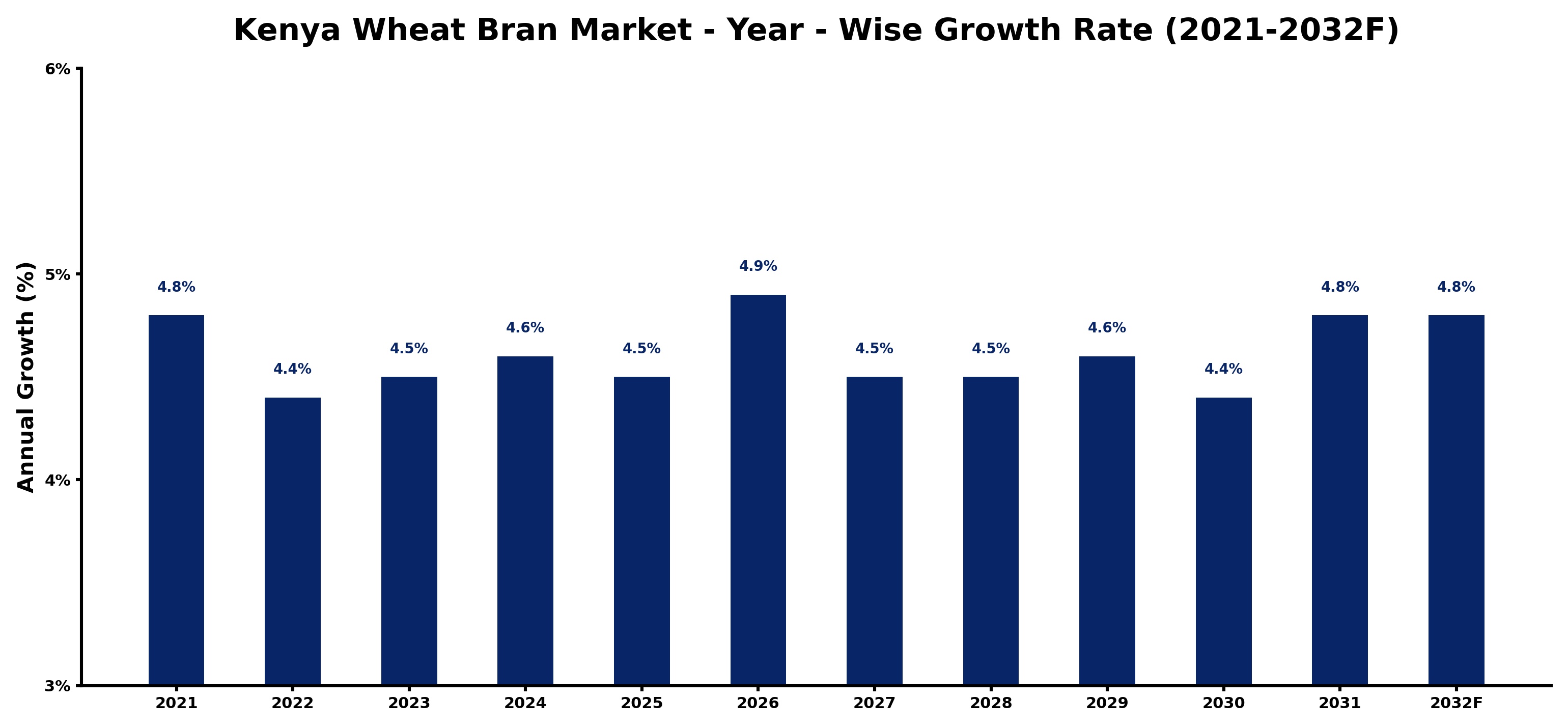
The table below presents the year‑wise growth rates along with the key drivers influencing the market
| Year | Growth Rate | Major Drivers |
| 2021 | 4.8% | Health awareness drove consumption growth |
| 2022 | 4.4% | Increased demand for nutritious options |
| 2023 | 4.5% | Baking trends fueled bran usage |
| 2024 | 4.6% | Local sourcing enhanced product availability |
| 2025 | 4.5% | Consumer interest in fiber-rich diets |
| 2026 | 4.9% | Innovative product offerings attracted buyers |
| 2027 | 4.5% | Export opportunities expanded market reach |
| 2028 | 4.5% | Sustainability trends influenced purchasing behavior |
| 2029 | 4.6% | Food fortification initiatives gained traction |
| 2030 | 4.4% | Increased awareness of health benefits |
| 2031 | 4.8% | Collaborations with health influencers increased |
| 2032 | 4.8% | E-commerce platforms enhanced accessibility |
Note - Market size estimations and growth projections presented in this report are based on 6Wresearch’s advanced forecasting approach, validated with industry datasets as of June 2026.
Kenya Wheat Bran Market Synopsis
The most significant force currently shaping the Kenya Wheat Bran market is the surge in demand for high-quality animal feed. With local milling companies and agricultural cooperatives stepping up to supply this essential ingredient, the industry is poised for notable advancements. The ongoing evolution in farming practices, alongside increased investments in the agricultural value chain, is further enhancing the market's robustness.
Moreover, the nutritional benefits of wheat bran are becoming widely recognized among livestock farmers, further fueling its adoption. The versatility of wheat bran, as both a feed ingredient and a component in other industrial applications, underscores its importance in the agricultural landscape of Kenya. This trend aligns well with the national agenda to boost food security and agricultural productivity.
Kenya Wheat Bran Market Key Takeaways
- The growing demand for livestock feed continues to be the primary driver of the Kenya Wheat Bran market.
- Wheat bran is increasingly recognized for its nutritional benefits, enhancing animal health and growth.
- Local milling companies are crucial suppliers, supporting agricultural cooperatives and enhancing food security.
- Market dynamics are influenced by variations in wheat harvests and competition from alternative feed sources.
- Government policies are providing essential support to promote agricultural productivity and quality standards.
Evaluation of Restraints in Kenya Wheat Bran Market
Despite the positive growth trajectory, the Kenya Wheat Bran market faces several restraints that could hinder its potential. Fluctuations in wheat harvests due to unpredictable weather patterns and varying agricultural practices often lead to supply inconsistencies. These inconsistencies can impact the availability and quality of wheat bran, thereby affecting its efficacy as a feed supplement. Furthermore, challenges related to transportation and storage conditions can diminish the nutritional value of wheat bran, presenting an additional layer of complexity for producers and consumers alike. The presence of competing feed supplements and imported alternatives also adds pressure on local suppliers to remain competitive in terms of pricing and quality.
Kenya Wheat Bran Market Trends
A notable trend in the Kenya Wheat Bran market is the increasing shift towards sustainable farming practices. As farmers seek to enhance the efficiency of their livestock operations, the focus on using locally sourced, nutrient-rich ingredients like wheat bran is gaining momentum. Additionally, the trend towards integrated farming systems, where crop and livestock production complement each other, is fostering greater demand for byproducts such as wheat bran. Technological advancements in processing and storage are also enhancing the quality and shelf-life of wheat bran, further influencing market dynamics.
Kenya Wheat Bran Market Opportunities
Investors and stakeholders in the Kenya Wheat Bran market can capitalize on several growth opportunities. The rising demand for organic livestock feed presents a lucrative avenue for wheat bran producers committed to sustainable practices. Furthermore, expanding export potential, especially within the East African region, could provide new revenue streams for local manufacturers. Collaborations with agricultural cooperatives to enhance supply chain efficiency also present an opportunity to meet rising demands more effectively.
Government Initiatives in the Kenya Wheat Bran Market
The Kenyan government is actively promoting initiatives aimed at bolstering the agricultural sector, particularly in areas related to food security and productivity. Policies designed to provide subsidies for wheat production and support for local milling industries are in place to strengthen the wheat bran supply chain. Additionally, regulatory measures aimed at ensuring quality standards and fair trade practices are being enforced, further fostering a conducive environment for market growth.
Future Insights of the Kenya Wheat Bran Market
Looking ahead to 2026-2032, the Kenya Wheat Bran market is expected to continue its upward trajectory, driven by sustained demand for animal feed. As the livestock sector evolves and expands, the focus on nutritional quality will likely grow, positioning wheat bran as an essential feed ingredient. Innovations in farming practices and processing technologies will further support market growth, reinforcing the pivotal role wheat bran plays in the broader agricultural value chain.
Kenya Wheat Bran Market Latest Developments (May 2025 - June 2026)
In recent months, the Kenya Wheat Bran market has witnessed significant developments, particularly in the areas of supply chain optimization and product quality enhancement. Local producers are increasingly investing in modern processing techniques to maintain the nutritional integrity of wheat bran. Moreover, initiatives aimed at improving transportation and storage conditions have emerged, addressing previous quality concerns. These advancements reflect a broader commitment within the industry to respond to changing market dynamics and consumer demands.
Kenya Wheat Bran Market - Key Attractiveness of the Report
- 10 Years of Market Numbers
- Historical Data Starting from 2022 to 2025
- Base Year: 2025
- Forecast Data until 2032
- Key Performance Indicators Impacting the Market
- Major Upcoming Developments and Projects
Key Highlights of the Report:
- Kenya Wheat Bran Market Outlook
- Market Size of Kenya Wheat Bran Market, 2025
- Forecast of Kenya Wheat Bran Market, 2032
- Historical Data and Forecast of Kenya Wheat Bran Revenues & Volume for the Period 2022-2032F
- Kenya Wheat Bran Market Trend Evolution
- Kenya Wheat Bran Market Drivers and Challenges
- Kenya Wheat Bran Price Trends
- Kenya Wheat Bran Porter's Five Forces
- Kenya Wheat Bran Industry Life Cycle
- Historical Data and Forecast of Kenya Wheat Bran Market Revenues & Volume By Product Type for the Period 2022-2032F
- Historical Data and Forecast of Kenya Wheat Bran Market Revenues & Volume By Animal Feed Grade for the Period 2022-2032F
- Historical Data and Forecast of Kenya Wheat Bran Market Revenues & Volume By Medical Use Grade for the Period 2022-2032F
- Historical Data and Forecast of Kenya Wheat Bran Market Revenues & Volume By Others for the Period 2022-2032F
- Historical Data and Forecast of Kenya Wheat Bran Market Revenues & Volume By Application for the Period 2022-2032F
- Historical Data and Forecast of Kenya Wheat Bran Market Revenues & Volume By Food Products for the Period 2022-2032F
- Historical Data and Forecast of Kenya Wheat Bran Market Revenues & Volume By Animal Feed for the Period 2022-2032F
- Historical Data and Forecast of Kenya Wheat Bran Market Revenues & Volume By Pharmacuticals for the Period 2022-2032F
- Historical Data and Forecast of Kenya Wheat Bran Market Revenues & Volume By Cosmetics for the Period 2022-2032F
- Historical Data and Forecast of Kenya Wheat Bran Market Revenues & Volume By Others for the Period 2022-2032F
- Kenya Wheat Bran Import Export Trade Statistics
- Market Opportunity Assessment By Product Type
- Market Opportunity Assessment By Application
- Kenya Wheat Bran Top Companies Market Share
- Kenya Wheat Bran Competitive Benchmarking By Technical and Operational Parameters
- Kenya Wheat Bran Company Profiles
- Kenya Wheat Bran Key Strategic Recommendations






































