Kenya Whipping Cream Market Size, Share & Growth Rate
The Kenya Whipping Cream Market was estimated at USD 293 Million in 2025 and is projected to reach USD 408 Million by 2032, growing at a CAGR of 4.8% from 2026 to 2032. This upward trajectory is driven by a convergence of factors including an expanding middle class with rising disposable incomes and a significant shift in consumer preferences towards premium and gourmet food products. Additionally, the burgeoning hospitality sector and the growing interest in baking and dessert preparation are further propelling market growth.
Kenya Whipping Cream Market Growth Rate Analysis (2021-2032)
The Kenya whipping cream market has exhibited steady growth, with an annual increase of 5.8% in 2021 and 2022, reflecting heightened consumer demand driven by the rising popularity of baking and coffee culture. This trend continued into 2023, where growth slightly accelerated to 5.9%, fueled by enhanced distribution channels and a growing middle class increasingly spending on premium dairy products. Although the growth rate is projected to stabilize around 5.8% to 5.6% from 2024 to 2028, minor fluctuations, such as the dip to 5.3% in 2027, can be attributed to external market pressures and supply chain challenges. Nevertheless, ongoing investments in dairy technology and infrastructure are expected to bolster the market's resilience through to 2032.
Kenya Whipping Cream Market Year-wise Growth Rate and Key Drivers
This graph highlights how the Kenya Whipping Cream Market has steadily grown over the past five years, supported by major growth factors.
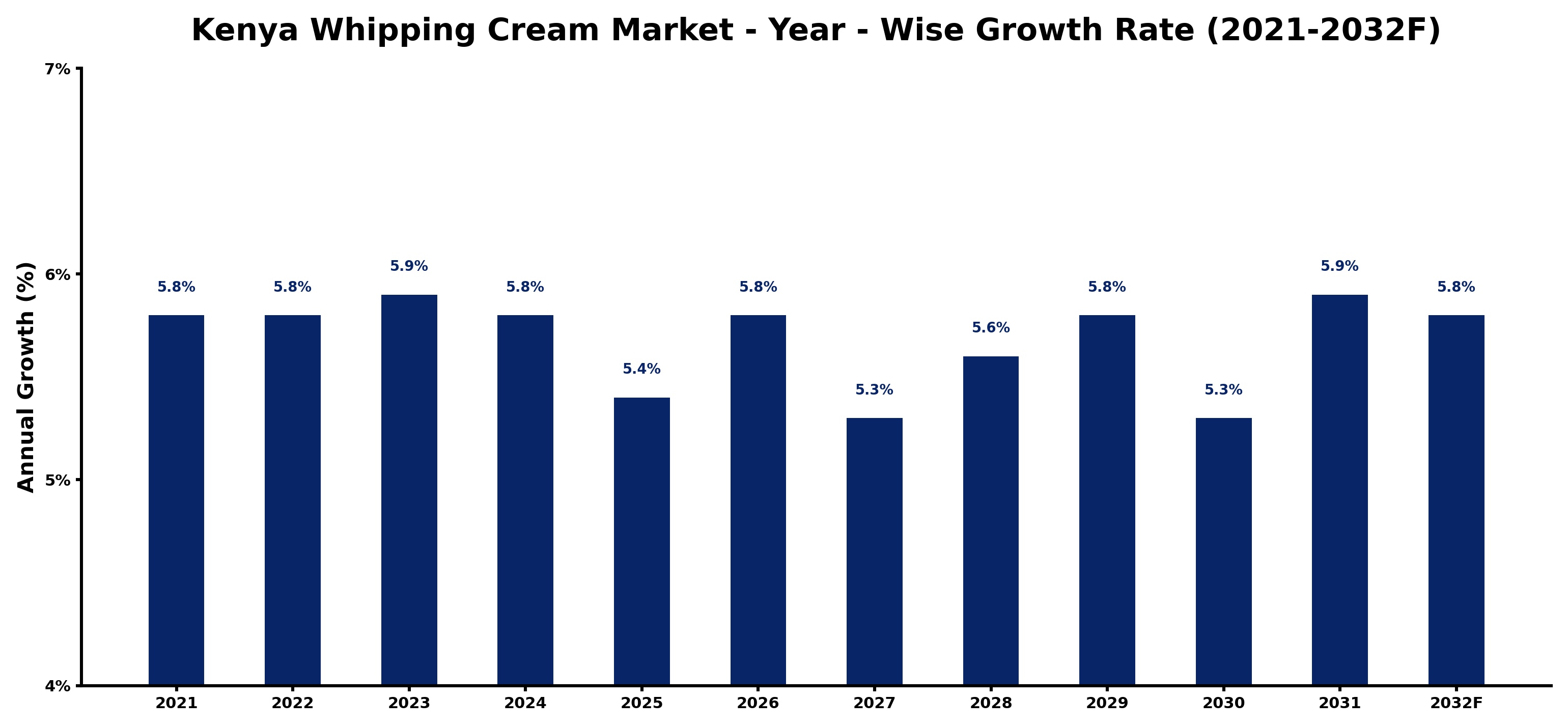
The table below presents the year‑wise growth rates along with the key drivers influencing the market
| Year | Growth Rate | Major Drivers |
| 2021 | 5.8% | Increased demand for desserts |
| 2022 | 5.8% | Growth in bakery sector sales |
| 2023 | 5.9% | Rising popularity of whipped toppings |
| 2024 | 5.8% | Expansion of dairy product offerings |
| 2025 | 5.4% | Emergence of artisanal cream brands |
| 2026 | 5.8% | Health-conscious consumer trends rising |
| 2027 | 5.3% | Innovative recipes using cream |
| 2028 | 5.6% | Social media food trends flourishing |
| 2029 | 5.8% | Catering services expanding rapidly |
| 2030 | 5.3% | Home baking trends gaining momentum |
| 2031 | 5.9% | Diverse culinary applications increasing |
| 2032 | 5.8% | Sustainable sourcing practices evolving |
Note - Market size estimations and growth projections presented in this report are based on 6Wresearch's advanced forecasting approach, validated with industry datasets as of June 2026.
Kenya Whipping Cream Market Synopsis
The Kenya whipping cream market has witnessed notable momentum in recent years, fueled by changing dietary habits and a growing inclination towards premium dairy offerings. This demand is expected to escalate as consumers increasingly seek indulgent culinary experiences.
In contrast, while the market exhibits robust growth potential, challenges remain. The relatively low awareness of whipping cream as a culinary ingredient and its higher price point compared to alternative dairy products may slow down widespread adoption. However, concerted efforts to educate consumers and innovate product offerings can bridge this gap.
Kenya Whipping Cream Market Key Takeaways
- Significant growth projected, with a market size expected to reach USD 408 Million by 2032.
- Increased disposable income and changing consumer preferences are driving demand for premium products.
- The rising popularity of plant-based alternatives is reshaping product offerings.
- The hospitality sector plays a crucial role in the market's expansion, contributing to elevated demand.
- Strategic partnerships with local farmers can enhance supply chain sustainability and product quality.
Evaluation of Restraints in Kenya Whipping Cream Market
Despite the promising outlook, the Kenya whipping cream market faces several significant challenges. Limited consumer awareness regarding whipping cream as a versatile culinary ingredient poses a barrier to entry for brands. Additionally, the relatively high cost of whipping cream, when compared to locally preferred dairy alternatives, may deter price-sensitive consumers. Furthermore, logistical challenges, particularly maintaining a cold chain for perishable products, can affect availability and market penetration, ultimately limiting the growth potential of whipping cream in Kenya. Addressing these restraints will be crucial for both new entrants and established brands seeking to thrive in this evolving market.
Kenya Whipping Cream Market Trends
Current trends in the Kenya whipping cream market indicate a marked shift towards premiumization, as consumers increasingly favor high-quality, indulgent products. There is a growing preference for healthier options, such as whipping creams that are lower in sugar, fat, and artificial additives, reflecting a wider trend towards wellness in food consumption. The rise of plant-based whipping cream alternatives is particularly noteworthy, catering to the expanding vegan and lactose-intolerant demographics. Innovative packaging solutions are also emerging, appealing to busy urban consumers seeking convenience without compromising quality.
Kenya Whipping Cream Market Opportunities
Investment opportunities within the Kenya whipping cream market are abundant. The ongoing growth of the foodservice industry presents a significant avenue for expansion, especially as dining experiences become more gourmet-centric. Additionally, establishing modern dairy processing facilities can ensure the production of high-quality products that meet international standards. Collaborating with local dairy farmers to secure a sustainable supply chain will also be instrumental. Innovative marketing strategies that highlight product uniqueness and environmental sustainability can further enhance brand positioning, appealing to an increasingly conscientious consumer base.
Government Initiatives in the Kenya Whipping Cream Market
While there are no specific government policies directly targeting the whipping cream market, the broader dairy industry in Kenya is regulated by the Kenya Dairy Board. This regulatory body sets standards for product quality, safety, and labeling, contributing to consumer protection and fostering industry growth. Furthermore, government initiatives aimed at supporting dairy farmers—such as training programs, market access, and financial assistance—have a positive indirect impact on the whipping cream market by ensuring a stable supply of high-quality dairy ingredients.
Future Insights of the Kenya Whipping Cream Market
Looking ahead to the period between 2026 and 2032, the future of the Kenya whipping cream market appears optimistic. Rising disposable incomes and a growing appetite for premium culinary ingredients will continue to drive demand. As urban populations become more affluent and exposed to global food trends, the inclination towards gourmet and baking products is expected to solidify. Consequently, market players who innovate and adapt to changing consumer preferences will likely thrive in this evolving landscape, creating exciting prospects for growth and investment.
Kenya Whipping Cream Market Latest Developments (May 2025 - June 2026)
In recent months, the Kenya whipping cream market has seen increased activity, particularly in product innovation and distribution strategies. New entrants are emerging with plant-based alternatives that cater to the growing vegan demographic, while established brands are revamping their packaging to enhance convenience and sustainability. Additionally, partnerships with local foodservice providers are strengthening market presence, creating a synergy that enhances visibility and accessibility for consumers. This evolving landscape positions the market for continued growth as it responds dynamically to consumer needs.
Kenya Whipping Cream Market - Key Attractiveness of the Report
- 10 Years of Market Numbers
- Historical Data Starting from 2022 to 2025
- Base Year: 2025
- Forecast Data until 2032
- Key Performance Indicators Impacting the Market
- Major Upcoming Developments and Projects
Key Highlights of the Report:
- Kenya Whipping Cream Market Outlook
- Market Size of Kenya Whipping Cream Market, 2025
- Forecast of Kenya Whipping Cream Market, 2032
- Historical Data and Forecast of Kenya Whipping Cream Revenues & Volume for the Period 2022-2032F
- Kenya Whipping Cream Market Trend Evolution
- Kenya Whipping Cream Market Drivers and Challenges
- Kenya Whipping Cream Price Trends
- Kenya Whipping Cream Porter's Five Forces
- Kenya Whipping Cream Industry Life Cycle
- Historical Data and Forecast of Kenya Whipping Cream Market Revenues & Volume By Product for the Period 2022-2032F
- Historical Data and Forecast of Kenya Whipping Cream Market Revenues & Volume By Dairy for the Period 2022-2032F
- Historical Data and Forecast of Kenya Whipping Cream Market Revenues & Volume By Non-Dairy for the Period 2022-2032F
- Historical Data and Forecast of Kenya Whipping Cream Market Revenues & Volume By Application for the Period 2022-2032F
- Historical Data and Forecast of Kenya Whipping Cream Market Revenues & Volume By B2B for the Period 2022-2032F
- Historical Data and Forecast of Kenya Whipping Cream Market Revenues & Volume By B2C for the Period 2022-2032F
- Historical Data and Forecast of Kenya Whipping Cream Market Revenues & Volume By Distribution Channel for the Period 2022-2032F
- Historical Data and Forecast of Kenya Whipping Cream Market Revenues & Volume By Warehouse Clubs for the Period 2022-2032F
- Historical Data and Forecast of Kenya Whipping Cream Market Revenues & Volume By Variety Stores for the Period 2022-2032F
- Historical Data and Forecast of Kenya Whipping Cream Market Revenues & Volume By Department Stores for the Period 2022-2032F
- Historical Data and Forecast of Kenya Whipping Cream Market Revenues & Volume By Online Retail for the Period 2022-2032F
- Historical Data and Forecast of Kenya Whipping Cream Market Revenues & Volume By Convenience Stores for the Period 2022-2032F
- Historical Data and Forecast of Kenya Whipping Cream Market Revenues & Volume By Supermarkets and Hypermarket for the Period 2022-2032F
- Historical Data and Forecast of Kenya Whipping Cream Market Revenues & Volume By Specialist Retailers for the Period 2022-2032F
- Historical Data and Forecast of Kenya Whipping Cream Market Revenues & Volume By Others for the Period 2022-2032F
- Kenya Whipping Cream Import Export Trade Statistics
- Market Opportunity Assessment By Product
- Market Opportunity Assessment By Application
- Market Opportunity Assessment By Distribution Channel
- Kenya Whipping Cream Top Companies Market Share
- Kenya Whipping Cream Competitive Benchmarking By Technical and Operational Parameters
- Kenya Whipping Cream Company Profiles
- Kenya Whipping Cream Key Strategic Recommendations






































