Kenya Wire Mesh Market Summary
The kenya wire mesh market was estimated at USD 218 Million in 2025 and is projected to reach USD 307 Million by 2032, growing at a CAGR of 5.8% from 2026 to 2032.
Kenya Wire Mesh Market Growth Rate Analysis (2021-2032)
The Kenya Wire Mesh market has exhibited stable growth, expanding at rates of 5.6% in 2021 and reaching 6.2% in 2023. This upward trend, sustained through 2024, is fueled by a burgeoning construction sector and increased investments in infrastructure projects, particularly as urbanization accelerates. The demand for durable fencing solutions and reinforcement in building projects has remained robust, with expectations of 5.9% growth by 2031. Policy initiatives aimed at enhancing local manufacturing have also bolstered market dynamics, encouraging technology adoption and more efficient production processes. Despite slight fluctuations, such as the anticipated 5.7% growth in 2025, the overall sentiment points to steady demand driven by infrastructure improvements and consumer confidence in the future.
Kenya Wire Mesh Market Year-wise Growth Rate and Key Drivers
This graph highlights how the Kenya Wire Mesh Market has steadily grown over the past five years, supported by major growth factors.
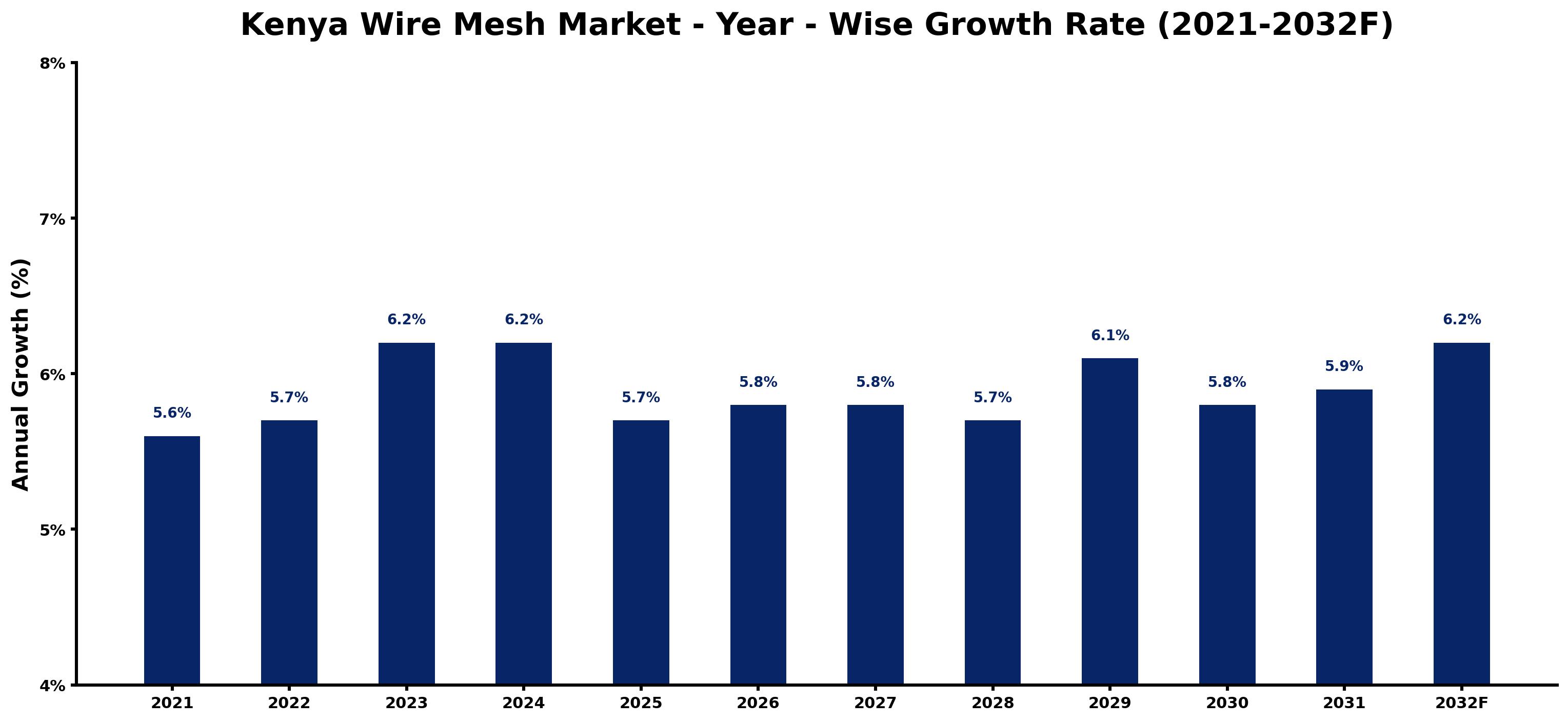
The table below presents the year wise growth rates along with the key drivers influencing the market
| Year | Growth Rate | Major Drivers |
| 2021 | 5.6% | Infrastructure projects expand, enhancing the demand for durable wire mesh solutions. |
| 2022 | 5.7% | Increased construction activities fuel the need for reliable fencing and reinforcements. |
| 2023 | 6.2% | Local manufacturers invest in technology to improve production efficiency of wire mesh. |
| 2024 | 6.2% | Urbanization trends create a surge in residential and commercial construction projects. |
| 2025 | 5.7% | Investment in renewable energy infrastructure requires advanced wire mesh for solar applications. |
| 2026 | 5.8% | Rising security concerns promote the use of wire mesh in protective structures. |
| 2027 | 5.8% | Growing agricultural investments drive demand for wire mesh in fencing and irrigation systems. |
| 2028 | 5.7% | Technological advancements decrease production costs, making wire mesh more accessible. |
| 2029 | 6.1% | E-commerce growth fuels logistics facilities, increasing wire mesh demand for warehouses. |
| 2030 | 5.8% | Environmental awareness boosts demand for sustainable wire mesh manufacturing practices. |
| 2031 | 5.9% | Regional trade agreements improve market access for imported wire mesh products. |
| 2032 | 6.2% | Economic diversification efforts lead to new sectors requiring wire mesh applications. |
Note - Market size estimations and growth projections presented in this report are based on 6Wresearch's advanced forecasting approach, validated with industry datasets as of June 2026.
Key Highlights of the Report:
- Kenya Wire Mesh Market Outlook
- Market Size of Kenya Wire Mesh Market, 2025
- Forecast of Kenya Wire Mesh Market, 2032F
- Historical Data and Forecast of Kenya Wire Mesh Revenues & Volume for the Period 2022-2032F
- Kenya Wire Mesh Market Trend Evolution
- Kenya Wire Mesh Market Drivers and Challenges
- Kenya Wire Mesh Price Trends
- Kenya Wire Mesh Porter's Five Forces
- Kenya Wire Mesh Industry Life Cycle
- Historical Data and Forecast of Kenya Wire Mesh Market Revenues & Volume By Types for the Period 2022-2032F
- Historical Data and Forecast of Kenya Wire Mesh Market Revenues & Volume By Electro Galvanized Welded Wire Mesh for the Period 2022-2032F
- Historical Data and Forecast of Kenya Wire Mesh Market Revenues & Volume By Hot Dipped Galvanized Welded Mesh for the Period 2022-2032F
- Historical Data and Forecast of Kenya Wire Mesh Market Revenues & Volume By PVC Coated Welded Mesh for the Period 2022-2032F
- Historical Data and Forecast of Kenya Wire Mesh Market Revenues & Volume By Welded Stainless Steel Mesh for the Period 2022-2032F
- Historical Data and Forecast of Kenya Wire Mesh Market Revenues & Volume By Welded Wire Fencing Panels for the Period 2022-2032F
- Historical Data and Forecast of Kenya Wire Mesh Market Revenues & Volume By Applications for the Period 2022-2032F
- Historical Data and Forecast of Kenya Wire Mesh Market Revenues & Volume By Construction for the Period 2022-2032F
- Historical Data and Forecast of Kenya Wire Mesh Market Revenues & Volume By Agricultural for the Period 2022-2032F
- Historical Data and Forecast of Kenya Wire Mesh Market Revenues & Volume By Industrial for the Period 2022-2032F
- Historical Data and Forecast of Kenya Wire Mesh Market Revenues & Volume By Transportation for the Period 2022-2032F
- Historical Data and Forecast of Kenya Wire Mesh Market Revenues & Volume By Horticultural for the Period 2022-2032F
- Historical Data and Forecast of Kenya Wire Mesh Market Revenues & Volume By Food Procuring Sector for the Period 2022-2032F
- Historical Data and Forecast of Kenya Wire Mesh Market Revenues & Volume By Others for the Period 2022-2032F
- Kenya Wire Mesh Import Export Trade Statistics
- Market Opportunity Assessment By Types
- Market Opportunity Assessment By Applications
- Kenya Wire Mesh Top Companies Market Share
- Kenya Wire Mesh Competitive Benchmarking By Technical and Operational Parameters
- Kenya Wire Mesh Company Profiles
- Kenya Wire Mesh Key Strategic Recommendations






































