Kenya Wood Charcoal Market Size, Share & Growth Rate
The Kenya Wood Charcoal Market was estimated at USD 468 Million in 2025 and is projected to reach USD 593 Million by 2032, growing at a CAGR of 3.4% from 2026 to 2032. This growth trajectory is primarily fueled by the increasing urbanization and the rising demand for affordable cooking fuel among households, as a large segment of the population continues to rely on wood charcoal. Moreover, as disposable incomes improve, there is a shift towards more efficient cooking practices, although the lack of access to alternative fuels remains a persistent challenge.
Kenya Wood Charcoal Market Growth Rate Analysis (2021-2032)
The Kenya wood charcoal market has experienced a gradual decline, with growth rates decreasing from 5.7% in 2021 to an anticipated 2.4% by 2032. Factors contributing to this trend include increasing regulatory pressure aimed at environmental sustainability, which is pushing many consumers toward cleaner energy alternatives. Additionally, shifts in technology are facilitating the development of more efficient cooking methods, further diminishing reliance on charcoal. Infrastructure improvements and urbanization have also influenced consumer preferences, driving demand for alternative energy sources. While there remains a steady market for charcoal, the ongoing energy transition is likely to continue impacting growth negatively, emphasizing the need for adaptation within the sector.
Kenya Wood Charcoal Market Year-wise Growth Rate and Key Drivers
This graph highlights how the Kenya Wood Charcoal Market has steadily grown over the past five years, supported by major growth factors.
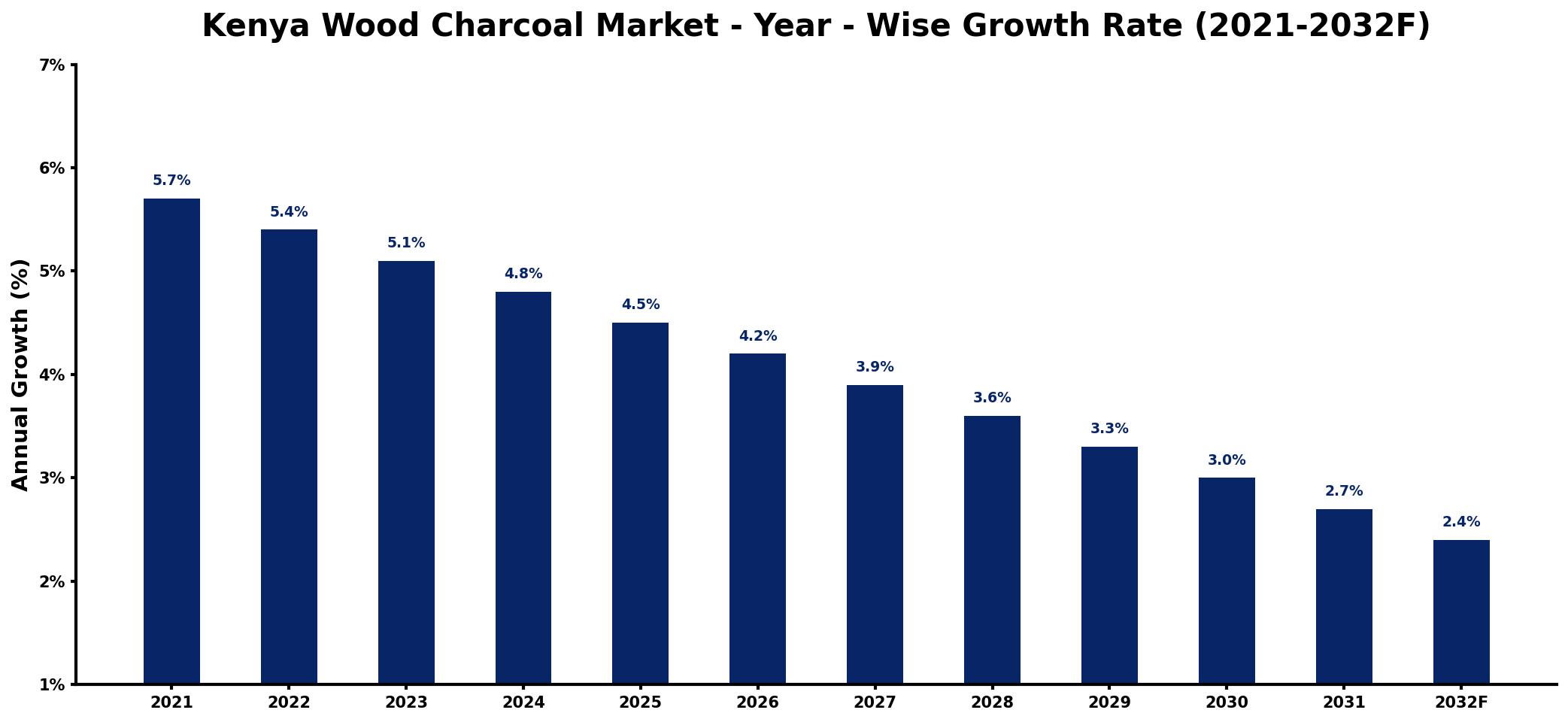
The table below presents the year‑wise growth rates along with the key drivers influencing the market
| Year | Growth Rate | Major Drivers |
| 2021 | 5.7% | Rising energy demand in households |
| 2022 | 5.4% | Increased investment in alternative fuels |
| 2023 | 5.1% | Expansion of rural cooking markets |
| 2024 | 4.8% | Growing exports to neighboring countries |
| 2025 | 4.5% | Higher urbanization rates driving consumption |
| 2026 | 4.2% | Sustainable sourcing initiatives gaining traction |
| 2027 | 3.9% | Emerging eco-friendly cooking solutions |
| 2028 | 3.6% | Enhanced distribution networks developing |
| 2029 | 3.3% | Rising awareness of renewable options |
| 2030 | 3.0% | Government support for sustainable practices |
| 2031 | 2.7% | Increased adoption of local businesses |
| 2032 | 2.4% | Growing popularity of biomass alternatives |
Note: Market size estimations and growth projections presented in this report are based on 6Wresearch's proprietary forecasting methodology, utilizing the latest available industry data, government publications, and primary research inputs.
Kenya Wood Charcoal Market Synopsis
In Kenya, wood charcoal serves as a primary energy source, crucial for both domestic cooking and industrial applications. The reliance on charcoal is particularly pronounced in urban and peri-urban areas, where its affordability and availability make it a staple choice for many households.
However, this reliance brings with it significant environmental concerns. The charcoal industry faces scrutiny for its impact on deforestation, prompting a shift towards more sustainable practices that balance economic growth with ecological preservation.
Kenya Wood Charcoal Market Key Takeaways
- The market's robust growth is driven by high domestic demand for cooking fuel and industrial use.
- Sustainable production practices are increasingly prioritized to combat deforestation and environmental impact.
- Government regulations are evolving to enhance quality standards and ensure responsible sourcing.
- Urbanization and rising incomes are shifting consumer preferences towards more efficient charcoal solutions.
- Market fragmentation due to informal production practices creates challenges in pricing stability and quality assurance.
Evaluation of Restraints in Kenya Wood Charcoal Market
The Kenya Wood Charcoal Market is significantly restrained by deforestation concerns and the ensuing environmental regulations. While these regulations aim to preserve the forest ecosystem, they also complicate the operations for producers, particularly those in the informal sector who often lack the resources to comply. Additionally, the inconsistency in quality standards leads to price volatility and consumer distrust. Furthermore, limited mechanization hampers production efficiency, constraining the sector's ability to scale sustainably in response to increasing demand.
Kenya Wood Charcoal Market Trends
A notable trend is the adoption of energy-efficient kilns, as producers look to improve yield while minimizing environmental impact. Additionally, the market is witnessing a gradual shift towards certified sustainable charcoal production, driven by both government initiatives and consumer awareness. The emphasis on eco-friendly alternatives is reshaping the landscape of wood charcoal supply, promoting practices that are better for the environment.
Kenya Wood Charcoal Market Opportunities
There are significant growth opportunities in the development of sustainable charcoal production technologies and practices. As consumers become more environmentally conscious, products that adhere to sustainability certifications are likely to gain traction. Furthermore, investments in mechanization and improved logistics can enhance production efficiency, allowing producers to better meet the growing demand while maintaining quality. With rising disposable incomes, opportunities also exist in diversifying into premium charcoal products for the growing middle class.
Government Initiatives in the Kenya Wood Charcoal Market
The Kenyan government has instituted a range of policies to regulate the wood charcoal industry, aimed at promoting sustainable practices and mitigating environmental degradation. This includes licensing requirements for producers and strict regulations on harvesting to protect forests. Moreover, the government is actively encouraging the transition to energy-efficient kilns and innovative production techniques, thereby fostering a framework that supports long-term sustainability in the charcoal market.
Future Insights of the Kenya Wood Charcoal Market
Looking ahead to 2026-2032, the Kenya Wood Charcoal Market is poised for continued growth, primarily driven by urban migration and rising energy needs. As more urban centers expand, the demand for reliable, affordable cooking fuel will likely intensify. The movement towards sustainable production practices will also gain momentum, propelled by both regulatory frameworks and increasing consumer preference for environmentally responsible products. This evolving landscape suggests a critical transition phase for the market, balancing economic viability with environmental stewardship.
Kenya Wood Charcoal Market Latest Developments (2025 - 2026)
Recent industry developments indicate a growing focus on sustainability within the wood charcoal sector. Producers are increasingly adopting eco-friendly kilns, which not only enhance production efficiency but also reduce emissions. Additionally, collaborations between government bodies and local producers are emerging, aimed at improving regulatory compliance and promoting sustainable harvesting practices across the country.
Kenya Wood Charcoal Market - Key Attractiveness of the Report
- 10 Years of Market Numbers
- Historical Data Starting from 2022 to 2025
- Base Year: 2025
- Forecast Data until 2032
- Key Performance Indicators Impacting the Market
- Major Upcoming Developments and Projects
Key Highlights of the Report:
- Kenya Wood Charcoal Market Outlook
- Market Size of Kenya Wood Charcoal Market, 2025
- Forecast of Kenya Wood Charcoal Market, 2032
- Historical Data and Forecast of Kenya Wood Charcoal Revenues & Volume for the Period 2022-2032F
- Kenya Wood Charcoal Market Trend Evolution
- Kenya Wood Charcoal Market Drivers and Challenges
- Kenya Wood Charcoal Price Trends
- Kenya Wood Charcoal Porter's Five Forces
- Kenya Wood Charcoal Industry Life Cycle
- Historical Data and Forecast of Kenya Wood Charcoal Market Revenues & Volume By Product for the Period 2022-2032F
- Historical Data and Forecast of Kenya Wood Charcoal Market Revenues & Volume By Charcoal Lumps for the Period 2022-2032F
- Historical Data and Forecast of Kenya Wood Charcoal Market Revenues & Volume By Charcoal Briquettes for the Period 2022-2032F
- Historical Data and Forecast of Kenya Wood Charcoal Market Revenues & Volume By Charcoal Powder for the Period 2022-2032F
- Historical Data and Forecast of Kenya Wood Charcoal Market Revenues & Volume By Wood for the Period 2022-2032F
- Historical Data and Forecast of Kenya Wood Charcoal Market Revenues & Volume By Softwood for the Period 2022-2032F
- Historical Data and Forecast of Kenya Wood Charcoal Market Revenues & Volume By Hardwood for the Period 2022-2032F
- Historical Data and Forecast of Kenya Wood Charcoal Market Revenues & Volume By Application for the Period 2022-2032F
- Historical Data and Forecast of Kenya Wood Charcoal Market Revenues & Volume By Fuel Feedstock for the Period 2022-2032F
- Historical Data and Forecast of Kenya Wood Charcoal Market Revenues & Volume By Reducing Agent for the Period 2022-2032F
- Historical Data and Forecast of Kenya Wood Charcoal Market Revenues & Volume By Filtration Agent & Gas Masking for the Period 2022-2032F
- Historical Data and Forecast of Kenya Wood Charcoal Market Revenues & Volume By Decolorizing Agent for the Period 2022-2032F
- Historical Data and Forecast of Kenya Wood Charcoal Market Revenues & Volume By Gastric Medicine for the Period 2022-2032F
- Historical Data and Forecast of Kenya Wood Charcoal Market Revenues & Volume By Sketches & Paints for the Period 2022-2032F
- Historical Data and Forecast of Kenya Wood Charcoal Market Revenues & Volume By Soil Conditioning for the Period 2022-2032F
- Historical Data and Forecast of Kenya Wood Charcoal Market Revenues & Volume By Others for the Period 2022-2032F
- Historical Data and Forecast of Kenya Wood Charcoal Market Revenues & Volume By End Use for the Period 2022-2032F
- Historical Data and Forecast of Kenya Wood Charcoal Market Revenues & Volume By Residential for the Period 2022-2032F
- Historical Data and Forecast of Kenya Wood Charcoal Market Revenues & Volume By Cooking Fuel for the Period 2022-2032F
- Historical Data and Forecast of Kenya Wood Charcoal Market Revenues & Volume By Gardening for the Period 2022-2032F
- Historical Data and Forecast of Kenya Wood Charcoal Market Revenues & Volume By Commercial Paints & Sketches for the Period 2022-2032F
- Historical Data and Forecast of Kenya Wood Charcoal Market Revenues & Volume By Water Treatment for the Period 2022-2032F
- Historical Data and Forecast of Kenya Wood Charcoal Market Revenues & Volume By Industrial for the Period 2022-2032F
- Kenya Wood Charcoal Import Export Trade Statistics
- Market Opportunity Assessment By Product
- Market Opportunity Assessment By Wood
- Market Opportunity Assessment By Application
- Market Opportunity Assessment By End Use
- Kenya Wood Charcoal Top Companies Market Share
- Kenya Wood Charcoal Competitive Benchmarking By Technical and Operational Parameters
- Kenya Wood Charcoal Company Profiles
- Kenya Wood Charcoal Key Strategic Recommendations






































