Kenya Wood Flooring Market Summary
The kenya wood flooring market was estimated at USD 720 Million in 2025 and is projected to reach USD 1031 Million by 2032, growing at a CAGR of 6.4% from 2026 to 2032.
Kenya Wood Flooring Market Year-wise Growth Rate and Key Drivers
This graph highlights how the Kenya Wood Flooring Market has steadily grown over the years, supported by major growth factors.
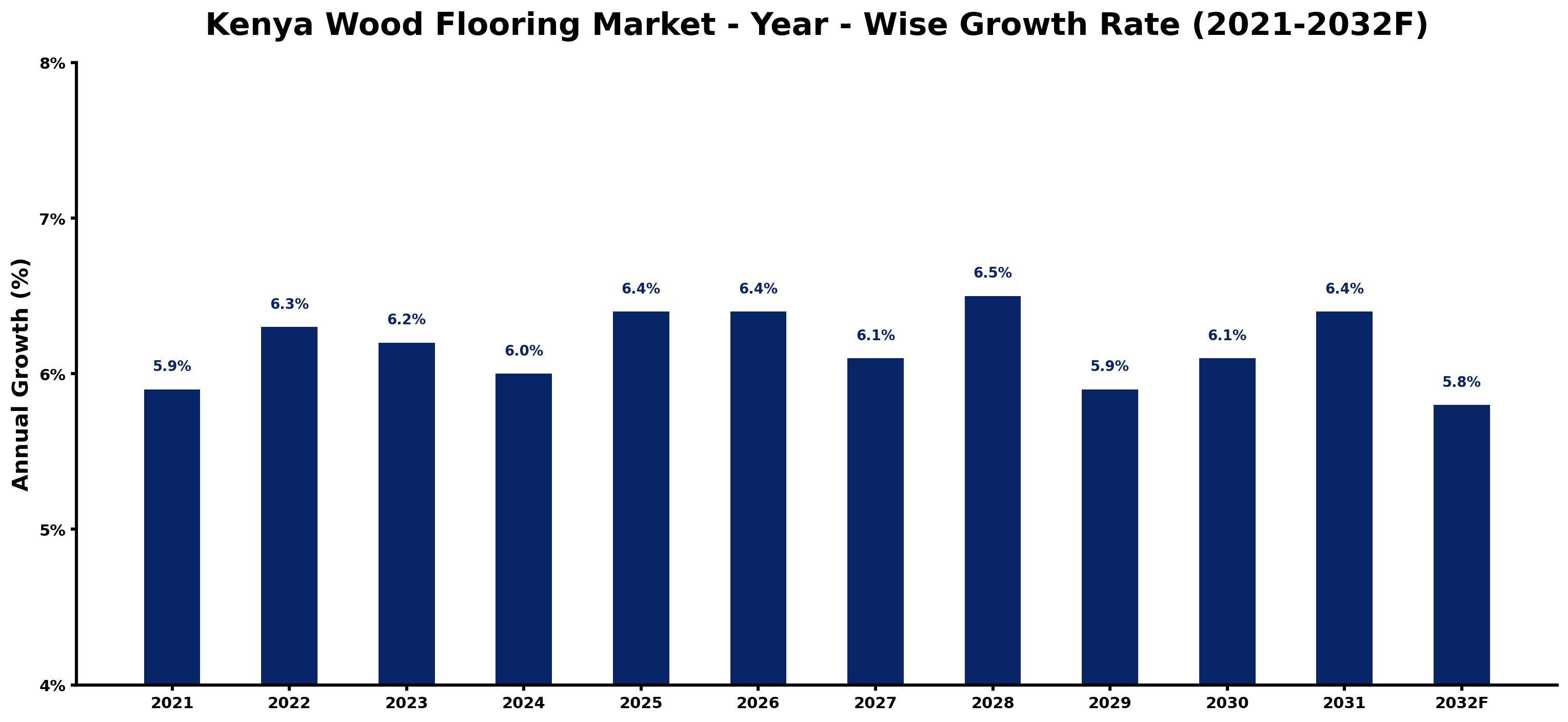
The table below presents the year wise growth rates along with the key drivers influencing the market
| Year | Growth Rate | Major Drivers |
| 2021 | 5.9% | Post-pandemic recovery amplifies demand for quality residential flooring solutions. |
| 2022 | 6.3% | Increased participation of local manufacturers enhances competitive pricing in flooring options. |
| 2023 | 6.2% | Urbanization trends spur new housing developments, expanding the wood flooring segment. |
| 2024 | 6.0% | Consumer preference shifts toward sustainable materials boosts market growth in eco-friendly flooring. |
| 2025 | 6.4% | Technological improvements in manufacturing processes enhance product durability and appeal. |
| 2026 | 6.4% | Investment in tourism infrastructure necessitates high-quality flooring for hospitality venues. |
| 2027 | 6.1% | Customization options for flooring attract affluent buyers seeking unique home aesthetics. |
| 2028 | 6.5% | Emergence of e-commerce platforms simplifies access to diverse wood flooring products. |
| 2029 | 5.9% | Increased awareness of maintenance benefits influences long-term flooring investments. |
| 2030 | 6.1% | Collaborations between architects and flooring companies foster innovative design solutions. |
| 2031 | 6.4% | Expanding middle-class population increases disposable income for home improvements. |
| 2032 | 5.8% | Environmental certification for wood products becomes a significant market differentiator. |
Note - Market size estimations and growth projections presented in this report are based on 6Wresearch's advanced forecasting approach, validated with industry datasets as of June 2026.
Kenya Wood Flooring Market Synopsis
The Kenya Wood Flooring Market is projected to reach 6.4% and witness significant growth during the forecast period (2026-2032). This growth is primarily driven by the increasing demand for aesthetically appealing and durable flooring solutions, coupled with rising construction activities across both residential and commercial sectors. The emergence of engineered wood products represents a shift toward sustainable and cost-effective alternatives to traditional hardwood, further fuelling market dynamics.
Kenya Wood Flooring Market Growth Drivers
The key drivers contributing to the expansion of the Kenya Wood Flooring Market encompass a range of demographic and economic factors. Firstly, urbanization is rapidly transforming the landscape of Kenyan cities, leading to a higher demand for residential and commercial real estate, which in turn drives flooring requirements. Secondly, the changing lifestyle preferences among consumers, who increasingly prioritize aesthetics and durability, are pushing the market towards innovative flooring solutions. Additionally, the affordability and sustainability of engineered wood products make them an appealing choice for many, further enhancing market prospects.
- The urbanization trend in Kenya is leading to increased construction activities, significantly impacting the demand for diverse flooring solutions.
- Changing consumer preferences towards sustainable and aesthetically pleasing solutions contribute to the growing popularity of engineered wood products.
- There is a rising awareness of environmental sustainability, encouraging consumers to opt for certified sustainable wood products.
- Investment in infrastructure development by both the government and private sectors stimulates demand for high-quality flooring solutions.
- The expansion of the real estate sector, particularly in urban areas, continues to drive construction and renovation projects, bolstering the wood flooring market.
Kenya Wood Flooring Market Challenges and Restraints
Despite the promising growth trajectory of the Kenya Wood Flooring Market, several challenges impede its progress. One significant challenge is the limited local manufacturing capabilities, which leads to a high dependency on imported flooring materials. This dependency not only affects pricing dynamics but also exposes the market to fluctuations in international supply chains. Moreover, inconsistent product quality and the absence of standardized grading systems contribute to reduced consumer confidence in local products, stalling market expansion. Furthermore, competition from alternative flooring materials, such as tiles and laminates, presents an ongoing challenge as consumers weigh their flooring options.
- High import dependency restricts the competitiveness of local products, leading to potential pricing disadvantages.
- Inconsistent quality across available products undermines consumer trust and decision-making.
- Lack of standardized grading systems for wood flooring jeopardizes market transparency and quality assurance.
- Competition from alternative flooring solutions, such as ceramic tiles and luxury vinyl, presents significant market challenges.
- Fluctuating import tariffs further complicate pricing structures, impacting market stability and growth.
Kenya Wood Flooring Market Government Investment and Initiatives
The Kenyan government plays a pivotal role in nurturing the wood flooring market through various policies and initiatives aimed at promoting sustainable forestry practices and local manufacturing capabilities. Regulatory frameworks are in place to ensure that wood flooring products not only meet quality standards but also adhere to environmental guidelines. These initiatives encourage the use of certified sustainable wood, thereby enhancing the market's sustainability credentials. Furthermore, the government is actively supporting research and development in innovative flooring technologies, which could create new opportunities for product differentiation and competitiveness on a global scale.
- Government regulations focus on promoting sustainable forestry, ensuring the responsible sourcing of wood materials.
- Incentives are provided for local manufacturers to boost production capabilities and reduce import dependency.
- Policies supporting research and innovation help drive advancements in flooring technologies and products.
- Quality assurance measures are implemented to ensure that wood flooring products meet both local and international standards.
- The government's commitment to sustainable practices helps to cultivate a more environmentally friendly industry.
Kenya Wood Flooring Market Latest Developments (May 2025 - June 2026)
Recent developments in the Kenya Wood Flooring Market between May 2025 and June 2026 indicate a continued focus on sustainability and innovation. The industry is witnessing increased collaboration between stakeholders aimed at improving the quality and availability of engineered wood products. Additionally, there has been a noticeable rise in government-led initiatives that promote local manufacturing and reduce import reliance. Industry players are also exploring new technologies that enhance the durability and aesthetic appeal of wood flooring solutions, aligning with consumer preferences for long-lasting products. This period has seen heightened awareness regarding environmental impacts, with more consumers showing interest in sustainable flooring materials.
Kenya Wood Flooring Market - Key Attractiveness of the Report
- 10 Years of Market Numbers
- Historical Data Starting from 2022 to 2025
- Base Year: 2025
- Forecast Data until 2032
- Key Performance Indicators Impacting the Market
- Major Upcoming Developments and Projects
Key Highlights of the Report:
- Kenya Wood Flooring Market Outlook
- Market Size of Kenya Wood Flooring Market, 2025
- Forecast of Kenya Wood Flooring Market, 2032F
- Historical Data and Forecast of Kenya Wood Flooring Revenues & Volume for the Period 2022-2032F
- Kenya Wood Flooring Market Trend Evolution
- Kenya Wood Flooring Market Drivers and Challenges
- Kenya Wood Flooring Price Trends
- Kenya Wood Flooring Porter's Five Forces
- Kenya Wood Flooring Industry Life Cycle
- Historical Data and Forecast of Kenya Wood Flooring Market Revenues & Volume By Product Type for the Period 2022-2032F
- Historical Data and Forecast of Kenya Wood Flooring Market Revenues & Volume By Solid Wood for the Period 2022-2032F
- Historical Data and Forecast of Kenya Wood Flooring Market Revenues & Volume By Engineered Wood for the Period 2022-2032F
- Historical Data and Forecast of Kenya Wood Flooring Market Revenues & Volume By Distribution Channel for the Period 2022-2032F
- Historical Data and Forecast of Kenya Wood Flooring Market Revenues & Volume By Home Centers for the Period 2022-2032F
- Historical Data and Forecast of Kenya Wood Flooring Market Revenues & Volume By Flagship Stores for the Period 2022-2032F
- Historical Data and Forecast of Kenya Wood Flooring Market Revenues & Volume By Specialty Stores for the Period 2022-2032F
- Historical Data and Forecast of Kenya Wood Flooring Market Revenues & Volume By Online for the Period 2022-2032F
- Historical Data and Forecast of Kenya Wood Flooring Market Revenues & Volume By Other for the Period 2022-2032F
- Historical Data and Forecast of Kenya Wood Flooring Market Revenues & Volume By End-User for the Period 2022-2032F
- Historical Data and Forecast of Kenya Wood Flooring Market Revenues & Volume By Residential for the Period 2022-2032F
- Historical Data and Forecast of Kenya Wood Flooring Market Revenues & Volume By Commercial for the Period 2022-2032F
- Kenya Wood Flooring Import Export Trade Statistics
- Market Opportunity Assessment By Product Type
- Market Opportunity Assessment By Distribution Channel
- Market Opportunity Assessment By End-User
- Kenya Wood Flooring Top Companies Market Share
- Kenya Wood Flooring Competitive Benchmarking By Technical and Operational Parameters
- Kenya Wood Flooring Company Profiles
- Kenya Wood Flooring Key Strategic Recommendations






































