Kenya Wood Wool Insulation Market Size, Share & Growth Rate
The Kenya Wood Wool Insulation Market was estimated at USD 486 Million in 2025 and is projected to reach USD 638 Million by 2032, growing at a CAGR of 4.0% from 2026 to 2032. This growth trajectory is primarily fueled by the rising demand for sustainable building materials, a necessity in light of the growing emphasis on energy efficiency within the construction sector. Moreover, the exceptional thermal and acoustic properties of wood wool panels make them an increasingly popular choice among architects and builders, further propelling market expansion.
Kenya Wood Wool Insulation Market Year-wise Growth Rate and Key Drivers
This graph highlights how the Kenya Wood Wool Insulation Market has steadily grown over the years, supported by major growth factors.
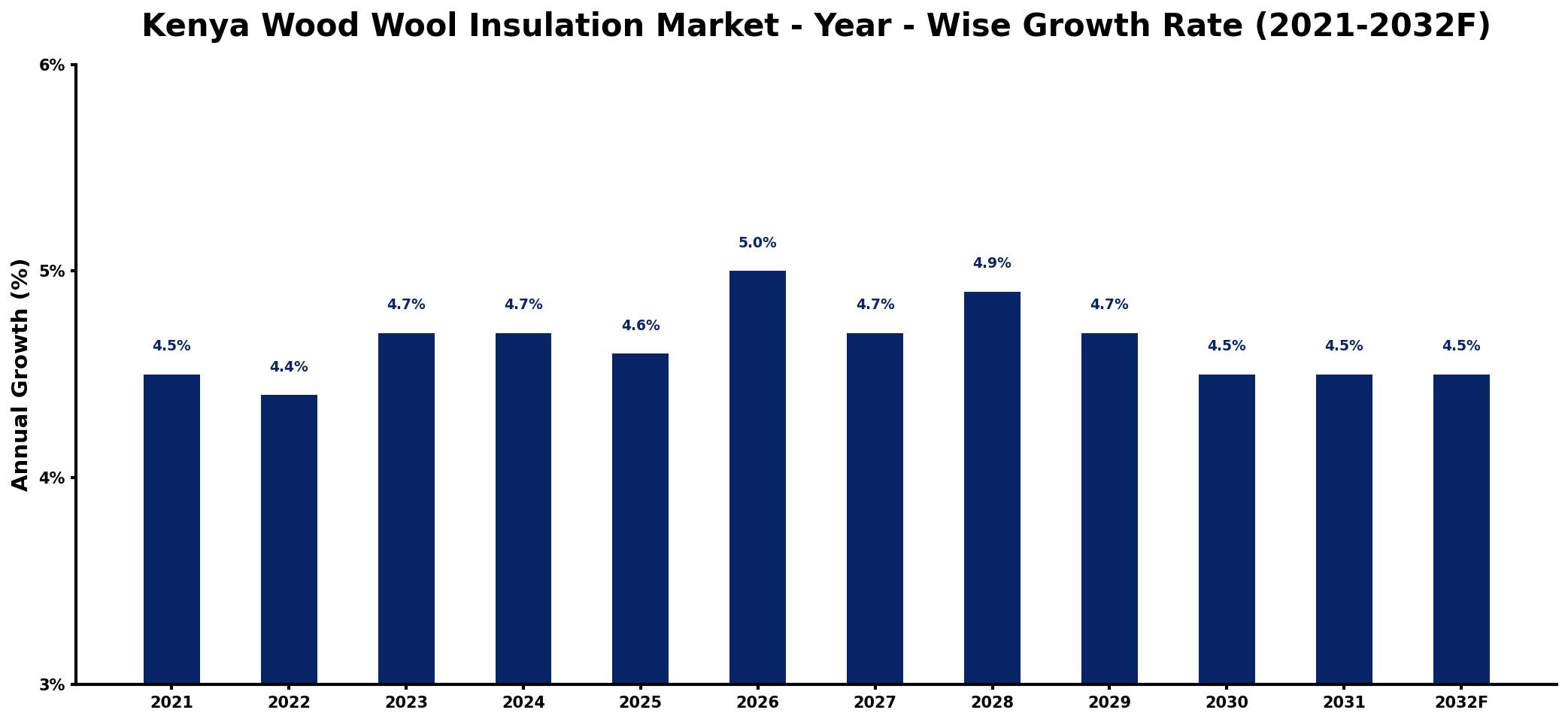
The table below presents the year‑wise growth rates along with the key drivers influencing the market
| Year | Growth Rate | Major Drivers |
| 2021 | 4.5% | Rising construction sector investments |
| 2022 | 4.4% | Increased energy efficiency awareness |
| 2023 | 4.7% | Growing sustainable building practices |
| 2024 | 4.7% | Expansion of green building certifications |
| 2025 | 4.6% | Surge in eco-friendly housing projects |
| 2026 | 5.0% | Government incentives for renewable materials |
| 2027 | 4.7% | Heightened consumer preference for sustainability |
| 2028 | 4.9% | Innovations in renewable material technologies |
| 2029 | 4.7% | Strengthened regulations on energy efficiency |
| 2030 | 4.5% | Increased demand for eco-conscious products |
| 2031 | 4.5% | Broader adoption of sustainable architecture |
| 2032 | 4.5% | Growing market for energy-efficient solutions |
Note: Market size estimations and growth projections presented in this report are based on 6Wresearch's proprietary forecasting methodology, utilizing the latest available industry data, government publications, and primary research inputs.
Kenya Wood Wool Insulation Market Synopsis
The recent momentum in the Kenya Wood Wool Insulation Market reflects a paradigm shift towards sustainable construction practices. With significant investments in green building initiatives, the market is at a crucial juncture. However, future growth hinges on addressing operational challenges and boosting local manufacturing capabilities.
As the market evolves, it is essential for stakeholders to navigate issues such as inconsistent material quality and limited awareness among consumers. The potential for growth remains robust, driven by increasing construction activities and favorable governmental policies promoting energy-efficient solutions.
Kenya Wood Wool Insulation Market Key Takeaways
- The market is witnessing a robust growth trajectory due to rising demands for energy-efficient building solutions.
- Wood wool insulation is favored for its impressive thermal and acoustic insulating properties.
- Challenges like limited local manufacturing and material supply inconsistencies need to be addressed for sustained growth.
- Government policies are evolving to support the adoption of sustainable building materials, including wood wool insulation.
- Future investments will likely concentrate on enhancing local production capabilities and increasing awareness among builders and consumers.
Evaluation of Restraints in Kenya Wood Wool Insulation Market
Despite the promising outlook for the Kenya Wood Wool Insulation Market, several key restraints persist. The high cost associated with importing advanced machinery inhibits local manufacturing capabilities, which stifles innovation and production scale-up. Furthermore, the market suffers from inconsistent supply and quality standards of raw materials, adversely affecting product performance. Compounding these issues is the relatively low consumer awareness regarding the benefits of wood wool insulation, resulting in lower adoption rates than optimal. Without robust government incentives and improved educational outreach, market growth may be restrained significantly.
Kenya Wood Wool Insulation Market Trends
Current trends indicate a significant pivot towards eco-friendly materials in construction. Increased public awareness about sustainability is driving demand for wood wool insulation, which is now recognized for its superior environmental benefits. Additionally, innovations in production technology are making wood wool insulation more accessible and affordable, appealing to both residential and commercial sectors. The rising influence of green building certifications further underscores the shift towards materials that promote thermal comfort and energy efficiency.
Kenya Wood Wool Insulation Market Opportunities
Opportunities for growth in the Kenya Wood Wool Insulation Market are burgeoning. Expansion in residential and commercial construction, combined with government pushes towards sustainable building practices, offers a fertile ground for investment. There is significant potential for local manufacturing facilities to emerge, addressing supply chain challenges and decreasing reliance on imports. Furthermore, partnerships with construction firms could enhance awareness and adoption, creating a win-win situation for both manufacturers and builders.
Government Initiatives in the Kenya Wood Wool Insulation Market
The Kenyan government is actively promoting energy efficiency and sustainable construction through various initiatives. Building codes and regulations increasingly prioritize thermal performance and the use of eco-friendly materials, including wood wool insulation. Incentives for local production and funding for research into innovative insulation technologies signal a commitment to meet the rising market demand. These efforts not only promote sustainability but also aim to fortify the local economy by nurturing homegrown industries.
Future Insights of the Kenya Wood Wool Insulation Market
Looking ahead to 2026-2032, the Kenya Wood Wool Insulation Market is poised for significant transformation. As the construction landscape continues to embrace sustainable practices, demand for wood wool insulation is likely to surge. A focus on energy efficiency will catalyze investments in production capabilities, while consumer education initiatives will foster greater awareness. Additionally, a collaborative approach between government and industry stakeholders may pave the way for innovative technologies and solutions, ensuring that the market stays ahead of emerging sustainability demands.
Kenya Wood Wool Insulation Market Latest Developments (2025 - 2026)
Recent developments within the Kenya Wood Wool Insulation Market indicate a growing alignment of industry practices with sustainable construction goals. Notable discussions around enhancing local manufacturing capabilities have emerged, signaling a proactive approach to addressing supply chain issues. Additionally, partnerships between government bodies and construction companies are starting to focus on integrating wood wool insulation into mainstream building practices, enhancing its visibility and adoption across both residential and commercial projects.
Kenya Wood Wool Insulation Market - Key Attractiveness of the Report
- 10 Years of Market Numbers
- Historical Data Starting from 2022 to 2025
- Base Year: 2025
- Forecast Data until 2032
- Key Performance Indicators Impacting the Market
- Major Upcoming Developments and Projects
Key Highlights of the Report:
- Kenya Wood Wool Insulation Market Outlook
- Market Size of Kenya Wood Wool Insulation Market, 2025
- Forecast of Kenya Wood Wool Insulation Market, 2032
- Historical Data and Forecast of Kenya Wood Wool Insulation Revenues & Volume for the Period 2022-2032F
- Kenya Wood Wool Insulation Market Trend Evolution
- Kenya Wood Wool Insulation Market Drivers and Challenges
- Kenya Wood Wool Insulation Price Trends
- Kenya Wood Wool Insulation Porter's Five Forces
- Kenya Wood Wool Insulation Industry Life Cycle
- Historical Data and Forecast of Kenya Wood Wool Insulation Market Revenues & Volume By Product Type for the Period 2022-2032F
- Historical Data and Forecast of Kenya Wood Wool Insulation Market Revenues & Volume By Stable for the Period 2022-2032F
- Historical Data and Forecast of Kenya Wood Wool Insulation Market Revenues & Volume By Flexible for the Period 2022-2032F
- Historical Data and Forecast of Kenya Wood Wool Insulation Market Revenues & Volume By Application for the Period 2022-2032F
- Historical Data and Forecast of Kenya Wood Wool Insulation Market Revenues & Volume By Thermal Insulation for the Period 2022-2032F
- Historical Data and Forecast of Kenya Wood Wool Insulation Market Revenues & Volume By Acoustic Insulation for the Period 2022-2032F
- Historical Data and Forecast of Kenya Wood Wool Insulation Market Revenues & Volume By Electrical Insulation for the Period 2022-2032F
- Kenya Wood Wool Insulation Import Export Trade Statistics
- Market Opportunity Assessment By Product Type
- Market Opportunity Assessment By Application
- Kenya Wood Wool Insulation Top Companies Market Share
- Kenya Wood Wool Insulation Competitive Benchmarking By Technical and Operational Parameters
- Kenya Wood Wool Insulation Company Profiles
- Kenya Wood Wool Insulation Key Strategic Recommendations






































