Kenya Zinc Sulphate Market Size, Share & Growth Rate
The Kenya Zinc Sulphate Market was estimated at USD 298 Million in 2025 and is projected to reach USD 393 Million by 2032, growing at a CAGR of 4.0% from 2026 to 2032. This growth trajectory is primarily propelled by the increasing demand for micronutrient fertilizers in agriculture, as farmers strive to improve yields and address nutrient deficiencies in crops. Furthermore, the rising interest in animal nutrition, where zinc sulphate plays a key role in enhancing growth and immunity, is adding to market momentum.
Kenya Zinc Sulphate Market Year-wise Growth Rate and Key Drivers
This graph highlights how the Kenya Zinc Sulphate Market has steadily grown over the years, supported by major growth factors.
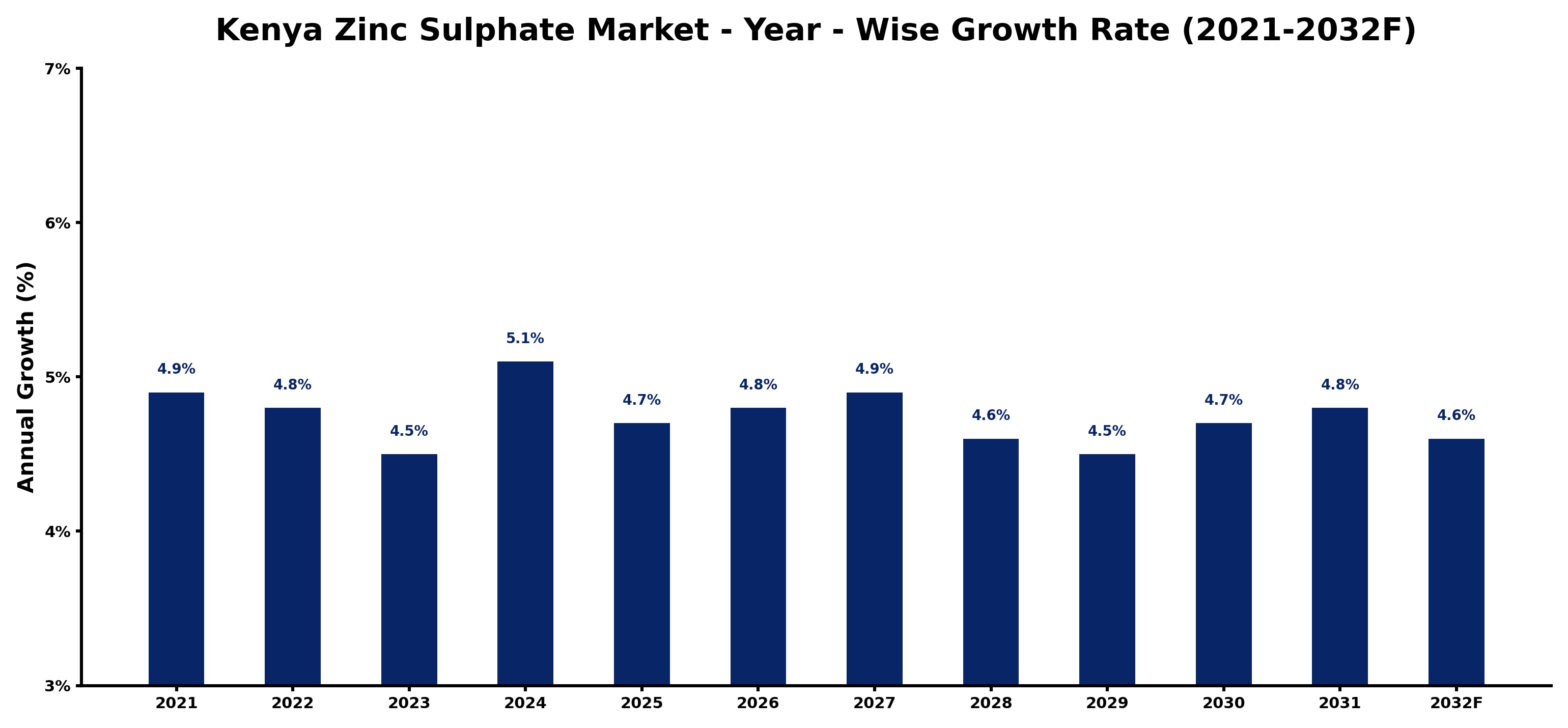
The table below presents the year‑wise growth rates along with the key drivers influencing the market
| Year | Growth Rate | Major Drivers |
| 2021 | 4.9% | Increased agricultural productivity demands |
| 2022 | 4.8% | Rising awareness of micronutrient benefits |
| 2023 | 4.5% | Enhanced fertilizer formulations gaining traction |
| 2024 | 5.1% | Government initiatives promoting zinc usage |
| 2025 | 4.7% | Growing demand for fortified crops |
| 2026 | 4.8% | Expansion of agricultural export markets |
| 2027 | 4.9% | Increased investment in agricultural research |
| 2028 | 4.6% | Sustainable farming practices gaining popularity |
| 2029 | 4.5% | Rising consumer health consciousness trends |
| 2030 | 4.7% | Technological advancements in farming techniques |
| 2031 | 4.8% | Collaboration with agricultural cooperatives expanding |
| 2032 | 4.6% | Industrial activity supported growth |
Note - Market size estimations and growth projections presented in this report are based on 6Wresearch's advanced forecasting approach, validated with industry datasets as of June 2026.
Kenya Zinc Sulphate Market Synopsis
In Kenya, the demand for zinc sulphate is significantly influenced by its critical role as a micronutrient fertilizer in agriculture. Farmers are increasingly recognizing the importance of zinc in crop development, particularly for staples like maize and beans, leading to higher utilization rates of this essential compound. Concurrently, the pharmaceutical sector is emerging as a notable consumer of zinc sulphate, where it serves as a vital dietary supplement, further driving market growth.
Despite its growing importance, the market remains challenged by limited local production capacities. A significant portion of zinc sulphate is still imported, which can elevate prices and affect accessibility for smaller farmers. The lack of awareness regarding the diverse applications of zinc sulphate also presents an opportunity for targeted educational initiatives to enhance its adoption.
Kenya Zinc Sulphate Market Key Takeaways
- The market's growth is primarily driven by agricultural applications, emphasizing the need for micronutrient fertilizers.
- Animal nutrition is an emerging application area contributing to the rising demand for zinc sulphate products.
- Government initiatives aim to enhance local production and reduce reliance on imports.
- Increasing awareness about the health benefits of zinc in human and animal nutrition is fostering market expansion.
- Despite growth opportunities, challenges related to production costs and awareness remain prevalent.
Evaluation of Restraints in Kenya Zinc Sulphate Market
The Kenya Zinc Sulphate Market faces several noteworthy restraints. A significant challenge is the reliance on imported zinc sulphate, which can lead to price volatility and supply inconsistencies. This situation is compounded by limited domestic manufacturing capabilities, which restricts local access to competitively priced products. Additionally, the lack of widespread knowledge regarding the effective usage and benefits of zinc sulphate in agriculture may hinder its adoption among farmers, especially smallholders. Addressing these challenges is crucial for unlocking the full potential of the market.
Kenya Zinc Sulphate Market Trends
Several trends are currently shaping the Kenya Zinc Sulphate Market. First, the growing emphasis on sustainable agricultural practices is driving the demand for zinc-based fertilizers that enhance soil health and crop productivity. Second, advancements in agricultural technology, including soil testing and precision farming, are allowing farmers to make data-driven decisions regarding nutrient management. Third, as the importance of animal health becomes more recognized, there is a shift towards integrated approaches that include nutritional supplements like zinc sulphate in livestock feed formulations.
Kenya Zinc Sulphate Market Opportunities
Opportunities for growth in the Kenya Zinc Sulphate Market are significant, particularly in enhancing local production capabilities. By investing in domestic manufacturing facilities, stakeholders can reduce dependency on imports and provide more affordable products to local farmers. Furthermore, there is an opportunity to increase awareness and education on the benefits of zinc sulphate in both agriculture and animal nutrition. Programs that focus on farmer training and engagement could result in higher adoption rates and contribute positively to overall market growth.
Government Initiatives in the Kenya Zinc Sulphate Market
The Kenyan government has taken proactive steps to support the zinc sulphate market through various initiatives. Policies aimed at boosting local production include tax incentives and subsidies for manufacturers. Moreover, there is a concerted effort to collaborate with industry stakeholders to enhance quality standards and ensure compliance with international regulations. Such government backing is designed to stimulate economic growth, create job opportunities, and bolster the country's competitive edge in the global zinc sulphate market.
Future Insights of the Kenya Zinc Sulphate Market
Looking ahead, the Kenya Zinc Sulphate Market is poised for robust growth between 2026 and 2032. As agricultural practices evolve and farmers increasingly recognize the value of micronutrient supplementation, demand for zinc sulphate is expected to rise steadily. Additionally, the integration of sustainable agricultural practices, alongside government efforts to bolster local production, will likely create a more resilient market. This strategic focus on enhancing both agricultural output and animal health suggests a promising future for stakeholders in the zinc sulphate sector.
Kenya Zinc Sulphate Market Latest Developments (May 2025 - June 2026)
Recent developments in the Kenya Zinc Sulphate Market indicate a growing interest in local production initiatives, with several manufacturers exploring the establishment of new facilities. There has also been a rise in collaborative efforts between agricultural organizations and governmental bodies to improve awareness and education regarding zinc supplementation. Innovations in agricultural practices, including precision farming techniques, are becoming more prevalent, leading to enhanced efficiency in nutrient application and usage.
Kenya Zinc Sulphate Market - Key Attractiveness of the Report
- 10 Years of Market Numbers
- Historical Data Starting from 2022 to 2025
- Base Year: 2025
- Forecast Data until 2032
- Key Performance Indicators Impacting the Market
- Major Upcoming Developments and Projects
Key Highlights of the Report:
- Kenya Zinc Sulphate Market Outlook
- Market Size of Kenya Zinc Sulphate Market, 2025
- Forecast of Kenya Zinc Sulphate Market, 2032
- Historical Data and Forecast of Kenya Zinc Sulphate Revenues & Volume for the Period 2022-2032F
- Kenya Zinc Sulphate Market Trend Evolution
- Kenya Zinc Sulphate Market Drivers and Challenges
- Kenya Zinc Sulphate Price Trends
- Kenya Zinc Sulphate Porter's Five Forces
- Kenya Zinc Sulphate Industry Life Cycle
- Historical Data and Forecast of Kenya Zinc Sulphate Market Revenues & Volume By Type for the Period 2022-2032F
- Historical Data and Forecast of Kenya Zinc Sulphate Market Revenues & Volume By Zinc Sulphate Anhydrous for the Period 2022-2032F
- Historical Data and Forecast of Kenya Zinc Sulphate Market Revenues & Volume By Zinc Sulphate Hexahydrate for the Period 2022-2032F
- Historical Data and Forecast of Kenya Zinc Sulphate Market Revenues & Volume By Zinc Sulphate Heptahydrate for the Period 2022-2032F
- Historical Data and Forecast of Kenya Zinc Sulphate Market Revenues & Volume By Zinc Sulphate Monohydrate for the Period 2022-2032F
- Historical Data and Forecast of Kenya Zinc Sulphate Market Revenues & Volume By Application for the Period 2022-2032F
- Historical Data and Forecast of Kenya Zinc Sulphate Market Revenues & Volume By Agrochemicals for the Period 2022-2032F
- Historical Data and Forecast of Kenya Zinc Sulphate Market Revenues & Volume By Chemicals for the Period 2022-2032F
- Historical Data and Forecast of Kenya Zinc Sulphate Market Revenues & Volume By Pharmaceuticals for the Period 2022-2032F
- Historical Data and Forecast of Kenya Zinc Sulphate Market Revenues & Volume By Synthetic Fibers for the Period 2022-2032F
- Historical Data and Forecast of Kenya Zinc Sulphate Market Revenues & Volume By Water Treatment for the Period 2022-2032F
- Historical Data and Forecast of Kenya Zinc Sulphate Market Revenues & Volume By Others for the Period 2022-2032F
- Kenya Zinc Sulphate Import Export Trade Statistics
- Market Opportunity Assessment By Type
- Market Opportunity Assessment By Application
- Kenya Zinc Sulphate Top Companies Market Share
- Kenya Zinc Sulphate Competitive Benchmarking By Technical and Operational Parameters
- Kenya Zinc Sulphate Company Profiles
- Kenya Zinc Sulphate Key Strategic Recommendations






































