Topics Covered in Kuwait Courier Market Report
Kuwait Courier Market Report thoroughly covers the market by Type, Delivery Mode, Customer Type, Destination and End-User. Kuwait Courier Market Outlook report provides an unbiased and detailed analysis of the ongoing Kuwait Courier Market trends, opportunities/high growth areas, and market drivers. This would help stakeholders devise and align their market strategies according to the current and future market dynamics.
Kuwait Courier Market Synopsis
During the period of 2021-2024, the Kuwait Courier market grew driven by rapid urbanization and digital transformation, significantly impacting its courier and logistics sector. The urban population surged tremendously, achieving full urbanization by 2024. This expansion, concentrated in Kuwait City and emerging areas such as Al-Mutlaa and South Abdullah Al-Mubarak, intensified demand for last-mile delivery services. The courier market benefited from a booming e-commerce landscape, as online spending surged, with local e-purchases dominating and card transactions occurring online. The retail sector also expanded, with consumer spending massively, while declining cash usage and rising POS transactions boosted delivery volumes and operational efficiency. These developments established a robust foundation for courier market growth, marked by increased digital transactions, and a premium, delivery-focused market.
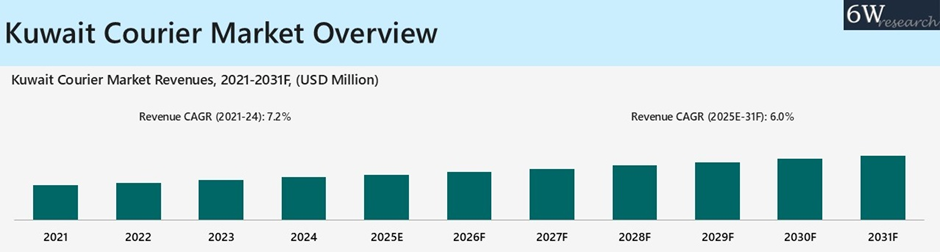
According to 6Wresearch, Kuwait Courier Market revenue is projected to grow at a CAGR of 6.0% during 2025-2031, supported by projected population growth in the country and urban concentration in hubs such as Kuwait City. Major infrastructure projects under the Fourth Kuwait Master Plan and Vision 2035, along with international collaborations, are enhancing smart logistics and transport systems. The Digital Trade Enabling Law and continued growth in online grocery and foodservice sectors, alongside rising electronic payments, would enhance scalability and responsiveness in the courier ecosystem. A projected a surge in the market size rate in e-commerce would reinforce demand for fast and reliable delivery. Growing mobile-first and omnichannel retail models, especially in grocery and B2B segments, would keep courier services central to Kuwait’s digital and economic transformation.
Market Segmentation by Type
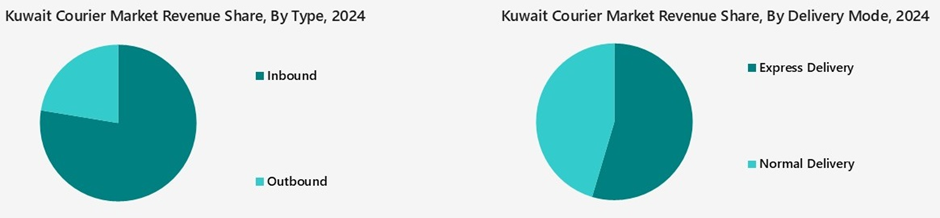
Kuwait's inbound courier market is driven by its high import dependency across consumer goods, electronics, pharmaceuticals, and industrial components—most of which arrive via air express. Cross-border e-commerce remains strong, with Kuwaitis frequently ordering premium products from global platforms. Businesses also rely on inbound shipments for samples and critical components. Additionally, the country’s large expatriate population fuels steady personal imports from home countries, further boosting inbound volume and value.
Market Segmentation by Delivery Mode
In 2024, Express delivery segment led the Kuwait courier market revenue share, influenced by premium B2B/B2C services including same-day or next-day delivery services, coupled with time-sensitive international shipments demand was on the rise. Logistics providers and e commerce brands both introduced fast delivery solution to stay at the top in the market, which appeal customers and repeat purchases.
Market Segmentation by Customer Type
B2B leads the Kuwait courier market majorly, driven by a strong landscape of the sectors, including commercial, industrial and institutional. Kuwait’s economy has been increasingly becoming consumer-driven, still revolving around several major sectors such as, BFSI, healthcare, oil & gas, construction, and oil & gas, construction, these all generate a high and consistent demand and parcel traffic between businesses.Market Segmentation by Destination
Domestic courier services have a higher share of total market value in Kuwait. This is due to high-volume local e-commerce, expanding C2C trade, and growing demand for fast intra-city delivery. Faster services are only available domestically, and they command higher per-parcel revenue.
Market Segmentation by End-User
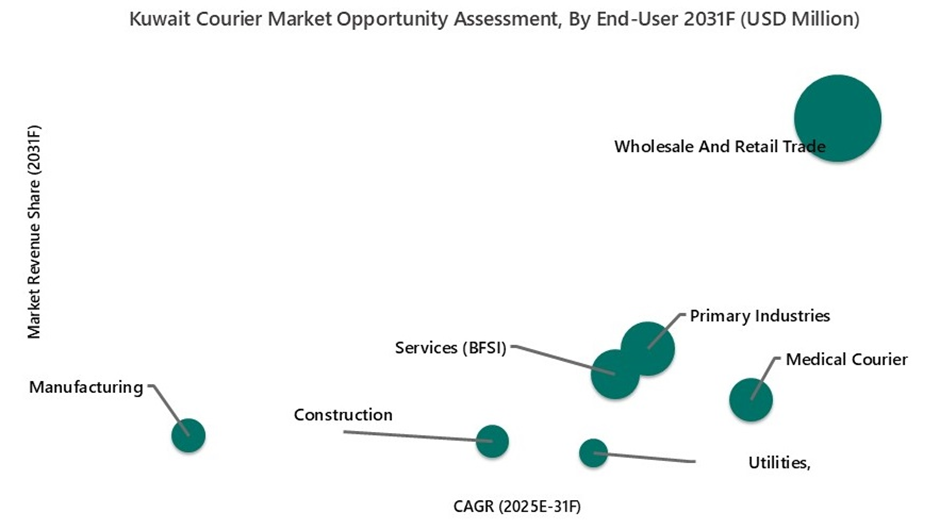
In 2024, the Wholesale and Retail Trade segment led the Kuwait courier market revenue share, driven by the surge in online shopping and digital marketplaces. Retailers and wholesalers increasingly depended on courier services to fulfill customer orders, reinforcing the sector's prominence in the market.
Key Attractiveness of the Report
- 10 Years Market Numbers.
- Historical Data Starting from 2021 to 2024
- Base Year 2024
- Forecast Data until 2031
- Key Performance Indicators Impacting the Market.
- Major Upcoming Developments and Projects.
Key Highlights of the Report:
- Kuwait Courier Market Overview
- Kuwait Courier Market Outlook
- Kuwait Courier Market Forecast
- Historical Data and Forecast of Kuwait Courier Market Revenues, for the Period 2021-2031F
- Historical Data and Forecast of Kuwait Courier Market Revenues, By Type, for the Period 2021-2031F
- Historical Data and Forecast of Kuwait Courier Market Revenues, By Delivery Mode for the Period 2021-2031F
- Historical Data and Forecast of Kuwait Courier Market Revenues, By Customer Type for the Period 2021-2031F
- Historical Data and Forecast of Kuwait Courier Market Revenues, By Destination for the Period 2021-2031F
- Historical Data and Forecast of Kuwait Courier Market Revenues, By End-User for the Period 2021-2031F
- Kuwait Courier Market Revenue Share, By Top 3 Companies
- Kuwait Courier Market Drivers and Restraints
- Kuwait Courier Market Trends
- Kuwait Courier Market Porters Five Forces
- Kuwait Courier Market Opportunity Assessment
- Competitive Benchmarking
- Company Profiles
- Key Strategic Recommendations
Market Scope and Segmentation
The report provides a detailed analysis of the following market segments
By Type
- Inbound
- Outbound
By Delivery Mode
- Express Delivery
- Normal Delivery
By Customer Type
- Business-To-Business (B2B)
- Consumer-To-Consumer (C2C)
- Business-To-Consumer (B2C)
By Domestic
- International/Cross-Border
- Destination
By End-User
- Medical Courier
- Services (BFSI)
- Wholesale And Retail Trade (E-Commerce)
- Primary Industries
- Manufacturing
- Construction
- Utilities






































