Kuwait Decorative Film Market Summary
The kuwait decorative film market was estimated at USD 982 Million in 2025 and is projected to reach USD 1749 Million by 2032, growing at a CAGR of 9.9% from 2026 to 2032.
Kuwait Decorative Film Market Year-wise Growth Rate and Key Drivers
This graph highlights how the Kuwait Decorative Film Market has steadily grown over the past five years, supported by major growth factors.
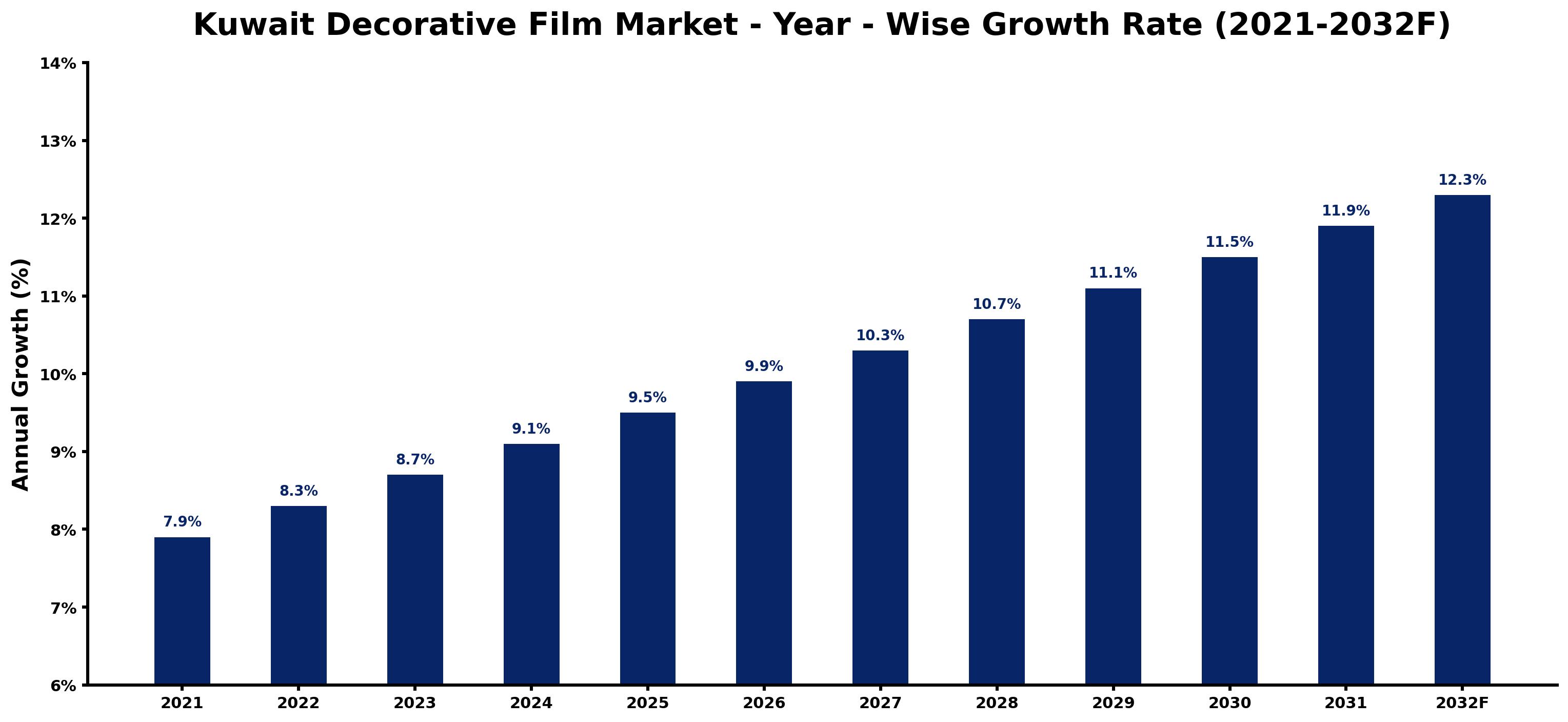
The table below presents the year wise growth rates along with the key drivers influencing the market
| Year | Growth Rate | Major Drivers |
| 2021 | 7.9% | Economic recovery post-COVID encourages increased investments in residential and commercial spaces. |
| 2022 | 8.3% | Evolving consumer preferences towards innovative interior design solutions spark interest in decorative films. |
| 2023 | 8.7% | Local manufacturers enhance production capabilities, reducing lead times for decorative film supply chains. |
| 2024 | 9.1% | Architectural trends in Kuwait emphasize aesthetics, driving demand for high-quality decorative films. |
| 2025 | 9.5% | Sustainability concerns encourage brands to explore eco-friendly decorative film materials and technologies. |
| 2026 | 9.9% | Expansion of retail sectors prompts a significant upgrade in commercial interior styling solutions. |
| 2027 | 10.3% | Technological advancements lead to improved film durability, catering to Kuwait's harsh climate requirements. |
| 2028 | 10.7% | Cross-border collaborations with international design firms enrich the local decorative film portfolio. |
| 2029 | 11.1% | Increased urbanization results in more residential projects incorporating decorative films for design flexibility. |
| 2030 | 11.5% | Luxury property developments create a niche market for premium decorative film offerings in Kuwait. |
| 2031 | 11.9% | Educational campaigns elevate awareness around benefits of decorative films among potential consumers. |
| 2032 | 12.3% | Integration of smart technologies in decorative films aligns with Kuwait's vision for futuristic urban living. |
Note - Market size estimations and growth projections presented in this report are based on 6Wresearch's advanced forecasting approach, validated with industry datasets as of June 2026.
Kuwait Decorative Film Market Synopsis
The Kuwait Decorative Film Market is projected to reach 9.9% and witness significant growth during the forecast period (2026-2032). This market is being driven by an increasing demand for decorative films across various end-user industries, including automotive, construction, electronics, and furniture manufacturing. The evolving market dynamics are further supported by rising disposable incomes among consumers and a growing preference for modern interior décor solutions. Moreover, heightened awareness of safety and security concerns is catalyzing the demand for privacy tinted glass windows, thereby contributing to the overall growth trajectory of the market.
Kuwait Decorative Film Market Growth Drivers
Several factors fuel the growth of the Kuwait Decorative Film Market. One of the prominent drivers is the increasing application of decorative films in the automotive sector. Manufacturers are incorporating these films to enhance the aesthetic appeal of vehicles while providing functionality such as UV protection and heat insulation.
- The construction industry is another significant contributor, where decorative films are utilized for architectural purposes, improving building aesthetics, and providing energy efficiency.
- The rising trend of urbanization in Kuwait, coupled with modern lifestyle changes, has propelled the demand for interior decoration, thereby increasing the usage of decorative films in residential and commercial spaces.
- Furthermore, the growing index of disposable income among consumers is enabling them to invest in modern home furnishings and decor, fostering market demand.
- Consumer awareness about window safety and protection against external elements is also encouraging the adoption of privacy tinted films, thus driving growth in this sector.
Kuwait Decorative Film Market Trends and Opportunities
The Kuwait Decorative Film Market is witnessing several trends that present opportunities for further growth. The rise in eco-friendly and sustainable materials is leading manufacturers to develop decorative films that not only meet aesthetic needs but also align with sustainability goals.
- Innovative technologies, such as advanced coating processes, are enhancing the performance characteristics of decorative films, making them more appealing to end-users.
- Customization has become a key trend, with consumers seeking personalized decorative solutions that reflect their unique tastes and preferences.
- Moreover, the integration of decorative films into smart window technologies offers exciting prospects for the market, combining aesthetics with enhanced functionality.
- As sectors such as hospitality and retail focus on unique design aesthetics, the demand for decorative films is likely to experience a corresponding rise.
Kuwait Decorative Film Market Challenges and Restraints
Despite the promising growth outlook, the Kuwait Decorative Film Market faces several challenges. High competition among manufacturers can lead to price wars, impacting overall profitability and market stability.
- Stringent government regulations concerning chemical emissions from decorative films pose a significant challenge, potentially hampering production and sales across the region.
- In addition, fluctuating raw material prices can disrupt production processes, leading to increased costs that can be passed on to consumers.
- Consumer perceptions regarding the durability and quality of decorative films may also act as a barrier, necessitating manufacturers to invest in quality assurance and performance testing.
- The challenge of educating end-users about the benefits and applications of decorative films remains crucial for market penetration and acceptance.
Kuwait Decorative Film Market Government Investment and Initiatives
The Kuwaiti government has been actively involved in initiatives that foster market growth, including investments in infrastructure and construction projects. Public spending on modernization and urban development has opened avenues for decorative film applications in buildings and public spaces. This commitment to enhancing urban landscapes aligns with the government's diversification plans away from oil dependency, paving the way for investments in innovative materials and technologies.
- In addition, the government encourages the use of energy-efficient building materials, which boosts demand for decorative films that provide thermal insulation and energy savings.
- Regulatory frameworks promoting environmental sustainability encourage manufacturers to produce eco-friendly decorative films, thereby enhancing their market reach.
- Public initiatives aimed at enhancing infrastructure, such as the construction of new housing projects, also contribute to increased demand for decorative films.
- The government's focus on safety regulations has led to increased awareness and demand for decorative films that enhance security features in buildings.
Kuwait Decorative Film Market Latest Developments (May 2025 - June 2026)
Recent developments in the Kuwait Decorative Film Market indicate a robust trend towards innovation and sustainability. In the period from May 2025 to June 2026, there has been a notable increase in collaborations between companies and research institutions aimed at innovating new film technologies to address consumer demands for eco-friendliness and performance.
- Moreover, the market has seen emerging startups that focus on niche decorative film products targeting specific consumer segments, further diversifying market offerings.
- Government-backed initiatives and funding for research on advanced film technologies are gaining momentum, showcasing a commitment to fostering innovation within the sector.
- Additionally, increasing trade exhibitions and conferences focusing on interior design and materials innovation have provided platforms for stakeholders to explore solutions and partnerships.
- Lastly, rising consumer awareness campaigns about decorative films' benefits have amplified market engagement, further stimulating demand.
Kuwait Decorative Film Market - Key Attractiveness of the Report
- 10 Years of Market Numbers
- Historical Data Starting from 2022 to 2025
- Base Year: 2025
- Forecast Data until 2032
- Key Performance Indicators Impacting the Market
- Major Upcoming Developments and Projects
Key Highlights of the Report:
- Kuwait Decorative Film Market Outlook
- Market Size of Kuwait Decorative Film Market, 2025
- Forecast of Kuwait Decorative Film Market, 2032F
- Historical Data and Forecast of Kuwait Decorative Film Revenues & Volume for the Period 2022-2032F
- Kuwait Decorative Film Market Trend Evolution
- Kuwait Decorative Film Market Drivers and Challenges
- Kuwait Decorative Film Price Trends
- Kuwait Decorative Film Porter's Five Forces
- Kuwait Decorative Film Industry Life Cycle
- Historical Data and Forecast of Kuwait Decorative Film Market Revenues & Volume By Product Type for the Period 2022-2032F
- Historical Data and Forecast of Kuwait Decorative Film Market Revenues & Volume By Stained Window Film for the Period 2022-2032F
- Historical Data and Forecast of Kuwait Decorative Film Market Revenues & Volume By Frosted Window Film for the Period 2022-2032F
- Historical Data and Forecast of Kuwait Decorative Film Market Revenues & Volume By Applications for the Period 2022-2032F
- Historical Data and Forecast of Kuwait Decorative Film Market Revenues & Volume By Residential for the Period 2022-2032F
- Historical Data and Forecast of Kuwait Decorative Film Market Revenues & Volume By Commercial for the Period 2022-2032F
- Kuwait Decorative Film Import Export Trade Statistics
- Market Opportunity Assessment By Product Type
- Market Opportunity Assessment By Applications
- Kuwait Decorative Film Top Companies Market Share
- Kuwait Decorative Film Competitive Benchmarking By Technical and Operational Parameters
- Kuwait Decorative Film Company Profiles
- Kuwait Decorative Film Key Strategic Recommendations






































