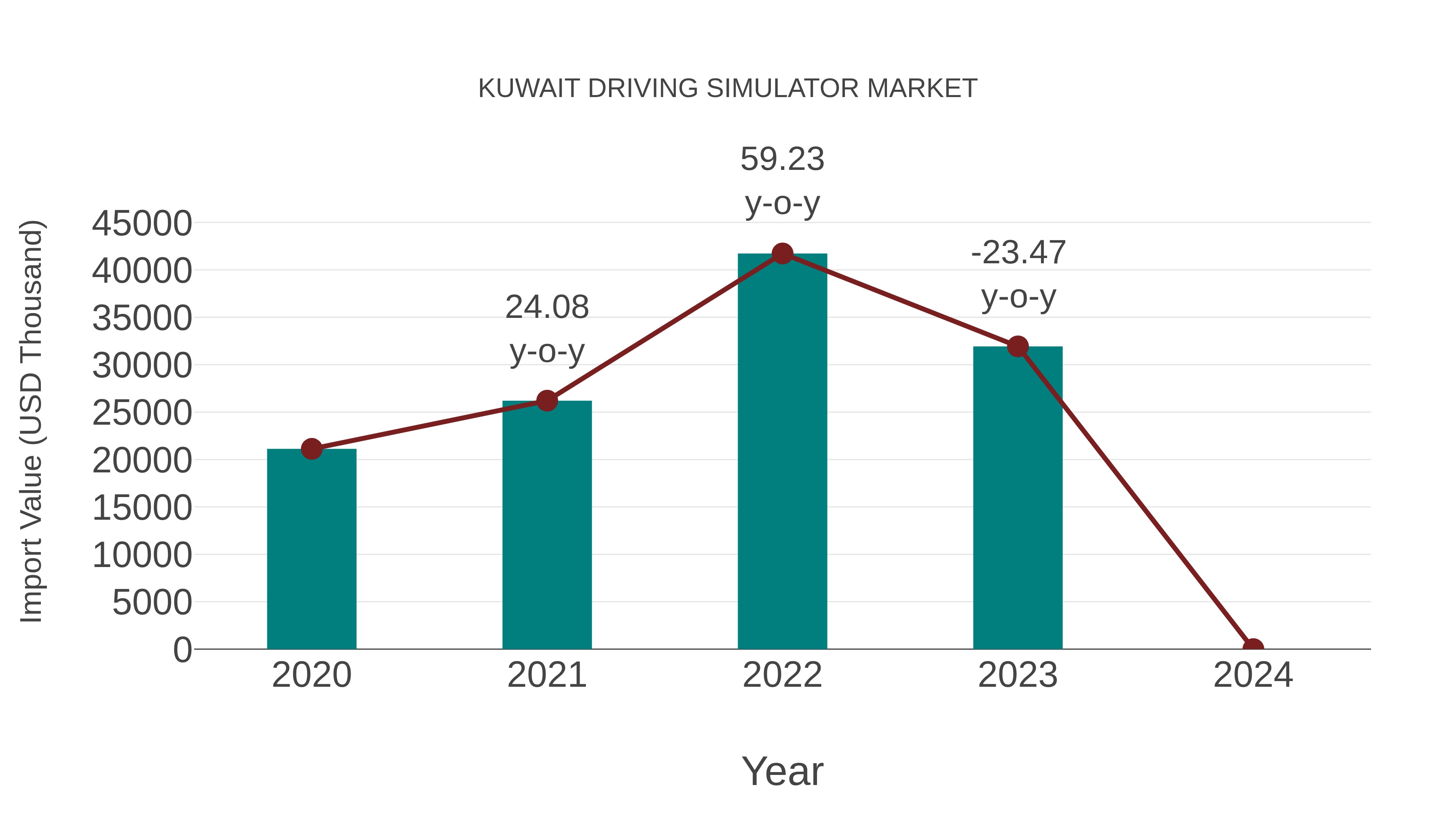
Kuwait Driving Simulator Market: Import Trend Analysis
Kuwait import trend for the driving simulator market exhibited a robust growth with a Compound Annual Growth Rate (CAGR) of 14.77% during 2020-2024. This indicates a strong import momentum and reflects a steady demand shift towards advanced simulation technologies, showcasing market stability and potential for further expansion.
Kuwait Driving Simulator Market Synopsis
The Kuwait Driving Simulator Market is experiencing steady growth due to the increasing demand for advanced driver training and simulation solutions. The market is primarily driven by the need for enhancing road safety, reducing accidents, and improving overall driving skills among individuals. Driving simulators offer a realistic and interactive environment for training new drivers, practicing different driving scenarios, and assessing driving behavior without the risks associated with on-road training. Key players in the Kuwait market offer a range of simulators catering to individual drivers, commercial fleet operators, and driving schools. The market is also witnessing a rise in adoption by government agencies and educational institutions to promote safer driving practices and reduce the number of road accidents. Overall, the Kuwait Driving Simulator Market is poised for continued growth as awareness about the benefits of simulation-based training increases.
Kuwait Driving Simulator Market Trends
The Kuwait Driving Simulator Market is witnessing a growing demand due to the increasing emphasis on road safety and driver training programs. The market is experiencing a trend towards advanced simulators that offer realistic driving experiences through virtual reality technology, leading to a more effective learning environment. Opportunities in the market include collaborations between driving schools and simulator manufacturers to enhance driver training programs, as well as the integration of artificial intelligence and machine learning capabilities into simulators to personalize training sessions. The adoption of driving simulators by government agencies for licensing exams and driver assessments also presents a significant opportunity for market growth in Kuwait. Overall, the driving simulator market in Kuwait is poised for expansion driven by technological advancements and a focus on improving road safety.
Kuwait Driving Simulator Market Challenges
In the Kuwait Driving Simulator Market, several challenges are faced, including high initial investment costs for setting up advanced driving simulators, limited awareness and acceptance of simulation technology among potential users, and the need for continuous updates and maintenance to keep up with evolving technology and regulations. Additionally, there may be a shortage of skilled personnel to operate and maintain the simulators effectively. Furthermore, cultural factors and preferences for traditional driving training methods could pose a challenge in promoting the adoption of driving simulators in Kuwait. Overcoming these challenges would require strategic marketing efforts, training programs for users and technicians, and partnerships with relevant stakeholders to demonstrate the benefits and effectiveness of driving simulators in enhancing road safety and driver training in Kuwait.
Kuwait Driving Simulator Market Investment Opportunities
The Kuwait Driving Simulator Market is primarily driven by the increasing focus on road safety and the need for efficient driver training programs. The rise in the number of road accidents and fatalities in Kuwait has highlighted the importance of implementing advanced driving simulation technology to enhance driver skills and awareness. Additionally, the growing demand for cost-effective and flexible training solutions, especially in the commercial and military sectors, is fueling the adoption of driving simulators. The advancements in simulation technology, such as immersive virtual reality experiences and real-time feedback mechanisms, are also contributing to the market growth by providing a realistic and interactive training environment. Overall, the Kuwait Driving Simulator Market is expected to continue expanding as organizations and individuals recognize the benefits of simulation-based training for improving driving proficiency and safety on the roads.
Kuwait Driving Simulator Market Government Polices
Government policies related to the Kuwait Driving Simulator Market include regulations on the use of driving simulators for training purposes, licensing requirements for driving instructors using simulators, and guidelines for integrating simulator-based training into the overall driver education curriculum. These policies aim to enhance road safety, improve driver competency, and reduce the number of traffic accidents in Kuwait. Additionally, the government may provide subsidies or incentives to driving schools and training centers to invest in advanced simulator technology to ensure high-quality driver training. Compliance with these policies is crucial for driving simulator providers and operators to operate legally and effectively in the Kuwait market while contributing to the overall goal of creating safer roads in the country.
Kuwait Driving Simulator Market Future Outlook
The future outlook for the Kuwait Driving Simulator Market appears positive, driven by advancements in technology, increasing emphasis on road safety, and the growing demand for driver training programs. The market is expected to witness steady growth as driving simulators offer a safe and cost-effective way to train new drivers and enhance the skills of experienced ones. Additionally, the integration of virtual reality and artificial intelligence into driving simulators is likely to further propel market growth by providing more realistic and interactive training experiences. With the government`s focus on improving road safety and reducing accidents, the Kuwait Driving Simulator Market is anticipated to expand in the coming years, presenting opportunities for both existing and new players in the industry.
Key Highlights of the Report:
- Kuwait Driving Simulator Market Outlook
- Market Size of Kuwait Driving Simulator Market, 2025
- Forecast of Kuwait Driving Simulator Market, 2032
- Historical Data and Forecast of Kuwait Driving Simulator Revenues & Volume for the Period 2022 - 2032F
- Kuwait Driving Simulator Market Trend Evolution
- Kuwait Driving Simulator Market Drivers and Challenges
- Kuwait Driving Simulator Price Trends
- Kuwait Driving Simulator Porter's Five Forces
- Kuwait Driving Simulator Industry Life Cycle
- Historical Data and Forecast of Kuwait Driving Simulator Market Revenues & Volume By Application for the Period 2022 - 2032F
- Historical Data and Forecast of Kuwait Driving Simulator Market Revenues & Volume By Training for the Period 2022 - 2032F
- Historical Data and Forecast of Kuwait Driving Simulator Market Revenues & Volume By Research & Testing for the Period 2022 - 2032F
- Historical Data and Forecast of Kuwait Driving Simulator Market Revenues & Volume By Vehicle Type for the Period 2022 - 2032F
- Historical Data and Forecast of Kuwait Driving Simulator Market Revenues & Volume By Car Simulator for the Period 2022 - 2032F
- Historical Data and Forecast of Kuwait Driving Simulator Market Revenues & Volume By Truck & Bus Simulator for the Period 2022 - 2032F
- Historical Data and Forecast of Kuwait Driving Simulator Market Revenues & Volume By Simulator Type for the Period 2022 - 2032F
- Historical Data and Forecast of Kuwait Driving Simulator Market Revenues & Volume By Training Simulator for the Period 2022 - 2032F
- Historical Data and Forecast of Kuwait Driving Simulator Market Revenues & Volume By Advanced Driving Simulator for the Period 2022 - 2032F
- Kuwait Driving Simulator Import Export Trade Statistics
- Market Opportunity Assessment By Application
- Market Opportunity Assessment By Vehicle Type
- Market Opportunity Assessment By Simulator Type
- Kuwait Driving Simulator Top Companies Market Share
- Kuwait Driving Simulator Competitive Benchmarking By Technical and Operational Parameters
- Kuwait Driving Simulator Company Profiles
- Kuwait Driving Simulator Key Strategic Recommendations






































