Kuwait Electrical Testing Equipment Market Size, Share & Growth Rate
The Kuwait Electrical Testing Equipment Market was estimated at USD 725 Million in 2025 and is projected to reach USD 1202 Million by 2032, growing at a CAGR of 7.5% from 2026 to 2032. This positive trajectory can be attributed to the robust investments in infrastructural developments across the nation, particularly in the oil and gas sector, coupled with the growing emphasis on safety and compliance within electrical installations. The ongoing push towards modernizing electrical grids and expanding renewable energy sources also serves to heighten the demand for advanced testing equipment.
Kuwait Electrical Testing Equipment Market Year-wise Growth Rate and Key Drivers
This graph highlights how the Kuwait Electrical Testing Equipment Market has steadily grown over the years, supported by major growth factors.
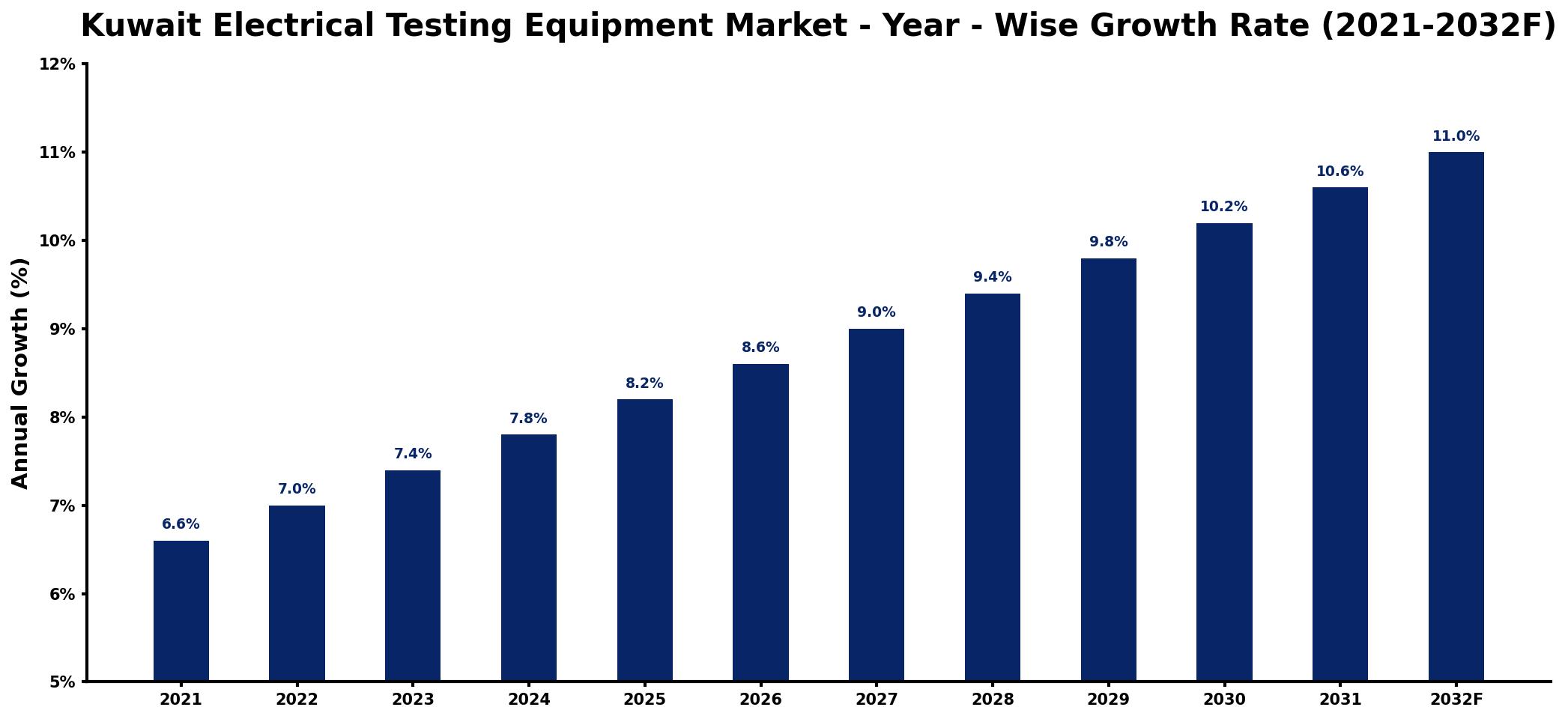
The table below presents the year‑wise growth rates along with the key drivers influencing the market
| Year | Growth Rate | Major Drivers |
| 2021 | 6.6% | Rising construction project investments |
| 2022 | 7.0% | Increased renewable energy initiatives |
| 2023 | 7.4% | Growing industrial automation adoption |
| 2024 | 7.8% | Expansion of smart grid technologies |
| 2025 | 8.2% | Surge in infrastructure development projects |
| 2026 | 8.6% | Higher focus on safety regulations |
| 2027 | 9.0% | Investments in power generation capacity |
| 2028 | 9.4% | Enhanced demand for maintenance services |
| 2029 | 9.8% | Growing urbanization and electrification |
| 2030 | 10.2% | Increased focus on energy efficiency |
| 2031 | 10.6% | growing downstream application demand |
| 2032 | 11.0% | Rising demand for sustainable solutions |
Note: Market size estimations and growth projections presented in this report are based on 6Wresearch's proprietary forecasting methodology, utilizing the latest available industry data, government publications, and primary research inputs.
Kuwait Electrical Testing Equipment Market Synopsis
Currently, the Kuwait Electrical Testing Equipment Market is on an upward trend, propelled by the nation's commitment to enhancing its electrical infrastructure across various industries. The demand for equipment such as multimeters, insulation testers, and power quality analyzers is surging, thanks to increased industrial activity and strict safety regulations.
The market showcases a mix of domestic and international vendors offering a diverse range of testing solutions. Key factors driving growth include the urgent need for preventive maintenance protocols and the transition towards digital technologies, which are enhancing operational efficiencies in electrical systems.
Kuwait Electrical Testing Equipment Market Key Takeaways
- The market is fueled by significant investments in infrastructure and energy sectors.
- Safety regulations are catalyzing the adoption of electrical testing equipment.
- Digitalization trends are reshaping how testing equipment is utilized and managed.
- There is an increasing demand for portable and user-friendly testing solutions.
- Renewable energy initiatives are creating new opportunities for specialized testing equipment.
Evaluation of Restraints in Kuwait Electrical Testing Equipment Market
Despite its growth potential, the Kuwait Electrical Testing Equipment Market is not without its challenges. Regulatory compliance remains a significant hurdle, as local manufacturers often struggle with adhering to stringent safety and quality standards. Furthermore, the lack of standardized testing procedures can lead to inconsistencies in equipment performance. Additionally, competition from established international brands introduces pressure on local companies to innovate and enhance their product offerings, which may not always be feasible given the fluctuating economic conditions driven by oil price volatility.
Kuwait Electrical Testing Equipment Market Trends
There is a discernible shift towards digital testing solutions that promise faster and more accurate results. The integration of IoT capabilities into testing devices is becoming increasingly popular, allowing for remote monitoring and diagnostic capabilities. Moreover, the industry is witnessing a growing emphasis on environmentally sustainable testing practices, aimed at reducing the carbon footprint associated with electrical systems.
Kuwait Electrical Testing Equipment Market Opportunities
The market is ripe with opportunities, particularly in the realms of smart grid technology and renewable energy. As Kuwait moves towards diversifying its energy portfolio, the demand for advanced testing equipment to support solar and wind energy initiatives is on the rise. Additionally, the growing construction sector presents a compelling case for companies to innovate and expand their product ranges, particularly with portable and easy-to-use testing solutions, catering to a broader spectrum of applications.
Government Initiatives in the Kuwait Electrical Testing Equipment Market
The regulatory landscape governing the Kuwait Electrical Testing Equipment Market is shaped by the Kuwait Ministry of Commerce and Industry. The government is keen on enforcing high standards and certifications for electrical testing equipment to ensure quality and safety. Furthermore, initiatives aimed at promoting local manufacturing have been introduced, offering support and incentives to domestic companies striving to meet compliance standards. These policies collectively aim to fortify the market while safeguarding consumer interests against substandard products.
Future Insights of the Kuwait Electrical Testing Equipment Market
Looking forward to the period from 2026 to 2032, the Kuwait Electrical Testing Equipment Market is anticipated to witness sustained growth. This is largely driven by continued investments in infrastructure and the diversification of energy sources, which will heighten the demand for reliable testing solutions. Moreover, as industries increasingly adopt advanced technologies to enhance the efficiency of electrical systems, the importance of cutting-edge testing equipment will become even more pronounced, paving the way for market expansion.
Kuwait Electrical Testing Equipment Market Latest Developments (2025 - 2026)
Recent developments in the market highlight a strong focus on innovation and technological advancement. Companies are actively working on integrating IoT capabilities into their testing solutions, facilitating real-time data analysis and remote diagnostics. This shift not only enhances operational efficiency but also responds to the increasing demand for safety and compliance in the electrical infrastructure sector. Additionally, public and private collaborations are being established to enhance product offerings and align them with the emerging trends in renewable energy.
Kuwait Electrical Testing Equipment Market - Key Attractiveness of the Report
- 10 Years of Market Numbers
- Historical Data Starting from 2022 to 2025
- Base Year: 2025
- Forecast Data until 2032
- Key Performance Indicators Impacting the Market
- Major Upcoming Developments and Projects
Key Highlights of the Report:
- Kuwait Electrical Testing Equipment Market Outlook
- Market Size of Kuwait Electrical Testing Equipment Market, 2025
- Forecast of Kuwait Electrical Testing Equipment Market, 2032
- Historical Data and Forecast of Kuwait Electrical Testing Equipment Revenues & Volume for the Period 2022-2032F
- Kuwait Electrical Testing Equipment Market Trend Evolution
- Kuwait Electrical Testing Equipment Market Drivers and Challenges
- Kuwait Electrical Testing Equipment Price Trends
- Kuwait Electrical Testing Equipment Porter's Five Forces
- Kuwait Electrical Testing Equipment Industry Life Cycle
- Historical Data and Forecast of Kuwait Electrical Testing Equipment Market Revenues & Volume By Service Type for the Period 2022-2032F
- Historical Data and Forecast of Kuwait Electrical Testing Equipment Market Revenues & Volume By Electrical Testing Equipment Calibration Services for the Period 2022-2032F
- Historical Data and Forecast of Kuwait Electrical Testing Equipment Market Revenues & Volume By Electrical Testing Equipment Repair Services or After Sales Services for the Period 2022-2032F
- Historical Data and Forecast of Kuwait Electrical Testing Equipment Market Revenues & Volume By Product Type for the Period 2022-2032F
- Historical Data and Forecast of Kuwait Electrical Testing Equipment Market Revenues & Volume By General Purpose Electrical Testing Equipment for the Period 2022-2032F
- Historical Data and Forecast of Kuwait Electrical Testing Equipment Market Revenues & Volume By Mechanical Electrical Test Equipment for the Period 2022-2032F
- Historical Data and Forecast of Kuwait Electrical Testing Equipment Market Revenues & Volume By End User for the Period 2022-2032F
- Historical Data and Forecast of Kuwait Electrical Testing Equipment Market Revenues & Volume By Aerospace and Defense for the Period 2022-2032F
- Historical Data and Forecast of Kuwait Electrical Testing Equipment Market Revenues & Volume By Telecommunications for the Period 2022-2032F
- Historical Data and Forecast of Kuwait Electrical Testing Equipment Market Revenues & Volume By Semiconductor and Electronics for the Period 2022-2032F
- Kuwait Electrical Testing Equipment Import Export Trade Statistics
- Market Opportunity Assessment By Service Type
- Market Opportunity Assessment By Product Type
- Market Opportunity Assessment By End User
- Kuwait Electrical Testing Equipment Top Companies Market Share
- Kuwait Electrical Testing Equipment Competitive Benchmarking By Technical and Operational Parameters
- Kuwait Electrical Testing Equipment Company Profiles
- Kuwait Electrical Testing Equipment Key Strategic Recommendations






































