Kuwait Enterprise AI Market Size & Growth Rate (2026-2032)
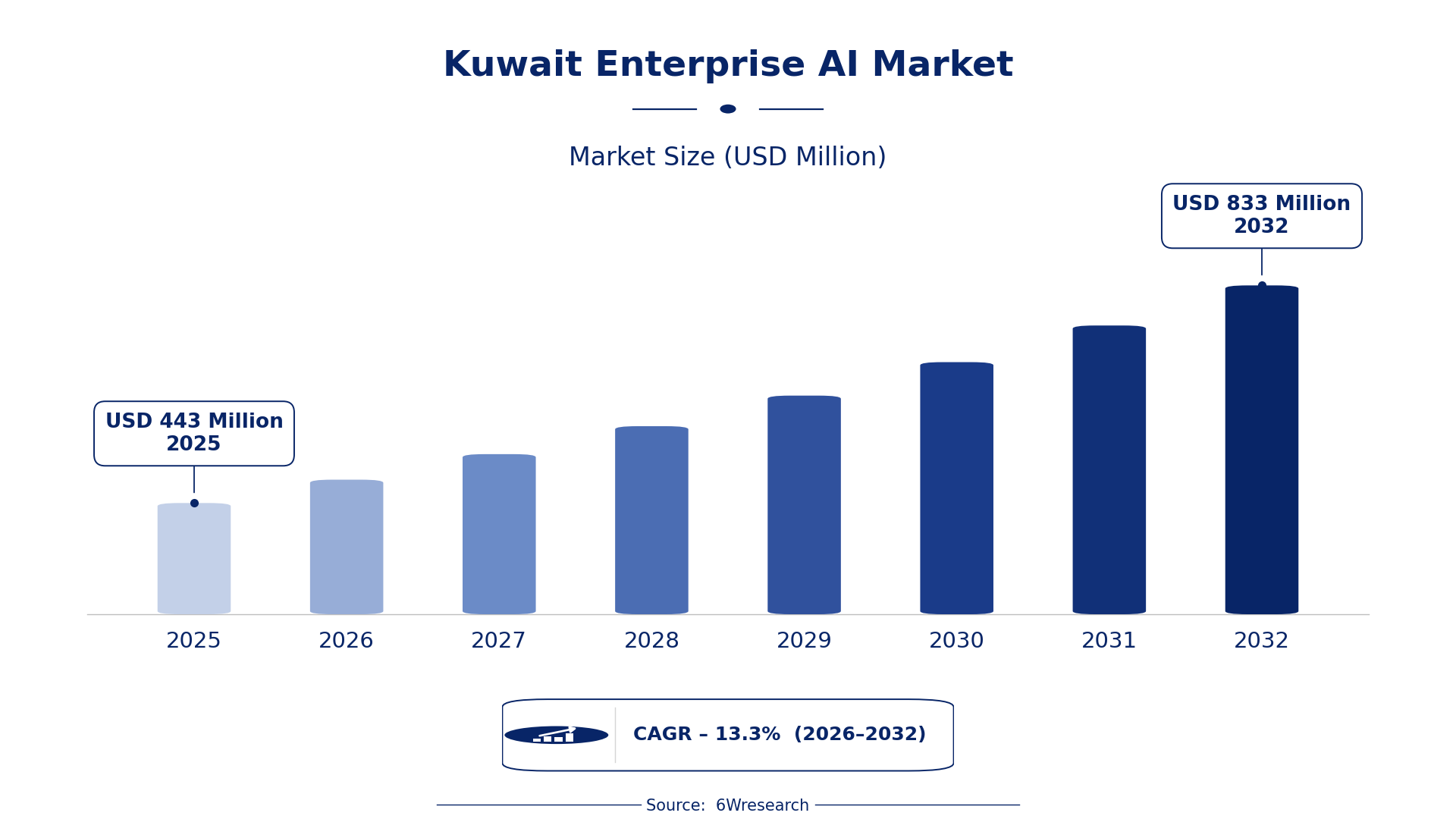
The Kuwait Enterprise AI Market was estimated at USD 443 Million in 2025 and is projected to reach USD 833 Million by 2032, growing at a CAGR of 13.3% from 2026 to 2032.
Kuwait Enterprise AI Market Synopsis
The demand for AI solutions in Kuwait is accelerating, with businesses across various sectors integrating these technologies to enhance customer interactions and streamline operations. The banking, healthcare, and oil & gas sectors are particularly vibrant, utilizing AI for predictive analytics and process automation.
As organizations recognize the importance of data-driven decision-making, AI is becoming a cornerstone of strategic initiatives. The government's commitment to digital transformation is further propelling the adoption of AI technologies, creating an environment ripe for innovation.
Kuwait Enterprise AI Market Year-wise Growth Rate and Key Drivers
This graph illustrates the annual growth rates of the Kuwait Enterprise AI Market from 2021 to 2032, highlighting a steady upward trajectory and projected expansion over the forecast period.
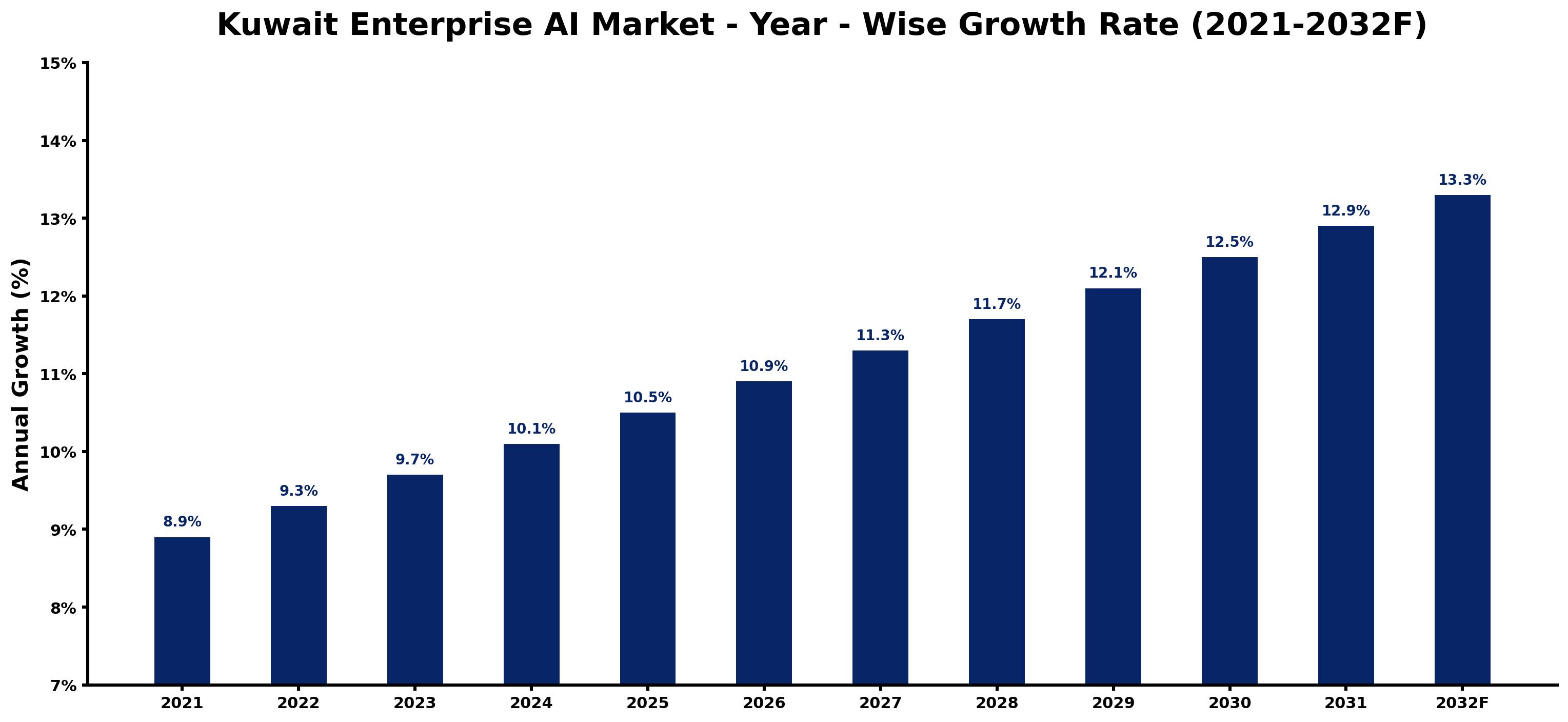
The table below presents the year‑wise growth rates along with the key drivers influencing the market
| Year | Growth Rate | Major Drivers |
| 2021 | 8.9% | Kuwait National Development Plan prioritizes AI integration. |
| 2022 | 9.3% | Growing startup ecosystem fosters innovative AI applications. |
| 2023 | 9.7% | Government's smart city projects boost AI technology demand. |
| 2024 | 10.1% | Increased focus on AI for oil and gas efficiency. |
| 2025 | 10.5% | Cybersecurity regulations drive enterprise AI adoption. |
| 2026 | 10.9% | Higher funding for AI research from private sector. |
| 2027 | 11.3% | Emerging interest in AI for retail analytics solutions. |
| 2028 | 11.7% | Ministry of Communication supports AI educational initiatives. |
| 2029 | 12.1% | Partnerships with international AI firms enhance local capabilities. |
| 2030 | 12.5% | Growth of fintech sector increases AI utilization. |
| 2031 | 12.9% | Government initiatives promote AI in public administration. |
| 2032 | 13.3% | Rising awareness of AI benefits among local businesses. |
Note: Market size estimations and growth projections presented in this report are based on 6Wresearch's proprietary forecasting methodology, utilizing the latest available industry data, government publications, and primary research inputs.
Kuwait Enterprise AI Market Key Takeaways
Below are some of the specific key takeaways from the market, including:
- The Kuwait Enterprise AI market is set for robust growth, driven by widespread adoption across critical industries.
- Government initiatives are crucial in supporting AI technology integration and innovation.
- Key trends include the rise of AI-powered chatbots and predictive analytics in business operations.
- Organizations face challenges such as a shortage of skilled professionals and data privacy concerns.
- Opportunities exist in personalized customer experiences and enhanced cybersecurity through AI solutions.
Evaluation of Restraints in Kuwait Enterprise AI Market
Despite its potential, the Kuwait Enterprise AI market is held back by a few pressing issues. A significant lack of skilled AI professionals poses challenges for organizations aiming to implement advanced technologies effectively. This shortage is compounded by a general limited awareness of AI's capabilities, leading to hesitancy among businesses in adopting these solutions.
Additionally, concerns regarding data privacy, especially in sensitive sectors like healthcare, hinder the deployment of AI applications. Regulatory hurdles, including compliance with data protection laws, further complicate the landscape, necessitating strategic investments in talent development and education.
Kuwait Enterprise AI Market Trends
Current trends indicate a surge in the use of AI-powered chatbots, which improve customer service by providing instant support. Predictive analytics is increasingly being adopted for strategic business decisions, enabling organizations to anticipate market changes and consumer behavior.
Automation of repetitive tasks is another trend gaining traction, as companies look to enhance operational efficiency. The integration of AI in supply chain management is also emerging, helping businesses optimize processes and reduce costs.
Kuwait Enterprise AI Market Opportunities
The future of the Kuwait Enterprise AI market is bright, with numerous opportunities for growth. Organizations can develop personalized customer experiences through AI-driven recommendations, which are becoming essential in retaining competitive advantage.
Fraud detection and cybersecurity are critical areas where AI can add value, particularly in the finance and healthcare sectors. on top of that, businesses are increasingly looking to integrate AI into their supply chain processes, which can lead to enhanced efficiency and cost savings.
Government Initiatives in the Kuwait Enterprise AI Market
The Kuwaiti government is actively shaping the Enterprise AI market through various initiatives aimed at fostering digital innovation. These policies reflect a commitment to integrating AI technologies across sectors to boost economic growth and efficiency. A supportive regulatory framework is essential for encouraging public and private sector collaboration, which is necessary for advancing AI adoption in the country.
- A national digital infrastructure upgrade programme launched in early 2025 focuses on enhancing connectivity and data security for businesses.
- Currently ongoing is a public-private partnership initiative that aims to develop AI training and education programs to build local talent in the field.
- A regulatory framework introduced in 2025 mandates ethical AI use in financial services, ensuring compliance with international standards.
- Planned for 2026 is a nationwide AI strategy aiming to attract foreign investment in technology and innovation sectors.
- The establishment of an AI research and development fund expected to support startups and entrepreneurs in the AI space.
Future Insights of the Kuwait Enterprise AI Market
Looking ahead to 2026-2032, the Kuwait Enterprise AI market is expected to experience substantial growth. The emphasis on digital transformation across industries will drive increased demand for AI solutions. As organizations continue to harness the power of AI, they will also focus on enhancing their operational capabilities and customer experiences.
The expansion of AI technologies such as machine learning and natural language processing will provide businesses with innovative tools to improve efficiency and decision-making. As the market matures, collaboration between technology providers and organizations will be key in unlocking the full potential of AI.
Kuwait Enterprise AI Market Latest Developments
In the last year, the Kuwait Enterprise AI market has seen a flurry of activity, underscoring its growth trajectory. Companies are increasingly investing in AI technologies to stay competitive and improve service delivery. This has led to a range of developments focused on enhancing the capabilities of AI applications across various sectors.
- A major technology vendor launched a new AI-driven analytics platform in Q3 2025, aimed at helping businesses make data-informed decisions.
- An initiative that began in early 2025 focuses on integrating AI into government services, streamlining processes for citizens.
- Currently underway is a collaboration between several local universities and tech firms to establish an AI incubator, fostering innovation among students and startups.
- A rollout expected to begin in mid-2026 will enhance AI capabilities in the healthcare sector, improving patient care and operational efficiency.
Kuwait Enterprise AI Market - Key Attractiveness of the Report
- 10 Years of Market Numbers
- Historical Data Starting from 2022 to 2025
- Base Year: 2025
- Forecast Data until 2032
- Key Performance Indicators Impacting the Market
- Major Upcoming Developments and Projects
Key Highlights of the Report:
- Kuwait Enterprise AI Market Outlook
- Market Size of Kuwait Enterprise AI Market, 2025
- Forecast of Kuwait Enterprise AI Market, 2032
- Historical Data and Forecast of Kuwait Enterprise AI Revenues & Volume for the Period 2022-2032F
- Kuwait Enterprise AI Market Trend Evolution
- Kuwait Enterprise AI Market Drivers and Challenges
- Kuwait Enterprise AI Price Trends
- Kuwait Enterprise AI Porter's Five Forces
- Kuwait Enterprise AI Industry Life Cycle
- Historical Data and Forecast of Kuwait Enterprise AI Market Revenues & Volume By Component for the Period 2022-2032F
- Historical Data and Forecast of Kuwait Enterprise AI Market Revenues & Volume By Solution for the Period 2022-2032F
- Historical Data and Forecast of Kuwait Enterprise AI Market Revenues & Volume By Services for the Period 2022-2032F
- Historical Data and Forecast of Kuwait Enterprise AI Market Revenues & Volume By Technology for the Period 2022-2032F
- Historical Data and Forecast of Kuwait Enterprise AI Market Revenues & Volume By Machine learning and deep learning for the Period 2022-2032F
- Historical Data and Forecast of Kuwait Enterprise AI Market Revenues & Volume By Natural Language Processing (NLP) for the Period 2022-2032F
- Historical Data and Forecast of Kuwait Enterprise AI Market Revenues & Volume By Application Area for the Period 2022-2032F
- Historical Data and Forecast of Kuwait Enterprise AI Market Revenues & Volume By Security and risk management for the Period 2022-2032F
- Historical Data and Forecast of Kuwait Enterprise AI Market Revenues & Volume By Marketing management for the Period 2022-2032F
- Historical Data and Forecast of Kuwait Enterprise AI Market Revenues & Volume By Customer support and experience for the Period 2022-2032F
- Historical Data and Forecast of Kuwait Enterprise AI Market Revenues & Volume By Human resource and recruitment management for the Period 2022-2032F
- Historical Data and Forecast of Kuwait Enterprise AI Market Revenues & Volume By Analytics application for the Period 2022-2032F
- Historical Data and Forecast of Kuwait Enterprise AI Market Revenues & Volume By Process automation for the Period 2022-2032F
- Historical Data and Forecast of Kuwait Enterprise AI Market Revenues & Volume By Deployment Type for the Period 2022-2032F
- Historical Data and Forecast of Kuwait Enterprise AI Market Revenues & Volume By Cloud for the Period 2022-2032F
- Historical Data and Forecast of Kuwait Enterprise AI Market Revenues & Volume By On-premises for the Period 2022-2032F
- Historical Data and Forecast of Kuwait Enterprise AI Market Revenues & Volume By Organization Size for the Period 2022-2032F
- Historical Data and Forecast of Kuwait Enterprise AI Market Revenues & Volume By Small and Medium-sized Businesses (SMBs) for the Period 2022-2032F
- Historical Data and Forecast of Kuwait Enterprise AI Market Revenues & Volume By Large enterprises for the Period 2022-2032F
- Kuwait Enterprise AI Import Export Trade Statistics
- Market Opportunity Assessment By Component
- Market Opportunity Assessment By Technology
- Market Opportunity Assessment By Application Area
- Market Opportunity Assessment By Deployment Type
- Market Opportunity Assessment By Organization Size
- Kuwait Enterprise AI Top Companies Market Share
- Kuwait Enterprise AI Competitive Benchmarking By Technical and Operational Parameters
- Kuwait Enterprise AI Company Profiles
- Kuwait Enterprise AI Key Strategic Recommendations






































