Kuwait Enterprise Application Integration Market Size & Growth Rate (2026-2032)
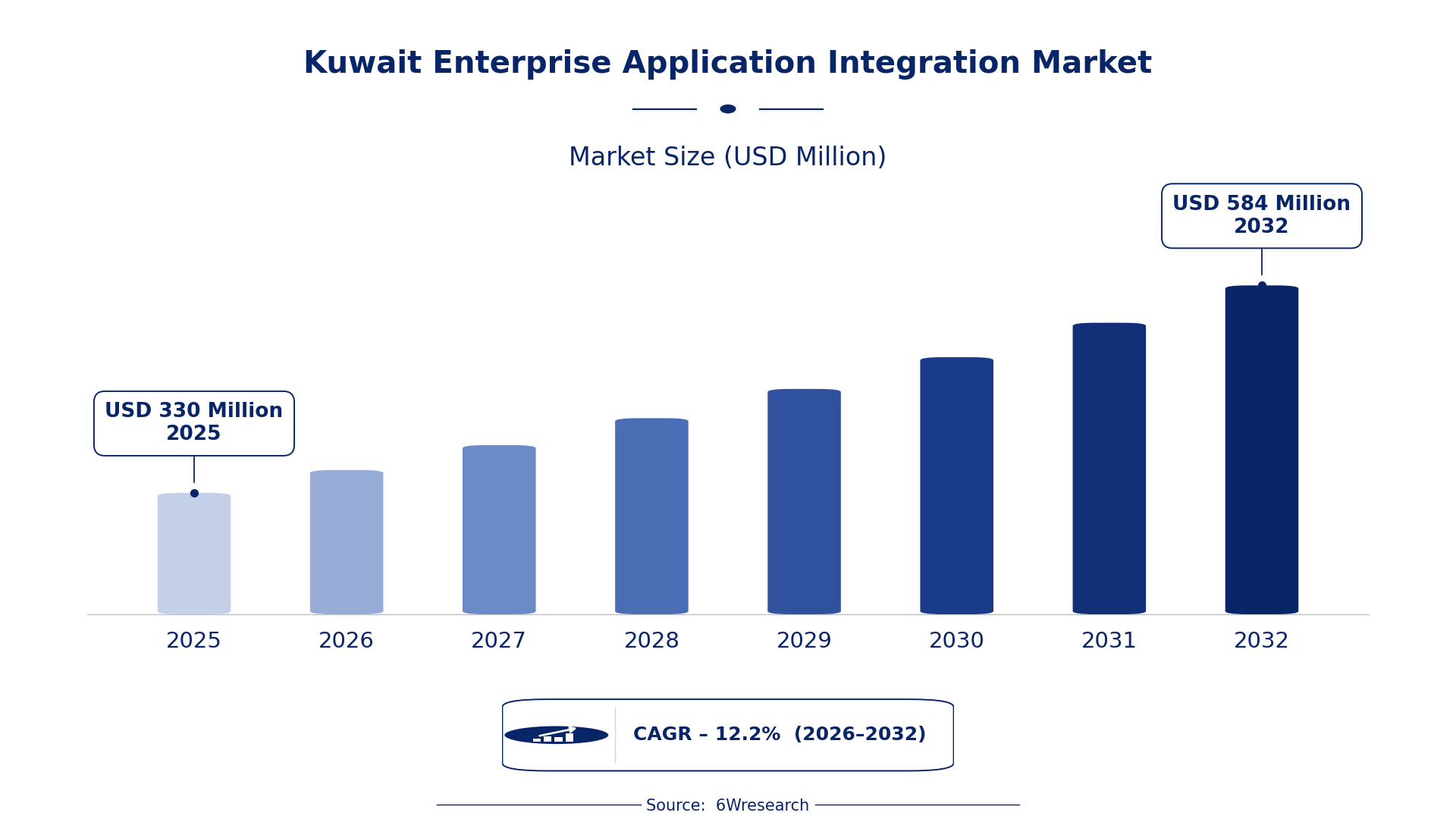
The Kuwait Enterprise Application Integration Market was estimated at USD 330 Million in 2025 and is projected to reach USD 584 Million by 2032, growing at a CAGR of 12.2% from 2026 to 2032.
Kuwait Enterprise Application Integration Market Synopsis
The growing emphasis on digital transformation is the most significant force currently shaping the Kuwait Enterprise Application Integration Market. As organizations seek to modernize their operations, the integration of disparate applications and systems is becoming critical for improving efficiency and customer engagement.
In this environment, cloud-based solutions have gained prominence, allowing companies to streamline their operations while ensuring real-time data access. Businesses are increasingly leveraging Enterprise Service Bus (ESB) and Application Programming Interface (API) management platforms to facilitate seamless communication between various applications, thereby enhancing overall operational efficiency.
Kuwait Enterprise Application Integration Market Year-wise Growth Rate and Key Drivers
This graph illustrates the annual growth rates of the Kuwait Enterprise Application Integration Market from 2021 to 2032, highlighting a steady upward trajectory and projected expansion over the forecast period.
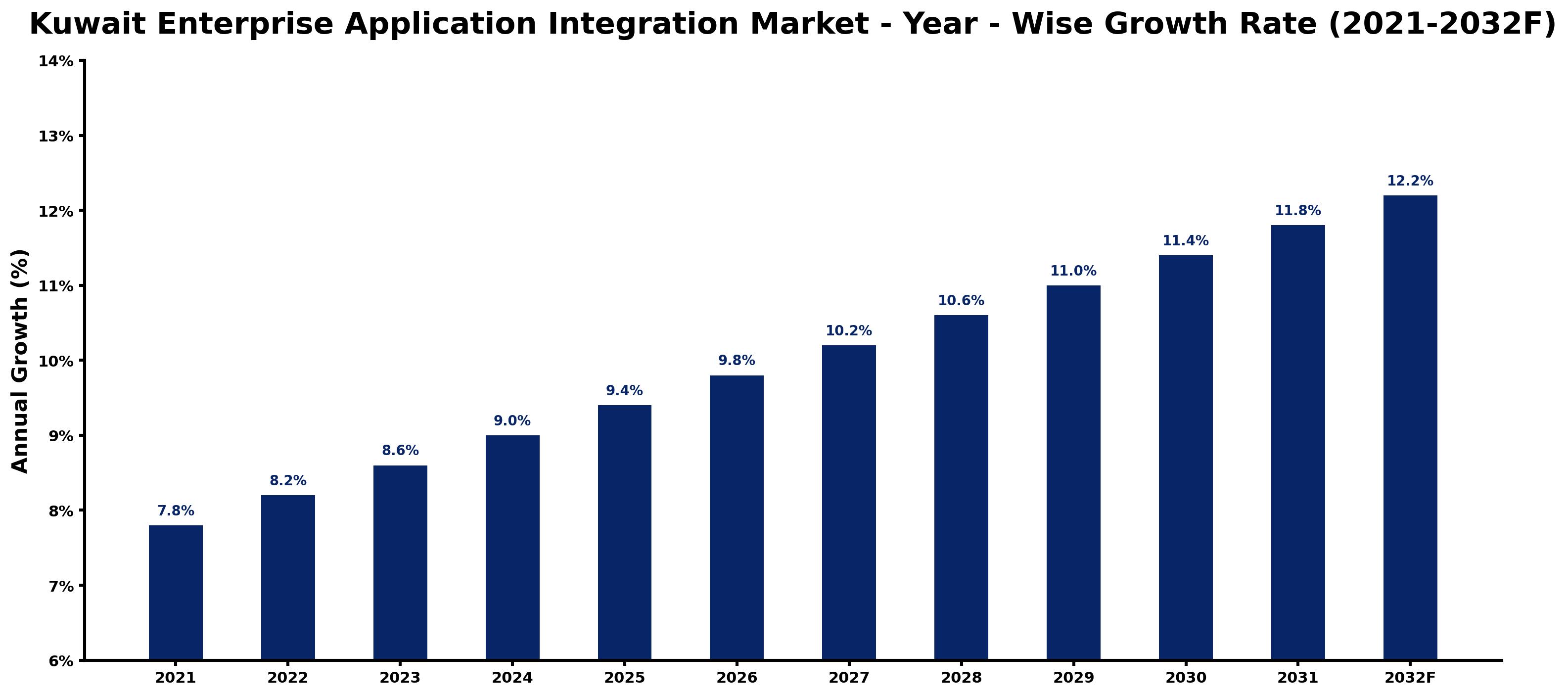
The table below presents the year‑wise growth rates along with the key drivers influencing the market
| Year | Growth Rate | Major Drivers |
| 2021 | 7.8% | Kuwait's digital transformation strategy boosts integration solutions. |
| 2022 | 8.2% | Government initiatives prioritize cloud adoption in enterprises. |
| 2023 | 8.6% | Increased investment in fintech drives application interoperability. |
| 2024 | 9.0% | Regulatory push for data compliance accelerates integration needs. |
| 2025 | 9.4% | Rising e-commerce activity necessitates streamlined backend systems. |
| 2026 | 9.8% | Growing mobile workforce demands secure application connectivity. |
| 2027 | 10.2% | Robust growth in oil and gas sector integrates ERP systems. |
| 2028 | 10.6% | Public sector digitalization projects require cohesive application frameworks. |
| 2029 | 11.0% | Kuwait's young workforce embraces innovative enterprise technologies. |
| 2030 | 11.4% | Regional economic diversification encourages application ecosystem expansion. |
| 2031 | 11.8% | Emerging startups fuel demand for agile integration platforms. |
| 2032 | 12.2% | Increased remote work fosters demand for seamless app integration. |
Note: Market size estimations and growth projections presented in this report are based on 6Wresearch's proprietary forecasting methodology, utilizing the latest available industry data, government publications, and primary research inputs.
Kuwait Enterprise Application Integration Market Key Takeaways
Below are some of the specific key takeaways from the market, including:
- The market is experiencing a growing demand for cloud-based integration solutions.
- Hybrid integration models are becoming increasingly popular among Kuwaiti organizations.
- Industry-specific integration solutions are in high demand, particularly in sectors like oil and gas, finance, and healthcare.
- Real-time data access and insights are crucial for decision-making, driving integration initiatives.
- Digital transformation initiatives are a primary driver for investment in EAI technologies.
Evaluation of Restraints in Kuwait Enterprise Application Integration Market
The complexity of integrating diverse systems across departments remains a significant constraint for businesses in the Kuwait Enterprise Application Integration Market. Organizations often struggle to ensure effective communication between legacy systems and modern cloud applications, which complicates data exchange and hampers overall efficiency. Compliance with data security regulations also poses challenges, as does the scarcity of skilled professionals proficient in EAI technologies. These factors collectively limit the potential for seamless integration and hinder operational optimization.
Kuwait Enterprise Application Integration Market Trends
Current trends indicate a strong shift toward cloud-centric integration solutions, primarily as businesses prioritize agility and responsiveness. The adoption of APIs is rapidly increasing, enabling companies to connect applications and services more effectively. Additionally, organizations are gravitating toward hybrid integration approaches, which allow for a blend of on-premise and cloud solutions to meet their unique operational needs. This trend is particularly pronounced in industries facing regulatory scrutiny, such as finance and healthcare, where compliance demands are rising.
Kuwait Enterprise Application Integration Market Opportunities
There are substantial opportunities for vendors focusing on industry-specific integration solutions tailored to sectors like oil and gas, healthcare, and finance. As businesses continue to prioritize digitalization, the demand for advanced EAI technologies will grow, especially those that provide real-time data synchronization and improved customer experiences. Vendors that can offer scalable, secure, and flexible integration platforms will find fertile ground for innovation and market penetration.
Government Initiatives in the Kuwait Enterprise Application Integration Market
Government policies in Kuwait are actively promoting digital transformation and fostering an environment conducive to the growth of the Enterprise Application Integration Market. The emphasis on modernizing infrastructure and adopting advanced technologies is crucial for enhancing competitiveness across various sectors. By focusing on data security and privacy regulations, the government aims to protect sensitive information, thus encouraging businesses to adopt EAI solutions.
- A recently completed initiative focused on upgrading national digital infrastructure to enhance connectivity across sectors.
- A current program is underway to streamline regulatory processes for EAI providers, making it easier for them to operate in Kuwait.
- Upcoming initiatives will prioritize incentives for businesses investing in integration technologies to further promote digital transformation.
- The government has introduced a regulatory framework aimed at ensuring data protection and compliance in integrated applications.
- Plans are in place for collaborative efforts between public and private sectors to enhance the adoption of innovative EAI solutions by 2028.
Future Insights of the Kuwait Enterprise Application Integration Market
Looking ahead, the Kuwait Enterprise Application Integration Market is set to expand significantly as businesses continue to invest in digital transformation. The need for efficient, real-time data sharing will be pivotal, particularly as more organizations adopt IoT technologies and cloud solutions. As competition intensifies, companies will seek to enhance customer experiences through integrated systems, reinforcing the importance of advanced EAI solutions. This trajectory suggests a vibrant future for the market, with numerous opportunities for innovation and growth.
Kuwait Enterprise Application Integration Market Latest Developments
In the past year, the Kuwait Enterprise Application Integration Market has witnessed a surge in activities aimed at enhancing integration capabilities across various sectors. Companies are increasingly focused on adopting technologies that facilitate seamless connectivity and operational efficiency.
- A major technology vendor launched a cloud-based integration platform in early 2025, aimed at improving data synchronization across organizations.
- An initiative that began in mid-2025 focuses on developing a national API management strategy to bolster integration efforts across industries.
- A rollout of new security protocols for integrated applications is expected to begin in the second half of 2026 to address compliance concerns.
- In Q1 2025, a collaborative project was initiated to train professionals in EAI technologies, addressing the skills gap in the market.
- Plans are underway for an upcoming conference in late 2026 to showcase advancements in EAI solutions and foster industry collaboration.
Kuwait Enterprise Application Integration Market - Key Attractiveness of the Report
- 10 Years of Market Numbers
- Historical Data Starting from 2022 to 2025
- Base Year: 2025
- Forecast Data until 2032
- Key Performance Indicators Impacting the Market
- Major Upcoming Developments and Projects
Key Highlights of the Report:
- Kuwait Enterprise Application Integration Market Outlook
- Market Size of Kuwait Enterprise Application Integration Market, 2025
- Forecast of Kuwait Enterprise Application Integration Market, 2032
- Historical Data and Forecast of Kuwait Enterprise Application Integration Revenues & Volume for the Period 2022-2032F
- Kuwait Enterprise Application Integration Market Trend Evolution
- Kuwait Enterprise Application Integration Market Drivers and Challenges
- Kuwait Enterprise Application Integration Price Trends
- Kuwait Enterprise Application Integration Porter's Five Forces
- Kuwait Enterprise Application Integration Industry Life Cycle
- Historical Data and Forecast of Kuwait Enterprise Application Integration Market Revenues & Volume By Deployment type for the Period 2022-2032F
- Historical Data and Forecast of Kuwait Enterprise Application Integration Market Revenues & Volume By Hosted for the Period 2022-2032F
- Historical Data and Forecast of Kuwait Enterprise Application Integration Market Revenues & Volume By On-Premise for the Period 2022-2032F
- Historical Data and Forecast of Kuwait Enterprise Application Integration Market Revenues & Volume By Hybrid for the Period 2022-2032F
- Historical Data and Forecast of Kuwait Enterprise Application Integration Market Revenues & Volume By Organization size for the Period 2022-2032F
- Historical Data and Forecast of Kuwait Enterprise Application Integration Market Revenues & Volume By Small for the Period 2022-2032F
- Historical Data and Forecast of Kuwait Enterprise Application Integration Market Revenues & Volume By Medium for the Period 2022-2032F
- Historical Data and Forecast of Kuwait Enterprise Application Integration Market Revenues & Volume By Enterprises for the Period 2022-2032F
- Historical Data and Forecast of Kuwait Enterprise Application Integration Market Revenues & Volume By Large Enterprises for the Period 2022-2032F
- Historical Data and Forecast of Kuwait Enterprise Application Integration Market Revenues & Volume By Industry Vertical for the Period 2022-2032F
- Historical Data and Forecast of Kuwait Enterprise Application Integration Market Revenues & Volume By Banking, financial services and insurance(BFSI) for the Period 2022-2032F
- Historical Data and Forecast of Kuwait Enterprise Application Integration Market Revenues & Volume By Business services for the Period 2022-2032F
- Historical Data and Forecast of Kuwait Enterprise Application Integration Market Revenues & Volume By IT and telecom for the Period 2022-2032F
- Historical Data and Forecast of Kuwait Enterprise Application Integration Market Revenues & Volume By Manufacturing for the Period 2022-2032F
- Historical Data and Forecast of Kuwait Enterprise Application Integration Market Revenues & Volume By Retail and wholesale for the Period 2022-2032F
- Historical Data and Forecast of Kuwait Enterprise Application Integration Market Revenues & Volume By Healthcare for the Period 2022-2032F
- Historical Data and Forecast of Kuwait Enterprise Application Integration Market Revenues & Volume By Government for the Period 2022-2032F
- Historical Data and Forecast of Kuwait Enterprise Application Integration Market Revenues & Volume By Other verticals( education, entertainment and media, power and utilities) for the Period 2022-2032F
- Kuwait Enterprise Application Integration Import Export Trade Statistics
- Market Opportunity Assessment By Deployment type
- Market Opportunity Assessment By Organization size
- Market Opportunity Assessment By Industry Vertical
- Kuwait Enterprise Application Integration Top Companies Market Share
- Kuwait Enterprise Application Integration Competitive Benchmarking By Technical and Operational Parameters
- Kuwait Enterprise Application Integration Company Profiles
- Kuwait Enterprise Application Integration Key Strategic Recommendations






































