Kuwait Enterprise Firewall Market Size & Growth Rate (2026-2032)
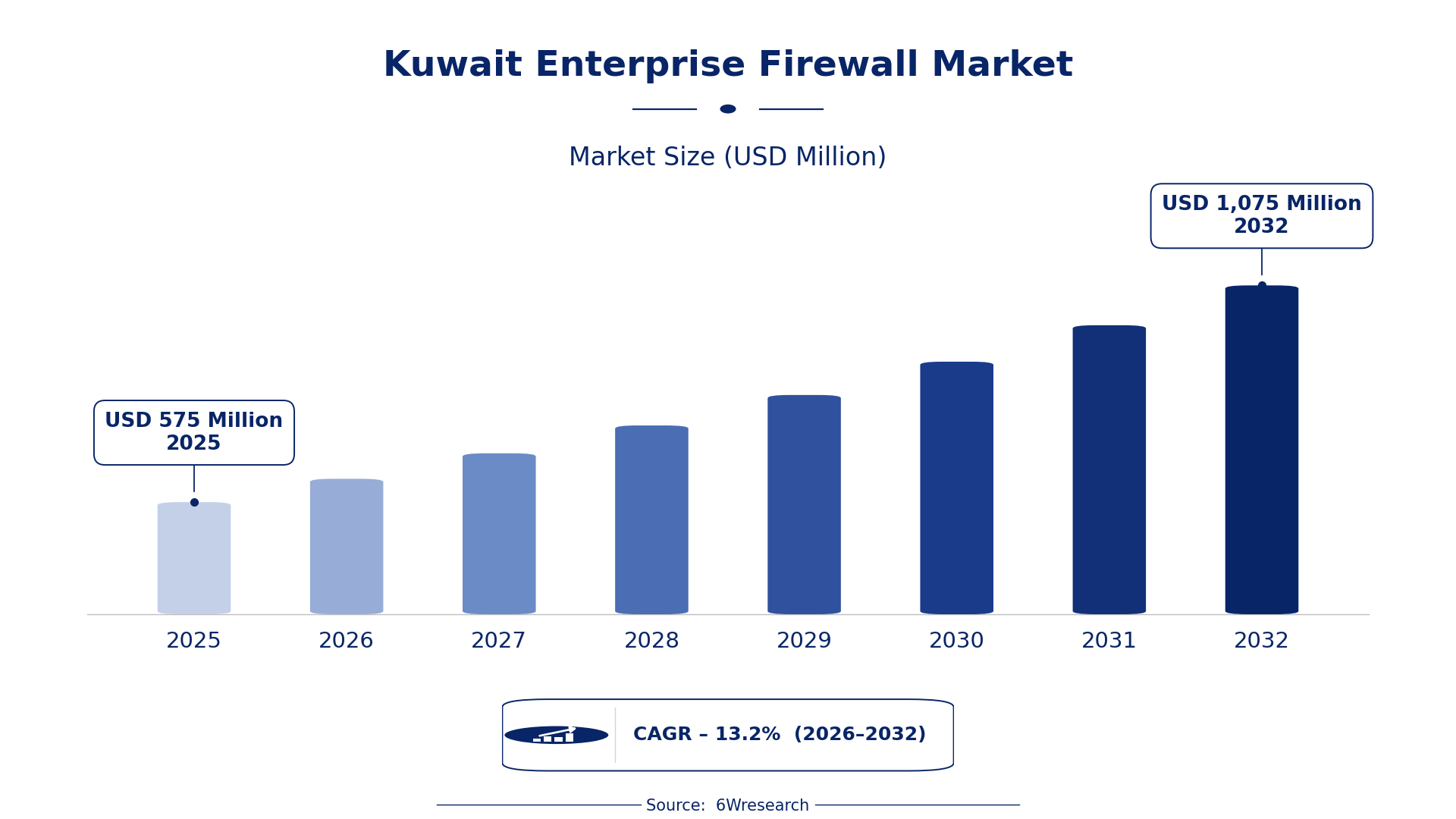
The Kuwait Enterprise Firewall Market was estimated at USD 575 Million in 2025 and is projected to reach USD 1075 Million by 2032, growing at a CAGR of 13.2% from 2026 to 2032.
Kuwait Enterprise Firewall Market Synopsis
The Kuwait Enterprise Firewall Market has seen an uptick in activity, fueled by rising cybersecurity threats and the widespread adoption of cloud technologies. As businesses strive for robust security measures, the market is shifting towards next-generation firewalls designed to counter sophisticated attacks.
Looking ahead, the trajectory appears increasingly promising as regulatory measures and heightened awareness of cyber risks drive investment. Organizations in Kuwait are prioritizing advanced firewall solutions, indicating a growing commitment to safeguarding sensitive information and infrastructures.
Kuwait Enterprise Firewall Market Year-wise Growth Rate and Key Drivers
This graph illustrates the annual growth rates of the Kuwait Enterprise Firewall Market from 2021 to 2032, highlighting a steady upward trajectory and projected expansion over the forecast period.
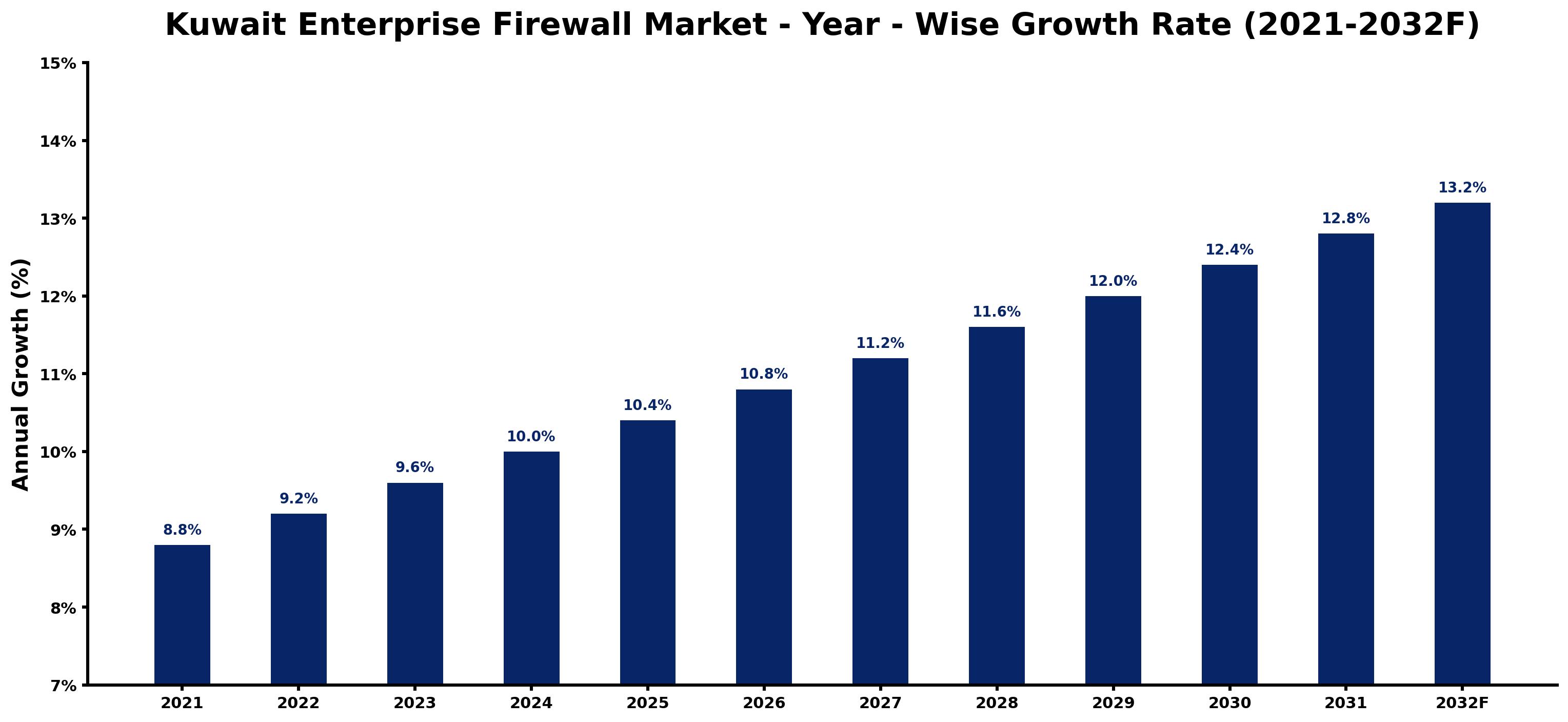
The table below presents the year‑wise growth rates along with the key drivers influencing the market
| Year | Growth Rate | Major Drivers |
| 2021 | 8.8% | Kuwait's cybersecurity regulations increasingly mandate firewall usage. |
| 2022 | 9.2% | Growing adoption of cloud services drives firewall investments. |
| 2023 | 9.6% | Kuwait's digital transformation initiatives prioritize cybersecurity measures. |
| 2024 | 10.0% | Increased cyber threats prompt stronger regulatory compliance efforts. |
| 2025 | 10.4% | Government promotes awareness around data protection and compliance. |
| 2026 | 10.8% | Strong demand for remote work solutions boosts firewall deployment. |
| 2027 | 11.2% | Emerging fintech sector necessitates enhanced network security solutions. |
| 2028 | 11.6% | Local enterprises seeking compliance with international cybersecurity standards. |
| 2029 | 12.0% | Investment in digital infrastructure increases firewall market demand. |
| 2030 | 12.4% | Rising IoT implementations require robust firewall protections. |
| 2031 | 12.8% | Heightened focus on protecting critical infrastructure from cyberattacks. |
| 2032 | 13.2% | Continued governmental support for cybersecurity initiatives encourages growth. |
Note: Market size estimations and growth projections presented in this report are based on 6Wresearch's proprietary forecasting methodology, utilizing the latest available industry data, government publications, and primary research inputs.
Kuwait Enterprise Firewall Market Key Takeaways
Below are some of the specific key takeaways from the market, including:
- The market is fueled by the rise in digital transformation initiatives among Kuwaiti businesses.
- Next-generation firewalls with advanced features are becoming the standard for enterprises.
- Compliance with stringent data protection regulations is driving demand for firewall solutions.
- Government initiatives play a critical role in enhancing cybersecurity measures across sectors.
- Investments are increasingly focused on customized firewall solutions tailored to specific industries.
Evaluation of Restraints in Kuwait Enterprise Firewall Market
Despite promising growth, the Kuwait Enterprise Firewall Market faces hurdles that cannot be overlooked. Rapidly evolving cyber threats demand continuous adaptation from businesses, but the sophistication required in threat detection often exceeds the current capabilities of many existing solutions. The challenge lies in balancing advanced security features with the need to manage high volumes of network traffic without introducing latency.
Additionally, a shortage of skilled cybersecurity professionals in Kuwait complicates the implementation and management of firewall technologies. Addressing these challenges necessitates ongoing training and innovation, elements crucial for maintaining resilience against cyber threats.
Kuwait Enterprise Firewall Market Trends
A surge in demand for advanced security solutions is evident in Kuwait, fueled primarily by increasing cyber threats. Notable trends include the migration towards cloud-based firewall solutions, which cater to the needs of remote work environments. on top of that, the adoption of zero trust security frameworks is becoming commonplace, allowing organizations to bolster their defenses against evolving attack vectors.
Another trend shaping the market involves the integration of threat intelligence into firewall solutions. This feature allows organizations to stay ahead of potential threats by proactively identifying and neutralizing risks before they escalate into significant breaches.
Kuwait Enterprise Firewall Market Opportunities
Vendors in the Kuwait Enterprise Firewall Market have a variety of opportunities to exploit, especially as organizations seek tailored solutions that address specific industry needs. The banking, healthcare, and government sectors are prime candidates for customized firewall offerings, driven by unique regulatory requirements and sensitive data handling.
As Kuwaiti enterprises increasingly prioritize compliance with data protection laws, there is significant potential for innovative firewall solutions that provide not only robust security but also simplify adherence to these regulations.
Government Initiatives in the Kuwait Enterprise Firewall Market
The Kuwaiti government has taken decisive steps to enhance cybersecurity across the nation, which directly impacts the Enterprise Firewall Market. Strong regulatory frameworks and national policies focus on safeguarding critical infrastructure and ensuring compliance with data protection standards. These initiatives are critical to fostering an environment where businesses can confidently invest in security technologies.
- A regulatory framework established in 2025 mandates all enterprises to deploy approved firewalls to secure their networks.
- Currently, an initiative is underway to conduct regular audits of firewall implementations across sectors to ensure compliance with security protocols.
- There are plans for a national cybersecurity awareness campaign aimed at educating businesses on best practices, expected to launch in late 2026.
- The government is promoting a cybersecurity certification program for professionals, enhancing the skill set of the workforce and bolstering market readiness.
Future Insights of the Kuwait Enterprise Firewall Market
As we look towards the future, the Kuwait Enterprise Firewall Market is set to expand steadily. Factors such as increasing digital transformation initiatives, alongside heightened regulatory compliance demands, will drive the adoption of advanced firewall technologies. Vendors that prioritize innovation, especially in threat detection and prevention, will be well-positioned to capture the market's momentum.
on top of that, as businesses become more aware of the vulnerabilities they face, investment in cybersecurity solutions, particularly firewalls that can scale with growing digital needs, will be vital to securing Kuwait's digital infrastructure.
Kuwait Enterprise Firewall Market Latest Developments
In recent months, the Kuwait Enterprise Firewall Market has experienced notable developments reflecting the urgency of enhancing cybersecurity. Organizations are increasingly recognizing the need for comprehensive firewall solutions as cyber threats evolve.
- A regional operator launched an upgraded firewall solution in Q2 2025, featuring advanced threat intelligence capabilities.
- An ongoing initiative aimed at integrating cloud-based firewall solutions began in early 2025 and continues to show promising adoption rates.
- A technology vendor announced a partnership in mid-2025 to develop tailored firewall solutions for the healthcare sector, enhancing security measures.
- By late 2026, a rollout of an AI-driven firewall system is expected, promising to improve real-time threat detection and response capabilities.
Kuwait Enterprise Firewall Market - Key Attractiveness of the Report
- 10 Years of Market Numbers
- Historical Data Starting from 2022 to 2025
- Base Year: 2025
- Forecast Data until 2032
- Key Performance Indicators Impacting the Market
- Major Upcoming Developments and Projects
Key Highlights of the Report:
- Kuwait Enterprise Firewall Market Outlook
- Market Size of Kuwait Enterprise Firewall Market, 2025
- Forecast of Kuwait Enterprise Firewall Market, 2032
- Historical Data and Forecast of Kuwait Enterprise Firewall Revenues & Volume for the Period 2022-2032F
- Kuwait Enterprise Firewall Market Trend Evolution
- Kuwait Enterprise Firewall Market Drivers and Challenges
- Kuwait Enterprise Firewall Price Trends
- Kuwait Enterprise Firewall Porter's Five Forces
- Kuwait Enterprise Firewall Industry Life Cycle
- Historical Data and Forecast of Kuwait Enterprise Firewall Market Revenues & Volume By Types for the Period 2022-2032F
- Historical Data and Forecast of Kuwait Enterprise Firewall Market Revenues & Volume By Next Generation for the Period 2022-2032F
- Historical Data and Forecast of Kuwait Enterprise Firewall Market Revenues & Volume By Application for the Period 2022-2032F
- Historical Data and Forecast of Kuwait Enterprise Firewall Market Revenues & Volume By Conventional for the Period 2022-2032F
- Historical Data and Forecast of Kuwait Enterprise Firewall Market Revenues & Volume By Industry vertical for the Period 2022-2032F
- Historical Data and Forecast of Kuwait Enterprise Firewall Market Revenues & Volume By Government & Public Utilities for the Period 2022-2032F
- Historical Data and Forecast of Kuwait Enterprise Firewall Market Revenues & Volume By Healthcare for the Period 2022-2032F
- Historical Data and Forecast of Kuwait Enterprise Firewall Market Revenues & Volume By Telecommunication for the Period 2022-2032F
- Historical Data and Forecast of Kuwait Enterprise Firewall Market Revenues & Volume By Education for the Period 2022-2032F
- Historical Data and Forecast of Kuwait Enterprise Firewall Market Revenues & Volume By Retail for the Period 2022-2032F
- Historical Data and Forecast of Kuwait Enterprise Firewall Market Revenues & Volume By Entertainment & Media for the Period 2022-2032F
- Historical Data and Forecast of Kuwait Enterprise Firewall Market Revenues & Volume By Manufacturing for the Period 2022-2032F
- Historical Data and Forecast of Kuwait Enterprise Firewall Market Revenues & Volume By Education for the Period 2022-2032F
- Historical Data and Forecast of Kuwait Enterprise Firewall Market Revenues & Volume By Organization Size for the Period 2022-2032F
- Historical Data and Forecast of Kuwait Enterprise Firewall Market Revenues & Volume By Small and Medium Sized Enterprises (SMBs) for the Period 2022-2032F
- Historical Data and Forecast of Kuwait Enterprise Firewall Market Revenues & Volume By Large Enterprises for the Period 2022-2032F
- Kuwait Enterprise Firewall Import Export Trade Statistics
- Market Opportunity Assessment By Types
- Market Opportunity Assessment By Industry vertical
- Market Opportunity Assessment By Organization Size
- Kuwait Enterprise Firewall Top Companies Market Share
- Kuwait Enterprise Firewall Competitive Benchmarking By Technical and Operational Parameters
- Kuwait Enterprise Firewall Company Profiles
- Kuwait Enterprise Firewall Key Strategic Recommendations






































