Kuwait Facility Management Market Size & Growth Rate (2026-2032)
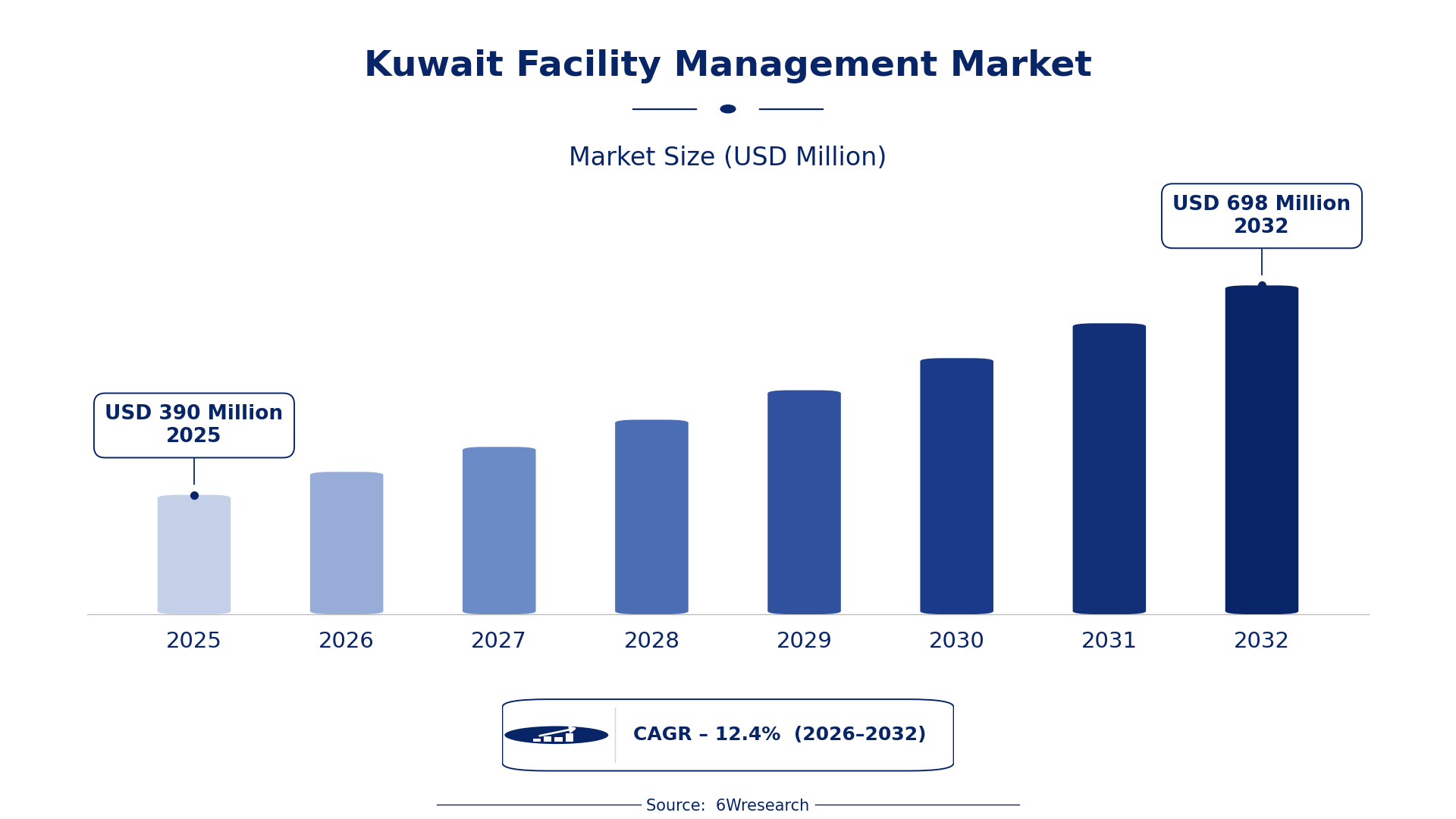
The Kuwait Facility Management Market was estimated at USD 390 Million in 2025 and is projected to reach USD 698 Million by 2032, growing at a CAGR of 12.4% from 2026 to 2032.
Kuwait Facility Management Market Synopsis
The current driving force behind the Kuwait Facility Management Market is the rapid urbanization and significant infrastructure projects underway in the region. This surge in development is demanding integrated facility management services that ensure operational efficiency and tenant satisfaction.
As the market matures, there’s a palpable shift toward technology-driven solutions. Companies are adopting smart technologies not only to streamline operations but also to meet the growing expectations of clients who seek sustainable and efficient management practices.
Kuwait Facility Management Market Year-wise Growth Rate and Key Drivers
This graph illustrates the annual growth rates of the Kuwait Facility Management Market from 2021 to 2032, highlighting a steady upward trajectory and projected expansion over the forecast period.
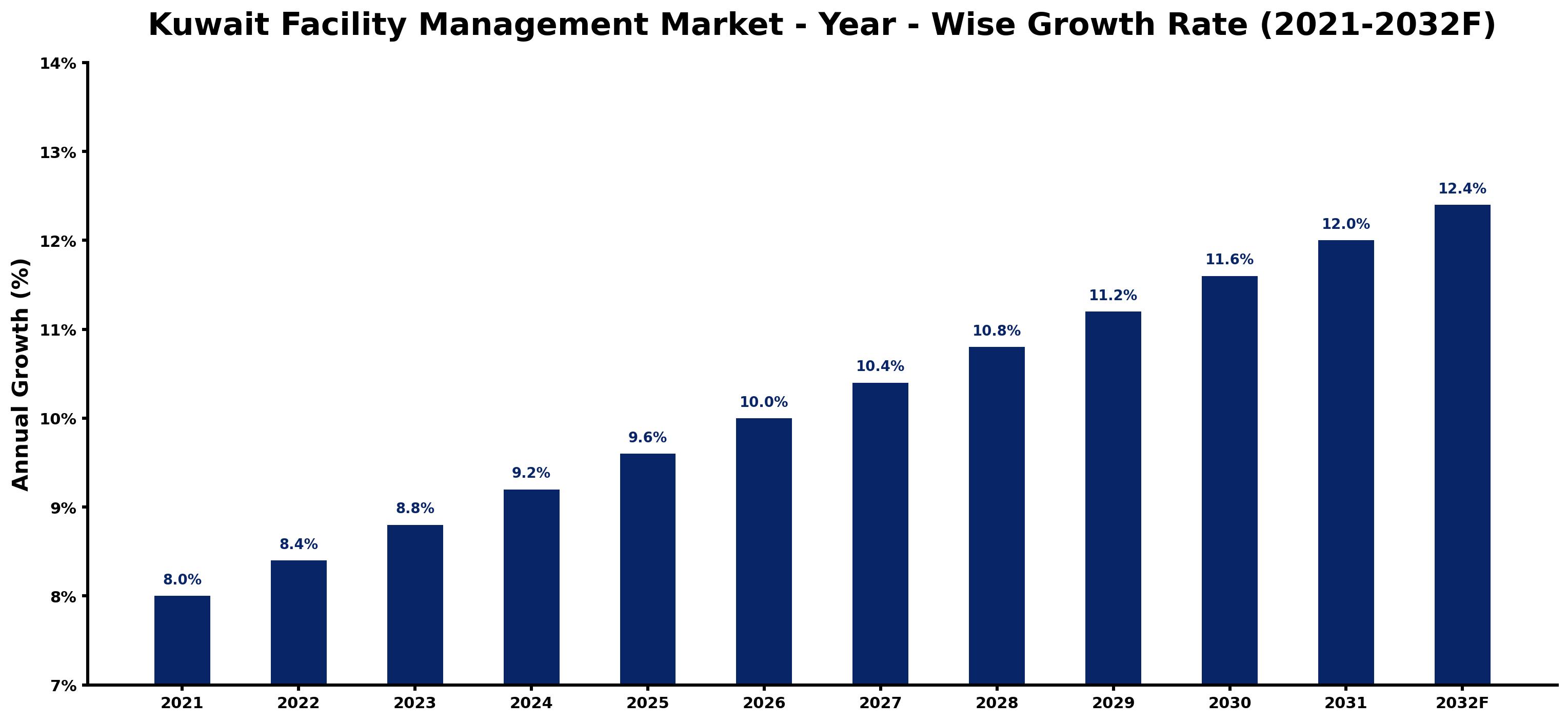
The table below presents the year‑wise growth rates along with the key drivers influencing the market
| Year | Growth Rate | Major Drivers |
| 2021 | 8.0% | Kuwait's Vision 2035 drives infrastructure development projects. |
| 2022 | 8.4% | Increasing health and safety regulations boost facility management needs. |
| 2023 | 8.8% | New sustainability initiatives prioritize eco-friendly building management. |
| 2024 | 9.2% | Rising expatriate population increases demand for managed properties. |
| 2025 | 9.6% | Growth in real estate sector drives facilities service contracts. |
| 2026 | 10.0% | New waste management laws enhance facility operations demand. |
| 2027 | 10.4% | Technological adoption in facility management improving operational efficiency. |
| 2028 | 10.8% | Increased tourism boosts demand for managed hospitality facilities. |
| 2029 | 11.2% | Government investments in public-private partnerships require management services. |
| 2030 | 11.6% | Urban development projects emphasize comprehensive facility oversight. |
| 2031 | 12.0% | Evolving corporate compliance mandates enhance facility service requirements. |
| 2032 | 12.4% | Leisure and entertainment hubs need specialized facility management solutions. |
Note: Market size estimations and growth projections presented in this report are based on 6Wresearch's proprietary forecasting methodology, utilizing the latest available industry data, government publications, and primary research inputs.
Kuwait Facility Management Market Key Takeaways
Below are some of the specific key takeaways from the market, including:
- Steady growth is anticipated as urbanization accelerates and infrastructure development ramps up.
- There is a pronounced demand for integrated facility management services across key sectors.
- Technology adoption is crucial for enhancing operational efficiency and tenant experience.
- Government policies are actively promoting sustainability and energy efficiency in facilities.
- Opportunities for specialized services, such as energy management and predictive maintenance, are expanding.
Evaluation of Restraints in Kuwait Facility Management Market
The Kuwait Facility Management Market faces notable restraints that hinder its potential. One of the primary issues is the intense competition among service providers, resulting in price wars that dilute service quality. Additionally, a shortage of skilled labor complicates service delivery, leaving many companies struggling to meet the demands of sophisticated clients.
Regulatory complexities add another layer of challenge, as businesses must constantly adapt to varying standards. The absence of standardized service quality benchmarks can lead to inconsistent customer experiences, underscoring the necessity for greater industry-wide coherence.
Kuwait Facility Management Market Trends
A key trend shaping the Kuwait Facility Management Market is the increasing focus on sustainability. Companies are incorporating green practices into their service offerings, driven by both regulatory mandates and client expectations. This shift not only reduces environmental impact but also aligns with global sustainability goals.
Smart building technologies are also gaining traction, enhancing operational efficiencies and occupant comfort. The integration of IoT and AI into facility management processes is expected to revolutionize how properties are managed, offering predictive maintenance and energy optimization as standard features.
Kuwait Facility Management Market Opportunities
Investment opportunities abound in the Kuwait Facility Management Market, particularly in specialized service offerings. As organizations increasingly seek to outsource non-core activities, there is a growing demand for providers who can offer tailored solutions in energy management, predictive maintenance, and space optimization.
Partnerships with technology firms present further growth avenues, enabling service providers to enhance their service delivery with cutting-edge solutions. Companies that can adapt to the evolving regulatory landscape and align their offerings with government sustainability goals will find themselves well-positioned for success.
Government Initiatives in the Kuwait Facility Management Market
Government initiatives play a critical role in shaping the Kuwait Facility Management Market. With a focus on sustainability and building efficiency, the authorities are implementing policies that encourage the adoption of green technologies and practices within the industry. This proactive stance is aimed at fostering an environment where facility management services can thrive, benefiting both the economy and the community.
- A recently completed initiative involved the introduction of regulations mandating green building certifications for new constructions.
- Currently, there is an ongoing program focused on upgrading public facilities to meet enhanced energy efficiency standards.
- Future plans include a comprehensive policy framework aimed at promoting smart building technologies across commercial and residential sectors.
- A recent campaign was launched to incentivize companies adopting sustainable practices in facility management.
- The government is also working on a public-private partnership model to enhance infrastructure development, which will include facility management services.
Future Insights of the Kuwait Facility Management Market
Looking ahead to 2026-2032, the Kuwait Facility Management Market is set for robust expansion. As urbanization continues to escalate, demand for integrated and efficient facility management services will grow exponentially. The incorporation of advanced technologies like IoT and AI will redefine service delivery, making operations more streamlined and responsive to client needs.
on top of that, the government's commitment to sustainable development will drive increased investment in green technologies. Companies that align their services with these initiatives will not only enhance their competitive edge but will also contribute to the broader goal of sustainability within the region.
Kuwait Facility Management Market Latest Developments
In recent months, the Kuwait Facility Management Market has witnessed a surge in activity as companies adapt to changing client expectations and regulatory frameworks. Providers are increasingly embracing innovative technologies to enhance service delivery and meet the demands for sustainable practices.
- A leading regional operator announced a new service offering focused on smart building technologies, set to launch in early 2025.
- A major technology vendor is currently implementing an IoT-based facility management platform across several commercial properties, enhancing operational efficiencies.
- An initiative that began in mid-2025 aims to train local workforce in advanced facility management practices and technologies.
- A rollout expected to begin in Q3 2026 will involve the integration of energy management solutions across multiple sectors.
- A partnership between several facility management firms is in the planning stages to develop a standardized service quality framework by late 2026.
Kuwait Facility Management Market - Key Attractiveness of the Report
- 10 Years of Market Numbers
- Historical Data Starting from 2022 to 2025
- Base Year: 2025
- Forecast Data until 2032
- Key Performance Indicators Impacting the Market
- Major Upcoming Developments and Projects
Key Highlights of the Report:
- Kuwait Facility Management Market Outlook
- Market Size of Kuwait Facility Management Market, 2025
- Forecast of Kuwait Facility Management Market, 2032
- Historical Data and Forecast of Kuwait Facility Management Revenues & Volume for the Period 2022-2032F
- Kuwait Facility Management Market Trend Evolution
- Kuwait Facility Management Market Drivers and Challenges
- Kuwait Facility Management Price Trends
- Kuwait Facility Management Porter's Five Forces
- Kuwait Facility Management Industry Life Cycle
- Historical Data and Forecast of Kuwait Facility Management Market Revenues & Volume By Component for the Period 2022-2032F
- Historical Data and Forecast of Kuwait Facility Management Market Revenues & Volume By Solutions for the Period 2022-2032F
- Historical Data and Forecast of Kuwait Facility Management Market Revenues & Volume By Services for the Period 2022-2032F
- Historical Data and Forecast of Kuwait Facility Management Market Revenues & Volume By Deployment Mode for the Period 2022-2032F
- Historical Data and Forecast of Kuwait Facility Management Market Revenues & Volume By Cloud for the Period 2022-2032F
- Historical Data and Forecast of Kuwait Facility Management Market Revenues & Volume By On-premises for the Period 2022-2032F
- Historical Data and Forecast of Kuwait Facility Management Market Revenues & Volume By Organization Size for the Period 2022-2032F
- Historical Data and Forecast of Kuwait Facility Management Market Revenues & Volume By Large enterprises for the Period 2022-2032F
- Historical Data and Forecast of Kuwait Facility Management Market Revenues & Volume By Small and medium-sized enterprises (SMEs) for the Period 2022-2032F
- Historical Data and Forecast of Kuwait Facility Management Market Revenues & Volume By Vertical for the Period 2022-2032F
- Historical Data and Forecast of Kuwait Facility Management Market Revenues & Volume By BFSI for the Period 2022-2032F
- Historical Data and Forecast of Kuwait Facility Management Market Revenues & Volume By IT and Telecom for the Period 2022-2032F
- Historical Data and Forecast of Kuwait Facility Management Market Revenues & Volume By Government and Public Administration for the Period 2022-2032F
- Historical Data and Forecast of Kuwait Facility Management Market Revenues & Volume By Healthcare for the Period 2022-2032F
- Historical Data and Forecast of Kuwait Facility Management Market Revenues & Volume By Education for the Period 2022-2032F
- Historical Data and Forecast of Kuwait Facility Management Market Revenues & Volume By Retail for the Period 2022-2032F
- Historical Data and Forecast of Kuwait Facility Management Market Revenues & Volume By Energy and Utilities for the Period 2022-2032F
- Historical Data and Forecast of Kuwait Facility Management Market Revenues & Volume By Manufacturing for the Period 2022-2032F
- Kuwait Facility Management Import Export Trade Statistics
- Market Opportunity Assessment By Component
- Market Opportunity Assessment By Deployment Mode
- Market Opportunity Assessment By Organization Size
- Market Opportunity Assessment By Vertical
- Kuwait Facility Management Top Companies Market Share
- Kuwait Facility Management Competitive Benchmarking By Technical and Operational Parameters
- Kuwait Facility Management Company Profiles
- Kuwait Facility Management Key Strategic Recommendations






































