Kuwait Field Service Management Market Size, Share & Growth Rate
The Kuwait Field Service Management Market was estimated at USD 1050 Million in 2025 and is projected to reach USD 1809 Million by 2032, growing at a CAGR of 8.1% from 2026 to 2032. This robust growth trajectory is primarily fueled by the increasing adoption of advanced technologies aimed at optimizing field operations across key industries. The drive towards digital transformation in sectors such as telecommunications and oil & gas is amplifying demand for innovative Field Service Management solutions, enhancing operational efficiency and customer satisfaction.
Kuwait Field Service Management Market Year-wise Growth Rate and Key Drivers
This graph highlights how the Kuwait Field Service Management Market has steadily grown over the years, supported by major growth factors.
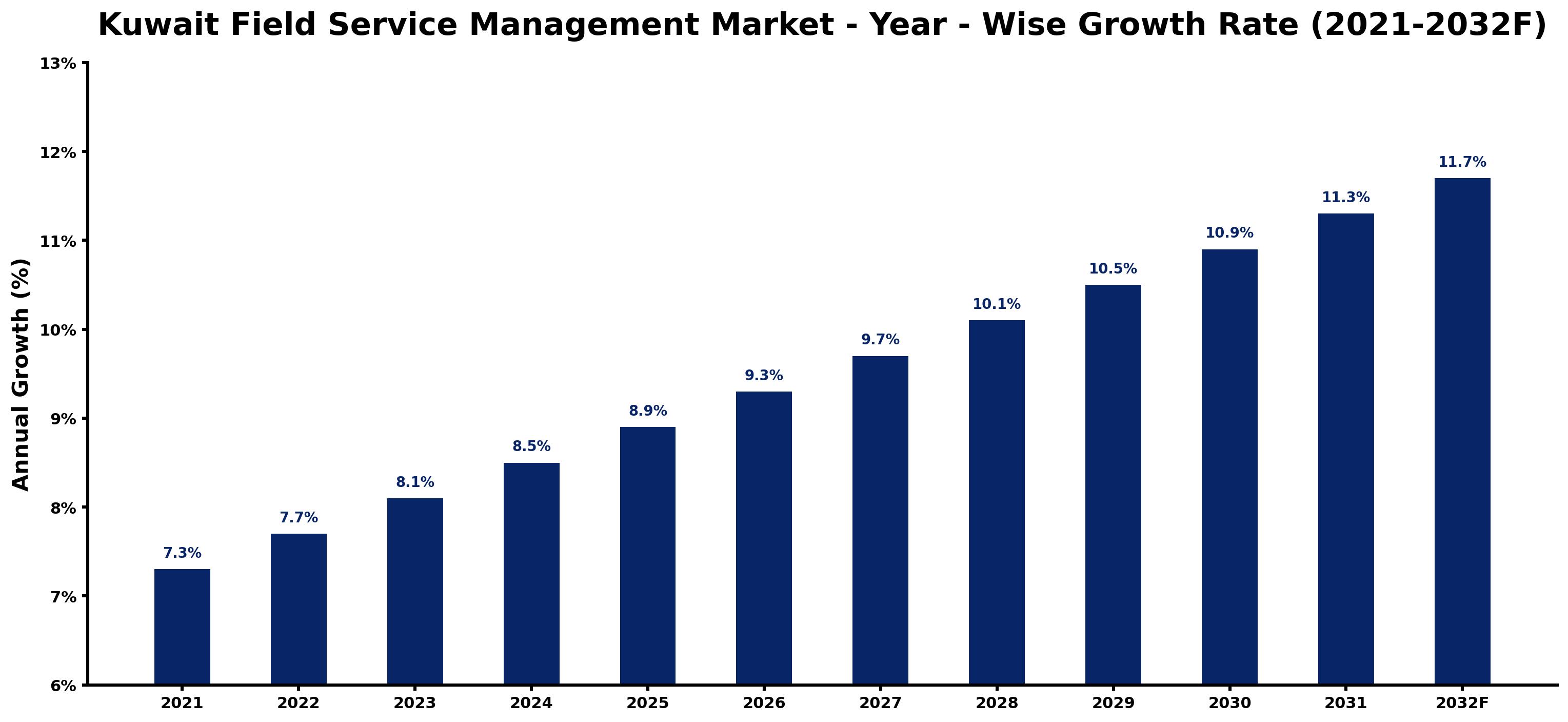
The table below presents the year‑wise growth rates along with the key drivers influencing the market
| Year | Growth Rate | Major Drivers |
| 2021 | 7.3% | Rapid growth in telecom and data center sectors |
| 2022 | 7.7% | Government infrastructure modernization initiatives |
| 2023 | 8.1% | Increasing adoption of advanced technologies |
| 2024 | 8.5% | Growing urbanization and commercial development |
| 2025 | 8.9% | Rising electricity demand across industries |
| 2026 | 9.3% | Increasing smart city development projects |
| 2027 | 9.7% | Growing urbanization and commercial development |
| 2028 | 10.1% | Increasing smart city development projects |
| 2029 | 10.5% | Increasing industrial automation investments |
| 2030 | 10.9% | Increasing industrial infrastructure investments |
| 2031 | 11.3% | Increasing adoption of advanced technologies |
| 2032 | 11.7% | Increasing smart city development projects |
Note - Market size estimations and growth projections presented in this report are based on 6Wresearch’s advanced forecasting approach, validated with industry datasets as of June 2026.
Kuwait Field Service Management Market Synopsis
The rising need for real-time tracking and efficient workforce management solutions is a key factor shaping the Kuwait Field Service Management market. With numerous industries striving for operational excellence, companies are turning to software that facilitates streamlined scheduling and dispatching, reducing downtime and improving overall service quality.
Moreover, as firms in Kuwait navigate an increasingly complex landscape marked by regulatory requirements and competitive pressures, the implementation of sophisticated analytics and remote diagnostics has become crucial. This focus on data-driven decision-making empowers organizations to better allocate resources and enhance service delivery.
Kuwait Field Service Management Market Key Takeaways
- The market is witnessing a significant shift towards cloud-based solutions for enhanced operational efficiency.
- Mobile technologies are increasingly utilized to improve communication between field technicians and office staff.
- Integration of IoT and AI is becoming essential for predictive maintenance and automated service scheduling.
- Data analytics is being leveraged to gain insights that improve resource allocation and operational strategies.
- Continuous investment in workforce training is vital to meet the demands of evolving technology and customer expectations.
Evaluation of Restraints in Kuwait Field Service Management Market
Despite its growth potential, the Kuwait Field Service Management market faces several limitations that could hinder progress. Key among these is the challenge of inefficient scheduling and routing of field technicians, which can lead to increased operational costs. Furthermore, a lack of real-time visibility into field operations inhibits organizations from optimizing resource utilization effectively. There are also concerns regarding the integration of emerging technologies such as IoT and AI into existing systems. These complexities, coupled with ongoing security concerns around data privacy, underscore the need for companies to innovate while navigating the intricacies of the market.
Kuwait Field Service Management Market Trends
Several notable trends are shaping the Kuwait Field Service Management market. A pronounced shift towards cloud-based solutions is facilitating real-time tracking of field operations, which, in turn, enhances responsiveness and agility. Additionally, the adoption of mobile technologies is streamlining communication, driving improvements in service delivery. As organizations increasingly integrate IoT devices, the focus on predictive maintenance is gaining traction, enabling proactive measures that minimize downtime. The utilization of advanced data analytics tools is also on the rise, helping businesses gain critical insights to refine their strategies.
Kuwait Field Service Management Market Opportunities
The landscape of the Kuwait Field Service Management market is ripe with investment opportunities. There is a growing demand for solutions that enhance scheduling, workforce management, and communication capabilities. Organizations can benefit from investing in tailored software development, mobile applications, and IoT integration, specifically designed to meet the needs of the Kuwaiti market. With a collective push towards innovation and efficiency, stakeholders have ample avenues to capitalize on the ongoing digital transformation trends.
Government Initiatives in the Kuwait Field Service Management Market
The Kuwaiti government is actively promoting the growth of the Field Service Management market through various initiatives. These policies emphasize improving the country's infrastructure, enhancing technology adoption, and upgrading workforce skills in the sector. By offering incentives such as tax breaks for companies operating in this domain, the government is fostering an environment conducive to innovation. Furthermore, regulations designed to ensure quality standards and safety measures are also in place, supporting sustainable development in the field service sector.
Future Insights of the Kuwait Field Service Management Market
Looking ahead to 2026-2032, the Kuwait Field Service Management market is anticipated to flourish, driven by a continued emphasis on efficiency and technology integration. The increasing reliance on advanced solutions like cloud computing, IoT, and AI will be pivotal in transforming field service operations. As organizations increasingly seek to reduce operational costs while enhancing customer satisfaction, there will be further investment in cutting-edge field service management tools. This trend indicates a bright future for the market, marked by continuous innovation and opportunity.
Kuwait Field Service Management Market Latest Developments (May 2025 - June 2026)
Recent developments in the Kuwait Field Service Management market reveal a growing emphasis on the adoption of mobile and cloud-based solutions. Industry players are increasingly looking to enhance their digital infrastructure to better support real-time operations. Additionally, discussions surrounding the integration of AI for smarter scheduling and customer engagement are becoming more prevalent. Furthermore, there is a noticeable increase in collaborations aimed at addressing training gaps in workforce skills, ensuring that technicians are equipped to meet modern demands.
Kuwait Field Service Management Market - Key Attractiveness of the Report
- 10 Years of Market Numbers
- Historical Data Starting from 2022 to 2025
- Base Year: 2025
- Forecast Data until 2032
- Key Performance Indicators Impacting the Market
- Major Upcoming Developments and Projects
Key Highlights of the Report:
- Kuwait Field Service Management Market Outlook
- Market Size of Kuwait Field Service Management Market, 2025
- Forecast of Kuwait Field Service Management Market, 2032
- Historical Data and Forecast of Kuwait Field Service Management Revenues & Volume for the Period 2022-2032F
- Kuwait Field Service Management Market Trend Evolution
- Kuwait Field Service Management Market Drivers and Challenges
- Kuwait Field Service Management Price Trends
- Kuwait Field Service Management Porter's Five Forces
- Kuwait Field Service Management Industry Life Cycle
- Historical Data and Forecast of Kuwait Field Service Management Market Revenues & Volume By Component for the Period 2022-2032F
- Historical Data and Forecast of Kuwait Field Service Management Market Revenues & Volume By Solutions for the Period 2022-2032F
- Historical Data and Forecast of Kuwait Field Service Management Market Revenues & Volume By Services for the Period 2022-2032F
- Historical Data and Forecast of Kuwait Field Service Management Market Revenues & Volume By Verticals for the Period 2022-2032F
- Historical Data and Forecast of Kuwait Field Service Management Market Revenues & Volume By Telecom for the Period 2022-2032F
- Historical Data and Forecast of Kuwait Field Service Management Market Revenues & Volume By Manufacturing & Construction for the Period 2022-2032F
- Historical Data and Forecast of Kuwait Field Service Management Market Revenues & Volume By Healthcare for the Period 2022-2032F
- Historical Data and Forecast of Kuwait Field Service Management Market Revenues & Volume By Energy & Utility for the Period 2022-2032F
- Historical Data and Forecast of Kuwait Field Service Management Market Revenues & Volume By Others for the Period 2022-2032F
- Historical Data and Forecast of Kuwait Field Service Management Market Revenues & Volume By Deployment Mode for the Period 2022-2032F
- Historical Data and Forecast of Kuwait Field Service Management Market Revenues & Volume By Cloud for the Period 2022-2032F
- Historical Data and Forecast of Kuwait Field Service Management Market Revenues & Volume By On-premise for the Period 2022-2032F
- Kuwait Field Service Management Import Export Trade Statistics
- Market Opportunity Assessment By Component
- Market Opportunity Assessment By Verticals
- Market Opportunity Assessment By Deployment Mode
- Kuwait Field Service Management Top Companies Market Share
- Kuwait Field Service Management Competitive Benchmarking By Technical and Operational Parameters
- Kuwait Field Service Management Company Profiles
- Kuwait Field Service Management Key Strategic Recommendations






































