Kuwait Insurance Telematics Market Size & Growth Rate (2026-2032)
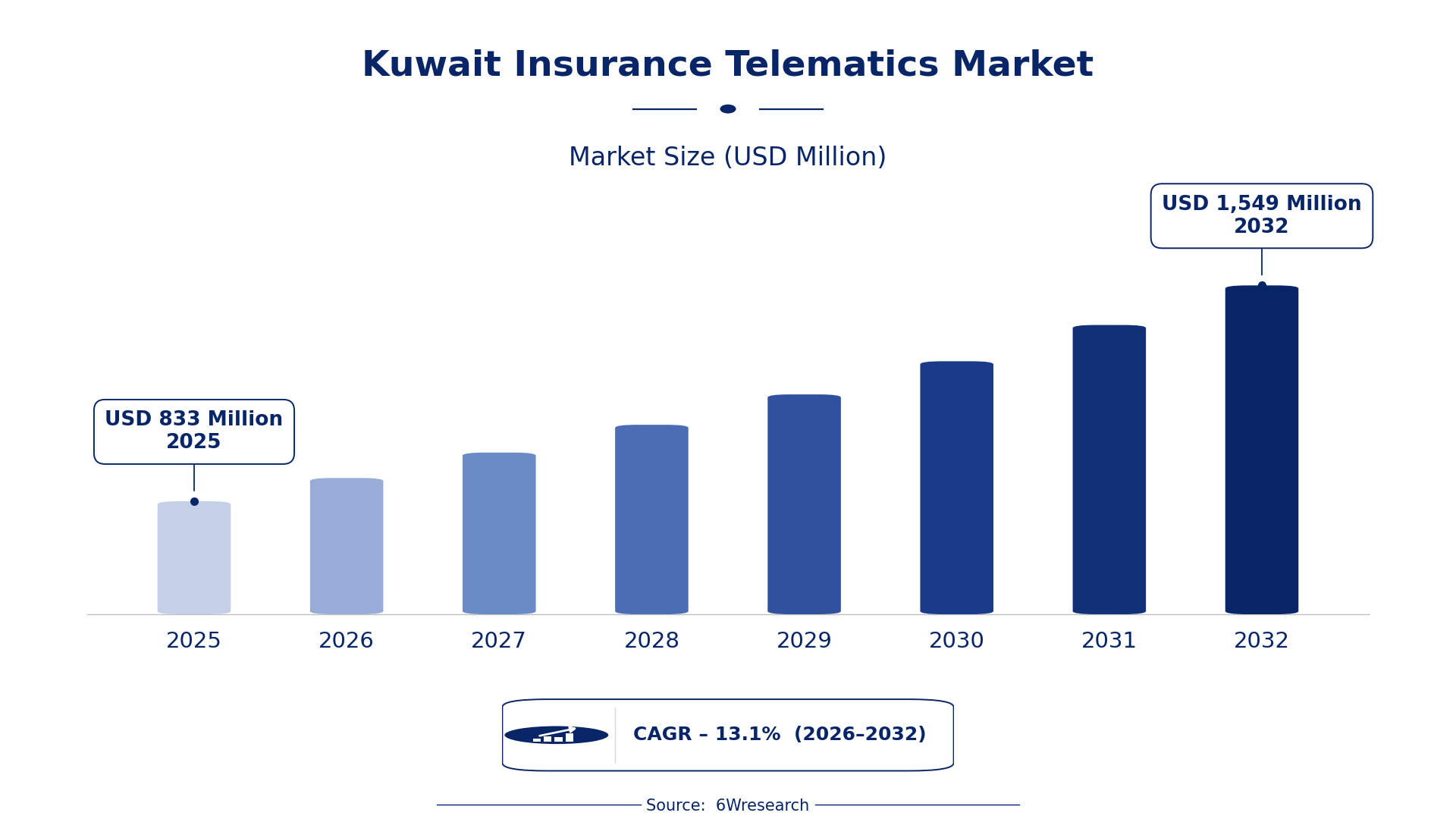
The Kuwait Insurance Telematics Market was estimated at USD 833 Million in 2025 and is projected to reach USD 1549 Million by 2032, growing at a CAGR of 13.1% from 2026 to 2032.
Kuwait Insurance Telematics Market Synopsis
The Kuwait Insurance Telematics Market is witnessing a notable surge, driven by the insurance sector's growing inclination toward technology. Insurers are increasingly adopting telematics solutions to fine-tune risk assessment and pricing strategies, enhancing customer engagement through personalized policies.
The introduction of GPS, sensors, and communication devices into vehicles allows insurers to gather detailed data on driving behaviors and vehicle performance. This shift not only enhances road safety but also enables the development of usage-based and behavior-based insurance models, aligning with the evolving expectations of consumers.
Kuwait Insurance Telematics Market Year-wise Growth Rate and Key Drivers
This graph illustrates the annual growth rates of the Kuwait Insurance Telematics Market from 2021 to 2032, highlighting a steady upward trajectory and projected expansion over the forecast period.
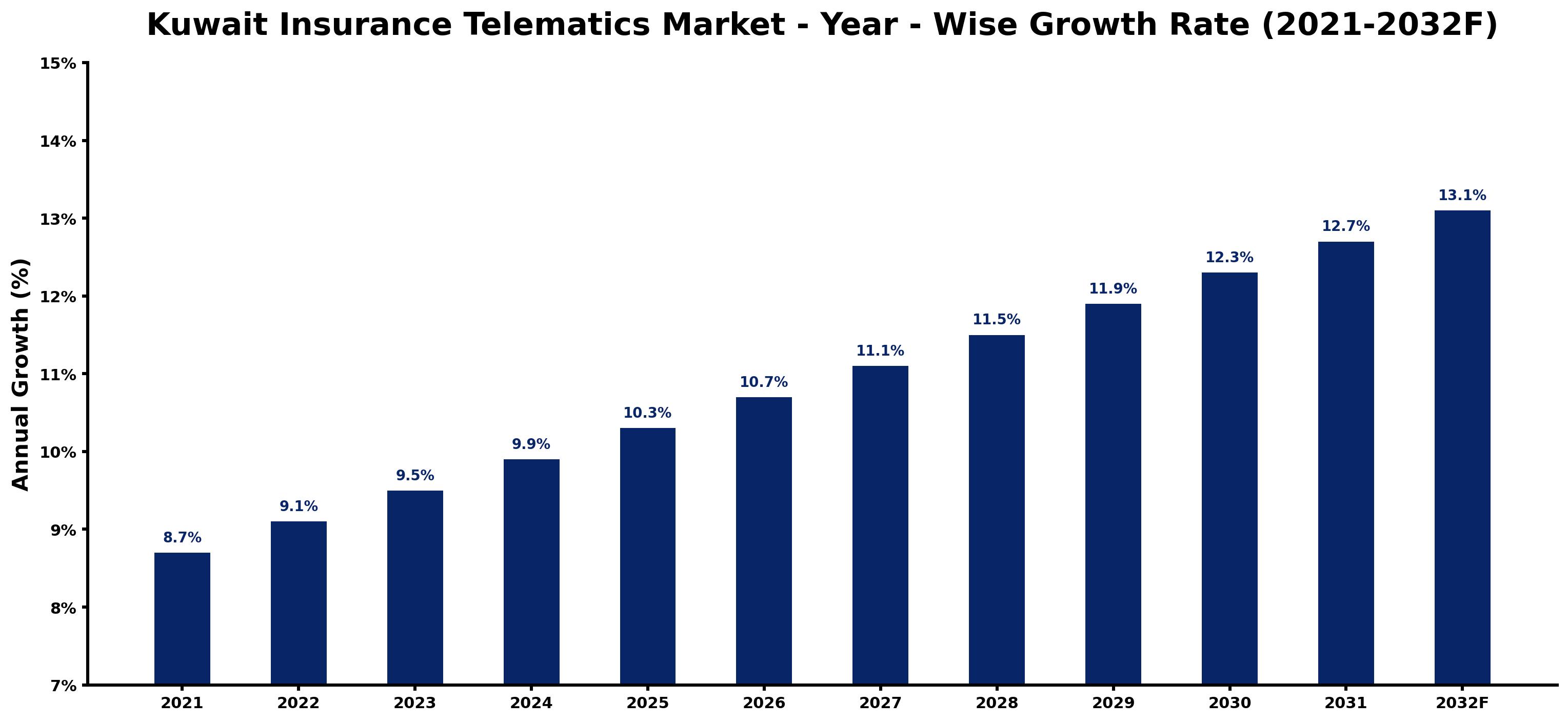
The table below presents the year‑wise growth rates along with the key drivers influencing the market
| Year | Growth Rate | Major Drivers |
| 2021 | 8.7% | Increased smartphone penetration enhancing telematics adoption |
| 2022 | 9.1% | Kuwait Motor Insurance Law incentivizing usage-based policies |
| 2023 | 9.5% | Government initiatives promoting smart transportation technologies |
| 2024 | 9.9% | Enhanced consumer demand for personalized insurance offerings |
| 2025 | 10.3% | Rise in car ownership boosting telematics market need |
| 2026 | 10.7% | Local insurance companies partnering with tech firms for innovation |
| 2027 | 11.1% | Growing awareness of vehicle safety features via telematics |
| 2028 | 11.5% | Focus on data privacy regulations enhancing telematics credibility |
| 2029 | 11.9% | Emergence of AI-driven analytics in local insurance firms |
| 2030 | 12.3% | Increased investment in telematics infrastructure by local government |
| 2031 | 12.7% | Adoption of electric vehicles driving new telematics solutions |
| 2032 | 13.1% | Kuwait's National Development Plan prioritizing smart insurance technologies |
Note: Market size estimations and growth projections presented in this report are based on 6Wresearch's proprietary forecasting methodology, utilizing the latest available industry data, government publications, and primary research inputs.
Kuwait Insurance Telematics Market Key Takeaways
Below are some of the specific key takeaways from the market, including:
- The market is projected to experience robust growth, reaching USD 1549 Million by 2032.
- Advancements in telematics technology are driving the adoption of personalized insurance solutions.
- Insurance providers are focusing on customer engagement through real-time feedback mechanisms.
- Government regulations are shaping the operational framework for telematics in insurance.
- Increasing road safety initiatives are contributing to market expansion.
Evaluation of Restraints in Kuwait Insurance Telematics Market
Despite promising growth, the Kuwait Insurance Telematics Market faces certain restraints. A primary challenge is ensuring the accuracy and reliability of data collected from telematics devices. Data privacy and security concerns also loom large, as consumer trust is paramount in adopting these technologies. Additionally, insurers must optimize usage-based insurance programs to effectively encourage safe driving behaviors, which can sometimes be a complex task requiring significant investment in technology and analytics.
Kuwait Insurance Telematics Market Trends
The shift towards connected vehicles is becoming a prominent trend, with insurers looking to integrate telematics into their offerings more seamlessly. There's a growing demand for real-time data analytics, enabling insurers to provide immediate feedback to drivers and adjust premiums accordingly. Additionally, the emergence of mobile applications for telematics services is enhancing customer interaction, allowing drivers to track their driving habits and earn rewards for safe behavior.
Kuwait Insurance Telematics Market Opportunities
Significant growth opportunities lie in the development of new telematics-based insurance products tailored to the specific needs of Kuwaiti consumers. The expansion of smart city initiatives and infrastructure enhancements further create a favorable environment for telematics adoption. Insurers can differentiate themselves by offering innovative solutions that leverage real-time data analytics to address individual risk profiles.
Government Initiatives in the Kuwait Insurance Telematics Market
Kuwait's regulatory framework is increasingly focusing on the insurance telematics sector, prioritizing consumer rights and data security. As the government promotes road safety and technological innovation, these policies are crucial for shaping the market dynamics. Regulatory standards are being introduced to ensure transparency and fairness in usage-based insurance programs, thus fostering consumer trust.
- A regulatory framework introduced in 2023 mandates strict data privacy measures for telematics data collection and transmission.
- Currently underway is a public awareness campaign aimed at educating consumers about the benefits of telematics in insurance.
- A planned initiative expected to launch in 2025 aims to enhance infrastructure for telematics devices across the nation.
- Ongoing collaborations between government agencies and technology providers are focused on developing standards for telematics devices.
- Future regulations expected by 2026 will establish guidelines for consumer consent and transparency in telematics-based insurance products.
Future Insights of the Kuwait Insurance Telematics Market
Looking ahead to 2026-2032, the Kuwait Insurance Telematics Market is set for significant transformation. As more insurers embrace data-driven strategies, personalized insurance offerings will become the norm. The integration of artificial intelligence and advanced analytics will enhance risk assessment capabilities, allowing for even greater precision in premium pricing. on top of that, as consumer acceptance of telematics grows, we can expect a proliferation of innovative products that cater to diverse driving behaviors and preferences.
Kuwait Insurance Telematics Market Latest Developments
Recent developments in the Kuwait Insurance Telematics Market reflect a dynamic shift towards greater technological integration. Over the past year, insurers have been increasingly focused on enhancing their telematics offerings to improve customer experiences and operational efficiencies.
- A major technology vendor launched a new telematics platform in early 2025, designed to provide insurers with advanced analytics capabilities.
- An ongoing initiative that began in mid-2025 aims to expand telematics adoption among small and medium-sized insurance firms.
- By late 2026, several insurers are expected to roll out personalized insurance products based on real-time driving behavior data.
- A recent partnership between a leading insurer and a tech firm, announced in Q1 2025, focuses on developing user-friendly mobile applications for telematics services.
- Upcoming in 2027 is a nationwide pilot program aimed at integrating telematics data with national road safety initiatives.
Kuwait Insurance Telematics Market - Key Attractiveness of the Report
- 10 Years of Market Numbers
- Historical Data Starting from 2022 to 2025
- Base Year: 2025
- Forecast Data until 2032
- Key Performance Indicators Impacting the Market
- Major Upcoming Developments and Projects
Key Highlights of the Report:
- Kuwait Insurance Telematics Market Outlook
- Market Size of Kuwait Insurance Telematics Market, 2025
- Forecast of Kuwait Insurance Telematics Market, 2032
- Historical Data and Forecast of Kuwait Insurance Telematics Revenues & Volume for the Period 2022-2032F
- Kuwait Insurance Telematics Market Trend Evolution
- Kuwait Insurance Telematics Market Drivers and Challenges
- Kuwait Insurance Telematics Price Trends
- Kuwait Insurance Telematics Porter's Five Forces
- Kuwait Insurance Telematics Industry Life Cycle
- Historical Data and Forecast of Kuwait Insurance Telematics Market Revenues & Volume By End User for the Period 2022-2032F
- Historical Data and Forecast of Kuwait Insurance Telematics Market Revenues & Volume By Small for the Period 2022-2032F
- Historical Data and Forecast of Kuwait Insurance Telematics Market Revenues & Volume By Medium Enterprises for the Period 2022-2032F
- Historical Data and Forecast of Kuwait Insurance Telematics Market Revenues & Volume By Large Enterprises for the Period 2022-2032F
- Historical Data and Forecast of Kuwait Insurance Telematics Market Revenues & Volume By Deployment Type for the Period 2022-2032F
- Historical Data and Forecast of Kuwait Insurance Telematics Market Revenues & Volume By Cloud for the Period 2022-2032F
- Historical Data and Forecast of Kuwait Insurance Telematics Market Revenues & Volume By On-Premises for the Period 2022-2032F
- Historical Data and Forecast of Kuwait Insurance Telematics Market Revenues & Volume By Organization Size for the Period 2022-2032F
- Historical Data and Forecast of Kuwait Insurance Telematics Market Revenues & Volume By Small and Medium Enterprises (SMEs) for the Period 2022-2032F
- Historical Data and Forecast of Kuwait Insurance Telematics Market Revenues & Volume By Large Enterprises for the Period 2022-2032F
- Kuwait Insurance Telematics Import Export Trade Statistics
- Market Opportunity Assessment By End User
- Market Opportunity Assessment By Deployment Type
- Market Opportunity Assessment By Organization Size
- Kuwait Insurance Telematics Top Companies Market Share
- Kuwait Insurance Telematics Competitive Benchmarking By Technical and Operational Parameters
- Kuwait Insurance Telematics Company Profiles
- Kuwait Insurance Telematics Key Strategic Recommendations






































