Kuwait Organic Food Market Size, Share & Growth Rate
The Kuwait Organic Food Market was estimated at USD 998 Million in 2025 and is projected to reach USD 1701 Million by 2032, growing at a CAGR of 7.9% from 2026 to 2032. This robust growth trajectory is primarily fueled by a surge in health consciousness among consumers, coupled with a growing expatriate demographic that is increasingly demanding organic food options. The governments commitment to sustainable agricultural practices also plays a crucial role in propelling market expansion.
Kuwait Organic Food Market Year-wise Growth Rate and Key Drivers
This graph highlights how the Kuwait Organic Food Market has steadily grown over the years, supported by major growth factors.
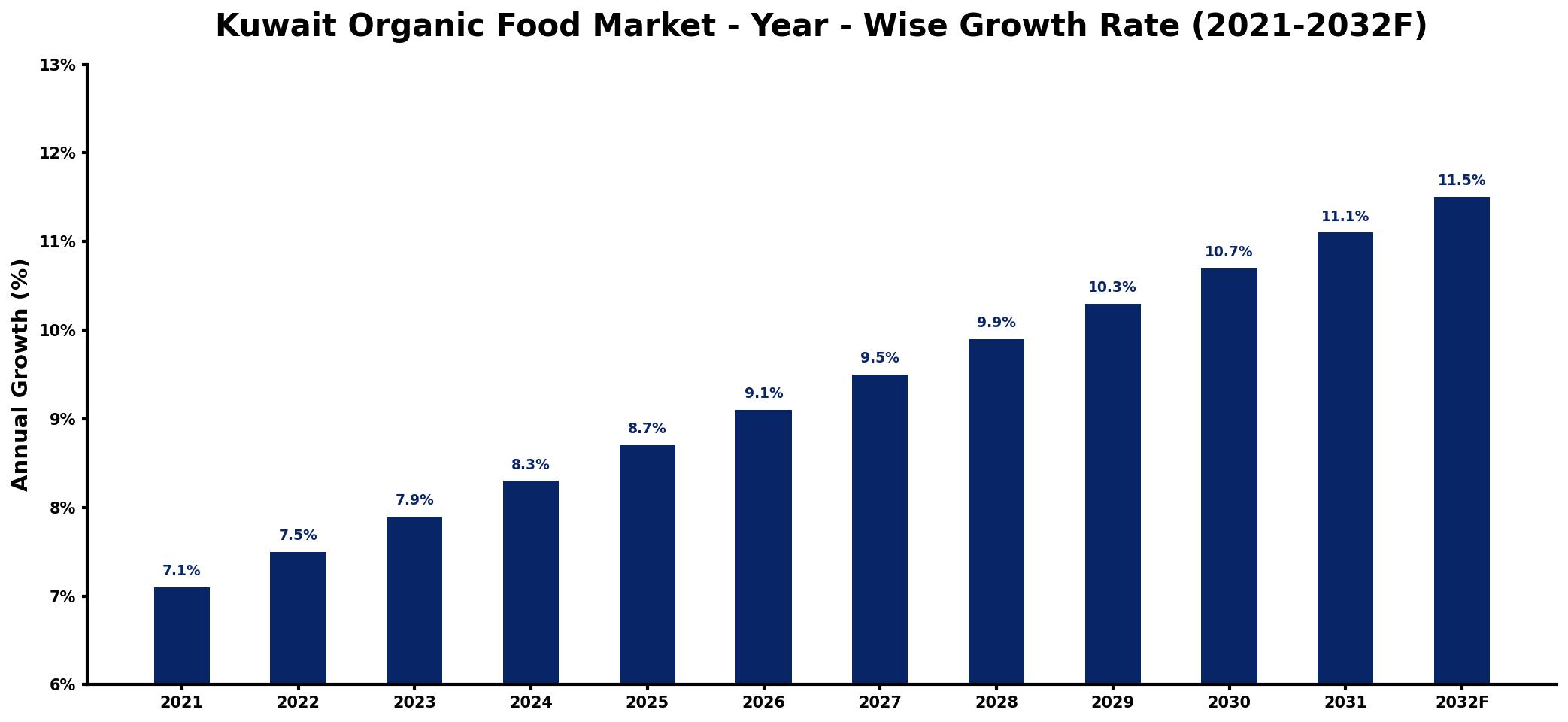
The table below presents the year‑wise growth rates along with the key drivers influencing the market
| Year | Growth Rate | Major Drivers |
| 2021 | 7.1% | Rising consumer health consciousness |
| 2022 | 7.5% | Increase in sustainable farming practices |
| 2023 | 7.9% | Growth in eco-friendly brands |
| 2024 | 8.3% | Expansion of retail distribution channels |
| 2025 | 8.7% | Surge in online shopping platforms |
| 2026 | 9.1% | enhanced product quality standards |
| 2027 | 9.5% | Growing awareness of nutrition benefits |
| 2028 | 9.9% | Investment in local agricultural technology |
| 2029 | 10.3% | Rising popularity of plant-based diets |
| 2030 | 10.7% | strengthening international trade flows |
| 2031 | 11.1% | rising procurement volume requirements |
| 2032 | 11.5% | improved raw material availability |
Note: Market size estimations and growth projections presented in this report are based on 6Wresearch's proprietary forecasting methodology, utilizing the latest available industry data, government publications, and primary research inputs.
Kuwait Organic Food Market Synopsis
The strongest force currently shaping the Kuwait Organic Food Market is the heightened awareness regarding health and environmental sustainability. As consumers become more informed about the benefits of organic products—such as their lack of harmful pesticides and chemicals—their purchasing behavior is shifting decisively towards organic options.
Additionally, the expanding range of available organic products, from fresh produce to packaged goods, is catalyzing this shift. With initiatives promoting local organic farming and a gradual increase in the number of specialty stores and e-commerce platforms, the market is positioned for sustained growth as it caters to the evolving preferences of health-conscious consumers.
Kuwait Organic Food Market Key Takeaways
- The market is driven by increasing health awareness and a preference for chemical-free food.
- Rising disposable incomes and an expanding expatriate population are key demand drivers.
- Government initiatives are fostering organic farming practices and supporting market growth.
- The rise of e-commerce platforms is enhancing accessibility to organic products.
- Local sourcing trends are gaining traction among consumers seeking quality and sustainability.
Evaluation of Restraints in Kuwait Organic Food Market
Despite the promising growth, the Kuwait Organic Food Market faces significant restraints. One of the primary challenges is the limited consumer awareness about organic products, which narrows the potential customer base. Furthermore, the local production of organic food is minimal, leading to an over-reliance on imports. This dependency not only affects pricing but also availability. Complicated certification processes pose additional hurdles for small-scale producers, making it difficult to enter the market. Additionally, the competitive landscape remains tough, as conventional products often come at lower price points, limiting market penetration for organic brands.
Kuwait Organic Food Market Trends
Several key trends are currently shaping the Kuwait Organic Food Market. A notable trend is the increasing demand for locally sourced organic produce, reflecting a desire for fresher, sustainable options. Consumers are also gravitating towards innovative organic packaged foods that combine convenience with health benefits. Furthermore, the shift towards organic beauty and personal care products signifies a broader understanding of wellness that extends beyond food. E-commerce is emerging as a significant player, facilitating greater access to organic offerings, especially among tech-savvy consumers.
Kuwait Organic Food Market Opportunities
The organic food market in Kuwait presents a wealth of investment opportunities driven by rising consumer demand for healthier options. Stakeholders can explore avenues in organic farming, production, distribution, and the burgeoning e-commerce sector tailored to organic goods. With a strong focus on sustainability, investors can benefit from collaborating with local farmers to create a more robust supply chain, while also engaging in marketing campaigns that educate consumers about the myriad benefits of organic foods.
Government Initiatives in the Kuwait Organic Food Market
The government of Kuwait has undertaken various initiatives aimed at promoting the organic food market. These initiatives include implementing stringent regulations on organic certification to ensure product quality and authenticity. Financial incentives and subsidies are provided to farmers and businesses that adopt organic farming methods. Moreover, there are ongoing programs focused on educating the public about the health benefits associated with organic foods, fostering a culture of healthier eating habits within the community.
Future Insights of the Kuwait Organic Food Market
Looking ahead to the period between 2026 and 2032, the Kuwait Organic Food Market is positioned for steady growth. The confluence of rising disposable incomes, an expanding expatriate community, and a societal shift towards environmentally friendly consumption practices will continue to drive demand for organic food. Government support for organic agriculture, coupled with a growing consumer preference for quality and authenticity, signals a vibrant future for the market. As consumers increasingly prioritize their health and wellness, opportunities for both local and international brands will flourish.
Kuwait Organic Food Market Latest Developments (2025 - 2026)
Recent developments in the Kuwait Organic Food Market indicate a shift towards greater innovation and accessibility. New local partnerships are being formed to bolster organic production capabilities and enhance the distribution of organic products. E-commerce platforms are increasingly expanding their offerings, making it easier for consumers to access a wider array of organic options. There is also a noticeable uptick in marketing campaigns focused on educating consumers about the nutritional and environmental benefits of organic food, reflecting the market's commitment to raising awareness.
Kuwait Organic Food Market - Key Attractiveness of the Report
- 10 Years of Market Numbers
- Historical Data Starting from 2022 to 2025
- Base Year: 2025
- Forecast Data until 2032
- Key Performance Indicators Impacting the Market
- Major Upcoming Developments and Projects
Key Highlights of the Report:
- Kuwait Organic Food Market Outlook
- Market Size of Kuwait Organic Food Market, 2025
- Forecast of Kuwait Organic Food Market, 2032
- Historical Data and Forecast of Kuwait Organic Food Revenues & Volume for the Period 2022-2032F
- Kuwait Organic Food Market Trend Evolution
- Kuwait Organic Food Market Drivers and Challenges
- Kuwait Organic Food Price Trends
- Kuwait Organic Food Porter's Five Forces
- Kuwait Organic Food Industry Life Cycle
- Historical Data and Forecast of Kuwait Organic Food Market Revenues & Volume By Food Type for the Period 2022-2032F
- Historical Data and Forecast of Kuwait Organic Food Market Revenues & Volume By Fruit & Vegetables for the Period 2022-2032F
- Historical Data and Forecast of Kuwait Organic Food Market Revenues & Volume By Meat for the Period 2022-2032F
- Historical Data and Forecast of Kuwait Organic Food Market Revenues & Volume By Fish & Poultry for the Period 2022-2032F
- Historical Data and Forecast of Kuwait Organic Food Market Revenues & Volume By Dairy Products for the Period 2022-2032F
- Historical Data and Forecast of Kuwait Organic Food Market Revenues & Volume By Frozen & Processed Foods for the Period 2022-2032F
- Historical Data and Forecast of Kuwait Organic Food Market Revenues & Volume By Others for the Period 2022-2032F
- Historical Data and Forecast of Kuwait Organic Food Market Revenues & Volume By Application for the Period 2022-2032F
- Historical Data and Forecast of Kuwait Organic Food Market Revenues & Volume By Commercial for the Period 2022-2032F
- Historical Data and Forecast of Kuwait Organic Food Market Revenues & Volume By Cosmetics & Personal Care for the Period 2022-2032F
- Historical Data and Forecast of Kuwait Organic Food Market Revenues & Volume By Households for the Period 2022-2032F
- Historical Data and Forecast of Kuwait Organic Food Market Revenues & Volume By Others for the Period 2022-2032F
- Kuwait Organic Food Import Export Trade Statistics
- Market Opportunity Assessment By Food Type
- Market Opportunity Assessment By Application
- Kuwait Organic Food Top Companies Market Share
- Kuwait Organic Food Competitive Benchmarking By Technical and Operational Parameters
- Kuwait Organic Food Company Profiles
- Kuwait Organic Food Key Strategic Recommendations






































