Kuwait Plastic Film Market Summary
The kuwait plastic film market was estimated at USD 1054 Million in 2025 and is projected to reach USD 1887 Million by 2032, growing at a CAGR of 10.0% from 2026 to 2032.
Kuwait Plastic Film Market Year-wise Growth Rate and Key Drivers
This graph highlights how the Kuwait Plastic Film Market has steadily grown over the past five years, supported by major growth factors.
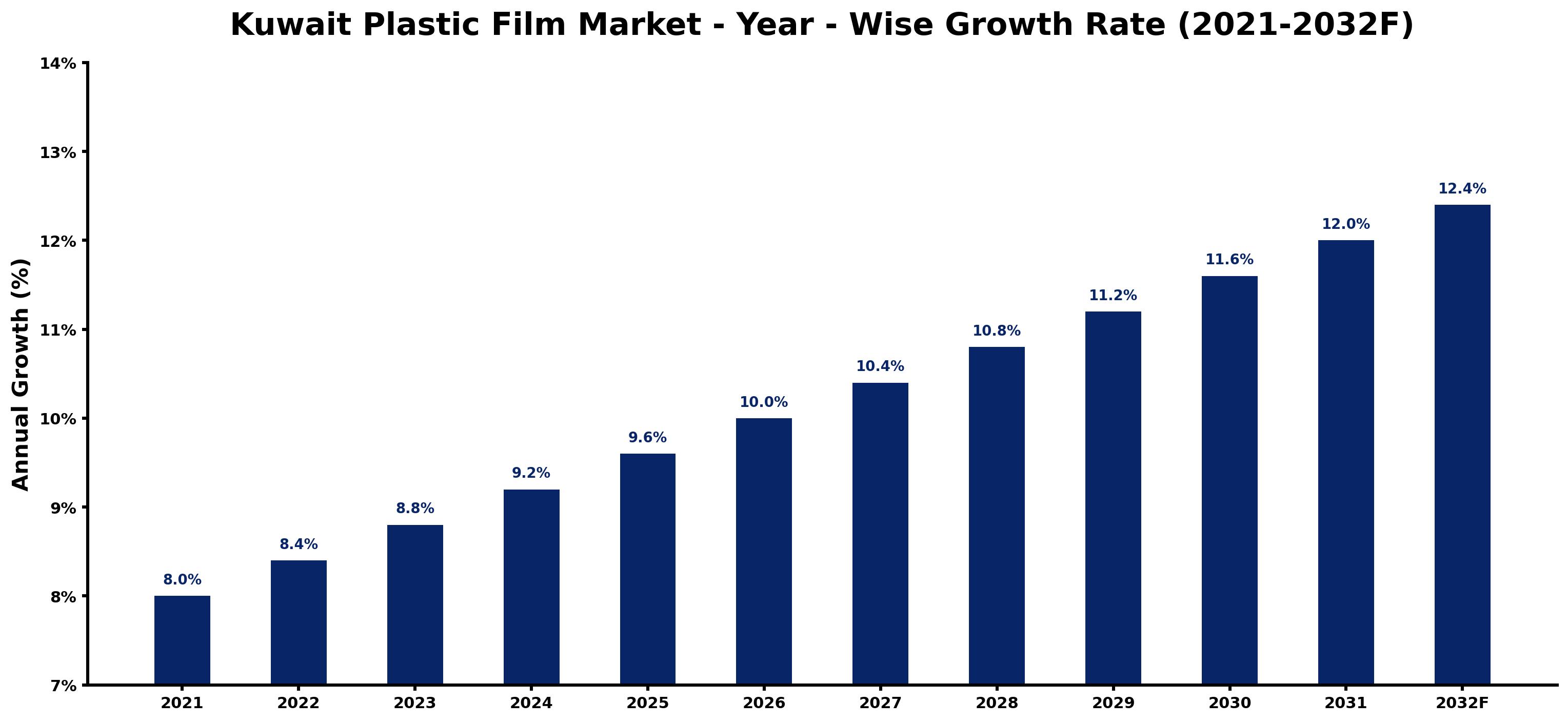
The table below presents the year wise growth rates along with the key drivers influencing the market
| Year | Growth Rate | Major Drivers |
| 2021 | 8.0% | Kuwait's construction sector showed momentum, enhancing demand for versatile plastic films. |
| 2022 | 8.4% | Emerging packaging innovations attracted industries aiming for efficient supply chain solutions. |
| 2023 | 8.8% | Rising consumer awareness about sustainability influenced biodegradable plastic film adoption. |
| 2024 | 9.2% | Manufacturers began focusing on high-performance films for specialized applications and markets. |
| 2025 | 9.6% | Increased investments in food processing industries spurred demand for flexible packaging options. |
| 2026 | 10.0% | Localized production capabilities strengthened supply chains amid rising regional competition. |
| 2027 | 10.4% | Urbanization trends drove packaging needs in the booming retail and e-commerce sectors. |
| 2028 | 10.8% | Technological enhancements led to improved production efficiency in plastic film manufacturing. |
| 2029 | 11.2% | A shift towards eco-friendly materials reshaped consumer preferences and market dynamics. |
| 2030 | 11.6% | Collaboration between manufacturers and retailers streamlined the plastic supply chain effectively. |
| 2031 | 12.0% | Expansion of logistics infrastructure supported growth in distribution channels for plastic films. |
| 2032 | 12.4% | Innovative recycling initiatives emerged, creating new opportunities within the plastic film market. |
Note - Market size estimations and growth projections presented in this report are based on 6Wresearch's advanced forecasting approach, validated with industry datasets as of June 2026.
Kuwait Plastic Film Market Synopsis
The Kuwait Plastic Film Market is projected to reach 10.0% and witness significant growth during the forecast period (2026-2032). This growth is driven by several factors inherent to the industry, particularly the rising demand for plastic films across diverse applications such as packaging, agriculture, and industrial manufacturing. As consumer preferences shift towards convenience, the need for packaged food products is escalating, significantly contributing to market expansion. Consumers are increasingly spending more, fueled by a growing population and enhanced disposable incomes, thereby creating a larger market for plastic films.
Kuwait Plastic Film Market Growth Drivers
Various factors are underpinning the robust growth of the Kuwait Plastic Film Market. These drivers include:
- The rising trend of urbanization has led to a higher demand for packaged and processed foods, which are often delivered in plastic film packaging.
- Increased investment in the agricultural sector has resulted in a higher usage of plastic films for crop protection, greenhouse construction, and mulching.
- Growth in the industrial sector due to ongoing infrastructure developments and industrialization initiatives contributes significantly to the plastic film demand.
- Innovations in plastic film technology, such as biodegradable options and enhanced properties like puncture resistance and thermal stability, are bolstering market growth.
- Rising environmental consciousness is prompting manufacturers to invest in research and development (R&D) for sustainable film options, further expanding market opportunities.
Kuwait Plastic Film Market Technological Advancements
Technological innovations are reshaping the landscape of the Kuwait Plastic Film Market. Manufacturers are focusing on enhancing production processes to create films that offer superior strength, flexibility, and resistance to environmental factors. Notable advancements include:
- Progress in polymer blends and additives which improve the functionality and lifespan of plastic films across various applications.
- The introduction of smart packaging solutions that integrate sensors to monitor freshness and quality, appealing to health-conscious consumers.
- Developments in recycling technologies that allow plastic films to be repurposed, addressing environmental concerns and regulatory pressures.
- Emergence of bioplastics, offering renewable and sustainable alternatives to traditional plastic films, which cater to the increasing demand for environmentally friendly products.
- Improvements in digital printing technology enable customized packaging solutions, making it easier for brands to differentiate their products.
Kuwait Plastic Film Market Government Investment and Initiatives
The role of government investments and initiatives in the Kuwait Plastic Film Market is significant, as public spending is directed towards enhancing the industrial base. Government policies are increasingly focused on fostering a sustainable economy, which benefits the plastic film sector. Initiatives include:
- Strategic development plans aimed at diversifying the economy and reducing reliance on oil, which includes boosting manufacturing sectors such as plastic film production.
- Incentives for companies investing in R&D for sustainable products, including grants and tax breaks aimed at promoting eco-friendly alternatives.
- Implementation of regulations promoting the use of recycled materials in manufacturing processes, thereby encouraging innovation in the production of plastic films.
- Support for public-private partnerships that aim to enhance supply chain efficiency and reduce costs associated with plastic film production.
- Investment in infrastructure projects that facilitate improved logistics and distribution channels for plastic film products.
Kuwait Plastic Film Market Latest Developments (May 2025 - June 2026)
Recent developments in the Kuwait Plastic Film Market reflect a dynamic industry adapting to consumer needs and technological advancements. Over the period from May 2025 to June 2026, notable trends have emerged:
- Continuing innovation in manufacturing techniques, with an emphasis on producing thinner films that retain strength and flexibility, catering to both cost and performance requirements.
- Heightened focus on the circular economy, with increasing calls for waste reduction and initiatives aimed at enhancing recycling rates of plastic materials.
- Adoption of digital technologies in production processes, leading to increased efficiency and reduced labor costs.
- Growing consumer preference for transparent and informative packaging, prompting manufacturers to explore new printing technologies and packaging designs.
- Collaborative efforts among industry stakeholders to set sustainable practices and standards that align with global environmental goals.
Kuwait Plastic Film Market - Key Attractiveness of the Report
- 10 Years of Market Numbers
- Historical Data Starting from 2022 to 2025
- Base Year: 2025
- Forecast Data until 2032
- Key Performance Indicators Impacting the Market
- Major Upcoming Developments and Projects
Key Highlights of the Report:
- Kuwait Plastic Film Market Outlook
- Market Size of Kuwait Plastic Film Market, 2025
- Forecast of Kuwait Plastic Film Market, 2032F
- Historical Data and Forecast of Kuwait Plastic Film Revenues & Volume for the Period 2022-2032F
- Kuwait Plastic Film Market Trend Evolution
- Kuwait Plastic Film Market Drivers and Challenges
- Kuwait Plastic Film Price Trends
- Kuwait Plastic Film Porter's Five Forces
- Kuwait Plastic Film Industry Life Cycle
- Historical Data and Forecast of Kuwait Plastic Film Market Revenues & Volume By Product Types for the Period 2022-2032F
- Historical Data and Forecast of Kuwait Plastic Film Market Revenues & Volume By Polyethylene (PE) for the Period 2022-2032F
- Historical Data and Forecast of Kuwait Plastic Film Market Revenues & Volume By Polypropylene (PP) for the Period 2022-2032F
- Historical Data and Forecast of Kuwait Plastic Film Market Revenues & Volume By Polyvinyl chloride (PVC) for the Period 2022-2032F
- Historical Data and Forecast of Kuwait Plastic Film Market Revenues & Volume By Polyethylene terephthalate (PET) for the Period 2022-2032F
- Historical Data and Forecast of Kuwait Plastic Film Market Revenues & Volume By Others for the Period 2022-2032F
- Historical Data and Forecast of Kuwait Plastic Film Market Revenues & Volume By Applications for the Period 2022-2032F
- Historical Data and Forecast of Kuwait Plastic Film Market Revenues & Volume By Packaging for the Period 2022-2032F
- Historical Data and Forecast of Kuwait Plastic Film Market Revenues & Volume By Construction for the Period 2022-2032F
- Historical Data and Forecast of Kuwait Plastic Film Market Revenues & Volume By Electricals & Electronics for the Period 2022-2032F
- Historical Data and Forecast of Kuwait Plastic Film Market Revenues & Volume By Automotive for the Period 2022-2032F
- Historical Data and Forecast of Kuwait Plastic Film Market Revenues & Volume By Pharmaceutical for the Period 2022-2032F
- Historical Data and Forecast of Kuwait Plastic Film Market Revenues & Volume By Agriculture for the Period 2022-2032F
- Historical Data and Forecast of Kuwait Plastic Film Market Revenues & Volume By Consumer Goods for the Period 2022-2032F
- Historical Data and Forecast of Kuwait Plastic Film Market Revenues & Volume By Utility for the Period 2022-2032F
- Kuwait Plastic Film Import Export Trade Statistics
- Market Opportunity Assessment By Product Types
- Market Opportunity Assessment By Applications
- Kuwait Plastic Film Top Companies Market Share
- Kuwait Plastic Film Competitive Benchmarking By Technical and Operational Parameters
- Kuwait Plastic Film Company Profiles
- Kuwait Plastic Film Key Strategic Recommendations






































