Kuwait Quality and Lifecycle Management Software Market Size & Growth Rate (2026-2032)
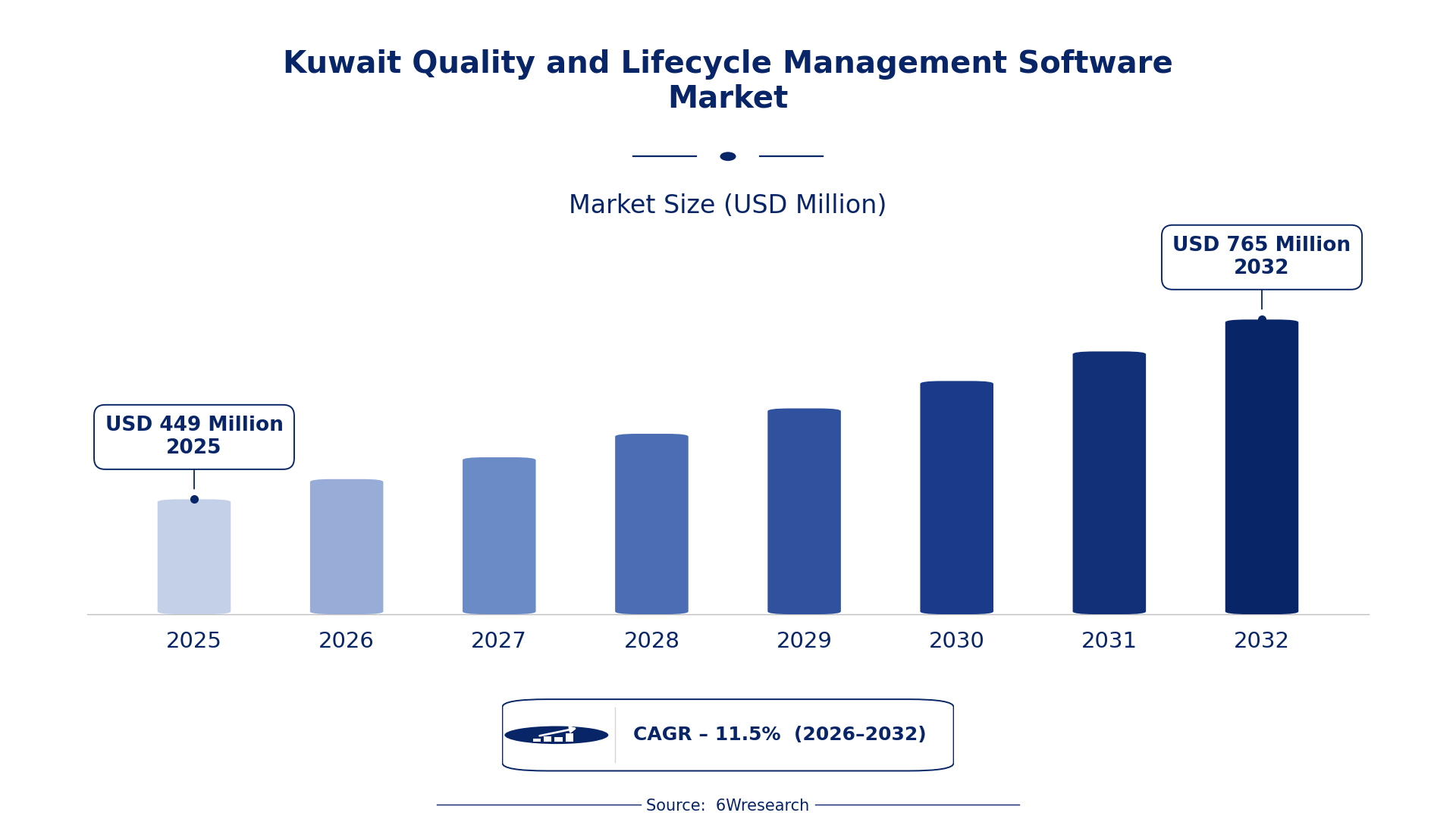
The Kuwait Quality and Lifecycle Management Software Market was estimated at USD 449 Million in 2025 and is projected to reach USD 765 Million by 2032, growing at a CAGR of 11.5% from 2026 to 2032.
Kuwait Quality and Lifecycle Management Software Market Synopsis
The current driving force in the Kuwait Quality and Lifecycle Management Software Market is the urgent demand for enhanced product quality and operational efficiency across various sectors. Companies are increasingly recognizing that robust software solutions can streamline processes from product development to end-of-life management.
As industries such as manufacturing, healthcare, and automotive evolve, the need for integrated quality management systems becomes ever more critical. Organizations are adapting to regulatory pressures while striving to meet customer expectations, fostering an environment ripe for software adoption that meets these complex demands.
Kuwait Quality and Lifecycle Management Software Market Year-wise Growth Rate and Key Drivers
This graph illustrates the annual growth rates of the Kuwait Quality and Lifecycle Management Software Market from 2021 to 2032, highlighting a steady upward trajectory and projected expansion over the forecast period.

The table below presents the year‑wise growth rates along with the key drivers influencing the market
| Year | Growth Rate | Major Drivers |
| 2021 | 7.1% | Ministry of Commerce's digital transformation initiatives |
| 2022 | 7.5% | High demand for quality assurance in construction projects |
| 2023 | 7.9% | Increased focus on local regulatory compliance standards |
| 2024 | 8.3% | Growth in oil and gas sector quality requirements |
| 2025 | 8.7% | Kuwait Vision 2035 spurring software investments |
| 2026 | 9.1% | Rising need for automated lifecycle management solutions |
| 2027 | 9.5% | Investment in manufacturing quality control technologies |
| 2028 | 9.9% | Enhanced focus on healthcare quality management systems |
| 2029 | 10.3% | Expanding petrochemical industry driving lifecycle software need |
| 2030 | 10.7% | Government incentives for technology adoption in industries |
| 2031 | 11.1% | Increasing integration of IoT in quality management processes |
| 2032 | 11.5% | Surge in e-commerce requiring robust quality solutions |
Note: Market size estimations and growth projections presented in this report are based on 6Wresearch's proprietary forecasting methodology, utilizing the latest available industry data, government publications, and primary research inputs.
Kuwait Quality and Lifecycle Management Software Market Key Takeaways
Below are some of the specific key takeaways from the market, including:
- Increased focus on quality assurance is driving software adoption in various sectors.
- Digital transformation initiatives are propelling demand for lifecycle management solutions.
- The integration of AI and machine learning is becoming a common feature in new software offerings.
- Regulatory compliance is a significant motivator for businesses to upgrade their quality management systems.
- Awareness and education about the benefits of these solutions are essential for market growth.
Evaluation of Restraints in Kuwait Quality and Lifecycle Management Software Market
Several factors hinder the Kuwait Quality and Lifecycle Management Software Market from reaching its full potential. A lack of awareness regarding the benefits of modern software solutions remains prevalent among businesses, resulting in low adoption rates. Many organizations continue to rely on traditional methods, which not only slows the transition to advanced solutions but also increases the risk of inefficiencies.
Budget constraints further complicate matters, as smaller firms may perceive software implementation costs as prohibitive. Additionally, the limited availability of skilled professionals adept at using these tools poses a challenge, making it critical for stakeholders to focus on education and training initiatives.
Kuwait Quality and Lifecycle Management Software Market Trends
One of the most notable trends is the shift toward digital transformation across industries, which is significantly influencing the demand for quality and lifecycle management software. Automation is increasingly seen as a means to enhance efficiency, reduce errors, and streamline operations.
The incorporation of advanced technologies, such as AI and machine learning, into these software solutions is not just a trend but a necessity. Companies are looking to leverage these tools to improve product quality, speed up time-to-market, and ensure regulatory compliance while enhancing customer satisfaction.
Kuwait Quality and Lifecycle Management Software Market Opportunities
The market presents numerous opportunities for growth and investment, particularly in sectors undergoing significant transformation. The increasing focus on regulatory compliance offers software vendors a chance to create tailored solutions that meet specific industry needs, particularly in healthcare and manufacturing.
on top of that, as businesses strive to achieve higher customer satisfaction, the demand for innovative tools that enhance product lifecycle management will continue to rise. The ongoing push for integrated quality management systems creates a fertile ground for companies to introduce sophisticated software offerings.
Government Initiatives in the Kuwait Quality and Lifecycle Management Software Market
The government of Kuwait is actively encouraging the adoption of quality and lifecycle management software through various initiatives aimed at enhancing technological innovation. This public-sector focus is crucial in establishing a regulatory environment conducive to growth and compliance, which is vital for businesses looking to improve operational efficiency and product quality.
- A national digital infrastructure upgrade program aimed at enhancing technology access across industries has recently been launched.
- Ongoing regulatory initiatives are being implemented to standardize quality management practices across key sectors, ensuring compliance and consumer protection.
- A planned public-private partnership focusing on workforce development is expected to address the skills gap in utilizing advanced software tools.
- Recent legislation has been introduced to streamline the approval processes for quality management solutions, encouraging faster adoption among businesses.
- Current efforts to promote research and development in the software sector are underway to foster innovation and support local startups.
Future Insights of the Kuwait Quality and Lifecycle Management Software Market
Looking ahead to 2026-2032, the Kuwait Quality and Lifecycle Management Software Market is set to experience steady growth. As digital technologies become more entrenched in daily operations, the demand for sophisticated quality and lifecycle management solutions will intensify.
The emphasis on meeting international quality standards and enhancing customer experiences will drive businesses to invest in advanced software solutions. As organizations in Kuwait seek to remain competitive, opportunities for both local and international vendors to address these evolving needs will continue to expand.
Kuwait Quality and Lifecycle Management Software Market Latest Developments
In the past year, the Kuwait Quality and Lifecycle Management Software Market has witnessed a surge in activity, with various initiatives aimed at enhancing technology adoption and improving quality management practices. Stakeholders are increasingly focusing on digital solutions that can streamline operations and ensure compliance.
- A major technology vendor launched a new AI-driven quality management software in early 2025, enhancing automation capabilities for manufacturing firms.
- Ongoing partnerships between software providers and local businesses aim to improve training programs, making it easier for companies to implement new solutions.
- By mid-2026, a regulatory initiative is expected to introduce stricter compliance standards for software quality, prompting firms to upgrade their systems.
- Research and development efforts are currently underway, focusing on integrating machine learning features into existing quality management tools.
- A planned rollout of cloud-based solutions is set to begin in the second half of 2026, allowing businesses to access advanced software without heavy upfront investments.
Kuwait Quality and Lifecycle Management Software Market - Key Attractiveness of the Report
- 10 Years of Market Numbers
- Historical Data Starting from 2022 to 2025
- Base Year: 2025
- Forecast Data until 2032
- Key Performance Indicators Impacting the Market
- Major Upcoming Developments and Projects
Key Highlights of the Report:
- Kuwait Quality and Lifecycle Management Software Market Outlook
- Market Size of Kuwait Quality and Lifecycle Management Software Market, 2025
- Forecast of Kuwait Quality and Lifecycle Management Software Market, 2032
- Historical Data and Forecast of Kuwait Quality and Lifecycle Management Software Revenues & Volume for the Period 2022-2032F
- Kuwait Quality and Lifecycle Management Software Market Trend Evolution
- Kuwait Quality and Lifecycle Management Software Market Drivers and Challenges
- Kuwait Quality and Lifecycle Management Software Price Trends
- Kuwait Quality and Lifecycle Management Software Porter's Five Forces
- Kuwait Quality and Lifecycle Management Software Industry Life Cycle
- Historical Data and Forecast of Kuwait Quality and Lifecycle Management Software Market Revenues & Volume By Solutions for the Period 2022-2032F
- Historical Data and Forecast of Kuwait Quality and Lifecycle Management Software Market Revenues & Volume By Bill of Material (BOM) Management for the Period 2022-2032F
- Historical Data and Forecast of Kuwait Quality and Lifecycle Management Software Market Revenues & Volume By Document and Product Data Management for the Period 2022-2032F
- Historical Data and Forecast of Kuwait Quality and Lifecycle Management Software Market Revenues & Volume By Quality Management for the Period 2022-2032F
- Historical Data and Forecast of Kuwait Quality and Lifecycle Management Software Market Revenues & Volume By Change Management for the Period 2022-2032F
- Historical Data and Forecast of Kuwait Quality and Lifecycle Management Software Market Revenues & Volume By Cost Management for the Period 2022-2032F
- Historical Data and Forecast of Kuwait Quality and Lifecycle Management Software Market Revenues & Volume By Governance and Compliance Management for the Period 2022-2032F
- Historical Data and Forecast of Kuwait Quality and Lifecycle Management Software Market Revenues & Volume By Lifecycle Analytics Management for the Period 2022-2032F
- Historical Data and Forecast of Kuwait Bill of Material (BOM) Management Quality and Lifecycle Management Software Market Revenues & Volume By Other Solutions for the Period 2022-2032F
- Historical Data and Forecast of Kuwait Quality and Lifecycle Management Software Market Revenues & Volume By Deployment Modes for the Period 2022-2032F
- Historical Data and Forecast of Kuwait Quality and Lifecycle Management Software Market Revenues & Volume By Cloud for the Period 2022-2032F
- Historical Data and Forecast of Kuwait Quality and Lifecycle Management Software Market Revenues & Volume By On-Premises for the Period 2022-2032F
- Historical Data and Forecast of Kuwait Quality and Lifecycle Management Software Market Revenues & Volume By Organization Size for the Period 2022-2032F
- Historical Data and Forecast of Kuwait Quality and Lifecycle Management Software Market Revenues & Volume By Small and Medium-sized Enterprises for the Period 2022-2032F
- Historical Data and Forecast of Kuwait Quality and Lifecycle Management Software Market Revenues & Volume By Large Enterprises for the Period 2022-2032F
- Historical Data and Forecast of Kuwait Quality and Lifecycle Management Software Market Revenues & Volume By Verticals for the Period 2022-2032F
- Historical Data and Forecast of Kuwait Quality and Lifecycle Management Software Market Revenues & Volume By Aerospace & Defense for the Period 2022-2032F
- Historical Data and Forecast of Kuwait Quality and Lifecycle Management Software Market Revenues & Volume By Automotive & Transport for the Period 2022-2032F
- Historical Data and Forecast of Kuwait Quality and Lifecycle Management Software Market Revenues & Volume By Consumer Goods & Retail for the Period 2022-2032F
- Historical Data and Forecast of Kuwait Quality and Lifecycle Management Software Market Revenues & Volume By Healthcare & Lifesciences for the Period 2022-2032F
- Historical Data and Forecast of Kuwait Quality and Lifecycle Management Software Market Revenues & Volume By Industrial Manufacturing for the Period 2022-2032F
- Historical Data and Forecast of Kuwait Quality and Lifecycle Management Software Market Revenues & Volume By IT & Telecom for the Period 2022-2032F
- Kuwait Quality and Lifecycle Management Software Import Export Trade Statistics
- Market Opportunity Assessment By Solutions
- Market Opportunity Assessment By Deployment Modes
- Market Opportunity Assessment By Organization Size
- Market Opportunity Assessment By Verticals
- Kuwait Quality and Lifecycle Management Software Top Companies Market Share
- Kuwait Quality and Lifecycle Management Software Competitive Benchmarking By Technical and Operational Parameters
- Kuwait Quality and Lifecycle Management Software Company Profiles
- Kuwait Quality and Lifecycle Management Software Key Strategic Recommendations






































