Kuwait Retail Industry Market Size, Share & Growth Rate
The Kuwait Retail Industry Market was estimated at USD 291 Million in 2025 and is projected to reach USD 366 Million by 2032, growing at a CAGR of 3.3% from 2026 to 2032. This growth trajectory is fueled by increasing consumer spending, urbanization, and a diverse expatriate population eager for a variety of retail experiences. The rise of modern shopping malls and an expanding e-commerce landscape further reinforces the attractiveness of the retail sector in Kuwait.
Kuwait Retail Industry Market Year-wise Growth Rate and Key Drivers
This graph highlights how the Kuwait Retail Industry Market has steadily grown over the years, supported by major growth factors.
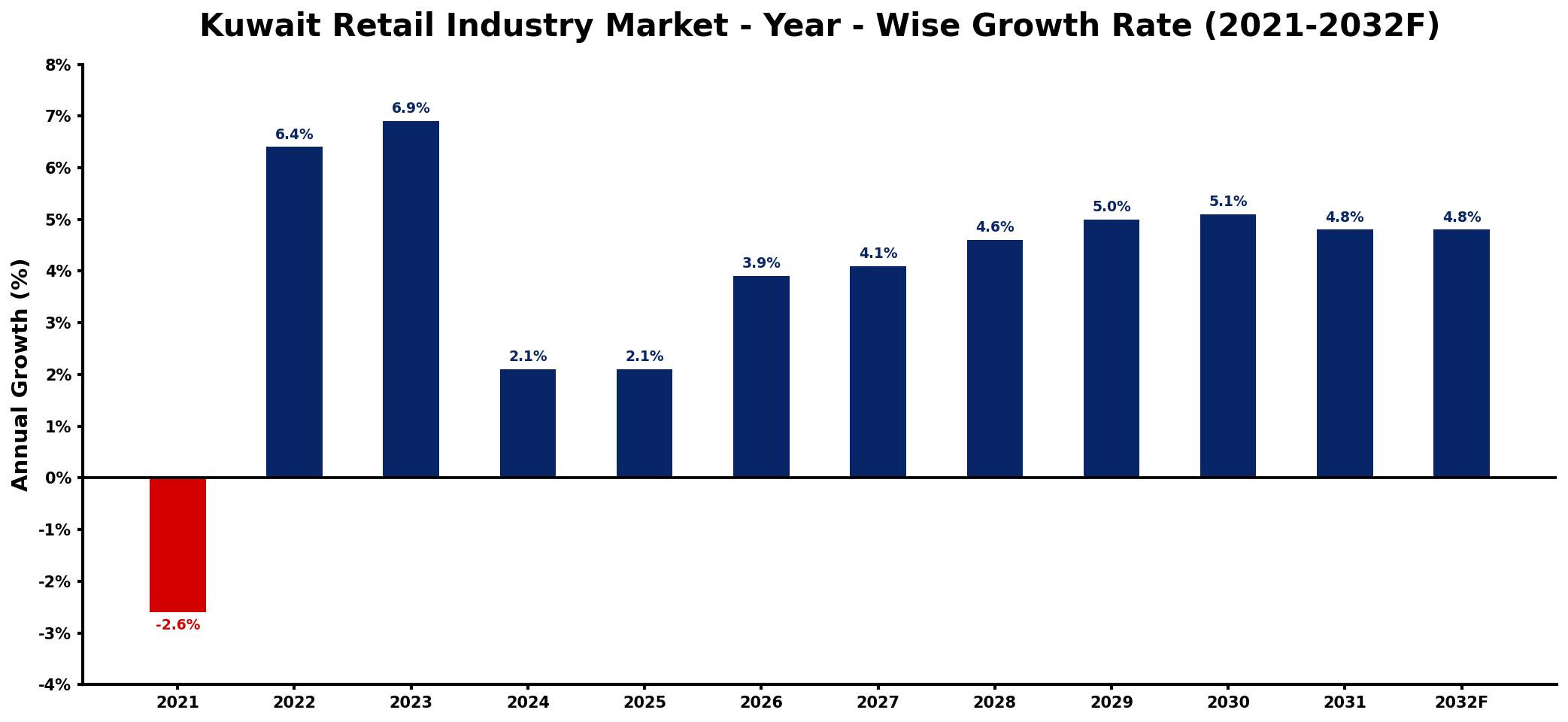
The table below presents the year‑wise growth rates along with the key drivers influencing the market
| Year | Growth Rate | Major Drivers |
| 2021 | -2.6% | decrease in consumer spending habits |
| 2022 | 6.4% | increased online shopping adoption rates |
| 2023 | 6.9% | growth in disposable income levels |
| 2024 | 2.1% | expansion of local shopping centers |
| 2025 | 2.1% | rise in tourism and visitors |
| 2026 | 3.9% | enhanced digital payment solutions |
| 2027 | 4.1% | development of loyalty programs |
| 2028 | 4.6% | emergence of eco-friendly products |
| 2029 | 5.0% | increased focus on customer experience |
| 2030 | 5.1% | rising export shipment volumes |
| 2031 | 4.8% | rising end-use demand growth |
| 2032 | 4.8% | growing downstream application demand |
Note: Market size estimations and growth projections presented in this report are based on 6Wresearch's proprietary forecasting methodology, utilizing the latest available industry data, government publications, and primary research inputs.
Kuwait Retail Industry Market Synopsis
Kuwait's retail landscape is evolving, characterized by a seamless integration of traditional stores and digital platforms. Consumers increasingly favor personalized shopping experiences and convenient service options, compelling retailers to innovate continuously.
The burgeoning online shopping sector, combined with high disposable incomes, is reshaping how businesses approach their marketing and operational strategies. As retailers modernize their outlets and embrace e-commerce, they are successfully meeting the diverse demands of a dynamic customer base.
Kuwait Retail Industry Market Key Takeaways
- The market is on a growth trajectory, driven by increasing consumer demand and urbanization.
- Retailers are enhancing their online presence to cater to a growing preference for e-commerce.
- Modern shopping malls and retail spaces are becoming prominent, attracting both local and expatriate consumers.
- Government initiatives are fostering a supportive environment for retail growth and innovation.
- Consumer preferences are shifting towards convenience and high-quality shopping experiences.
Evaluation of Restraints in Kuwait Retail Industry Market
Despite its robust growth, the Kuwait Retail Industry faces certain restraints that can impact its overall performance. Economic fluctuations present a significant challenge, influencing consumer purchasing behavior and altering spending patterns. Additionally, as international brands penetrate the market, local retailers experience intensified competition, compelling them to invest heavily in market research and customer relationship management. Adapting to the evolving preferences of consumers demands not only agility but also a willingness to innovate, which may prove challenging for some established businesses.
Kuwait Retail Industry Market Trends
A notable trend in the Kuwait Retail Industry is the increasing popularity of omnichannel retailing, which enables customers to switch seamlessly between online and in-store shopping. This is accompanied by the growth of digital marketing strategies, enhancing customer engagement and loyalty. Furthermore, the demand for experiential shopping, where consumers seek unique and immersive experiences, is leading retailers to focus on creating differentiated value propositions.
Kuwait Retail Industry Market Opportunities
There are substantial growth opportunities in the Kuwait Retail Industry, particularly in e-commerce and mobile shopping. Retailers can capitalize on the expanding digital landscape by offering streamlined online services and personalized shopping experiences. Moreover, the ongoing development of modern retail spaces presents an avenue for brands to attract new customers and increase market share. Investments in technology and digital solutions are likely to yield significant returns in this evolving marketplace.
Government Initiatives in the Kuwait Retail Industry Market
The government of Kuwait is actively promoting the growth of the retail sector through various initiatives aimed at enhancing infrastructure and streamlining business regulations. These efforts include the modernization of shopping districts, fostering e-commerce platforms, and encouraging foreign investment in retail ventures. Additionally, training programs for retail employees are being established to improve service quality and elevate customer satisfaction across the industry.
Future Insights of the Kuwait Retail Industry Market
Looking ahead to the period between 2026 and 2032, the Kuwait Retail Industry is poised for continued growth, driven by technological advancements and a strong economic environment. Retailers are expected to leverage data analytics and customer insights to tailor their offerings and enhance shopping experiences. Additionally, as the expatriate population continues to diversify and expand, there will be increasing demand for various retail products and services, ensuring a vibrant market landscape.
Kuwait Retail Industry Market Latest Developments (2025 - 2026)
Recent developments in the Kuwait Retail Industry indicate a strong push towards integrating technology into retail operations. Businesses are increasingly adopting AI-driven analytics to better understand customer preferences and improve inventory management. Moreover, initiatives to enhance the shopping experience, including loyalty programs and in-store technology, are becoming more prevalent as retailers adapt to the changing landscape.
Kuwait Retail Industry Market - Key Attractiveness of the Report
- 10 Years of Market Numbers
- Historical Data Starting from 2022 to 2025
- Base Year: 2025
- Forecast Data until 2032
- Key Performance Indicators Impacting the Market
- Major Upcoming Developments and Projects
Key Highlights of the Report:
- Kuwait Retail Industry Market Outlook
- Market Size of Kuwait Retail Industry Market, 2025
- Forecast of Kuwait Retail Industry Market, 2032
- Historical Data and Forecast of Kuwait Retail Industry Revenues & Volume for the Period 2022-2032F
- Kuwait Retail Industry Market Trend Evolution
- Kuwait Retail Industry Market Drivers and Challenges
- Kuwait Retail Industry Price Trends
- Kuwait Retail Industry Porter's Five Forces
- Kuwait Retail Industry Industry Life Cycle
- Historical Data and Forecast of Kuwait Retail Industry Market Revenues & Volume By Product for the Period 2022-2032F
- Historical Data and Forecast of Kuwait Retail Industry Market Revenues & Volume By Food and Beverages for the Period 2022-2032F
- Historical Data and Forecast of Kuwait Retail Industry Market Revenues & Volume By Personal and Household Care for the Period 2022-2032F
- Historical Data and Forecast of Kuwait Retail Industry Market Revenues & Volume By Apparel, Footwear, and Accessories for the Period 2022-2032F
- Historical Data and Forecast of Kuwait Retail Industry Market Revenues & Volume By Furniture, Toys, and Hobby for the Period 2022-2032F
- Historical Data and Forecast of Kuwait Retail Industry Market Revenues & Volume By Electronic and Household Appliances for the Period 2022-2032F
- Historical Data and Forecast of Kuwait Retail Industry Market Revenues & Volume By Other Products for the Period 2022-2032F
- Historical Data and Forecast of Kuwait Retail Industry Market Revenues & Volume By Distribution Channel for the Period 2022-2032F
- Historical Data and Forecast of Kuwait Retail Industry Market Revenues & Volume By Supermarkets/Hypermarkets for the Period 2022-2032F
- Historical Data and Forecast of Kuwait Retail Industry Market Revenues & Volume By Convenience Stores for the Period 2022-2032F
- Historical Data and Forecast of Kuwait Retail Industry Market Revenues & Volume By Department Stores for the Period 2022-2032F
- Historical Data and Forecast of Kuwait Retail Industry Market Revenues & Volume By Specialty Stores for the Period 2022-2032F
- Historical Data and Forecast of Kuwait Retail Industry Market Revenues & Volume By Online for the Period 2022-2032F
- Historical Data and Forecast of Kuwait Retail Industry Market Revenues & Volume By Other Distribution Channels for the Period 2022-2032F
- Kuwait Retail Industry Import Export Trade Statistics
- Market Opportunity Assessment By Product
- Market Opportunity Assessment By Distribution Channel
- Kuwait Retail Industry Top Companies Market Share
- Kuwait Retail Industry Competitive Benchmarking By Technical and Operational Parameters
- Kuwait Retail Industry Company Profiles
- Kuwait Retail Industry Key Strategic Recommendations






































