Kuwait Risk Analytics Market Size & Growth Rate (2026-2032)
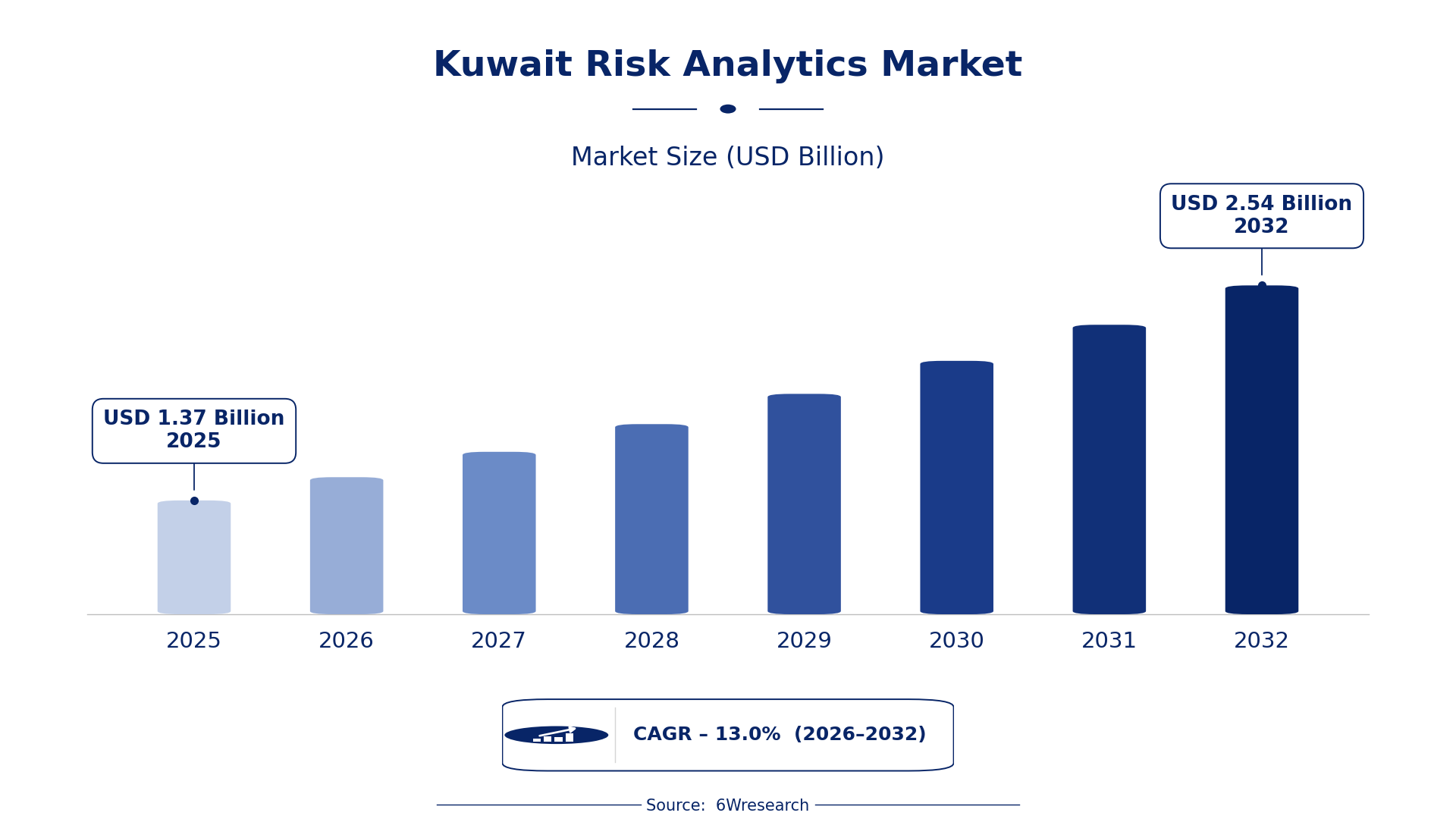
The Kuwait Risk Analytics Market was estimated at USD 1374 Million in 2025 and is projected to reach USD 2542 Million by 2032, growing at a CAGR of 13.0% from 2026 to 2032.
Kuwait Risk Analytics Market Synopsis
Kuwait's Risk Analytics Market is on an upward trajectory, driven by a growing recognition of the need for advanced analytics in risk management. Businesses across various sectors, from finance to healthcare, are increasingly adopting sophisticated tools to address emerging threats and ensure compliance with stringent regulations.
As organizations grapple with cybersecurity concerns and regulatory pressures, the demand for effective risk analytics solutions is becoming critical. The ongoing shift towards cloud-based analytics is enhancing flexibility and scalability, providing Kuwaiti enterprises with the necessary tools to bolster their decision-making processes.
Kuwait Risk Analytics Market Year-wise Growth Rate and Key Drivers
This graph illustrates the annual growth rates of the Kuwait Risk Analytics Market from 2021 to 2032, highlighting a steady upward trajectory and projected expansion over the forecast period.
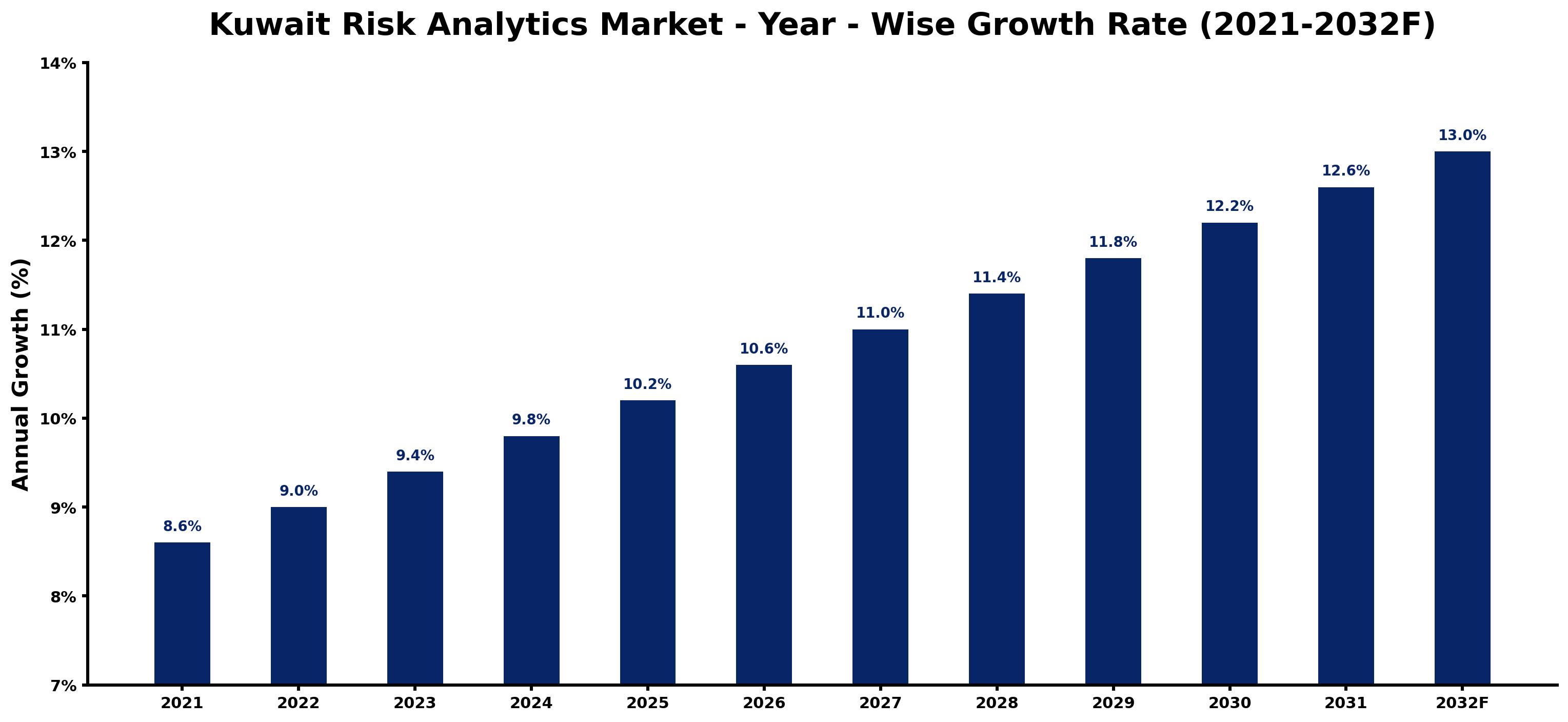
The table below presents the year‑wise growth rates along with the key drivers influencing the market
| Year | Growth Rate | Major Drivers |
| 2021 | 8.6% | Increased regulatory focus on financial risk management. |
| 2022 | 9.0% | Kuwait Vision 2035 emphasizes risk assessment technologies. |
| 2023 | 9.4% | Growing adoption of digital banking solutions in Kuwait. |
| 2024 | 9.8% | New cybersecurity laws enhancing risk analytics demand. |
| 2025 | 10.2% | Kuwait’s youth demographic increasing tech-savvy risk profiles. |
| 2026 | 10.6% | Investment in fintech startups boosting risk analysis tools. |
| 2027 | 11.0% | Government incentives for local risk management solutions. |
| 2028 | 11.4% | Rising foreign investment requiring robust risk evaluations. |
| 2029 | 11.8% | Expanded insurance coverage triggering demand for risk analytics. |
| 2030 | 12.2% | Sector-specific regulations spurring tailored risk solutions. |
| 2031 | 12.6% | Integration of AI in local analytics platforms. |
| 2032 | 13.0% | Local enterprises prioritizing resilience against economic volatility. |
Note: Market size estimations and growth projections presented in this report are based on 6Wresearch's proprietary forecasting methodology, utilizing the latest available industry data, government publications, and primary research inputs.
Kuwait Risk Analytics Market Key Takeaways
Below are some of the specific key takeaways from the market, including:
- The market is projected to grow significantly, with an estimated value of USD 2542 Million by 2032.
- Advanced analytics solutions are increasingly being integrated into risk management practices across multiple industries.
- Cloud-based risk analytics are gaining traction due to their scalability and flexibility advantages.
- Cybersecurity and regulatory compliance are major driving factors for the adoption of risk analytics tools.
- Investment in skilled professionals is necessary to overcome the shortage of expertise in the field.
Evaluation of Restraints in Kuwait Risk Analytics Market
Despite its growth potential, the Kuwait Risk Analytics Market faces several restraints. A significant challenge is the shortage of skilled professionals with expertise in risk analytics, which limits organizations' ability to implement effective solutions. Data privacy and security concerns also loom large, as businesses struggle to manage sensitive information while ensuring compliance with local regulations. on top of that, the integration of diverse data sources for comprehensive risk assessments presents a formidable barrier, complicating the analytics process and affecting overall decision-making quality.
Kuwait Risk Analytics Market Trends
The market is witnessing a notable shift towards integrating artificial intelligence and machine learning into risk analytics solutions. These technologies enable organizations to process vast amounts of data in real-time, enhancing their ability to identify potential risks. Additionally, there’s a growing emphasis on predictive analytics, allowing businesses to anticipate and mitigate risks before they materialize. This trend reflects an overarching desire for proactive risk management strategies, particularly in sectors such as banking and healthcare, where the stakes are high.
Kuwait Risk Analytics Market Opportunities
There are substantial opportunities for vendors in the Kuwait Risk Analytics Market to develop tailored solutions that cater to the unique needs of Kuwaiti businesses. Compliance with Islamic finance principles presents a specific demand for customized risk analytics tools. on top of that, the increasing focus on cybersecurity creates a lucrative avenue for analytics providers to offer solutions that help organizations protect sensitive data against escalating cyber threats.
Government Initiatives in the Kuwait Risk Analytics Market
Government policies play a crucial role in shaping the Kuwait Risk Analytics Market. The Kuwaiti government is actively enhancing data security regulations and promoting transparency in risk assessment practices. By fostering collaboration between public and private sectors, the government aims to encourage the adoption of advanced technologies in risk management.
- A regulatory framework for data security was introduced in 2025 to strengthen compliance across industries.
- Currently, there is an ongoing initiative to develop a national cybersecurity strategy that includes risk analytics as a key component.
- A planned public-private partnership aims to advance research in risk analytics technologies by 2028.
- The government is hosting workshops and training programs to build expertise in risk management solutions.
- Recent investments have been made in infrastructure upgrades to support data analytics capabilities in public sectors.
Future Insights of the Kuwait Risk Analytics Market
Looking ahead, the Kuwait Risk Analytics Market is set for robust growth as organizations increasingly prioritize risk management and compliance. The ongoing rise in cyber threats and the demand for real-time monitoring solutions will drive investments in advanced analytics technologies. on top of that, as the market matures, we can expect an expansion in the variety of solutions available, catering to specific industry needs and challenges. This evolution will likely lead to deeper insights and more efficient risk mitigation strategies.
Kuwait Risk Analytics Market Latest Developments
In recent months, the Kuwait Risk Analytics Market has seen significant developments that reflect the growing emphasis on advanced analytics in risk management. Organizations are increasingly investing in cutting-edge technologies to enhance their capabilities and address evolving challenges.
- A major technology vendor launched a new risk analytics platform in Q1 2025, aimed at streamlining compliance processes for businesses.
- An initiative that began in late 2025 focuses on integrating AI-driven analytics into existing risk management frameworks across the banking sector.
- A leading regional operator is currently upgrading its cybersecurity analytics capabilities, with expected completion by mid-2026.
- Plans are underway for a nationwide risk assessment program expected to kick off in early 2027, designed to enhance data governance across industries.
- Recently completed workshops by the government have successfully trained over 500 professionals in risk analytics methodologies.
Kuwait Risk Analytics Market - Key Attractiveness of the Report
- 10 Years of Market Numbers
- Historical Data Starting from 2022 to 2025
- Base Year: 2025
- Forecast Data until 2032
- Key Performance Indicators Impacting the Market
- Major Upcoming Developments and Projects
Key Highlights of the Report:
- Kuwait Risk Analytics Market Outlook
- Market Size of Kuwait Risk Analytics Market, 2025
- Forecast of Kuwait Risk Analytics Market, 2032
- Historical Data and Forecast of Kuwait Risk Analytics Revenues & Volume for the Period 2022-2032F
- Kuwait Risk Analytics Market Trend Evolution
- Kuwait Risk Analytics Market Drivers and Challenges
- Kuwait Risk Analytics Price Trends
- Kuwait Risk Analytics Porter's Five Forces
- Kuwait Risk Analytics Industry Life Cycle
- Historical Data and Forecast of Kuwait Risk Analytics Market Revenues & Volume By Component for the Period 2022-2032F
- Historical Data and Forecast of Kuwait Risk Analytics Market Revenues & Volume By Software (ETL Tools, Risk Calculation Engines, GRC Software) for the Period 2022-2032F
- Historical Data and Forecast of Kuwait Risk Analytics Market Revenues & Volume By Services for the Period 2022-2032F
- Historical Data and Forecast of Kuwait Risk Analytics Market Revenues & Volume By Risk Type for the Period 2022-2032F
- Historical Data and Forecast of Kuwait Risk Analytics Market Revenues & Volume By Strategic Risk for the Period 2022-2032F
- Historical Data and Forecast of Kuwait Risk Analytics Market Revenues & Volume By Operational Risk for the Period 2022-2032F
- Historical Data and Forecast of Kuwait Risk Analytics Market Revenues & Volume By Financial Risk for the Period 2022-2032F
- Historical Data and Forecast of Kuwait Risk Analytics Market Revenues & Volume By Deployment Mode for the Period 2022-2032F
- Historical Data and Forecast of Kuwait Risk Analytics Market Revenues & Volume By Cloud for the Period 2022-2032F
- Historical Data and Forecast of Kuwait Risk Analytics Market Revenues & Volume By On-premises for the Period 2022-2032F
- Historical Data and Forecast of Kuwait Risk Analytics Market Revenues & Volume By Organization Size for the Period 2022-2032F
- Historical Data and Forecast of Kuwait Risk Analytics Market Revenues & Volume By Large enterprises for the Period 2022-2032F
- Historical Data and Forecast of Kuwait Risk Analytics Market Revenues & Volume By Small and medium-sized enterprises (SMEs) for the Period 2022-2032F
- Historical Data and Forecast of Kuwait Risk Analytics Market Revenues & Volume By Vertical for the Period 2022-2032F
- Historical Data and Forecast of Kuwait Risk Analytics Market Revenues & Volume By Banking and Financial Services for the Period 2022-2032F
- Historical Data and Forecast of Kuwait Risk Analytics Market Revenues & Volume By Insurance for the Period 2022-2032F
- Historical Data and Forecast of Kuwait Risk Analytics Market Revenues & Volume By Manufacturing for the Period 2022-2032F
- Historical Data and Forecast of Kuwait Risk Analytics Market Revenues & Volume By Transportation and Logistics for the Period 2022-2032F
- Historical Data and Forecast of Kuwait Risk Analytics Market Revenues & Volume By Retail and Consumer Goods for the Period 2022-2032F
- Historical Data and Forecast of Kuwait Risk Analytics Market Revenues & Volume By IT and Telecom for the Period 2022-2032F
- Historical Data and Forecast of Kuwait Risk Analytics Market Revenues & Volume By Government and Defense for the Period 2022-2032F
- Historical Data and Forecast of Kuwait Risk Analytics Market Revenues & Volume By Healthcare and Life Sciences for the Period 2022-2032F
- Kuwait Risk Analytics Import Export Trade Statistics
- Market Opportunity Assessment By Component
- Market Opportunity Assessment By Risk Type
- Market Opportunity Assessment By Deployment Mode
- Market Opportunity Assessment By Organization Size
- Market Opportunity Assessment By Vertical
- Kuwait Risk Analytics Top Companies Market Share
- Kuwait Risk Analytics Competitive Benchmarking By Technical and Operational Parameters
- Kuwait Risk Analytics Company Profiles
- Kuwait Risk Analytics Key Strategic Recommendations






































