Kuwait Scissors and Shears Market Summary
The kuwait scissors and shears market was estimated at USD 1100 Million in 2025 and is projected to reach USD 1844 Million by 2032, growing at a CAGR of 8.8% from 2026 to 2032.
Kuwait Scissors and Shears Market Year-wise Growth Rate and Key Drivers
This graph highlights how the Kuwait Scissors and Shears Market has steadily grown over the past five years, supported by major growth factors.
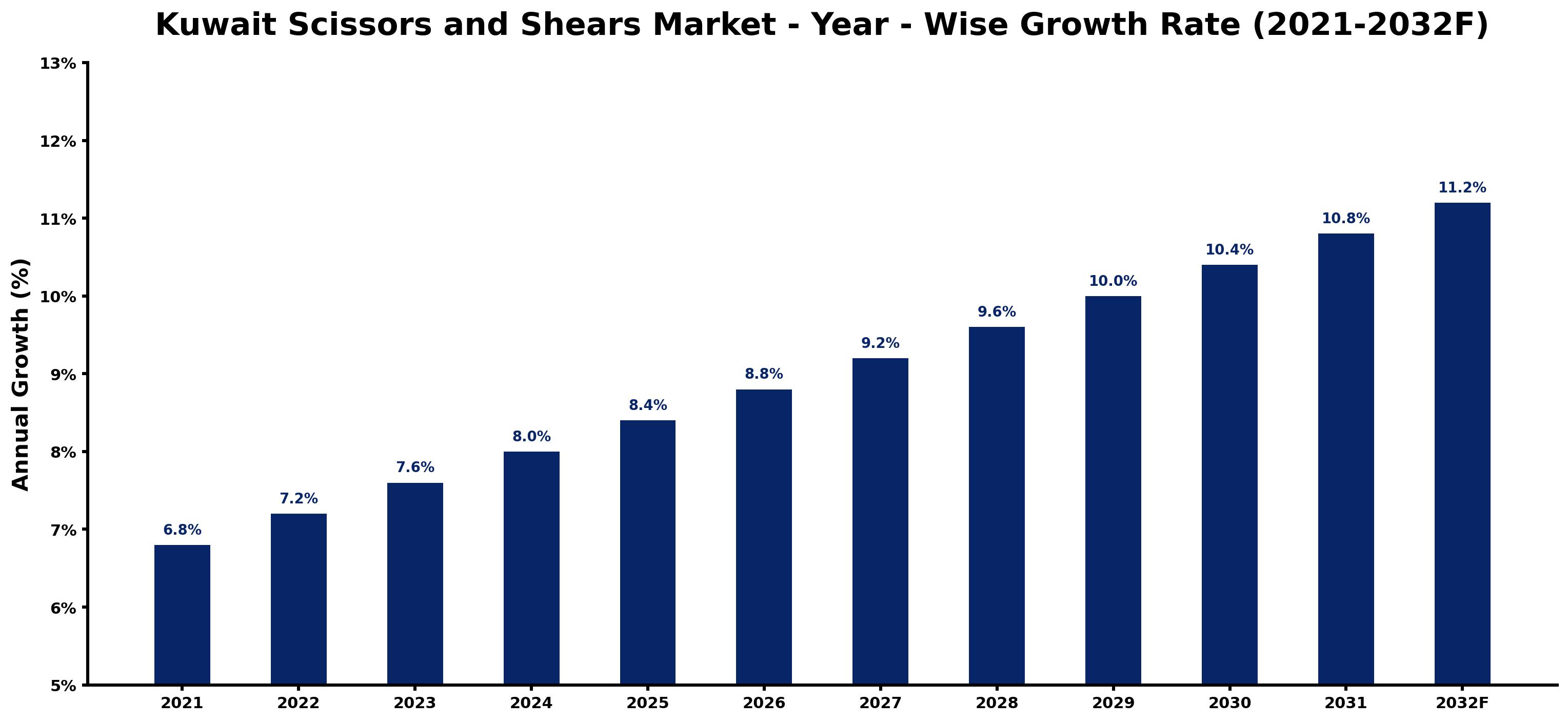
The table below presents the year wise growth rates along with the key drivers influencing the market
| Year | Growth Rate | Major Drivers |
| 2021 | 6.8% | Retail sector recovery post-pandemic prompted increased sales of scissors and shears. |
| 2022 | 7.2% | Local manufacturers enhanced product quality, attracting consumers seeking durable tools. |
| 2023 | 7.6% | Emerging trends in DIY projects spurred interest in versatile cutting tools. |
| 2024 | 8.0% | Online shopping platforms gained traction, making these tools more accessible to consumers. |
| 2025 | 8.4% | Cultural emphasis on craftsmanship has led to a surge in artisanal tool demand. |
| 2026 | 8.8% | Construction projects in the GCC increased demand for specialized shears and scissors. |
| 2027 | 9.2% | Innovative designs featuring ergonomic handles captured the attention of home users. |
| 2028 | 9.6% | Environmental sustainability trends prompted interest in eco-friendly scissors and shears. |
| 2029 | 10.0% | Greater emphasis on educational arts programs drove demand for quality cutting tools. |
| 2030 | 10.4% | International brands entering the market increased competition, enhancing product offerings. |
| 2031 | 10.8% | Economic diversification efforts in Kuwait triggered investment in consumer goods sectors. |
| 2032 | 11.2% | Technological advancements in materials led to the creation of lightweight cutting tools. |
Note - Market size estimations and growth projections presented in this report are based on 6Wresearch's advanced forecasting approach, validated with industry datasets as of June 2026.
Kuwait Scissors and Shears Market Synopsis
The Kuwait Scissors and Shears Market is projected to reach 8.8% and witness significant growth during the forecast period (2026-2032). This promising trajectory is largely driven by the increasing demand for professional-grade scissors and shears, propelled by a growing emphasis on personal grooming and hygiene. As consumers become more aware of the standards required for personal and professional grooming tools, the market is expected to evolve in response to these trends.
Kuwait Scissors and Shears Market Growth Drivers
Several factors contribute to the anticipated expansion of the Kuwait scissors and shears market. Firstly, there is a notable rise in consumer awareness regarding hygiene and safety standards, especially in contexts where these tools are utilized daily, such as in healthcare or beauty services. This awareness is prompting consumers to invest in higher-quality, professional-grade products.
- Professional-grade scissors and shears are increasingly viewed as essential tools in various industries, resulting in heightened demand.
- Moreover, the trend towards personal grooming reflects a broader cultural shift, with consumers placing greater importance on their appearance and the quality of tools used.
- The local manufacturing initiatives have empowered consumers by providing more accessible options without compromising quality.
- Additionally, the emergence of e-commerce platforms is making it easier for consumers to access these products, further driving sales.
- Government initiatives, such as the "Made In Kuwait" scheme, have fostered a favorable environment for local manufacturers to innovate and expand their product lines, also contributing to market growth.
Kuwait Scissors and Shears Market Trends and Opportunities
The Kuwait scissors and shears market is witnessing several trends that present significant opportunities for players within the industry. The ongoing shift towards sustainability is influencing consumer preferences, with many seeking eco-friendly alternatives crafted from sustainable materials.
- As the beauty and grooming industry embraces sustainability, the demand for scissors and shears made from recycled and environmentally-friendly materials is on the rise.
- The integration of advanced technologies into product design, such as ergonomic handles and precision cutting, is becoming increasingly prevalent.
- Furthermore, the customization of scissors and shears to meet specific consumer needs is gaining traction, providing personalized options for various applications.
- In the educational sector, the incorporation of scissors and shears into school supplies is promoting early adoption and familiarity, potentially nurturing long-term customer loyalty.
- The growth of the DIY culture in Kuwait is driving the need for high-quality, versatile tools, pushing manufacturers to innovate continuously.
Kuwait Scissors and Shears Market Challenges and Restraints
While the Kuwait scissors and shears market is poised for growth, several challenges and restraints could impede its progress. Import reliance for specialized equipment can create vulnerabilities, particularly in the face of global supply chain disruptions.
- Variability in raw material prices can affect production costs and, subsequently, market prices, posing challenges for local manufacturers.
- Counterfeit products present ongoing concerns, as inferior alternatives can erode consumer trust in genuine, high-quality products.
- Further, the market may face obstacles related to regulatory compliance, as manufacturers must meet stringent safety and hygiene standards.
- The competition from low-cost imports can pressure local producers, making it difficult to maintain quality while keeping prices competitive.
- Lastly, limited access to advanced manufacturing technologies might hinder the ability of local firms to innovate and expand their offerings effectively.
Kuwait Scissors and Shears Market Government Investment and Initiatives
The government of Kuwait has been instrumental in fostering a favorable environment for the growth of the scissors and shears market through various initiatives. These actions include public investments aimed at enhancing local manufacturing capabilities and promoting the "Made In Kuwait" initiative, which encourages consumers to support local products.
- Public spending on infrastructure development is paving the way for better logistics and distribution channels, facilitating easier access to markets for local manufacturers.
- Additionally, the government is offering incentives for businesses that innovate in the field of personal grooming tools, promoting research and development in the sector.
- Training programs and educational initiatives focused on producing skilled labor in the manufacturing industry are also being implemented, helping to elevate local production standards.
- The regulatory framework governing product safety and quality is being continually updated to align with international standards, enhancing market credibility.
- Moreover, government-led marketing campaigns aim to raise awareness about the benefits of local products, directly supporting consumer confidence and market growth.
Kuwait Scissors and Shears Market Latest Developments (May 2025 - June 2026)
Recent developments in the Kuwait scissors and shears market signify a dynamic industry landscape. Manufacturers are actively adapting to consumer trends, introducing innovative products that align with the increasing focus on hygiene and safety. The growing preference for multifunctional tools has prompted companies to enhance their product offerings, resulting in greater variety and improved convenience for consumers.
- In response to sustainability trends, some manufacturers are exploring biodegradable materials for their products, catering to the environmentally conscious consumer base.
- Technological advancements in design have led to a wave of new products featuring ergonomic designs that improve user experience and effectiveness.
- Additionally, partnerships between manufacturers and local retailers are fostering a more robust distribution network, enhancing product availability across the region.
- Collaborative workshops and forums among industry stakeholders are promoting dialogue to address common challenges and share best practices, strengthening community ties.
- Finally, there is an observable shift in marketing strategies, with brands increasingly leveraging digital platforms to reach a broader audience and engage with consumers effectively.
Kuwait Scissors and Shears Market - Key Attractiveness of the Report
- 10 Years of Market Numbers
- Historical Data Starting from 2022 to 2025
- Base Year: 2025
- Forecast Data until 2032
- Key Performance Indicators Impacting the Market
- Major Upcoming Developments and Projects
Key Highlights of the Report:
- Kuwait Scissors and Shears Market Outlook
- Market Size of Kuwait Scissors and Shears Market, 2025
- Forecast of Kuwait Scissors and Shears Market, 2032F
- Historical Data and Forecast of Kuwait Scissors and Shears Revenues & Volume for the Period 2022-2032F
- Kuwait Scissors and Shears Market Trend Evolution
- Kuwait Scissors and Shears Market Drivers and Challenges
- Kuwait Scissors and Shears Price Trends
- Kuwait Scissors and Shears Porter's Five Forces
- Kuwait Scissors and Shears Industry Life Cycle
- Historical Data and Forecast of Kuwait Scissors and Shears Market Revenues & Volume By Type for the Period 2022-2032F
- Historical Data and Forecast of Kuwait Scissors and Shears Market Revenues & Volume By Scissors for the Period 2022-2032F
- Historical Data and Forecast of Kuwait Scissors and Shears Market Revenues & Volume By Shears for the Period 2022-2032F
- Historical Data and Forecast of Kuwait Scissors and Shears Market Revenues & Volume By Application for the Period 2022-2032F
- Historical Data and Forecast of Kuwait Scissors and Shears Market Revenues & Volume By Residential for the Period 2022-2032F
- Historical Data and Forecast of Kuwait Scissors and Shears Market Revenues & Volume By Non-Residential for the Period 2022-2032F
- Kuwait Scissors and Shears Import Export Trade Statistics
- Market Opportunity Assessment By Type
- Market Opportunity Assessment By Application
- Kuwait Scissors and Shears Top Companies Market Share
- Kuwait Scissors and Shears Competitive Benchmarking By Technical and Operational Parameters
- Kuwait Scissors and Shears Company Profiles
- Kuwait Scissors and Shears Key Strategic Recommendations






































