Kuwait Service Virtualization Market Size & Growth Rate (2026-2032)
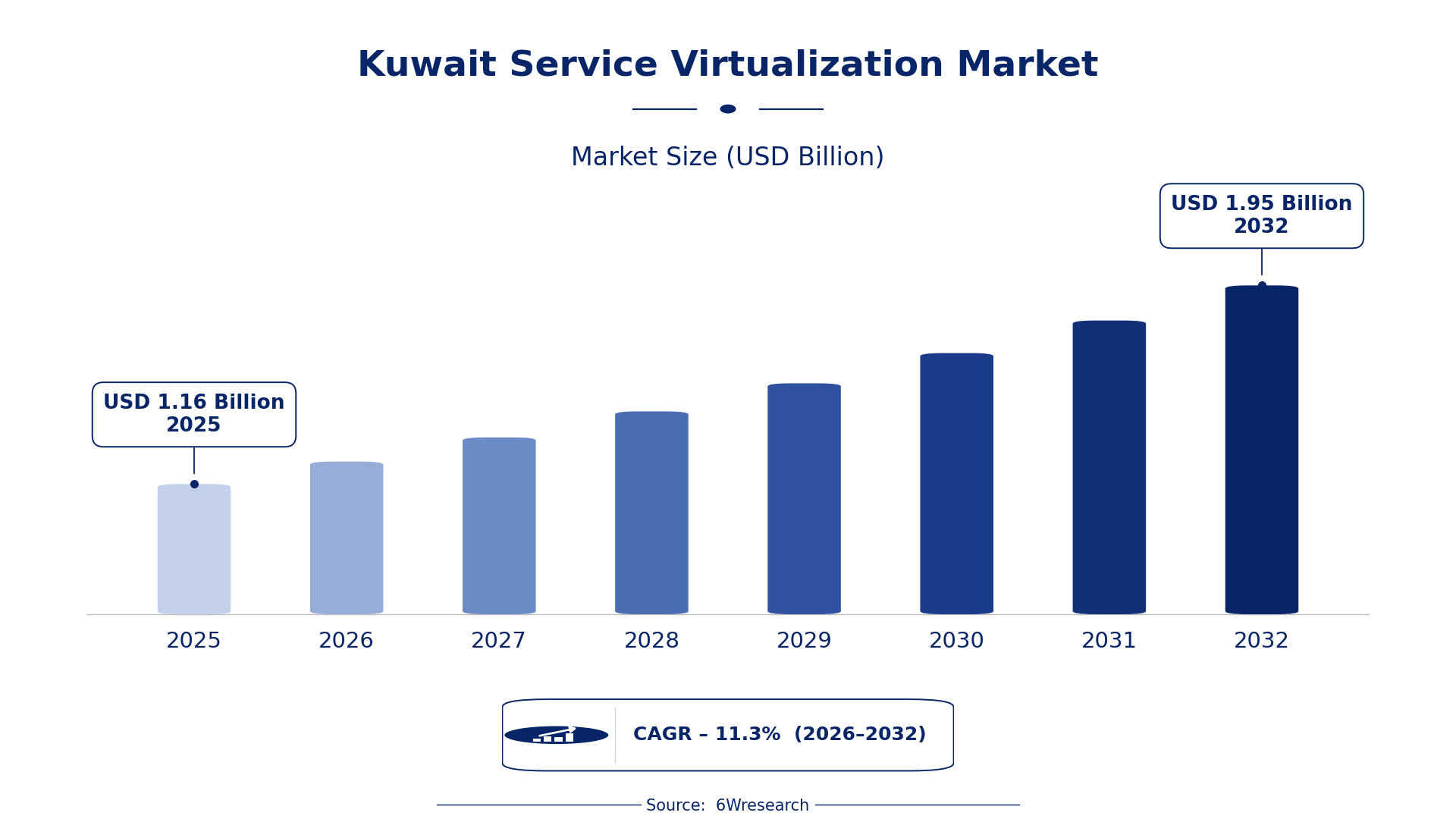
The Kuwait Service Virtualization Market was estimated at USD 1157 Million in 2025 and is projected to reach USD 1951 Million by 2032, growing at a CAGR of 11.3% from 2026 to 2032.
Kuwait Service Virtualization Market Synopsis
The increasing adoption of digital technologies across various sectors, especially banking and healthcare, is the driving force behind the growth of the Kuwait Service Virtualization Market. Organizations are harnessing service virtualization to streamline their software development processes, leading to faster time-to-market and improved operational efficiencies.
As businesses strive to enhance customer experiences and innovate rapidly, investments in service virtualization tools are on the rise. The competitive market is characterized by a diverse range of vendors offering tailored solutions, further pushing advancements in the field.
Kuwait Service Virtualization Market Year-wise Growth Rate and Key Drivers
This graph illustrates the annual growth rates of the Kuwait Service Virtualization Market from 2021 to 2032, highlighting a steady upward trajectory and projected expansion over the forecast period.
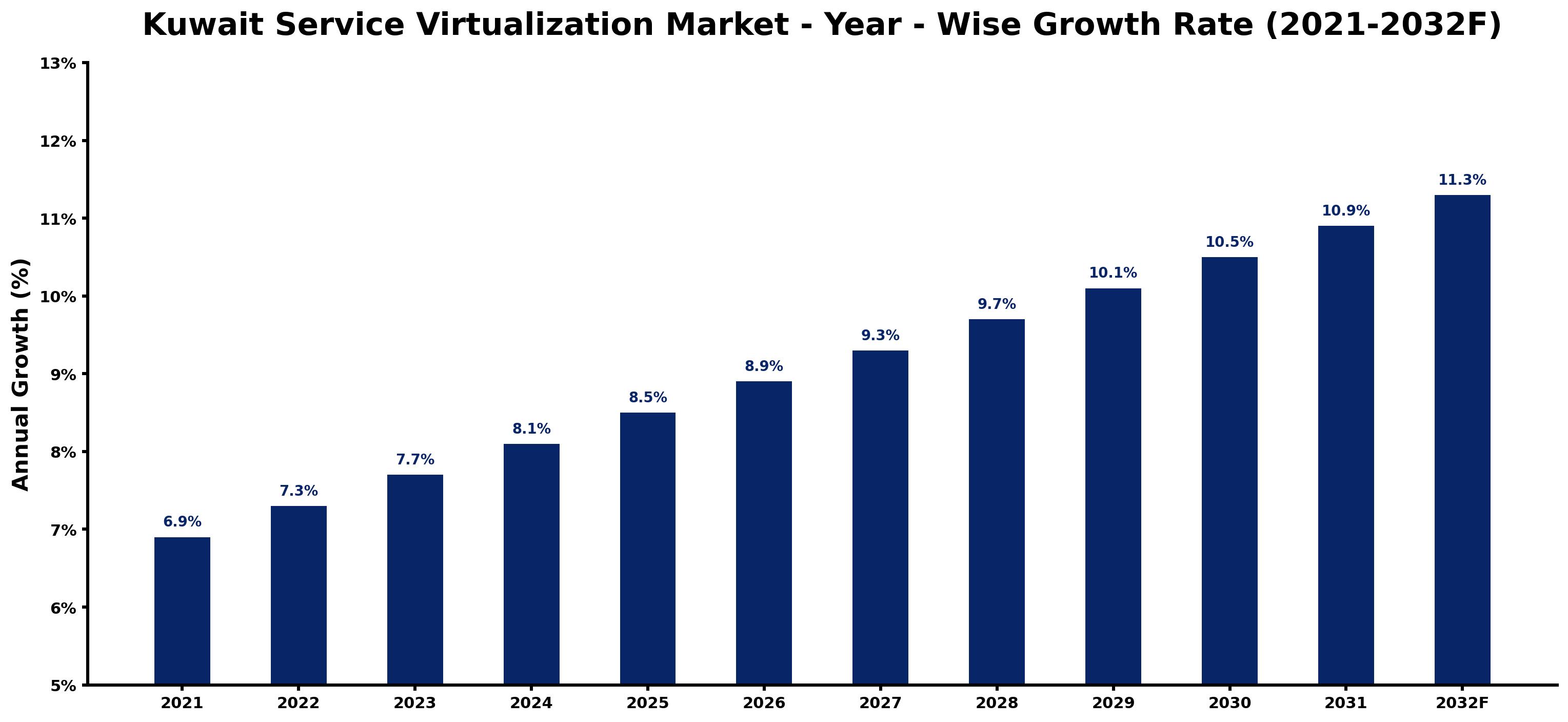
The table below presents the year‑wise growth rates along with the key drivers influencing the market
| Year | Growth Rate | Major Drivers |
| 2021 | 6.9% | Kuwait's National Digital Transformation Initiative boosting virtualization uptake. |
| 2022 | 7.3% | Increased demand for remote work solutions post-pandemic in Kuwait. |
| 2023 | 7.7% | Adoption of cloud-native applications driving service virtualization growth. |
| 2024 | 8.1% | Kuwait's telecom sector enhancing digital services for SMEs. |
| 2025 | 8.5% | Government regulations promoting digital services innovation in Kuwait. |
| 2026 | 8.9% | Emergence of local startups focusing on virtualization technologies. |
| 2027 | 9.3% | Growing investment in fintech services expanding virtualization needs. |
| 2028 | 9.7% | Rising cybersecurity concerns necessitating advanced virtualization solutions. |
| 2029 | 10.1% | Kuwait's healthcare sector adopting virtualization for telemedicine applications. |
| 2030 | 10.5% | Increased virtualization for smart city frameworks in Kuwait. |
| 2031 | 10.9% | Regulatory compliance driving demand for virtual service environments. |
| 2032 | 11.3% | Surge in AI integrations enhancing service virtualization adoption. |
Note: Market size estimations and growth projections presented in this report are based on 6Wresearch's proprietary forecasting methodology, utilizing the latest available industry data, government publications, and primary research inputs.
Kuwait Service Virtualization Market Key Takeaways
Below are some of the specific key takeaways from the market, including:
- The market is witnessing increased investment from businesses aiming to enhance software development and testing processes.
- Cloud-based service virtualization solutions are gaining traction, driven by demands for scalability and cost-effectiveness.
- Organizations are focusing on reducing dependencies on external systems to improve parallel development and testing.
- A lack of skilled professionals poses a challenge for effective implementation and management of service virtualization tools.
- Government initiatives play a crucial role in promoting the adoption of virtualization technologies in Kuwait.
Evaluation of Restraints in Kuwait Service Virtualization Market
Despite its promising growth, the Kuwait Service Virtualization Market faces several restraints. Limited awareness and understanding of virtualization technology within organizations hinder its widespread adoption. There's also a considerable skills gap, as companies struggle to find professionals who can implement and manage these complex tools effectively. Concerns surrounding data security and compliance further exacerbate these issues, with many businesses hesitant to fully embrace virtualization. Resistance stemming from traditional business practices can complicate integration with existing IT infrastructures, presenting additional hurdles that the market must overcome to achieve its full potential.
Kuwait Service Virtualization Market Trends
Cloud-based service virtualization is gaining momentum as companies seek solutions that offer flexibility and scalability. This trend is underscored by the growing demand for tools capable of simulating intricate systems, which streamlines the development lifecycle and elevates software quality. Organizations are increasingly recognizing that service virtualization can reduce development bottlenecks by allowing teams to work independently, thus accelerating their time-to-market.
Kuwait Service Virtualization Market Opportunities
The market holds substantial investment opportunities across diverse sectors. As Kuwait pushes digital transformation, there’s a heightened demand for effective virtualization solutions in healthcare, banking, and retail. Companies that specialize in tailored service virtualization tools can capitalize on this trend. Furthermore, the need for consulting services to develop effective virtualization strategies presents a viable growth avenue for investors aiming to assist organizations in enhancing operational efficiency and customer service.
Government Initiatives in the Kuwait Service Virtualization Market
Kuwait's government policies are actively shaping the Service Virtualization Market by promoting digital transformation and innovation. By providing incentives and creating a supportive regulatory environment, the government is committed to advancing technology adoption. Initiatives that prioritize training and awareness are vital for building local expertise and facilitating the seamless integration of virtualization solutions across various sectors.
- A recent initiative introduced tax incentives for companies investing in virtualization technologies, enhancing financial support for adoption.
- Currently underway is a national training program aimed at developing a skilled workforce proficient in service virtualization tools.
- A regulatory framework established in 2025 emphasizes data security and compliance for organizations utilizing virtualized services.
- A planned public-private partnership set to launch by 2027 will focus on enhancing the digital infrastructure necessary for widespread technology adoption.
Future Insights of the Kuwait Service Virtualization Market
As we look ahead to 2026-2032, the Kuwait Service Virtualization Market is set for steady growth fueled by the increasing shift towards digital transformation across industries. Organizations will continue to prioritize agile software development and testing methodologies, with service virtualization playing a critical role in simulating complex environments. The ongoing trend of cloud adoption, coupled with an emphasis on reducing operational costs, is expected to drive demand for innovative service virtualization solutions. As businesses strive to deliver high-quality software products more efficiently, the market is likely to expand, presenting ample opportunities for growth and innovation.
Kuwait Service Virtualization Market Latest Developments
In the past year, the Kuwait Service Virtualization Market has seen a notable uptick in activity, as organizations respond to the urgent need for digital transformation. The focus has shifted towards enhancing software development processes through advanced virtualization solutions. Companies are actively seeking partnerships to broaden their service offerings and improve operational efficiency.
- A leading technology vendor launched a new cloud-based service virtualization platform in early 2025, designed to enhance scalability for development teams.
- Ongoing collaborations between universities and tech firms aim to create specialized training programs for virtualization tool management, expected to yield results by late 2025.
- A major operator initiated a pilot project in Q2 2025 to test integration capabilities of virtualization solutions within existing infrastructures.
- An upcoming initiative planned for early 2026 will seek to enhance public awareness about the advantages of adopting service virtualization technologies.
Kuwait Service Virtualization Market - Key Attractiveness of the Report
- 10 Years of Market Numbers
- Historical Data Starting from 2022 to 2025
- Base Year: 2025
- Forecast Data until 2032
- Key Performance Indicators Impacting the Market
- Major Upcoming Developments and Projects
Key Highlights of the Report:
- Kuwait Service Virtualization Market Outlook
- Market Size of Kuwait Service Virtualization Market, 2025
- Forecast of Kuwait Service Virtualization Market, 2032
- Historical Data and Forecast of Kuwait Service Virtualization Revenues & Volume for the Period 2022-2032F
- Kuwait Service Virtualization Market Trend Evolution
- Kuwait Service Virtualization Market Drivers and Challenges
- Kuwait Service Virtualization Price Trends
- Kuwait Service Virtualization Porter's Five Forces
- Kuwait Service Virtualization Industry Life Cycle
- Historical Data and Forecast of Kuwait Service Virtualization Market Revenues & Volume By Component for the Period 2022-2032F
- Historical Data and Forecast of Kuwait Service Virtualization Market Revenues & Volume By Software/Tools for the Period 2022-2032F
- Historical Data and Forecast of Kuwait Service Virtualization Market Revenues & Volume By Services for the Period 2022-2032F
- Historical Data and Forecast of Kuwait Service Virtualization Market Revenues & Volume By Deployment Type for the Period 2022-2032F
- Historical Data and Forecast of Kuwait Service Virtualization Market Revenues & Volume By On-Premises for the Period 2022-2032F
- Historical Data and Forecast of Kuwait Service Virtualization Market Revenues & Volume By Cloud for the Period 2022-2032F
- Historical Data and Forecast of Kuwait Service Virtualization Market Revenues & Volume By Verticals for the Period 2022-2032F
- Historical Data and Forecast of Kuwait Service Virtualization Market Revenues & Volume By IT Services for the Period 2022-2032F
- Historical Data and Forecast of Kuwait Service Virtualization Market Revenues & Volume By Telecommunication for the Period 2022-2032F
- Historical Data and Forecast of Kuwait Service Virtualization Market Revenues & Volume By BFSI for the Period 2022-2032F
- Historical Data and Forecast of Kuwait Service Virtualization Market Revenues & Volume By Retail and eCommerce for the Period 2022-2032F
- Historical Data and Forecast of Kuwait Service Virtualization Market Revenues & Volume By Media and Entertainment for the Period 2022-2032F
- Historical Data and Forecast of Kuwait Service Virtualization Market Revenues & Volume By Healthcare for the Period 2022-2032F
- Historical Data and Forecast of Kuwait Service Virtualization Market Revenues & Volume By Automotive for the Period 2022-2032F
- Historical Data and Forecast of Kuwait Service Virtualization Market Revenues & Volume By Others for the Period 2022-2032F
- Historical Data and Forecast of Kuwait Service Virtualization Market Revenues & Volume By s for the Period 2022-2032F
- Kuwait Service Virtualization Import Export Trade Statistics
- Market Opportunity Assessment By Component
- Market Opportunity Assessment By Deployment Type
- Market Opportunity Assessment By Verticals
- Market Opportunity Assessment By s
- Kuwait Service Virtualization Top Companies Market Share
- Kuwait Service Virtualization Competitive Benchmarking By Technical and Operational Parameters
- Kuwait Service Virtualization Company Profiles
- Kuwait Service Virtualization Key Strategic Recommendations






































