Kuwait Warehousing and Storage Market Size, Share & Growth Rate
The Kuwait Warehousing and Storage Market was estimated at USD 175 Million in 2025 and is projected to reach USD 222 Million by 2032, growing at a CAGR of 3.5% from 2026 to 2032. This growth trajectory is underpinned by a surge in e-commerce, which necessitates sophisticated warehousing solutions for quick order fulfillment. Additionally, the manufacturing and logistics sectors are rapidly evolving, driving the demand for modern facilities equipped with advanced inventory management systems and temperature control capabilities.
Kuwait Warehousing and Storage Market Year-wise Growth Rate and Key Drivers
This graph highlights how the Kuwait Warehousing and Storage Market has steadily grown over the years, supported by major growth factors.
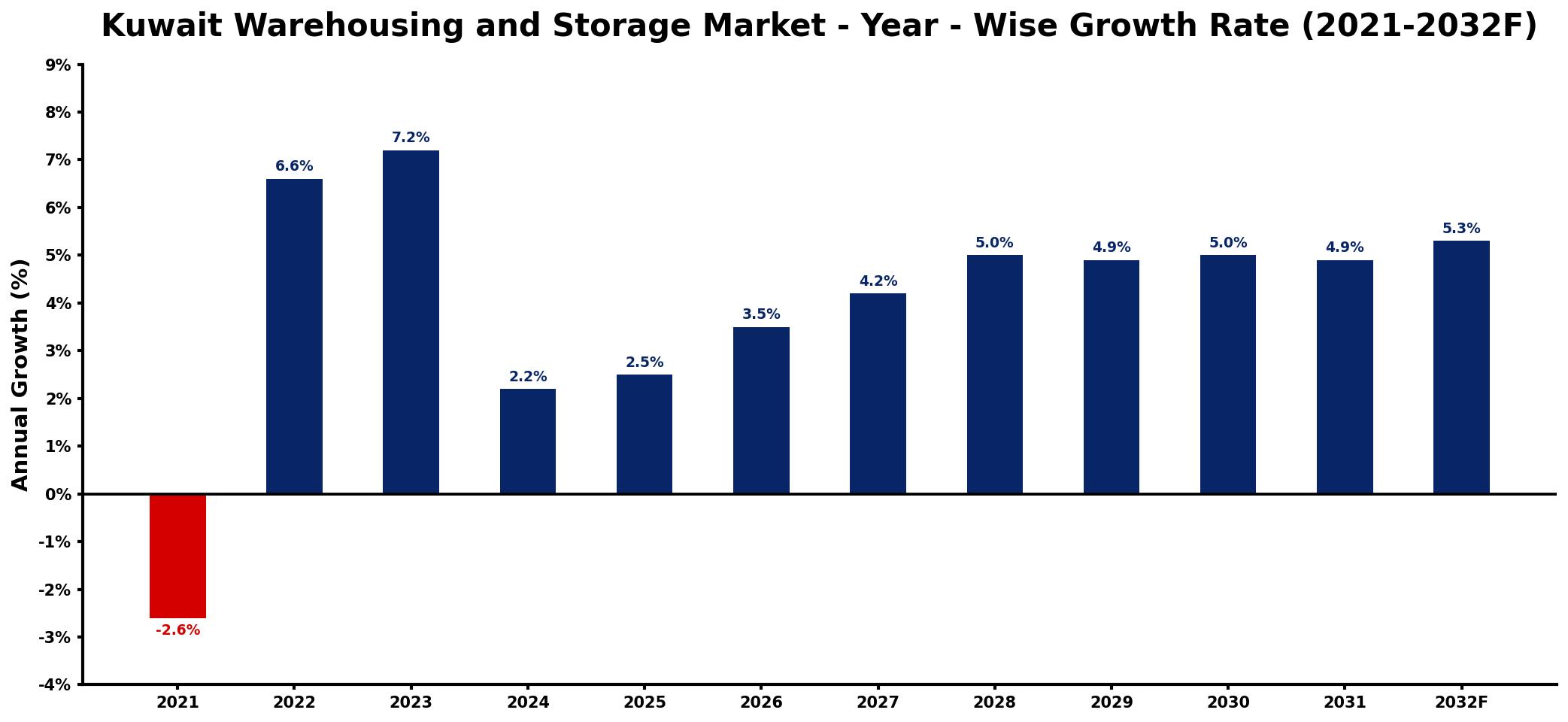
The table below presents the year‑wise growth rates along with the key drivers influencing the market
| Year | Growth Rate | Major Drivers |
| 2021 | -2.6% | decreased inventory management efficiency |
| 2022 | 6.6% | rising e-commerce market demand |
| 2023 | 7.2% | increased logistics infrastructure investment |
| 2024 | 2.2% | growing demand for cold chain |
| 2025 | 2.5% | expansion of regional trade networks |
| 2026 | 3.5% | enhanced technology adoption trends |
| 2027 | 4.2% | surge in consumer goods distribution |
| 2028 | 5.0% | higher demand for automated solutions |
| 2029 | 4.9% | strengthened international supply chains |
| 2030 | 5.0% | growing urbanization and population |
| 2031 | 4.9% | increased focus on sustainability practices |
| 2032 | 5.3% | rising demand for fulfillment centers |
Note: Market size estimations and growth projections presented in this report are based on 6Wresearch's proprietary forecasting methodology, utilizing the latest available industry data, government publications, and primary research inputs.
Kuwait Warehousing and Storage Market Synopsis
Recently, the Kuwait warehousing market has seen robust development, fueled by various industrial sectors. However, as we look ahead, the focus will shift towards embracing technological advancements and enhancing operational efficiencies to meet growing demands.
While the current landscape showcases significant growth, the future will increasingly depend on innovative storage solutions and the expansion of logistics infrastructure. These elements are pivotal to sustaining momentum and addressing the evolving needs of businesses and consumers alike.
Kuwait Warehousing and Storage Market Key Takeaways
- Significant expansion driven by e-commerce and logistics sectors.
- Modern facilities with advanced inventory and temperature control systems are in high demand.
- Strategic investments from the government are enhancing logistics infrastructure.
- Growing emphasis on efficient supply chain management and timely delivery of goods.
- Challenges remain in modernizing existing facilities and addressing space constraints.
Evaluation of Restraints in Kuwait Warehousing and Storage Market
Despite the promising growth in the Kuwait warehousing and storage market, several constraints hinder progress. A major limitation is the challenge of space; the available warehouse space is often insufficient to accommodate the increasing demand for storage and distribution needs. Moreover, existing facilities require modernization to incorporate advanced technologies that enhance efficiency and reliability. Addressing these restraints will be crucial for businesses aiming to remain competitive in a rapidly evolving landscape.
Kuwait Warehousing and Storage Market Trends
Current trends within the Kuwait warehousing and storage market highlight a shift towards automated systems that optimize storage and retrieval processes. Technologies like the Internet of Things (IoT) and advanced data analytics are becoming essential in managing inventory and improving supply chain visibility. Furthermore, the growing consumer preference for quick delivery options has accelerated the need for strategically located warehouses, especially those able to provide temperature-controlled environments for perishable goods.
Kuwait Warehousing and Storage Market Opportunities
The Kuwait warehousing and storage market presents numerous opportunities for growth and investment. As companies continue to pivot towards e-commerce, there is a pressing need for modernized logistics facilities capable of meeting rapid order fulfillment requirements. Additionally, the government's initiatives to develop free trade zones and special economic zones provide a conducive environment for attracting foreign investment, further expanding warehouse capabilities across the region.
Government Initiatives in the Kuwait Warehousing and Storage Market
The Kuwaiti government's commitment to economic diversification and infrastructure development is shaping the warehousing and storage landscape. By promoting investments in logistics infrastructure and the establishment of free trade zones, the government is enhancing the markets appeal to both local and foreign investors. Furthermore, regulatory reforms aimed at streamlining customs procedures are bolstering operational efficiency and enhancing the overall performance of the logistics sector.
Future Insights of the Kuwait Warehousing and Storage Market
Looking towards 2026-2032, the Kuwait warehousing and storage market is poised for continued growth, propelled by evolving consumer behaviors and technological advancements. The integration of smart warehouse solutions and automation will be pivotal in improving operational efficiencies, making it imperative for businesses to adapt. As the market matures, we anticipate a greater emphasis on sustainability and innovative practices, which will shape the future landscape of warehousing in Kuwait.
Kuwait Warehousing and Storage Market Latest Developments (2025 - 2026)
In recent months, the warehousing and storage market in Kuwait has experienced a shift towards greater investment in automation technologies and smart storage solutions. Industry players are increasingly focused on enhancing efficiency through digitization and advanced inventory management systems. Government initiatives aimed at improving logistics infrastructure continue to create a favorable environment for expansion and modernization of warehousing facilities, paving the way for future growth in the sector.
Kuwait Warehousing and Storage Market - Key Attractiveness of the Report
- 10 Years of Market Numbers
- Historical Data Starting from 2022 to 2025
- Base Year: 2025
- Forecast Data until 2032
- Key Performance Indicators Impacting the Market
- Major Upcoming Developments and Projects
Key Highlights of the Report:
- Kuwait Warehousing and Storage Market Outlook
- Market Size of Kuwait Warehousing and Storage Market, 2025
- Forecast of Kuwait Warehousing and Storage Market, 2032
- Historical Data and Forecast of Kuwait Warehousing and Storage Revenues & Volume for the Period 2022-2032F
- Kuwait Warehousing and Storage Market Trend Evolution
- Kuwait Warehousing and Storage Market Drivers and Challenges
- Kuwait Warehousing and Storage Price Trends
- Kuwait Warehousing and Storage Porter's Five Forces
- Kuwait Warehousing and Storage Industry Life Cycle
- Historical Data and Forecast of Kuwait Warehousing and Storage Market Revenues & Volume By Type for the Period 2022-2032F
- Historical Data and Forecast of Kuwait Warehousing and Storage Market Revenues & Volume By General Warehousing and Storage for the Period 2022-2032F
- Historical Data and Forecast of Kuwait Warehousing and Storage Market Revenues & Volume By Refrigerated Warehousing and Storage for the Period 2022-2032F
- Historical Data and Forecast of Kuwait Warehousing and Storage Market Revenues & Volume By Farm Product Warehousing and Storage for the Period 2022-2032F
- Historical Data and Forecast of Kuwait Warehousing and Storage Market Revenues & Volume By Ownership for the Period 2022-2032F
- Historical Data and Forecast of Kuwait Warehousing and Storage Market Revenues & Volume By Private Warehouses for the Period 2022-2032F
- Historical Data and Forecast of Kuwait Warehousing and Storage Market Revenues & Volume By Public Warehouses for the Period 2022-2032F
- Historical Data and Forecast of Kuwait Warehousing and Storage Market Revenues & Volume By Bonded Warehouses for the Period 2022-2032F
- Historical Data and Forecast of Kuwait Warehousing and Storage Market Revenues & Volume By End-Use for the Period 2022-2032F
- Historical Data and Forecast of Kuwait Warehousing and Storage Market Revenues & Volume By Manufacturing for the Period 2022-2032F
- Historical Data and Forecast of Kuwait Warehousing and Storage Market Revenues & Volume By Consumer Goods for the Period 2022-2032F
- Historical Data and Forecast of Kuwait Warehousing and Storage Market Revenues & Volume By Retail for the Period 2022-2032F
- Historical Data and Forecast of Kuwait Warehousing and Storage Market Revenues & Volume By Food and Beverage for the Period 2022-2032F
- Historical Data and Forecast of Kuwait Warehousing and Storage Market Revenues & Volume By IT Hardware for the Period 2022-2032F
- Historical Data and Forecast of Kuwait Warehousing and Storage Market Revenues & Volume By Healthcare for the Period 2022-2032F
- Historical Data and Forecast of Kuwait Warehousing and Storage Market Revenues & Volume By Chemicals for the Period 2022-2032F
- Historical Data and Forecast of Kuwait Warehousing and Storage Market Revenues & Volume By Others for the Period 2022-2032F
- Kuwait Warehousing and Storage Import Export Trade Statistics
- Market Opportunity Assessment By Type
- Market Opportunity Assessment By Ownership
- Market Opportunity Assessment By End-Use
- Kuwait Warehousing and Storage Top Companies Market Share
- Kuwait Warehousing and Storage Competitive Benchmarking By Technical and Operational Parameters
- Kuwait Warehousing and Storage Company Profiles
- Kuwait Warehousing and Storage Key Strategic Recommendations






































