Laos Alternative Building Materials Market: Top 5 Importing Countries and Market Competition (HHI) Analysis
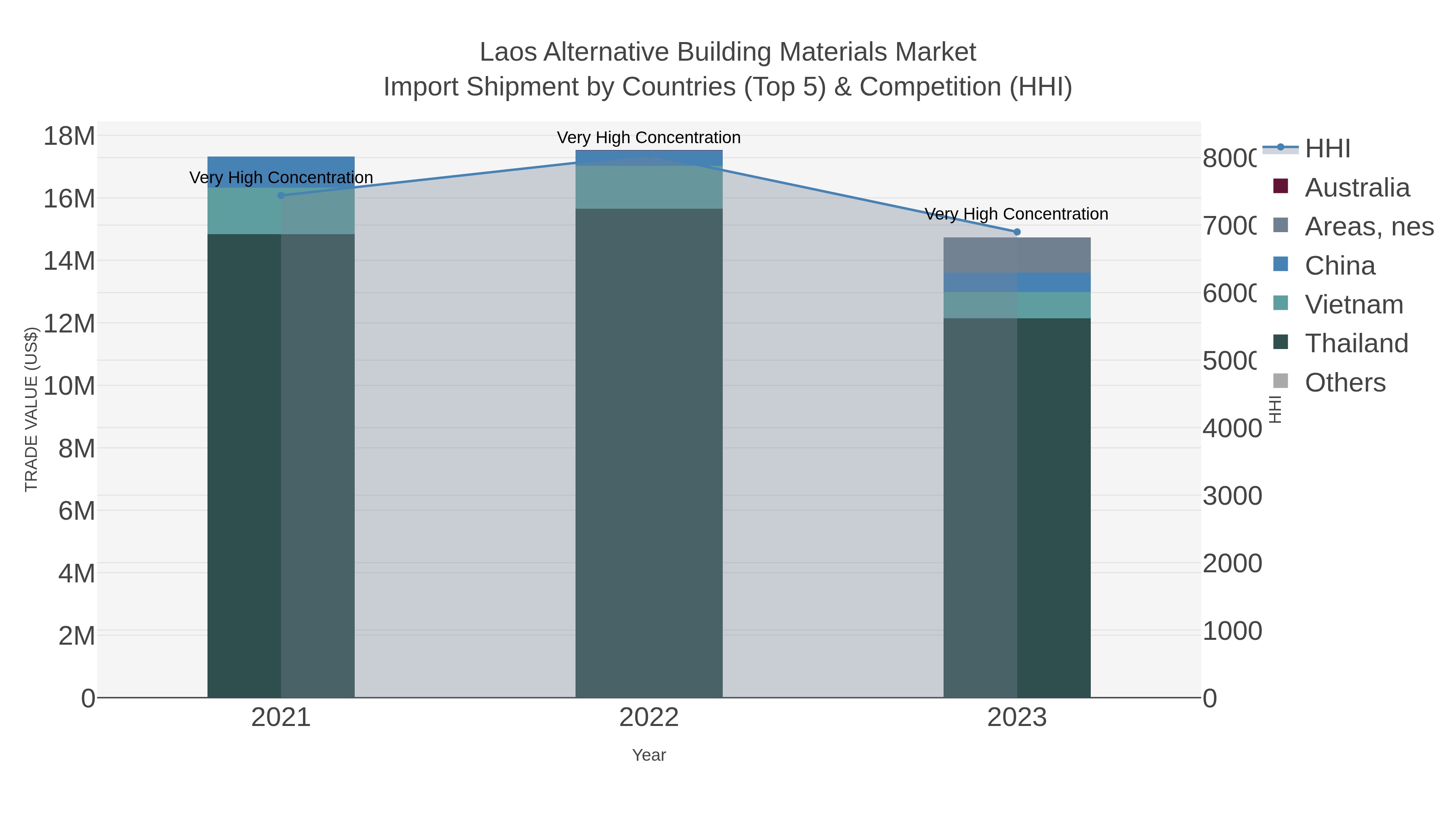
In 2023, Laos continued to rely on alternative building materials imports, with top exporters being Thailand, Areas, nes, Vietnam, China, and Australia. Despite high concentration indicated by the Herfindahl-Hirschman Index (HHI), the market experienced a negative compound annual growth rate (CAGR) of -7.76% and a growth rate of -15.92%. These figures suggest a challenging landscape for alternative building materials importers in Laos, highlighting the need for strategic adaptations to navigate the changing market dynamics.
Key Highlights of the Report:
- Laos Alternative Building Materials Market Outlook
- Market Size of Laos Alternative Building Materials Market, 2025
- Forecast of Laos Alternative Building Materials Market, 2032
- Historical Data and Forecast of Laos Alternative Building Materials Revenues & Volume for the Period 2022 - 2032F
- Laos Alternative Building Materials Market Trend Evolution
- Laos Alternative Building Materials Market Drivers and Challenges
- Laos Alternative Building Materials Price Trends
- Laos Alternative Building Materials Porter`s Five Forces
- Laos Alternative Building Materials Industry Life Cycle
- Historical Data and Forecast of Laos Alternative Building Materials Market Revenues & Volume By Material for the Period 2022 - 2032F
- Historical Data and Forecast of Laos Alternative Building Materials Market Revenues & Volume By Bamboo for the Period 2022 - 2032F
- Historical Data and Forecast of Laos Alternative Building Materials Market Revenues & Volume By Recycled Plastic for the Period 2022 - 2032F
- Historical Data and Forecast of Laos Alternative Building Materials Market Revenues & Volume By Wood for the Period 2022 - 2032F
- Historical Data and Forecast of Laos Alternative Building Materials Market Revenues & Volume By Others for the Period 2022 - 2032F
- Historical Data and Forecast of Laos Alternative Building Materials Market Revenues & Volume By End User for the Period 2022 - 2032F
- Historical Data and Forecast of Laos Alternative Building Materials Market Revenues & Volume By Residential for the Period 2022 - 2032F
- Historical Data and Forecast of Laos Alternative Building Materials Market Revenues & Volume By Non-residential for the Period 2022 - 2032F
- Historical Data and Forecast of Laos Alternative Building Materials Market Revenues & Volume By Application for the Period 2022 - 2032F
- Historical Data and Forecast of Laos Alternative Building Materials Market Revenues & Volume By Construction for the Period 2022 - 2032F
- Historical Data and Forecast of Laos Alternative Building Materials Market Revenues & Volume By Furniture for the Period 2022 - 2032F
- Historical Data and Forecast of Laos Alternative Building Materials Market Revenues & Volume By Flooring for the Period 2022 - 2032F
- Laos Alternative Building Materials Import Export Trade Statistics
- Market Opportunity Assessment By Material
- Market Opportunity Assessment By End User
- Market Opportunity Assessment By Application
- Laos Alternative Building Materials Top Companies Market Share
- Laos Alternative Building Materials Competitive Benchmarking By Technical and Operational Parameters
- Laos Alternative Building Materials Company Profiles
- Laos Alternative Building Materials Key Strategic Recommendations






































