Laos Bathroom Furniture Market: Top 5 Importing Countries and Market Competition (HHI) Analysis
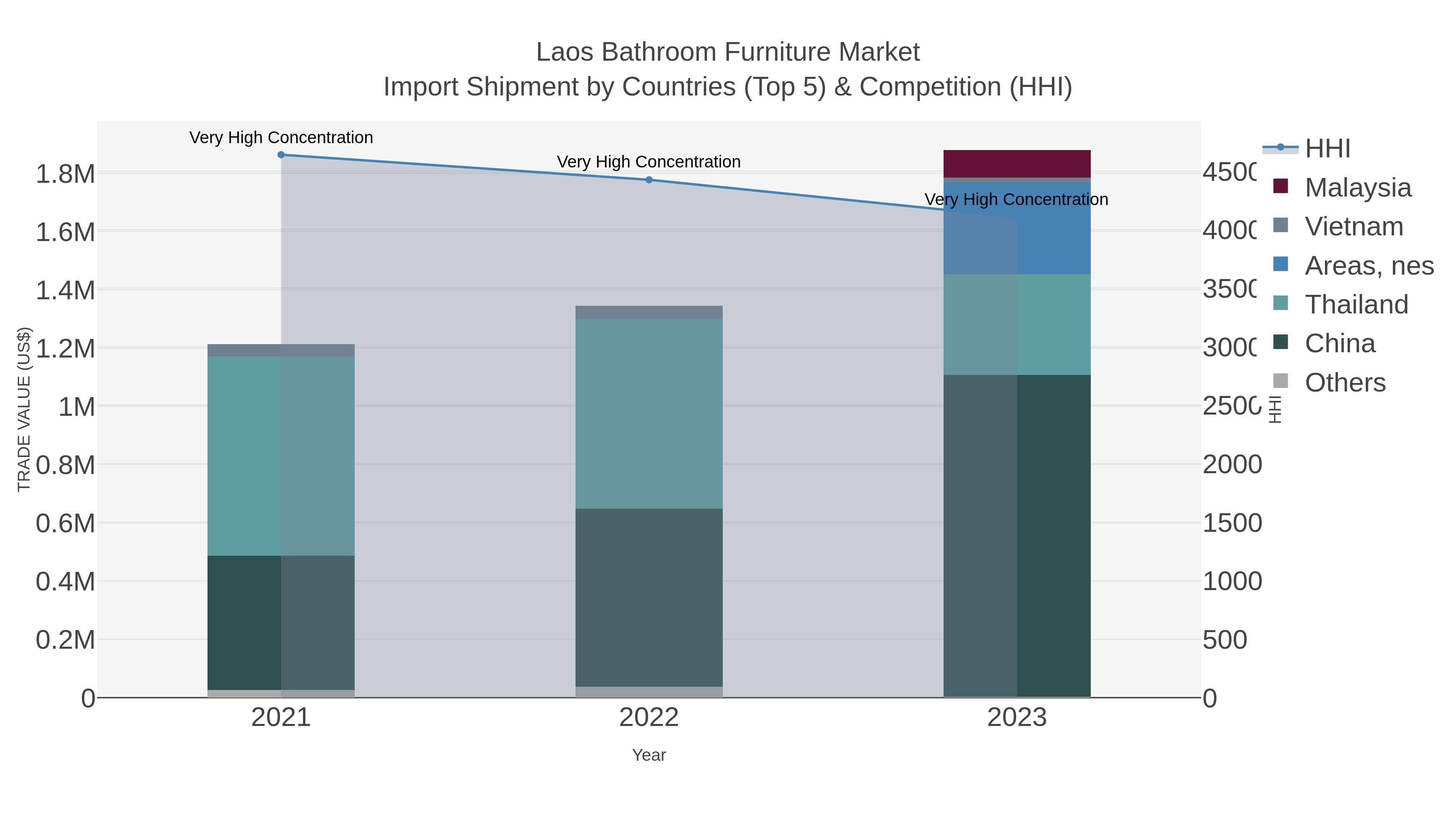
In 2023, Laos saw a significant increase in bathroom furniture import shipments, with top exporters being China, Thailand, Areas, nes, Malaysia, and Vietnam. The high Herfindahl-Hirschman Index (HHI) indicates a concentrated market, likely dominated by these key players. The impressive compound annual growth rate (CAGR) of 24.46% highlights a thriving industry, while the growth rate of 39.7% demonstrates the rapid expansion of the market. As demand for bathroom furniture continues to rise in Laos, exporters can capitalize on these trends to further establish their presence in the market.
Key Highlights of the Report:
- Laos Bathroom Furniture Market Outlook
- Market Size of Laos Bathroom Furniture Market, 2025
- Forecast of Laos Bathroom Furniture Market, 2032
- Historical Data and Forecast of Laos Bathroom Furniture Revenues & Volume for the Period 2022 - 2032F
- Laos Bathroom Furniture Market Trend Evolution
- Laos Bathroom Furniture Market Drivers and Challenges
- Laos Bathroom Furniture Price Trends
- Laos Bathroom Furniture Porter`s Five Forces
- Laos Bathroom Furniture Industry Life Cycle
- Historical Data and Forecast of Laos Bathroom Furniture Market Revenues & Volume By Type for the Period 2022 - 2032F
- Historical Data and Forecast of Laos Bathroom Furniture Market Revenues & Volume By Bath Vanities for the Period 2022 - 2032F
- Historical Data and Forecast of Laos Bathroom Furniture Market Revenues & Volume By Console Vanity for the Period 2022 - 2032F
- Historical Data and Forecast of Laos Bathroom Furniture Market Revenues & Volume By Vanity Tops for the Period 2022 - 2032F
- Historical Data and Forecast of Laos Bathroom Furniture Market Revenues & Volume By Bathroom Mirrors for the Period 2022 - 2032F
- Historical Data and Forecast of Laos Bathroom Furniture Market Revenues & Volume By Other for the Period 2022 - 2032F
- Historical Data and Forecast of Laos Bathroom Furniture Market Revenues & Volume By Application for the Period 2022 - 2032F
- Historical Data and Forecast of Laos Bathroom Furniture Market Revenues & Volume By Household for the Period 2022 - 2032F
- Historical Data and Forecast of Laos Bathroom Furniture Market Revenues & Volume By Commercial for the Period 2022 - 2032F
- Historical Data and Forecast of Laos Bathroom Furniture Market Revenues & Volume By Other for the Period 2022 - 2032F
- Laos Bathroom Furniture Import Export Trade Statistics
- Market Opportunity Assessment By Type
- Market Opportunity Assessment By Application
- Laos Bathroom Furniture Top Companies Market Share
- Laos Bathroom Furniture Competitive Benchmarking By Technical and Operational Parameters
- Laos Bathroom Furniture Company Profiles
- Laos Bathroom Furniture Key Strategic Recommendations






































