Laos Hair Conditioner Market: Top 5 Importing Countries and Market Competition (HHI) Analysis
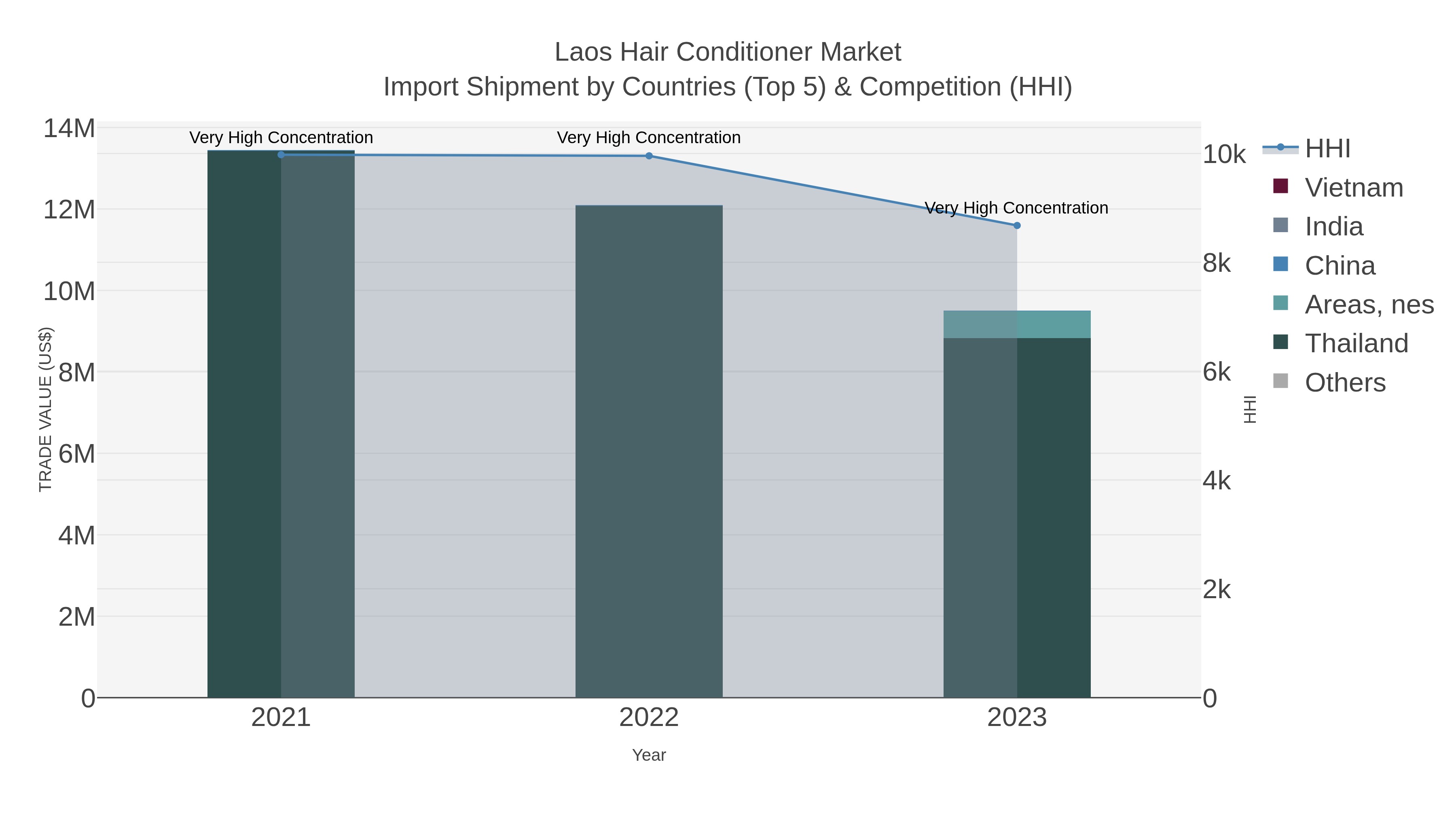
In 2023, Laos continued to rely on imports of hair conditioner, with Thailand, China, India, and Japan emerging as key exporters. Despite a high concentration level in the market, the industry experienced a significant decline, with a Compound Annual Growth Rate (CAGR) of -15.9% and a growth rate of -21.4%. This indicates a challenging landscape for hair conditioner import shipments in Laos, emphasizing the need for strategic adjustments and market innovations to drive future growth opportunities.
Key Highlights of the Report:
- Laos Hair Conditioner Market Outlook
- Market Size of Laos Hair Conditioner Market, 2025
- Forecast of Laos Hair Conditioner Market, 2032
- Historical Data and Forecast of Laos Hair Conditioner Revenues & Volume for the Period 2022 - 2032F
- Laos Hair Conditioner Market Trend Evolution
- Laos Hair Conditioner Market Drivers and Challenges
- Laos Hair Conditioner Price Trends
- Laos Hair Conditioner Porter`s Five Forces
- Laos Hair Conditioner Industry Life Cycle
- Historical Data and Forecast of Laos Hair Conditioner Market Revenues & Volume By Product Type for the Period 2022 - 2032F
- Historical Data and Forecast of Laos Hair Conditioner Market Revenues & Volume By Dry Hair for the Period 2022 - 2032F
- Historical Data and Forecast of Laos Hair Conditioner Market Revenues & Volume By Oily Hair for the Period 2022 - 2032F
- Historical Data and Forecast of Laos Hair Conditioner Market Revenues & Volume By Normal Hair for the Period 2022 - 2032F
- Historical Data and Forecast of Laos Hair Conditioner Market Revenues & Volume By Professional for the Period 2022 - 2032F
- Historical Data and Forecast of Laos Hair Conditioner Market Revenues & Volume By Non-professional for the Period 2022 - 2032F
- Historical Data and Forecast of Laos Hair Conditioner Market Revenues & Volume By Application for the Period 2022 - 2032F
- Historical Data and Forecast of Laos Hair Conditioner Market Revenues & Volume By Online Retail for the Period 2022 - 2032F
- Historical Data and Forecast of Laos Hair Conditioner Market Revenues & Volume By Offline Retail for the Period 2022 - 2032F
- Historical Data and Forecast of Laos Hair Conditioner Market Revenues & Volume By Personal Use for the Period 2022 - 2032F
- Historical Data and Forecast of Laos Hair Conditioner Market Revenues & Volume By Personal Use for the Period 2022 - 2032F
- Historical Data and Forecast of Laos Hair Conditioner Market Revenues & Volume By Barber shop for the Period 2022 - 2032F
- Historical Data and Forecast of Laos Hair Conditioner Market Revenues & Volume By Hotel for the Period 2022 - 2032F
- Laos Hair Conditioner Import Export Trade Statistics
- Market Opportunity Assessment By Product Type
- Market Opportunity Assessment By Application
- Laos Hair Conditioner Top Companies Market Share
- Laos Hair Conditioner Competitive Benchmarking By Technical and Operational Parameters
- Laos Hair Conditioner Company Profiles
- Laos Hair Conditioner Key Strategic Recommendations






































